“Just list leadership and teamwork” is the worst advice in sports skills in a resume. Those words describe almost everyone and prove nothing about you.
A recruiter needs to see what you did, under what conditions, with whom, and what changed because of it. Your sport is useful only when it supplies that evidence. A captaincy, training plan, officiating role, team-management task, or comeback from injury can support almost any career story, but only after you translate it into workplace behavior.
Why Listing Sports Skills on a Resume Fails
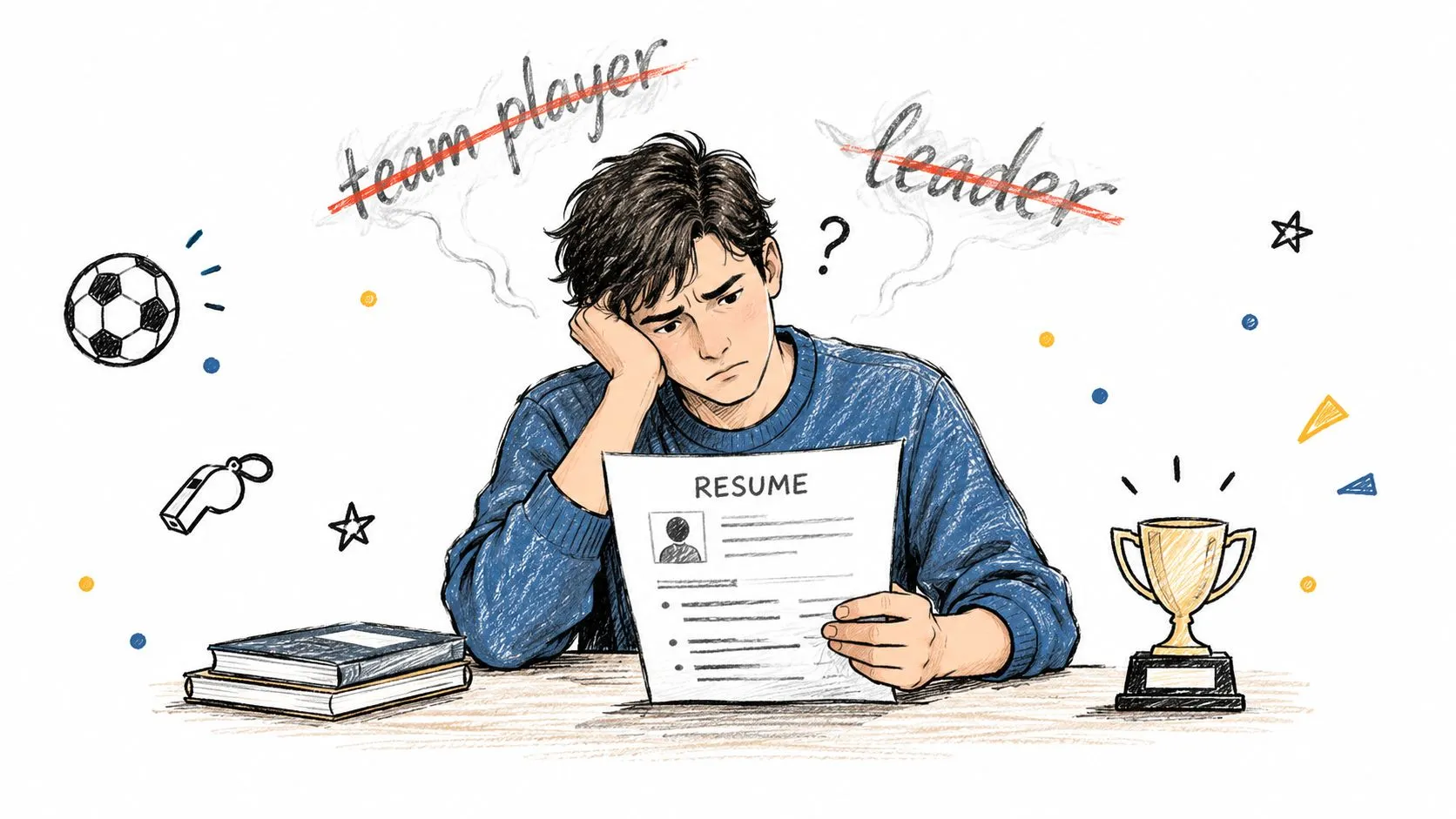
Most candidates turn athletic experience into a personality quiz. They write “team player,” “disciplined,” “leader,” and “resilient,” then wonder why the resume still feels empty. The problem isn't that those qualities are irrelevant. The problem is that adjectives give recruiters nothing they can evaluate.
A large UK mixed-methods study examined 5,838 graduates, 112 employers, and 13 university senior executives. Graduates who participated in university sport identified teamwork, leadership or managing others, and organizing, planning, and coordinating as the skills most strongly developed through sport. The study also associated university sport with graduate-level employment, more positive career views, and an estimated annual salary advantage of £4,264 to £5,616 compared with graduates whose activity was limited to gym attendance or no sport. It doesn't prove that sport alone causes better outcomes, but it gives you a credible basis for presenting athletics as transferable capability, not decoration. Read the full Sheffield Hallam study.pdf).
Traits don't survive a recruiter scan
Employer priorities make the weakness obvious. In a National Association of Colleges and Employers validation study, 97.5% of employer respondents rated professionalism and work ethic essential or absolutely essential, 96.3% rated critical thinking and problem-solving that highly, 91.6% did so for oral and written communication, and 90.0% for teamwork and collaboration. Leadership reached the same importance level for 55.9% of respondents. See the NACE validation study.
Those figures don't mean employers automatically prefer athletes. They mean your athletic history can become relevant when it demonstrates behaviors employers already value. “Demonstrated leadership” is a label. “Coordinated training communication for a 20-person squad during a coaching change” is evidence.
The rule: Your sporting past is a source of proof, not a source of adjectives.
Use this guide to listing strengths on a resume if you need to separate genuine strengths from empty self-description. Then rewrite every athletic claim until a skeptical hiring manager could ask, “How do you know?”
The Four-Step Method to Translate Sports Skills into Resume Bullets
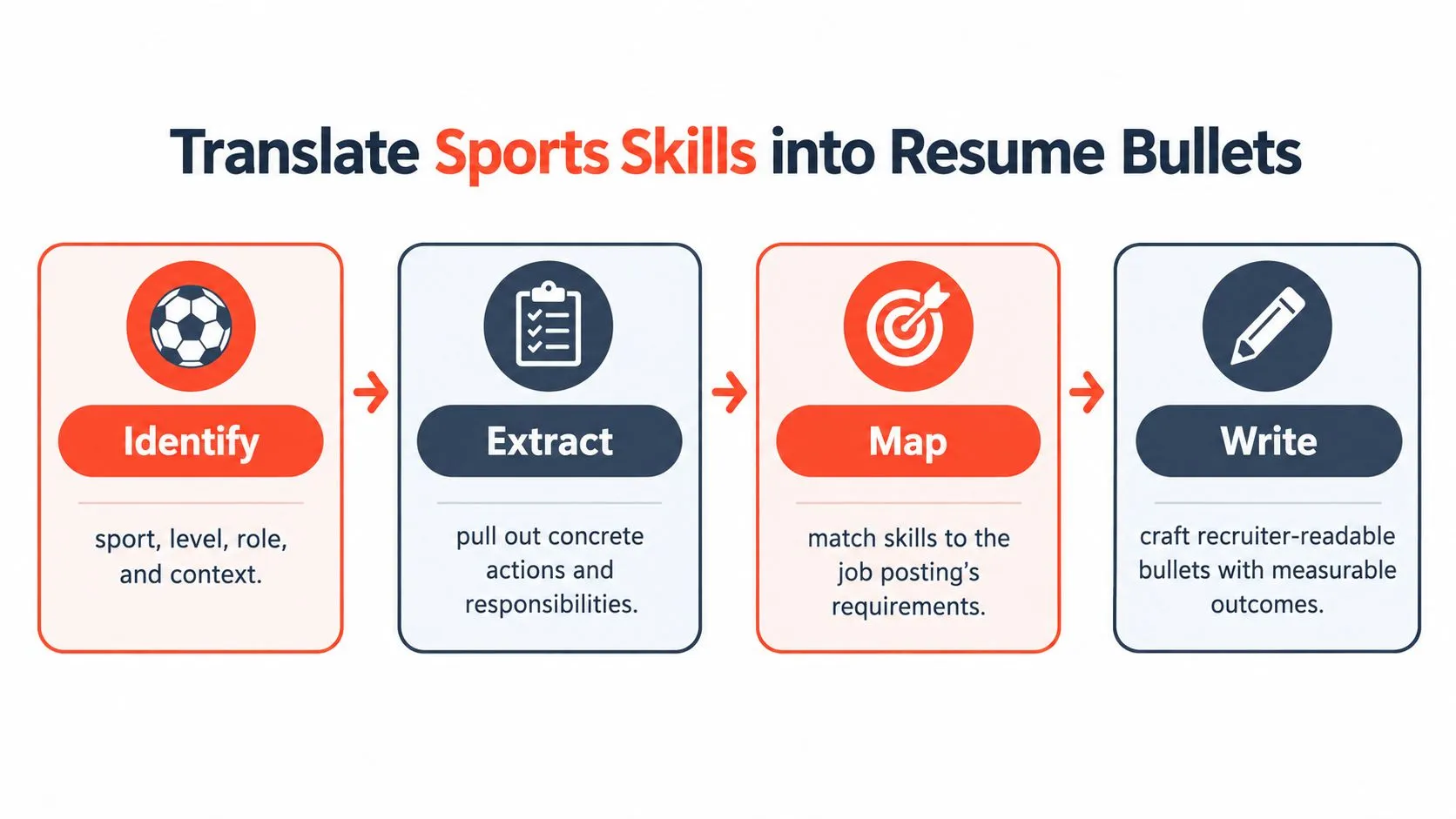
A strong bullet follows a simple path. Identify the experience, extract the behavior, attach an outcome, and connect it to the job. Skip one of those steps and the line usually turns back into a hobby description.
1. Identify the setting
Name the sport, level, role, and competitive context. “Played football” is too broad. “Club football goalkeeper,” “university rowing athlete,” “volunteer youth coach,” or “regional tennis official” gives the reader a usable frame.
You don't need elite status. A recreational runner, club-team administrator, coach, referee, or injured athlete can all show relevant work. The level matters less than the responsibility you carried.
2. Extract the behavior
Ask what you did beyond participation. Did you coordinate plays, resolve conflict, coach newer teammates, maintain attendance, analyze performance, arrange travel, or follow a training plan despite competing demands?
The football fitness drill ideas are useful here not because a recruiter needs the drills, but because they can help you remember the planning, instruction, adaptation, and feedback involved in running training.
3. Attach the result
Add a verifiable outcome whenever you have one. Useful evidence includes a win, ranking, attendance result, performance improvement, tournament progression, or team size. If the sport produced no headline statistic, use operational scale: events coordinated, teammates supported, training sessions managed, or schedules maintained.
Don't manufacture precision. “Supported regular weekly training” is better than a fake number. Credibility matters more than athletic theater.
4. Connect it to the vacancy
The same experience can support different applications. For operations, emphasize scheduling and logistics. For sales, show communication, preparation, and response to setbacks. For customer success, highlight conflict resolution and relationship management. For an entry-level corporate role, show reliability, teamwork, planning, and clear information flow.
A useful structure is:
Coordinated [team or process] across [scale] to achieve [measurable result], adapting strategy during [constraint].
Examples:
- Club football manager: Coordinated weekly fixtures, transport, and player availability for a 16-person club squad, resolving schedule conflicts before match days.
- Distance runner: Maintained a structured training plan while balancing coursework, adjusting sessions around changing academic demands.
- Youth coach: Led practice activities for younger players, adapting instruction for different ability levels and communicating progress to families.
- Match official: Applied competition rules consistently, explained decisions under pressure, and resolved disputes without interrupting play.
These aren't templates to copy blindly. They're demonstrations of the thinking required to turn sports skills in a resume into readable evidence.
Where Sports Skills Belong in a Resume
Don't dump athletics into a “Skills” keyword pile. That section is for compact technical and professional keywords, not a four-year story about leadership or commitment.
Choose placement based on evidence strength, recency, and relevance.
Choosing the Right Section for Sports Experience
| Section | Use When | Bullet Style | Watch Out For |
|---|---|---|---|
| Work Experience | The role involved substantial operations, coaching, administration, or paid performance | Write it like any other job, with actions and outcomes | Inflated titles or sports jargon |
| Leadership | You led teammates, organized activity, mentored others, or owned decisions | Emphasize responsibility, scope, and judgment | Calling yourself a leader without a situation |
| Activities | Athletics supports an early-career application but isn't the main evidence | Use a concise entry with one or two strong bullets | Letting it overpower internships or employment |
| Additional Experience | Older or secondary athletic involvement still reinforces the target role | Compress it into one relevant line | Keeping it only to fill space |
| Skills | Only when the skill is genuinely separate from the story, such as officiating certification | Use a short keyword or credential | Writing “teamwork” and “discipline” alone |
A recent graduate with limited work history might expand a captaincy under Leadership. A mid-career operations manager should usually compress an old sports role unless it supplies a distinctive example that current work doesn't show. A professional applying for event operations could place tournament coordination under Work Experience, especially if the responsibility resembled a job.
Use this guide to the resume skills section to keep the keyword area focused. Your bullets should carry the evidence.
Before and After Examples for Real Candidates
The fastest way to understand this work is to watch vague lines become defensible. The examples below use illustrative candidate details, so replace every figure with your own verified information.
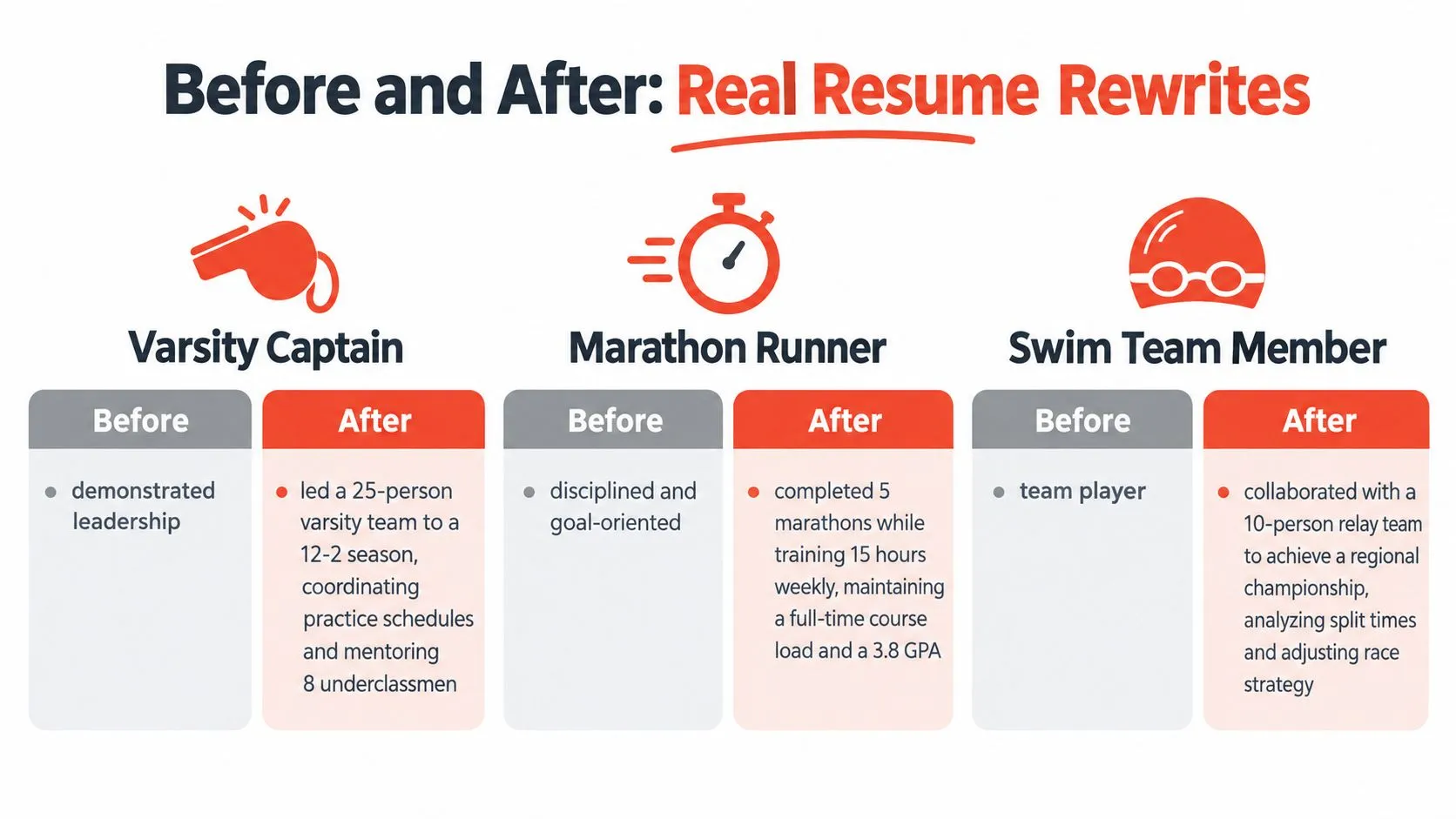
Varsity captain
Before:
“Demonstrated leadership and teamwork.”
After:
“Led a 25-person varsity team through a 12-2 season, coordinating practice schedules and mentoring eight underclassmen.”
The rewrite names the role, scale, action, and result. It also gives the recruiter two workplace signals: coordination and people development. If those details aren't true for you, don't borrow them. Use your actual roster, result, and mentoring responsibility.
Club-team manager
Before:
“Managed a club sports team.”
After:
“Managed weekly scheduling, travel coordination, and player communication for a club team, resolving availability conflicts before competitions.”
This candidate doesn't need a championship or ranking. The value sits in the operating behavior. Scheduling, communication, and conflict resolution can matter in operations, customer success, recruiting, and administrative roles.
Runner returning from injury
Before:
“Resilient marathon runner.”
After:
“Rebuilt training after injury through a structured return-to-running plan, tracking progress, adjusting workload, and maintaining consistent communication with a training partner.”
The stronger version doesn't hide the interruption or make a dramatic claim about resilience. It shows the process. For a career changer or returner, that is more persuasive than presenting an old athletic identity as a credential.
Evidence beats eligibility. You don't need a varsity label, a medal, or a famous result. You need a real responsibility and a clear account of what you changed.
Matching Sports Evidence to the Job You Actually Want
Sports skills in a resume only help when they map to the role. Start with the job description, then look past the keyword. “Stakeholder communication” may mean explaining decisions clearly. “Ownership” may mean following through when plans change. “Collaboration” may mean sharing responsibility instead of waiting for instructions.
The NACE employer data gives you a useful priority order. Employers rated professionalism and work ethic, critical thinking and problem-solving, communication, and teamwork among their most important competencies. Choose the sporting moment that proves the competency the vacancy needs, not the moment you're personally proudest of.

Match the evidence to the work
- Operations: Use fixture planning, travel arrangements, attendance tracking, equipment control, or schedule changes.
- Sales: Use preparation, clear communication, competitive focus, response to rejection, and adapting your approach during a match or season.
- Customer success: Use conflict resolution, coaching, listening, expectation setting, and maintaining relationships through setbacks.
- Entry-level corporate roles: Use deadline management, shared accountability, problem-solving, and communicating under pressure.
- People management: Use captaincy, mentoring, coaching, feedback, delegation, and decisions that affected group performance.
A sports example becomes stronger when you explain the constraint. “Organized training” is ordinary. “Adjusted training communication around changing player availability and competition travel” shows judgment.
If you're applying for a role connected to performance or coaching, resources such as tennis exercises for power can help you name the technical planning behind your experience. For unrelated roles, translate the activity into decisions and outcomes rather than copying specialist language.
The key question is simple: Which moment from your sport makes the hiring manager more confident you can do this job? Use that moment. Leave the impressive but irrelevant detail out.
Turning Real Games into Resume-Ready Bullets
The method is easy. Remembering the details is harder.
Start with one sporting moment and answer four questions:
- What were you responsible for?
- What constraint made the task difficult?
- How many people, events, or sessions were involved?
- What changed because of your action?
Don't worry about polished wording at first. Write the raw account. A team photo archive, such as this QR code photo collection for teams, may help you recover names, events, dates, and responsibilities you no longer remember clearly.
Then turn the account into a bullet with context, action, and outcome. “Played for the club” becomes “Coordinated player communication and fixture logistics for a club squad while resolving weekly availability changes.” The second line tells the reader how you operate.
The same principle applies to writing effective bullet points in a resume. Don't ask whether your sports experience is impressive enough. Ask whether it contains evidence relevant to the work you want.
StoryCV offers an online resume writing process that asks about what you did, draws out the context, and turns your answers into resume-ready writing. Visit StoryCV to talk through your sporting experience and build bullets that show the role, action, scale, and result instead of merely claiming leadership.