A resume can look polished and still fail hard. The hiring manager reads it once, says, “It looks fine, but I can't tell what you did,” and the file dies in silence. That's the modern bottleneck, because your CV isn't only being read by a person, it's being parsed, ranked, and filtered before a human ever sees it.
AI CV review exists because that filter is now routine. The job is no longer to make your resume “look professional.” The job is to make your work legible to software and believable to a skeptical interviewer. If your bullets don't carry real context, they blur into the pile.
What the machine sees before the recruiter does
Early applicant-tracking systems appeared when application volume outgrew manual handling, and later systems became more accessible as personal computing spread. By 1988, Resumix had introduced resume parsing, which turned narrative career history into structured fields that could be searched and compared with job requirements (historical overview of resume parsing and ATS evolution). That core pattern still holds.
Modern screening goes further. It uses semantic matching, ranking, workflow automation, and machine-learning recommendations, so the best resume isn't the one with the most buzzwords, it's the one that states scope, action, and outcome in plain language. That's why a line like “managed operations” is weak, while “managed a 14-site operations workflow across finance and support” gives both software and humans something to work with.
If you want a useful parallel, look at how observability works in ops. A system only improves when you can see what it's doing, where it fails, and what changed. The same logic shows up in Applied's guide on AI observability for ops teams, because opaque systems need traceability before they need more automation.
Practical rule: if a stranger can't infer your scope, tools, and result in ten seconds, the resume is too vague.
How AI CV review actually works
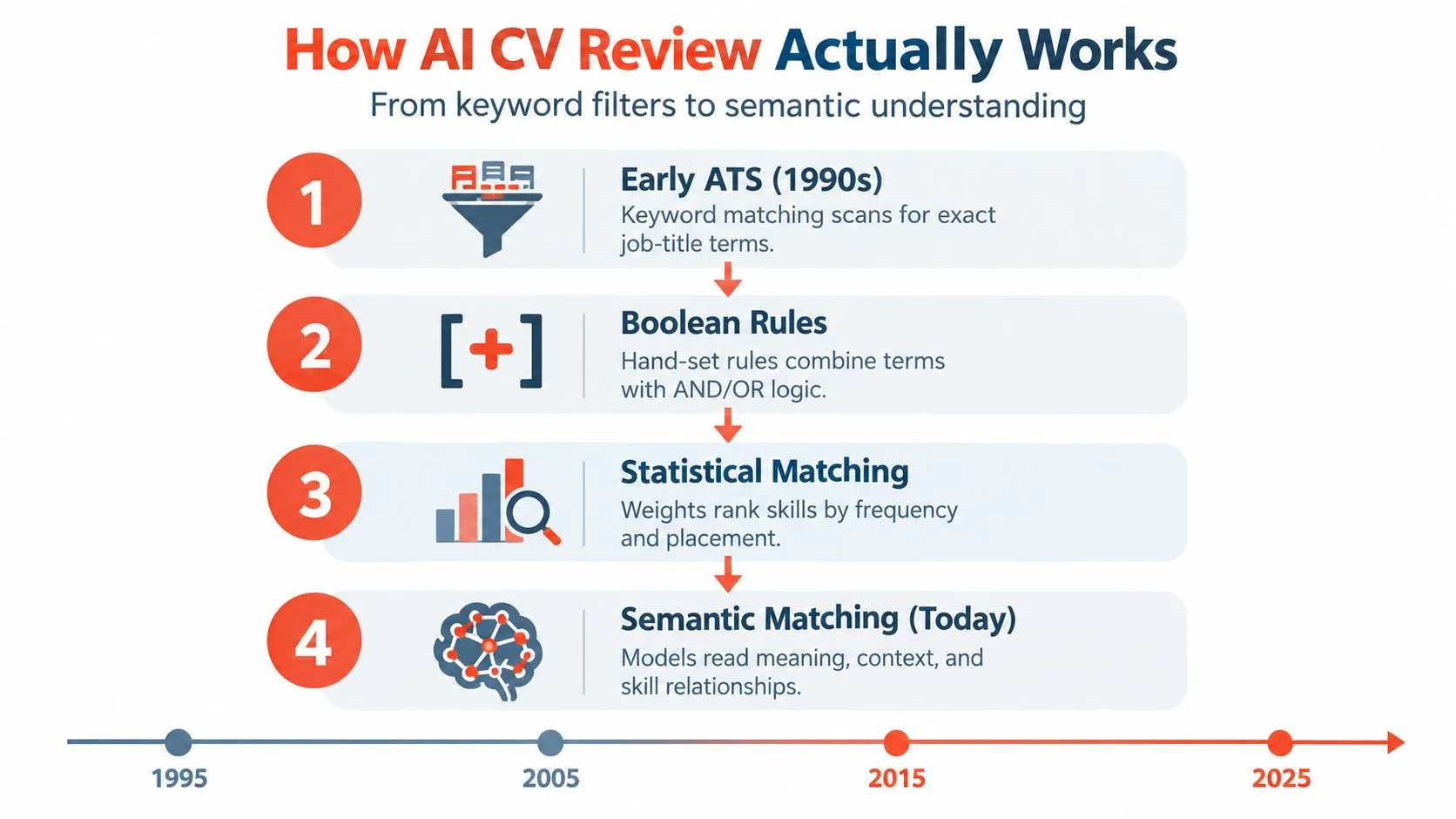
AI review did not appear out of nowhere. It grew out of old filtering systems that first sorted by keywords, then by rules, then by more flexible matching. The important shift is simple, exact wording matters less than meaning, but meaning still has to be written clearly enough to extract.
Keywords get you in the door, meaning gets you shortlisted
A keyword system looks for direct term overlap. A semantic system looks for equivalent meaning, so it can recognize that “grew renewal revenue” and “improved retention for recurring accounts” may describe related work even if the wording differs. That matters because controlled research found keyword-based screening rejected nearly half of qualified candidates, while semantic matching more than doubled recall without lowering precision (controlled experiments on semantic matching).
This is why stuffing a resume with repeated phrases is a weak strategy. It confuses the signal. Better is to write the work the way a strong hiring manager would summarize it after a conversation, with context, action, and outcome.
Why structure beats buzzwords
A modern screener can detect more than titles. It can compare the phrasing of skills, rank evidence, and infer whether a candidate has done adjacent work that maps to the role. Research on applicant-tracking systems notes that scoring models are now common as the first resume filter, which is exactly why structure still matters, but not in the old keyword-stuffing sense (scoring models inside ATS filters).
The practical takeaway is blunt. Name the thing you did, the environment you did it in, and the result. If you led a rollout, say what changed. If you built a report, say what decision it supported. If you improved a process, say where the bottleneck was.
Synopsix's overview of AI hiring tools is useful background if you want a broader view of how employers are layering these systems into hiring workflows.
The hidden trap of AI self-preference
A lot of candidates think the game is to sound more machine-friendly. That's a mistake. In controlled research from the University of Maryland Smith School of Business, models preferred resumes generated by the same model over equally qualified human-written or competing-model resumes, with self-preference rates ranging from roughly 67% to 82% and a 23% to 60% higher shortlisting likelihood when the same model handled generation and screening (UMD Smith study on AI hiring tools).
Generic polish can help the bot and hurt the interview
That is the trap. A resume can be polished enough to please a model, then feel empty in a live interview because the candidate can't explain the claims with the same clarity. If your bullets sound generic, over-bright, and oddly interchangeable, you may be optimizing for the wrong reader. Human interviewers notice when the language is smooth but the substance is thin.
The better move is to write for defendability. Every claim should survive a follow-up question. What did you own? What changed? What tools did you use? If you can't answer those questions, the line needs revision.
For a practical check on how people overuse models while writing resumes, StoryCV's guide to ChatGPT for resume writing is a useful complement. The point isn't to avoid assistance. The point is to keep the facts intact.
A resume that sounds “AI-friendly” but can't be defended is a liability, not an upgrade.
Speed versus context, the AI trade-off
AI screening is fast. Manual review is slower. That trade-off is real, and you should respect it without worshipping it. In one experimental comparison, an AI screening system processed each resume in 2.5 seconds versus 180 seconds for manual review, a 72-fold difference, and handled about 1,000 resumes per day compared with 100 manually; the same experiment reported 92% screening accuracy for AI versus 88% for manual review (experimental comparison of AI and manual review).
AI screening is efficient, not complete
Speed does not equal judgment. The EEOC flagged resume-screening software as an employment technology that can create disability-discrimination risks and told employers to assess screening outcomes, accessibility, explanations, and accommodations (EEOC guidance on resume-screening software and disability risk). The Department of Justice and the EEOC also warned that these systems can unlawfully screen out qualified applicants who could do the job with reasonable accommodation.
That matters because automated review can flatten context. Career breaks, military service, caregiving, international experience, and nonlinear paths all carry meaning that a fast filter may miss. A resume built only for compression can become less fair, not more.
AI vs Manual Screening
| Factor | AI Screening | Manual Review |
|---|---|---|
| Speed | Extremely fast | Slower, more deliberate |
| Volume | Handles large batches easily | Limited by human time |
| Context | Can miss nuance, breaks, and career shape | More capable of reading the story |
| Fairness risk | Can reproduce bias if unchecked | Still subjective, but easier to reason about |
| Best use | First pass, pattern detection | Borderline cases, contextual judgment |
The right stance is not anti-AI. It's pro-human judgment at the point where judgment matters most. Use AI to clear noise. Use humans to decide what the noise was hiding.
StoryCV's article on AI resume screening fits well here if you want a deeper look at how screening logic and resume content interact.
How to interpret and act on AI feedback
Treat AI feedback like a diagnostic readout, not a verdict. If the tool says your resume is weak, the first question isn't “How do I make the score go up?” It's “What did the system fail to understand?” That's a much better frame, especially if your career isn't linear.
Look for context gaps, not just low scores
The hardest resumes to review are often the most interesting ones. Veterans, returners, career changers, and people with mixed responsibilities get penalized when the system only sees a flattened chronology. Bias studies make that problem visible. A 2025 study highlighted that resumes with Black-associated names received equal selection rates to white-associated names in only 6.3% of tests, which is a warning sign for anyone auditing automated recommendations (Brookings analysis of gender, race, and intersectional bias in AI resume screening).
So read the feedback with suspicion. If it suggests removing context, check whether that context is the proof of competence. If it pushes you toward vagueness, stop. Vagueness is how qualified people disappear.
Use a simple credibility test
Before you keep a suggested rewrite, run it through three checks.
- Could I defend this in an interview? If not, it's too polished.
- Does it preserve the actual scope of the work? If not, it's too compressed.
- Would a human understand the impact without guessing? If not, it's too abstract.
If you want a practical companion on rewriting, StoryCV's guide on using AI for resume writing is worth a look. The right workflow is not “feed in bullets and accept the output.” It's “test the rewrite against reality.”
Preserve your voice on purpose
A lot of candidates overcorrect and make their resume sound sterile. Don't do that. Strong resumes have rhythm, specificity, and plain English. They read like someone who did the work.
StoryCV, human writing, AI efficiency
A better resume isn't a template exercise. It's editorial work. You have to pull out the facts, decide what matters, and turn real experience into language that holds up with both software and people.
That's where refining AI dictation output is a useful mental model, because the first pass is rarely the final voice. StoryCV works the same way in practice, it turns your experience into resume-ready writing through a guided interview, so the output reflects your actual work instead of generic filler.
If you're staring at a resume that looks “fine” but says almost nothing useful, stop polishing it and start translating it.
StoryCV helps you turn real work into clear bullets that a recruiter can read and a screen can parse. If you want to stop guessing and start writing from the substance of your own experience, visit StoryCV and start with your first role.