Most advice about ai resume screening gets the problem backward.
People act like a robot reads your resume, stamps yes or no, and throws your career into a void. That's not how most recruiting teams work. The recruiter is still the one making the call. AI usually helps them sort, summarize, and prioritize a pile that would otherwise take too long to read.
That distinction matters. If you think the machine is the audience, you write for extraction. If you know a human is still at the end of the chain, you write for comprehension. One approach gives you a resume stuffed with borrowed phrases. The other gives you a resume that survives both the AI skim and the recruiter read.
AI Doesn't Reject Your Resume
AI doesn't reject your resume. A recruiter looking at AI-generated output does.
Yes, automation is real. Among the 51% of US companies leveraging AI in hiring, 65% of employers report AI automatically rejects candidates before human review, and 49% of hiring managers auto-dismiss suspected AI-generated resumes, according to CoverSentry's hiring AI statistics. That's the ugly part.
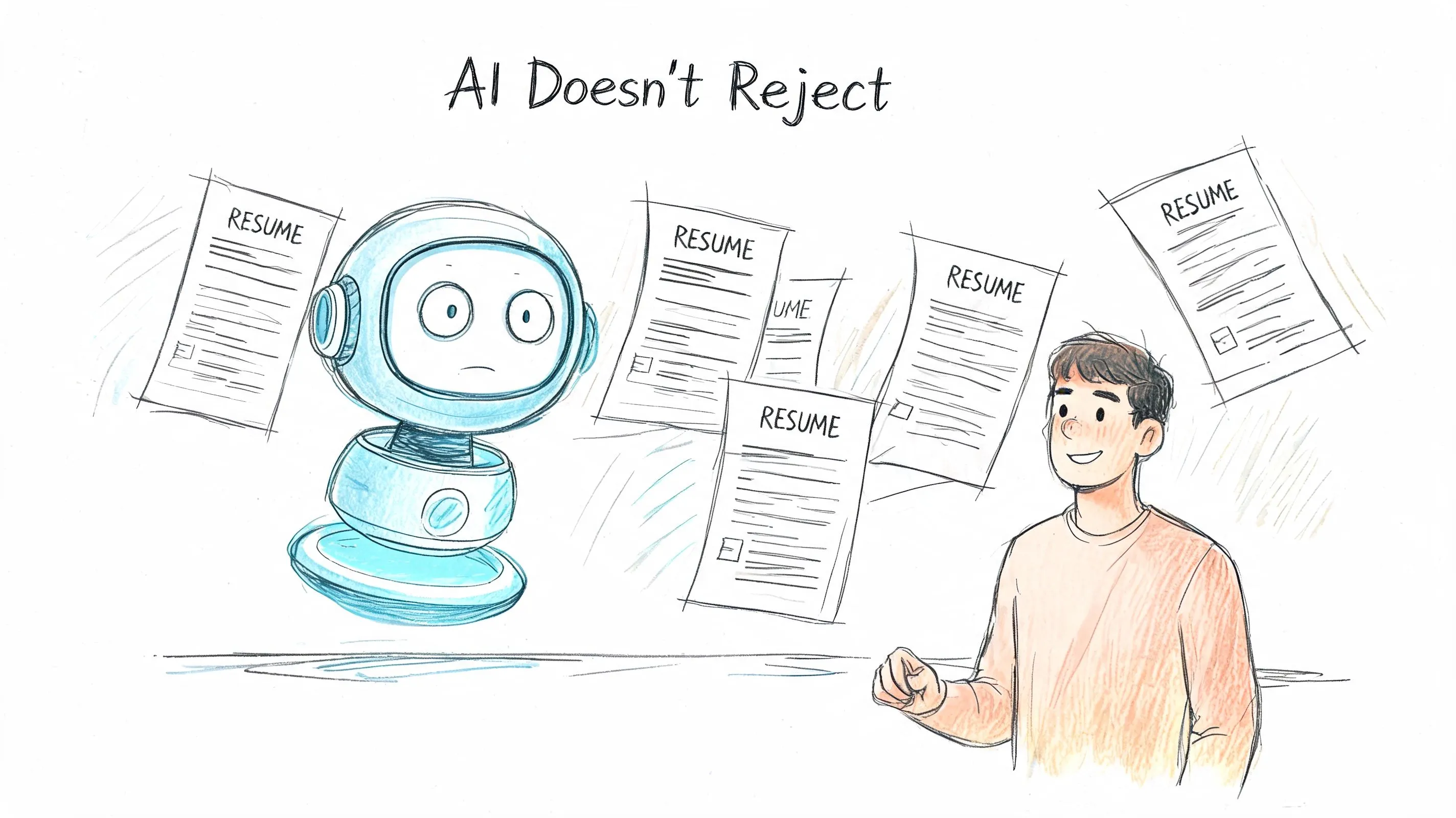
But job seekers still misunderstand what that means. They imagine a perfect little villain in the middle of the process. An algorithm reads every line, scores their soul, then blocks the door. In practice, recruiting departments use AI to make the pile smaller and easier to scan.
The myth that causes bad resumes
The myth is simple. "I need to beat the bot."
That's why so many resumes now read like taxonomies instead of work histories. Endless noun lists. Skill dumps. Bullets that mention every tool in the stack and say nothing about what the person did.
AI can filter. It still can't get excited about you. A recruiter can.
If a recruiter sees a weak, generic, stuffed resume at the top of the shortlist, you still lose. The machine didn't kill your chances by itself. It handed your writing to a human who wasn't impressed.
Your Resume and the Recruiter's New Copilot
Recruiters use AI the way overloaded teams use any useful software. As a copilot.
According to MyPerfectResume's survey on AI in hiring and layoffs, 73% of US employers now integrate AI into hiring decisions, and 70% of recruiters credit AI for slashing manual screening time. That tells you what AI is for. Speed. Triage. Sorting. Not replacing judgment.
What recruiters actually use it for
A recruiter doesn't want another black box. They want help getting to a manageable shortlist.
In plain terms, AI resume screening often helps with:
- Summary generation by turning a full resume into a quick recruiter snapshot
- Candidate ranking by sorting applicants against the role's requirements
- Keyword surfacing by highlighting the terms and experiences most relevant to the job
- Shortlist sorting by pushing stronger matches toward the top of the queue
That changes your job as a candidate.
You're not writing for a machine that loves repetition. You're writing for a tired human who may first see you through an AI summary panel, a ranked list, or a few extracted bullets. If the surfaced content is vague, generic, or bloated, you look vague, generic, and bloated.
The real audience is still human
A good mental model is this: AI is the recruiter's research assistant.
It reads fast. It organizes. It points. Then the recruiter reads the strongest-looking profiles and decides who gets a conversation.
Practical rule: Write like the recruiter will only see the top slice of your resume first, because that's often what happens.
That means clarity beats cleverness. Specifics beat jargon. Real work beats keyword confetti.
How AI Resume Screening Actually Works
Most ai resume screening systems do three jobs in sequence. They read the resume, compare it to the role, and surface the strongest-looking candidates to a recruiter.
Modern systems use multi-layered NLP to parse resumes, evaluate fit, and surface only the top 10-15% of candidates, reducing recruiter workload by up to 90% in high-volume scenarios, as described in Augtal's explanation of AI resume screening.
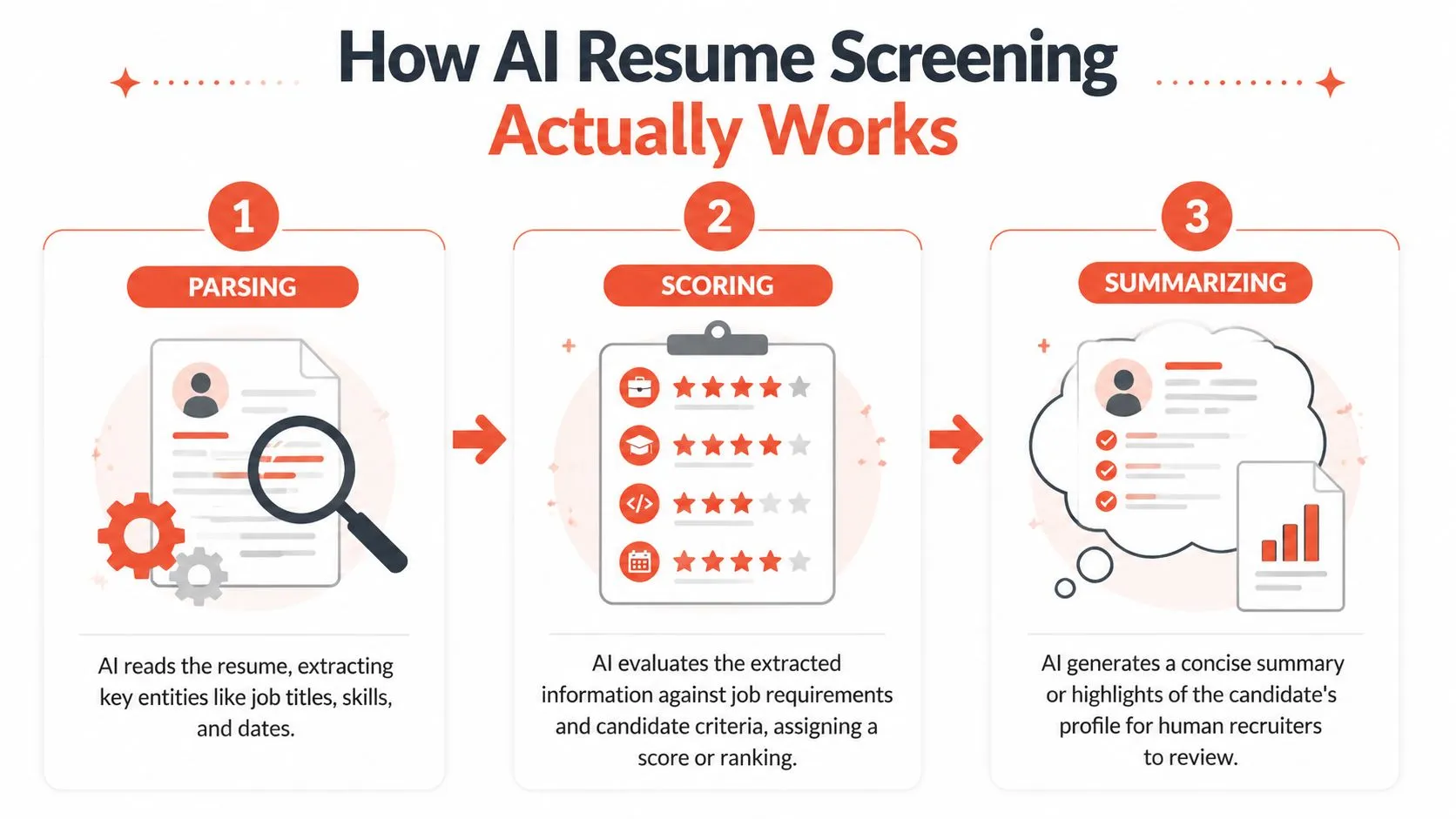
Parsing
First, the system extracts the basics from messy documents.
It looks for things like your job titles, dates, employers, skills, certifications, and education. This is why clean formatting still matters. If your resume is visually clever but structurally chaotic, you make the first step harder for no gain.
Scoring
Then it compares what it found against the role.
This isn't just old-school exact keyword matching. Modern systems try to understand relevance and role alignment. They're looking at whether your experience connects to the job, whether your skills appear in context, and whether your career progression makes sense.
A bullet that says what changed because you were there gives the system more signal than a bullet that just lists responsibilities.
Summarizing
Finally, it creates a usable output for the recruiter.
That might be a ranked list, a short profile summary, highlighted competencies, or surfaced resume excerpts. So if only two of your bullets get surfaced, those two bullets need to carry weight on their own.
Here's the practical version:
- Make each bullet self-contained so it still makes sense when extracted
- Name the work clearly with familiar role language
- Show impact and context so both software and humans can tell why it mattered
If you're trying to understand how this interacts with ATS logic, StoryCV's breakdown of the ATS filter 90 10 rule is a useful companion. For the next step after the resume, solid job interview preparation also matters, because the shortlist only gets you into the next round.
The Failure of Keyword Stuffing
Keyword stuffing is the worst popular advice in this category.
It comes from the wrong premise. If you think ai resume screening is just a dumb gate that counts words, you'll cram in more words. But advanced systems don't just reward repetition. They look for coherent, precise articulation of experience. Vervoe's breakdown of AI in resume screening notes that advanced tools penalize resumes lacking narrative coherence and precise skill articulation, and that generic, keyword-stuffed bullets often score lower than contextual achievements.
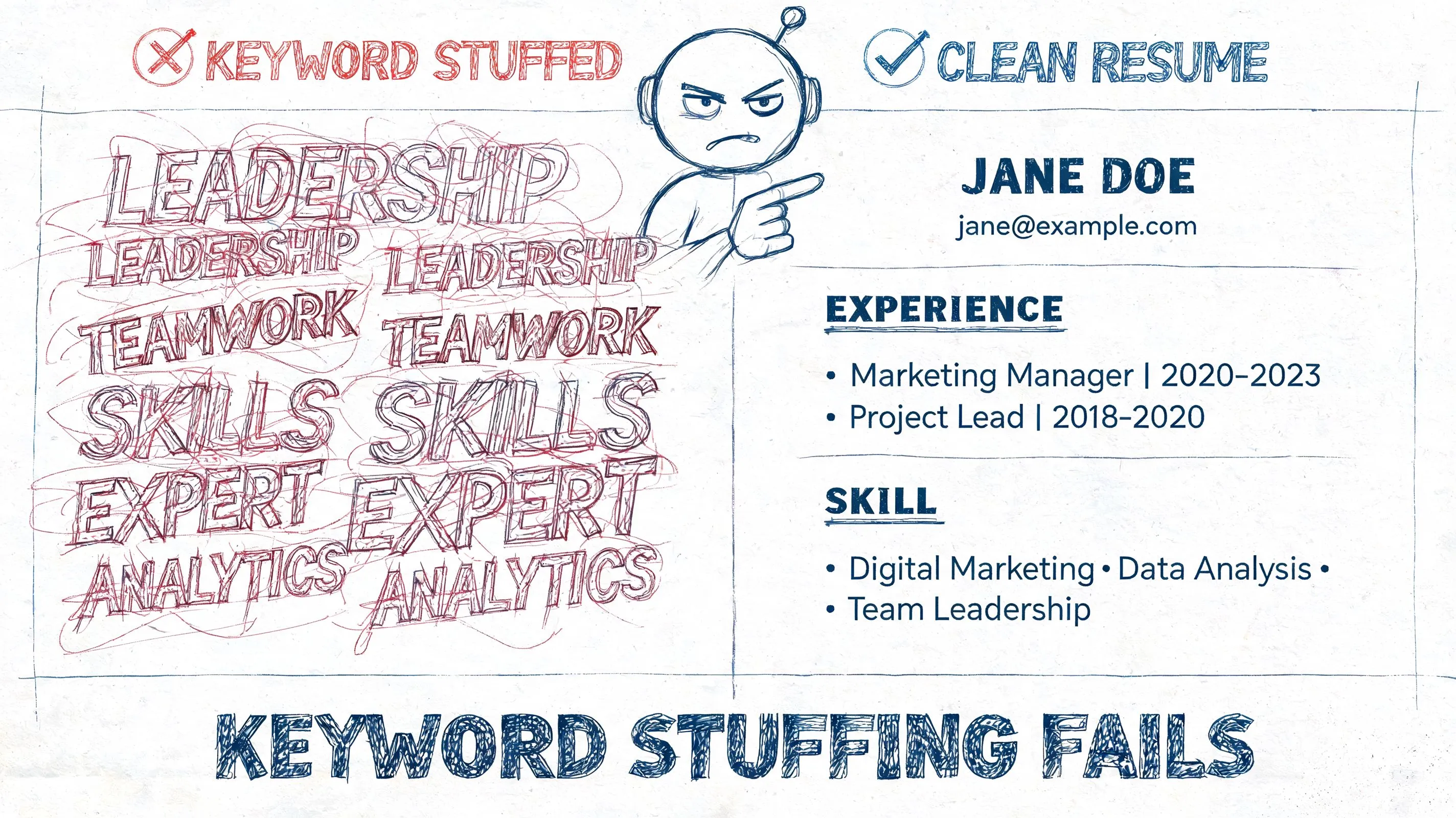
Before and after
Stuffing looks like this.
| Version | Example bullet |
|---|---|
| Bad | Responsible for project management, stakeholder management, cross-functional collaboration, process improvement, reporting, KPI tracking, operations strategy, and team coordination across business initiatives |
| Better | Led a cross-functional ops cleanup that cut reporting delays by redesigning the weekly KPI process and giving sales and finance one shared source of truth |
The first bullet tries to cover everything. It says almost nothing. The second gives a recruiter something to hold onto. A real action. A real problem. A real change.
What to do instead
Use the job description, but don't copy-paste its vocabulary into every line.
- Mirror important terms selectively when they match your work
- Anchor skills in action so they appear in context, not as debris
- Rewrite vague bullets until each one shows ownership and consequence
If you're tailoring role by role, this guide to tailoring your resume to a job description is the right approach. Adapt the language. Don't cosplay the posting.
A stuffed resume tells me what software you've heard of. A strong resume tells me what you changed.
Write for a Human Assume an AI Saw It First
This is the rule that works.
Write for a human. Assume an AI saw it first.
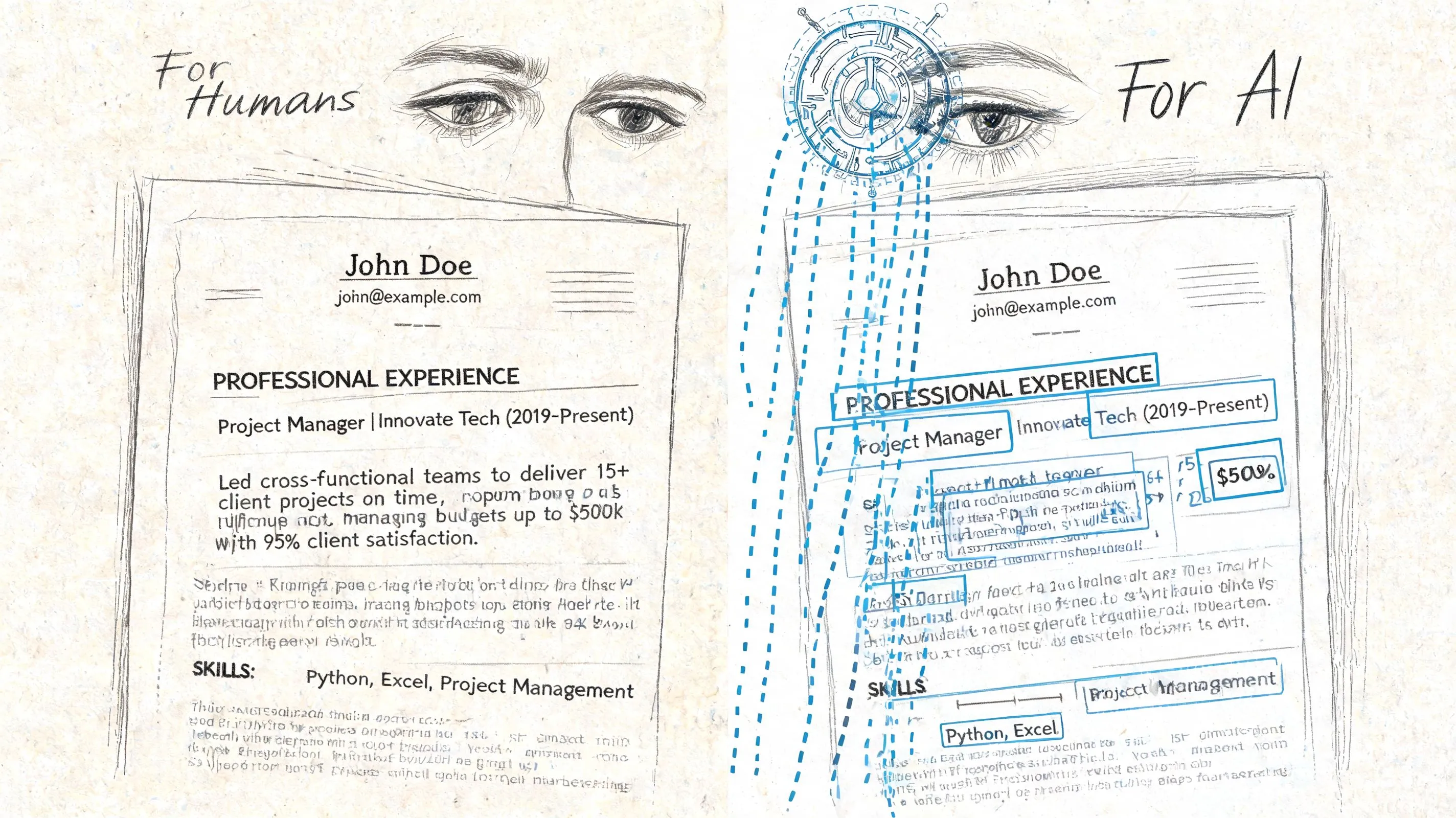
That means each bullet should do two jobs. It should survive extraction, and it should make a recruiter want to talk to you.
The shape of a survivable bullet
A good bullet usually includes these pieces:
- A clear action so someone can tell what you did fast
- Relevant context so the action means something
- An outcome so the reader knows what changed
- Plain language so the line still works when isolated from the rest of the role
Weak bullets depend on surrounding bullets to make sense. Strong bullets can stand alone.
For example, "Owned onboarding improvements" is weak. It depends on the reader filling in the rest. "Rebuilt customer onboarding steps after support handoff issues, giving new clients one clearer path into implementation" is much stronger because it still works when surfaced by itself.
A simple edit test
Take any bullet on your resume and ask:
- Would this make sense if it were the only line a recruiter saw?
- Does it show what changed because I did the work?
- Would a human want to ask a follow-up question?
If the answer is no, rewrite it.
A short walkthrough helps here:
If a bullet reads like anybody could've written it, it won't help you. The useful bullets sound like lived experience.
Your Story Still Matters Most
The fear around ai resume screening is really fear of being flattened into keywords.
Fair fear. Bad conclusion.
The better conclusion is this: generic resumes are easier to dismiss than ever. If AI helps a recruiter skim faster, then bland writing dies faster too. Your edge is still the same thing it has always been. Clear evidence of judgment, ownership, and impact.
If you want to spot the kind of language that makes recruiters suspicious, this piece on how to tell if a resume is AI generated is worth reading.
Story beats stuffing. Substance beats imitation. Good writing still wins.
StoryCV is a Digital Resume Writer, not a template library and not a resume builder. It helps you turn vague experience into clear, credible bullets that work for both AI screening and human readers. If your career story is real but your resume doesn't show it, StoryCV helps you write the version that does.