
Your annual review self-assessment form is open in a tab. The deadline is two days away. You've already typed and deleted the same first sentence three times.
That usually means you're trapped between two bad options.
Option one: you go modest. You write what you did, not what it changed. You sound professional, responsible, and completely forgettable.
Option two: you go full corporate theater. Suddenly every project was “cross-functional,” every meeting “strategic,” and every normal piece of competence “transformational.” Nobody believes that version either.
A good review of performance needs a different move. Stop writing like your defense lawyer. Stop writing like your own PR team. Write about your year the way you'd describe a colleague whose work you respect: clearly, specifically, and without fake humility.
That Blank Self-Assessment Form
The worst part isn't the writing. It's the weird self-consciousness.
You know what you worked on. You remember the hard weeks, the messy handoffs, the project that almost slipped, the thing you fixed that nobody else wanted to touch. But the moment you have to describe your own contribution, your brain turns dramatic or evasive.

That pressure is built into the system. 69% of organizations conduct performance reviews only annually or bi-annually, which turns one document into a summary of an entire year's value, according to FolksRH's performance management statistics. No wonder people freeze.
Why this form feels harder than it should
When feedback is infrequent, the self-assessment starts carrying too much weight. It's no longer just a reflection. It becomes evidence, argument, memory aid, and political document all at once.
That's also why boring internal forms matter more than they should. If your team uses pulse checks or engagement prompts during the year, you have raw material when review season arrives. A practical place to look is Formbricks employee satisfaction survey templates, not because a survey writes your review for you, but because recurring questions help you notice patterns before they disappear.
The self-review gets painful when you treat it like a personality test. It gets easier when you treat it like a record of changed outcomes.
Don't confuse blank with unclear
Many individuals staring at a blank form do not have nothing to say. They have too much to say, and no frame for choosing.
If you need help with structure, StoryCV already has a practical guide on how to write a self-assessment for performance review. But structure isn't the primary problem for most mid-career people. Tone is.
You're not failing because you can't remember your work. You're failing because you keep switching between understatement and overstatement.
The Two Voices That Kill Your Review
The first bad voice is the Modest Lister.
This person writes things like: attended project meetings, supported rollout, collaborated with stakeholders, completed assigned work. Everything is technically true. None of it helps.
The second bad voice is the Corporate Salesbot.
This person writes: drove meaningful impact, spearheaded strategic alignment, delivered significant value across cross-functional stakeholders. It sounds polished until you notice it says almost nothing.
The modest voice erases your agency
Managers are busy. They won't automatically reconstruct the importance of your work from a task list.
If you write “helped with onboarding redesign,” your manager has to do the interpretive labor. What exactly did you do? What problem were you solving? Did anything improve because of your involvement? If you don't answer those questions, you're asking the reader to grade a blank space.
That's why modesty is not the same as accuracy. A bare list of duties isn't neutral. It's incomplete.
The salesy voice triggers suspicion
There's a reason vague praise lands badly. The halo effect in reviews causes broad positive impressions to overpower specific judgment, which makes generic, flattering language less credible when it isn't backed by evidence, as discussed in this research summary on rating bias and the halo effect.
Put more clearly: if your review sounds like ad copy, people assume it's hiding weak substance.
Practical rule: If a sentence could describe five different employees, it's too vague to help you.
Here's the difference:
| Bad version | Why it fails |
|---|---|
| “Supported cross-functional initiatives” | Nobody knows what you owned |
| “Drove major strategic transformation” | Sounds inflated without proof |
| “Reworked the launch plan after deadlines slipped, reset dependencies, and got the release over the line” | Specific, credible, useful |
Both voices come from the same fear
You don't want to sound arrogant. So you trim away judgment and impact.
Then you worry you sound flat. So you add abstract power words.
Now you've created the worst possible mix: thin facts wrapped in big language.
A review of performance works when you stop trying to manage how impressive you sound and start making your work legible.
The Respected Colleague Frame
Use one mental trick. It fixes most of this.
Write about yourself the way you'd write about a colleague whose work you respect.

You wouldn't undersell them by saying, “She attended meetings and helped out.” That would be unfair.
You also wouldn't write, “She revolutionized collaboration through visionary leadership.” That would be embarrassing.
You'd probably write something like this: she took over the onboarding flow after earlier attempts stalled, simplified the process, and got it moving again. Clean. Fair. Specific.
Why this frame works
It forces you into a sane register.
When you describe respected peers, you naturally include the pieces that matter:
- Context about the problem
- Action you can point to
- Change that happened because they were there
That tone is neither modest nor salesy. It's adult.
A self-assessment can also hold more nuance than a resume. Your manager already knows the team, the year, the politics, the constraints. You can name the trade-off. You can admit what was messy. You can say what you'd do differently next time without sounding weak.
If you want a quick reset before writing, watch this and then come back to your draft with less ego and more clarity.
Write as a witness to your work, not a marketer for it.
How to Describe a Project Three Ways
Let's make this real.
Say you worked on a checkout redesign in Q3. The old flow was clunky. Previous attempts to fix it didn't stick. You stepped in, simplified the form, coordinated with engineering, and the new version reduced cart abandonment after launch.
Here's how that same project sounds in three different voices.
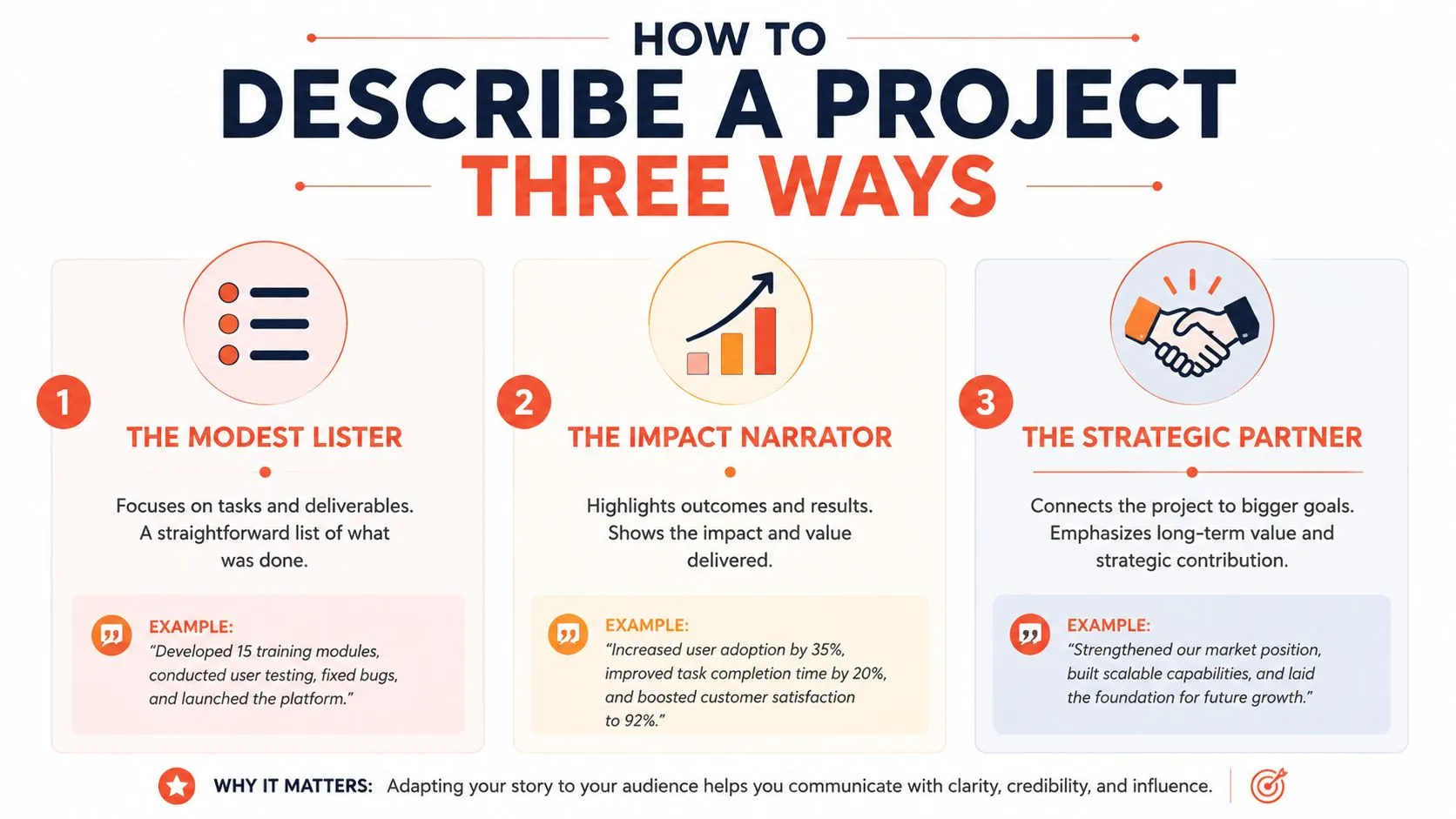
Version one is modest and useless
“Worked on the Q3 checkout flow redesign.”
That's not false. It's just thin. It tells the reader almost nothing about difficulty, ownership, judgment, or result.
This is what people write when they think humility means staying vague.
Version two is polished and unconvincing
“Spearheaded a paradigm-shifting customer experience transformation that redefined the checkout journey and drove meaningful stakeholder alignment.”
This is the language people use when they're trying to sound senior instead of sounding accurate.
The problem isn't confidence. The problem is abstraction. The sentence avoids the work itself.
Version three actually earns trust
“Rebuilt the checkout flow after two earlier attempts stalled. I simplified the form from 12 fields to 5, clarified error states with engineering, and helped ship a version that contributed to a 15% decrease in cart abandonment in the first month.”
That works because it gives the reader three things:
-
The setup
The project wasn't a clean win handed to you. It had history and friction. -
The choices
You didn't just “support” the redesign. You made concrete changes. -
The consequence
Something moved afterward.
That last part matters a lot. In technical reviews, strong ratings often come from linking the work to business effect. TalentGuard gives a simple example: an “Exceeds Expectations” rating might involve a 30 to 50ms latency reduction that leads to better retention or throughput, as described in TalentGuard's examples of software skills performance comments.
That's the model. Not “I optimized performance.” Say what changed, and why it mattered.
If you're in project-heavy work and want sharper language for sequencing, dependencies, and delivery trade-offs, even something like a PMP practice exam at Mindmesh Academy can help you tighten how you describe scope, risk, and execution.
For sharper bullets and cleaner phrasing, StoryCV's guide on how to write impact statements is useful because it pushes you past tasks and toward consequence.
Translate Your Review into Career Growth
A solid self-assessment shouldn't die inside your HR system.
It should become source material for promotion conversations, better one-on-ones, and your next resume update.
Reviews need context. Resumes need compression
This is the big structural difference people miss.
In a review of performance, you can say: the migration had stalled twice, the deadline was fixed, two teams disagreed on ownership, and you chose the lower-risk path to get the release out. That context helps your manager judge your decisions.
On a resume, that same story needs to get tighter. The backstory shrinks. The consequence stays.
| Document | Better version |
|---|---|
| Self-assessment | “Took over the migration after earlier delays, reset ownership between teams, and shipped the lower-risk plan to keep the release on track.” |
| Resume bullet | “Led stalled migration to launch by resetting ownership and execution plan across teams.” |
Use the review to ask for better feedback
With over two-thirds of employees saying manager feedback is essential for improvement, a well-written self-review gives your manager something concrete to respond to, according to Quantum Workplace's performance management statistics. That's the hidden value. Good writing creates a better conversation.
Don't end your draft with a vague “looking forward to continued growth.” That says nothing.
End with a short forward-looking section:
-
What you proved this year
Name the strengths that showed up repeatedly. -
What you want to sharpen
Pick one capability that would change your level or scope. -
What support you need
Ask for a project, decision area, or feedback cadence that matches the next step.
For people trying to turn scattered work into a coherent next move, Statspresso's approach to actionable team analytics is a useful reminder that patterns beat anecdotes. Look for repeatable evidence, not random highlights.
And before you compress anything into a resume, do a proper reflection pass. This guide on career reflection before resume writing helps with that. StoryCV takes a similar interview-based approach by pulling out context first, then tightening the narrative later.
A strong self-review is not a victory lap. It's a draft of your next level.
Answering Your Lingering Questions
What if my work doesn't have hard metrics
Then don't fake them.
Use before-and-after language. Name what was stuck, unclear, slow, messy, or risky before you stepped in. Then describe what became easier, cleaner, faster, more reliable, or better aligned after your work.
Good evidence can be qualitative:
- Decision quality improved because leaders had clearer options
- Handoffs got smoother because documentation stopped living in five places
- A project moved again because someone finally owned the dependencies
Specificity still matters even without a number.
Should you mention failures
Yes, if you write about them like an adult.
Don't confess dramatically. Don't hide them either. Pick the case where your judgment improved. State what went wrong, what you changed, and how you'd approach it next time.
That kind of sentence builds trust fast because real work includes trade-offs, bad calls, and revisions.
What if your manager disagrees with your view
Don't turn it into a courtroom argument.
Try language like this:
“I may be weighting this project differently than you are, so I'd like to compare how each of us is assessing the scope, constraints, and outcome.”
That keeps the conversation on evidence and interpretation. Not ego.
If you remember one thing, remember this: the part that sounds like bragging usually isn't the direct sentence. It's the vague one. Clear, grounded language is less self-promotional than fluffy language because it gives the other person facts to react to.
If you're good at your job but bad at writing about it, StoryCV helps turn messy experience into clear, credible career stories. It's a digital resume writer, not a template library. You answer guided questions, it pulls out the useful context, and you get language that sounds like a competent adult instead of a corporate slogan generator.