You've sent 30 applications. You've gotten 30 polite rejections. Your resume looks fine to you, which is why this is so frustrating.
It has the right tools. The right titles. The right companies. It probably even looks clean.
Still, it's not converting.
That usually means the problem isn't your background. It's the way the background is being presented. Most engineering resume mistakes aren't loud. They're subtle. The resume sounds competent, but flat. It reads like a database export of your career instead of proof that you solve expensive problems.
And yes, employers punish bad writing hard. Research with 445 recruiters found that resumes with five spelling errors got an interview probability that was 18.5 percentage points lower than error-free resumes, and even resumes with just one or two mistakes still took a 7.3 percentage point hit, according to this hiring study on resume errors. So fix the obvious stuff first.
But clean grammar alone won't save a weak story.
The bigger issue is that most mid-career engineering resumes confuse information with evidence. They list stacks, platforms, migrations, ceremonies, and architecture. They skip the part a hiring manager needs. What changed because you were there?
That's the thread running through the worst engineering resume mistakes. The resume says what you touched. It doesn't show what moved. Once that happens, every other section gets weaker too. Your strongest work starts looking generic. Your judgment disappears. Your seniority becomes hard to see.
Your stack is not your story
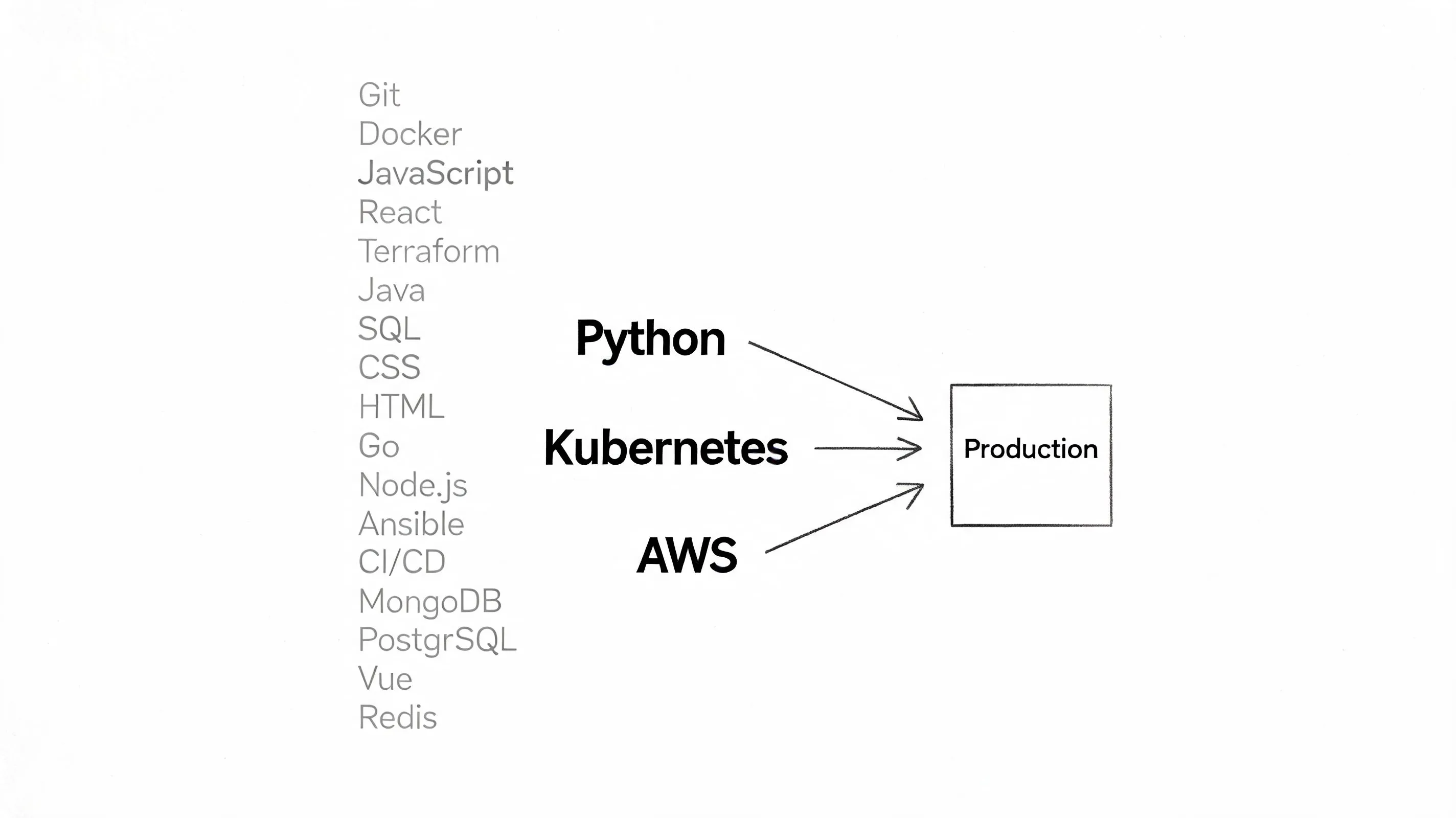
The most common pattern across engineering resumes is simple. They read like a job description with product names pasted in.
“Kubernetes.” “AWS.” “Python.” “Kafka.” “Terraform.”
Fine. Lots of people have used those.
A hiring manager isn't trying to buy a bag of tools. They're trying to hire someone who made those tools do something useful. Data engineering guidance gets this exactly right. Recruiters lose confidence when candidates list technologies without showing the business outcome or even the problem solved, and they often spend only 2 minutes reviewing a resume, which makes every weak bullet expensive, according to this analysis of data engineer resume mistakes.
Skills lists don't prove judgment
Senior engineers often undermine their own efforts in this specific area. You have performed significant work, but you describe it like an inventory system.
Weak:
- Tool-first bullet: Designed and implemented microservices architecture using Kubernetes and AWS.
- Platform-first bullet: Built data pipelines with Spark, Kafka, and Airflow.
- Resume-filler bullet: Worked on backend services for scalability and reliability.
None of these tell me what was broken, why it mattered, or what got better.
Stronger:
- Outcome-first bullet: Rebuilt the deployment pipeline from a monolith to microservices on Kubernetes. Reduced release cycles from two weeks to two days and let teams ship independently without blocking each other.
- Problem-first bullet: Built event-driven data pipelines with Kafka and Spark to replace batch jobs that delayed reporting. Gave operations a same-day view of failures instead of waiting for overnight refreshes.
- Change-first bullet: Reworked backend bottlenecks that were slowing customer onboarding. Cut internal setup time enough that support stopped escalating it every week.
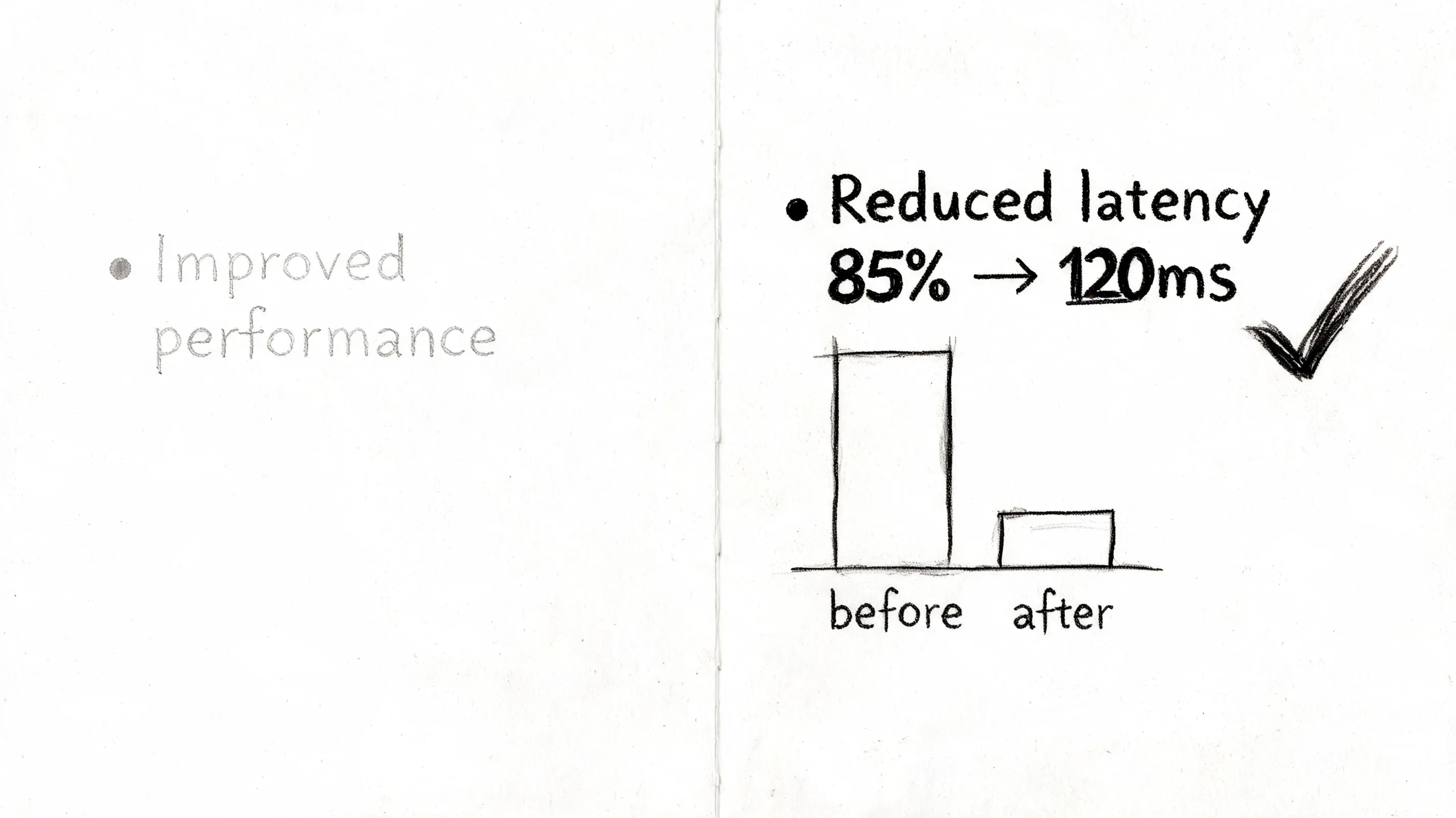
The point isn't “add metrics everywhere and call it a day.” The point is showing movement.
Practical rule: If a bullet can be copied onto another engineer's resume without sounding weird, it's too generic.
One more thing. Don't hide your tools. Embed them inside the outcome. That's how you stay readable for humans while still making the relevant technologies visible.
If you need a reminder that projects should show solved problems instead of random stacks, a round-up of practical Ruby projects for 2026 makes the same point in a different context. The project matters because of what it does, not because Ruby exists.
Architecture is only impressive when it changed something
You built a distributed system. Great.
So did the last three candidates.
Architecture, by itself, is not impact. It's a means. If your bullet stops at “designed system architecture” or “built a scalable platform,” you're asking the reader to imagine the value for you. They won't.
Recruiters already struggle to judge candidate quality from resumes. In one foundational study, people trying to assess capability from resumes were correct only 53% of the time, which is basically coin-flip territory, according to Aline Lerner's write-up on why resumes fail to communicate impact. If your bullets make the reader guess, you lose.
Here's a visual version of the problem engineers create for themselves:
Show the before and after
A technical reader may admire the architecture. A hiring manager wants the delta.
Weak:
- Architecture-only bullet: Developed a new caching layer for the main application.
- System-design bullet: Built internal platform services for multi-region support.
- Infra bullet: Designed a resilient event processing architecture.
These feel serious. They say almost nothing.
Stronger bullets name the pain:
- Operational change: Built a Redis caching layer after the primary database became the bottleneck during peak traffic. The app stopped stalling under read-heavy load and support tickets dropped.
- Team change: Added multi-region support so customer launches no longer depended on a single regional deployment window.
- Risk change: Reworked event processing after retries were creating duplicate downstream actions. Gave the team predictable recovery instead of manual cleanup.
Platform and infrastructure engineers have this especially hard because their best work looks like nothing happened. That's the job. Systems stayed up. Deployments stopped breaking. On-call got quieter.
So write the counterfactual.
Ask:
- What would have kept breaking: What repeated failure did this remove?
- What bottleneck disappeared: What used to slow the team or the product down?
- What manual work ended: What did people stop doing once this existed?
If the value of your work was “nothing exploded anymore,” say that in grown-up language. That's real impact.
If your bullets sound like the job post, you've disappeared
This one is brutal because it feels responsible. You're trying to match the role. You mirror the language in the job description. You mention cross-functional teams, agile delivery, system design, stakeholder communication.
Now your resume sounds exactly like everyone else's.
A hiring manager already knows what a senior engineer is supposed to do. They know people collaborate. They know teams use CI/CD. They know engineers attend planning meetings. Repeating generic job conditions doesn't create evidence.
Job description language is not proof
Weak bullets usually have one of these smells:
- Responsibility smell: Responsible for maintaining the CI/CD pipeline.
- Process smell: Collaborated with cross-functional teams to deliver features.
- Corporate smell: Participated in agile ceremonies and sprint planning.
- Ownership smell: Worked closely with stakeholders to align technical solutions with business goals.
All of that may be true. None of it is useful.
Stronger bullets isolate what was distinct about your version of the work:
- Specific intervention: Overhauled a brittle Jenkins pipeline that kept failing at release time. Made failures visible earlier so engineers stopped discovering them at deploy time.
- Distinct contribution: Worked with product and support to redesign an approval flow that users kept abandoning halfway through. Shipped a simpler sequence that reduced confusion and support escalations.
- Actual leadership: Took over a service no one wanted to touch, documented the failure modes, and made it safe enough that newer engineers could ship to it without hand-holding.
Many engineering resume mistakes begin compounding at this stage. First, you list tools. Then you describe architecture vaguely. Then you flatten the whole thing further by writing bullets that sound copied from the role you want.
That's how a strong career turns into beige text.
A visual cue helps. If your most impressive bullets could sit comfortably inside the original job ad, rewrite them.
One-page minimalism can gut the evidence
A lot of smart engineers cut the wrong words.
They've heard the one-page rule so many times that they remove the exact details that make the work legible. Now every bullet is short, efficient, and weirdly empty.
That's a bad trade.
For experienced engineers, context is not fluff. Context is what tells the reader whether your work was simple, messy, political, urgent, high-scale, customer-facing, or critical. The same action can look junior or senior depending on the setting.
Context is what makes impact believable
Compare these two bullets.
Weak:
- Stripped bullet: Migrated the user database to a new system.
Better:
- Context-rich bullet: Led a zero-downtime migration of a large user database from a legacy system with poor documentation while multiple product teams were still shipping against it.
The second version works because it answers the questions a good reader already has. How risky was this? How constrained was it? Why was it hard?
Don't overcorrect and write mini novels. Just restore the missing frame:
- Scale: Was this internal, customer-facing, high-volume, or mission-critical?
- Constraint: Did you have little time, messy legacy code, missing docs, or active dependencies?
- Consequence: What would have gone wrong if this failed?
For mid-career engineers, two pages is often the sane choice if it preserves signal. Compress older work. Expand recent, relevant work. Don't amputate context just to satisfy a fake purity test.
A one-page resume that hides the hard part of your work is not concise. It's incomplete.
This matters for soft skills too. People say “strong communicator” or “team player” because they've cut away the story that would prove it. The effective fix is not adding a soft-skills section. It's embedding proof inside the bullet. If you're trying to show leadership, conflict handling, or cross-team influence, think in scenes, not labels. That's especially important for career changers and returners who need to carry strengths from one context into another.
Technical depth should support business impact, not bury it
A lot of engineers lead with implementation detail because that feels safe. The code is real. The systems are real. The design choices are real.
But your resume is not a design doc.
If the first thing a hiring manager sees is protocol choices, infrastructure components, internal architecture, or a wall of acronyms, they still don't know why your work mattered. That's dangerous because non-technical reviewers often screen before technical ones, and they struggle when resumes lean too hard on unexplained jargon.
Lead with the effect, then show the mechanism
Weak:
- Implementation-first bullet: Implemented Brotli compression for static assets and tuned cache-control behavior across the CDN layer.
- Infra-first bullet: Introduced Terraform modules and standardized environment provisioning across services.
- Data-first bullet: Built Kafka consumers and Airflow DAGs for downstream event processing.
Better:
- Effect-first bullet: Reduced asset payload size by introducing Brotli compression and better cache behavior, which made the site load faster for users on slower connections.
- Team-first bullet: Standardized environment provisioning with Terraform so teams stopped rebuilding infrastructure by hand and could launch services with fewer setup mistakes.
- Decision-first bullet: Built event pipelines that replaced delayed reporting and gave teams faster visibility into operational issues.
That's the right order. Start with the business or operational outcome. Then support it with the technical mechanism.
This doesn't mean “dumb it down.” It means stop forcing the reader to reverse-engineer the value from implementation details.
There's also a keyword trap here. Yes, role-relevant terminology matters. But stuffing your resume with every term from the job description can make it unreadable. A better approach is selective precision. Use the language that truthfully matches your experience. Cut the jargon that only exists to sound advanced.
For engineers trying to balance clear writing with ATS relevance, Rasmussen's advice on common resume mistakes points toward the same tension. Clarity beats complexity. Keyword stuffing isn't a personality.
Here's the simpler test. Could a smart non-engineer understand why this bullet mattered? If not, it's probably too deep too early.
The fix is not more bullets. It's a better narrative
By now the pattern should be obvious.
You list technologies instead of outcomes. Then you describe architecture without naming what changed. Then your bullets start sounding like the job spec. Then you cut context to keep things “tight.” Then you lead with technical depth so hard that the actual value gets buried.
That whole chain produces a resume that looks polished and says very little.
Rewrite for movement, not memory
If you only do one thing after reading this, do this for every major bullet:
- Start with the problem: What was broken, slow, risky, expensive, or unclear?
- Name your intervention: What did you specifically change?
- End with the result: What became faster, safer, easier, cheaper, clearer, or more reliable?
A bullet doesn't need to be dramatic. It needs to be legible.
If you're applying to different kinds of roles, tailor the order of your bullets too. An SRE resume should not lead with UI polish. A product engineering resume should not open with an internal platform refactor unless it changed shipping speed, stability, or customer experience in a way that matters to that role.
That's also why sending one generic version everywhere backfires. Hiring managers read a generic resume as weak fit or weak interest. If you need help with that process, StoryCV has a guide on tailoring your resume to a job description.
And if you think you “can't quantify” your work, slow down. Usually the metric exists, but no one labeled it as a KPI. What changed when you left versus when you started? Fewer outages. Faster deploys. Simpler onboarding. Less manual cleanup. Those are all evidence. StoryCV's guide to using metrics in a resume is useful if you need help turning those changes into stronger bullets.
Career pivots need the same treatment. A chronology alone won't explain why a frontend engineer is moving into platform, or why someone came from logistics into software. The missing piece is a short connecting narrative. StoryCV has examples of that in its article on narrative resume examples.
Here's one more visual reminder that role focus matters:
8 Engineering Resume Mistakes: Impact & Fixes
| Issue | 🔄 Implementation Complexity | Resource Requirements | 📊 Expected Outcomes ⚡ | Ideal Use Cases | ⭐ Key Advantages / 💡 Tip |
|---|---|---|---|---|---|
| Listing Technologies Instead of Outcomes | Low, rewrite bullets to lead with impact | Minimal time; gather one or two examples and metrics | Clearer differentiation; faster recruiter recognition | All applicants, especially early–mid career | ⭐ Shows value, not tools · 💡 Start with outcome, then list tech |
| Describing Architecture Without Naming What Changed | Medium, add baseline and delta measurements | Access to logs/metrics, stakeholder context | Demonstrates real reliability/performance gains | Platform, SRE, infra architects | ⭐ Proves scale impact · 💡 State "before → after" with numbers |
| Writing Bullets That Mirror the Job Spec | Low, convert duties into accomplishments | Time to extract ownership and outcomes | Highlights initiative and measurable results | Mid/senior engineers seeking leadership signals | ⭐ Shows ownership · 💡 Use active verbs + quantification |
| Cutting All Context for One-Page Brevity | Medium, balance brevity and necessary context | Selective editing; include scale, timeline, team size | Restores credibility; enables accurate hiring assessment | Senior roles, large-scale projects | ⭐ Communicates complexity · 💡 Add one-line context (users/RPS/timelines) |
| Leading With Technical Depth Over Business Impact | Medium, translate tech to business KPIs | Product/business input; map technical changes to KPIs | Better hiring justification; aligns with company goals | Senior engineers, cross-functional roles | ⭐ Connects work to ROI · 💡 Open with business outcome, follow with tech |
| Neglecting Narrative for Career Changers and Gaps | Low, craft concise narrative and select projects | Time to write summary; portfolio or project links | Reduces recruiter uncertainty; reframes gaps as strengths | Career changers, return-to-work candidates | ⭐ Builds coherent story · 💡 1–2 sentence pivot summary + examples |
| Failing to Tailor for the Role | Moderate, customize order and emphasis per job | Time per application; role research and edits | Higher relevance and callback rate | Competitive roles or role switches | ⭐ Targets hiring manager needs · 💡 Reorder top achievements for role |
| Not Quantifying Your Work (Even When You Think You Can't) | Low, identify proxies and relative metrics | Data gathering; estimates from peers or tools | Increases credibility; makes impact verifiable | All roles, critical for product/data-focused work | ⭐ Turns claims into facts · 💡 Use percentages, time saved, or user counts |
Stop filling boxes. Start telling your story
Your resume is not supposed to be an archive of tasks. It's supposed to make a hiring team believe you solve the kind of problems they have.
That's the primary issue behind most engineering resume mistakes. Too much of the document is spent naming what you touched. Not enough is spent showing what changed because you touched it.
The fix is not a prettier template. It's not adding more buzzwords. It's not cramming in every acronym from the job post and hoping some system likes it. It's better judgment on the page.
Write like someone who understands cause and effect.
Say what was wrong. Say what you did. Say what got better. Keep the tools in the sentence, but don't let them become the sentence.
If you're senior, act like it in your bullets. Seniority is not “worked with cross-functional stakeholders.” It's identifying the core problem, choosing the right tradeoff, and changing the outcome. That needs to be visible.
And be ruthless about dead language. Cut “responsible for.” Cut “worked on.” Cut “collaborated with.” Cut every bullet that sounds like HR could have written it.
Also, proofread like the interview depends on it, because sometimes it does. As noted earlier, resume errors get punished before anyone even reaches your technical depth. Sloppy writing makes the rest of your experience easier to ignore.
The good news is this is fixable. Most resumes don't fail because the person lacks substance. They fail because the substance got flattened into generic bullet points.
That's why a guided writing process is more useful than a box-filling template. StoryCV approaches this as a digital resume writer, not a builder. It asks for context, tradeoffs, and outcomes, then helps turn that into cleaner narrative. That's a better fit for experienced professionals who've done meaningful work but struggle to describe it cleanly.
If you want to clean up AI-heavy drafts before you send applications, this piece on transforming AI drafts into more human cover letter text is also worth a look. Same principle. Generic writing gets ignored.
Your work probably isn't the problem.
Your resume language is.
If your resume reads like a list of tools and duties, StoryCV can help you turn it into a clear story of impact. It uses a guided interview to pull out the context, decisions, and outcomes that most engineers leave out, so your resume sounds like a person who solved hard problems, not a spreadsheet with keywords.