You’ve been working for twelve or fifteen years. You’ve run teams, cleaned up ugly systems, shipped hard projects, and made decisions with actual consequences. Now you sit down to write a resume and end up with a four-page inventory of everything you’ve touched.
That’s normal.
Experienced professionals have a harder time writing resumes, not an easier one. The problem isn’t writing. The problem is editing. When you’ve done real work, the hard part is deciding what earns space and what doesn’t.
The usual advice is lazy. “Just cut it to the last ten years” sounds neat, but it misses the core question. Your resume is not a storage unit for your career. It’s a case for the role you want next.
The Expert’s Dilemma You’re Not Imagining
The most common pattern I see on experienced-professional resumes is simple. Four pages. Eight bullets per role. Every system touched. Every project mentioned. Almost no prioritization.
That document feels thorough. It reads like fog.
Recruiters spend 6 to 8 seconds on an initial review, and resumes outside the ideal 475 to 600 word range are often penalized early. 43% of those resumes are seen as less hireable before the content is even properly read, according to Cultivated Culture’s resume statistics.
That’s the expert’s dilemma. Junior candidates struggle because they don’t have enough material. Senior candidates struggle because they have too much, and most of it is hard-won. Cutting it feels dishonest.
It isn’t.
Why senior resumes get worse, not better
The hardest resumes usually come from people in the 12 to 18 year stretch of their careers. They’ve grown into real scope, but they often haven’t had to explain themselves to strangers for a long time. Reputation, referrals, and internal mobility did the work. Then suddenly a document has to carry the whole story.
That’s disorienting.
Your resume gets weaker the moment it tries to prove everything.
Common advice makes this worse. “Only include the last ten years” treats the problem like a date filter. It isn’t a date problem. It’s an argument problem.
The over-inclusion test
Use this quick check:
- Too many bullets: If every role has the same number of bullets, you’re documenting evenly instead of prioritizing.
- Too much tooling: If you list every platform or technology touched, you’re describing exposure, not value.
- Too much effort: If a bullet stays because it took a lot of work, that’s nostalgia, not strategy.
The resume isn’t failing because you’ve done too much. It’s failing because the reader can’t see what matters fastest.
Stop Archiving Your Past Start Arguing for Your Future
Most experienced professionals treat the resume like a historical record. That’s the mistake.
A good resume doesn’t ask, “What did I do?” It asks, “What case am I making for the next role?”

The gap between a resume and a job description is one of the biggest failure points. On average, resumes match only 51% of the relevant keywords from the job description, according to Innate’s key resume statistics. That’s not a formatting issue. That’s a relevance issue.
A senior ops leader example
Say you’re a senior operations leader with fifteen years of experience. You’ve managed warehouse transitions, vendor negotiations, ERP cleanups, hiring, compliance, and one ugly legacy system that consumed two years of your life.
Your previous employer may have cared a great deal about that legacy system. Your next employer might not care at all.
If you’re applying for a role focused on scaling multi-site operations, then these matter:
- Cross-functional execution across ops, finance, and procurement
- Process redesign that reduced friction
- Team leadership during growth or change
- Systems thinking tied to business performance
What probably doesn’t deserve prime real estate:
- Maintenance work on old internal processes nobody else uses
- Low-impact projects that were urgent then but irrelevant now
- Detailed task lists that describe workload rather than results
Practical rule: If a bullet exists because your previous employer cared about it, but your next employer won’t, cut it or demote it.
Use this filter on every bullet
Ask one question:
Does this prove I can solve my next employer’s problems?
That’s the heuristic. Not effort. Not recency by itself. Not sentiment.
Here’s the difference in practice:
| Resume logic | What it sounds like | What it does |
|---|---|---|
| Archive logic | “I should include this because I owned it.” | Creates clutter |
| Argument logic | “I should include this because it supports the case I’m making.” | Creates focus |
If you’re trying to figure out how to write resume when you have a lot of experience, stop thinking like a historian. Think like an advocate. You’re not preserving your past. You’re selecting evidence.
A Better Resume Structure Than the 15-Year Rule
The crude version says cut everything older than fifteen years. The better version says control detail, not truth.
You do not need to erase your earlier career. You need to stop giving equal space to unequal material.
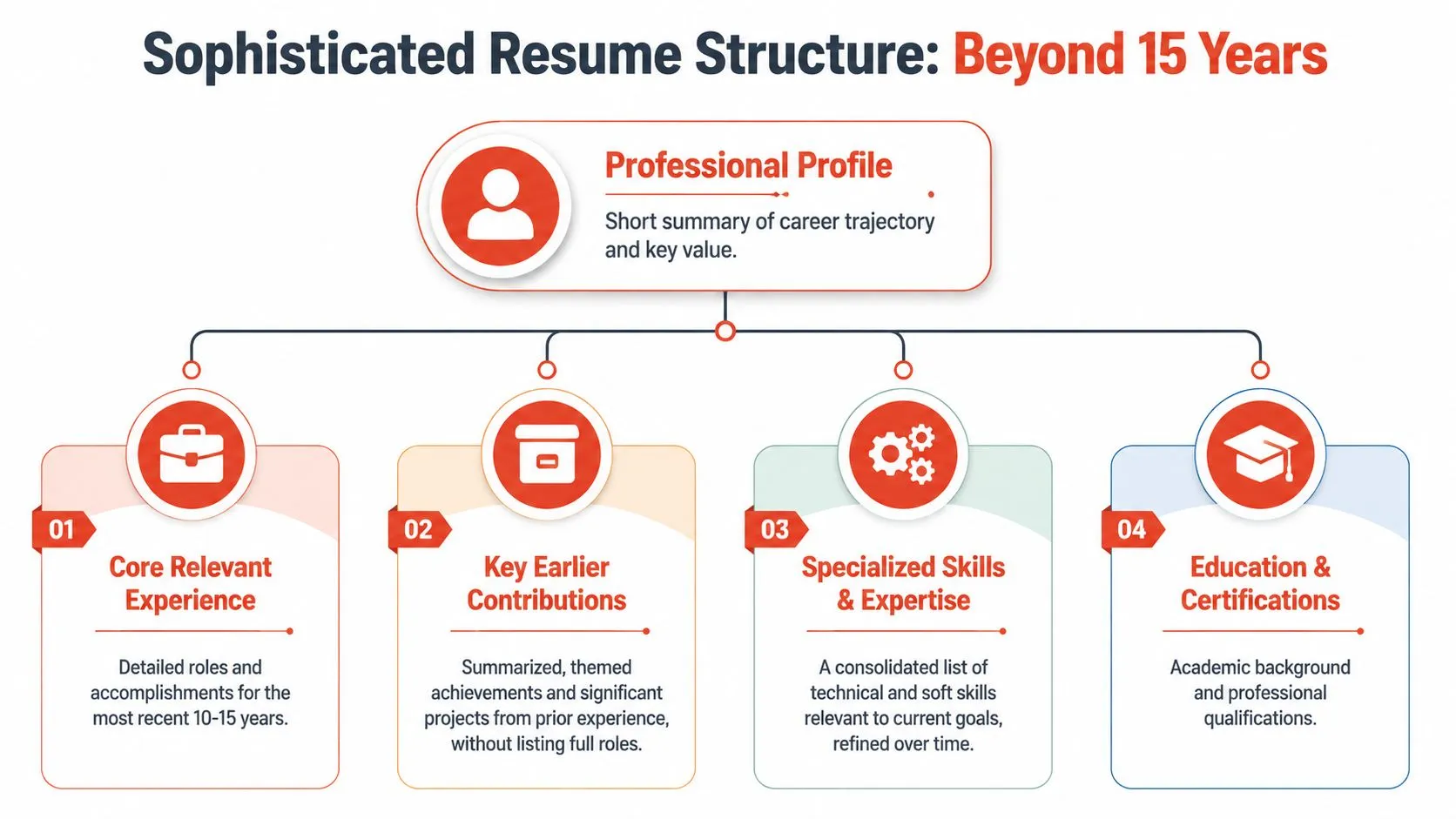
Resume experts recommend strategic compression over simple chronological listing. The strongest resumes for experienced candidates select 3 to 4 positions that best demonstrate fit for the target role and limit each one to 2 to 3 powerful, single-line bullet points, as noted in Business News Daily’s resume writing tips.
The structure that works
Use three layers.
Professional summary
This is not a personality paragraph. It’s a positioning statement.
Keep it tight. State your lane, your level, and the kind of problems you solve now.
Example:
Senior operations leader with experience across multi-site fulfillment, process redesign, vendor management, and systems improvement. Known for stabilizing messy operations, leading cross-functional teams, and turning bottlenecks into scalable workflows.
That does more work than a paragraph full of adjectives.
Selected experience
This is the center of the resume. Choose 3 to 4 roles that best support the role you want now.
For each role:
- Keep bullets scarce: Two or three is enough if they’re strong.
- Lead with relevance: Put the most aligned role first, even if another role was busier.
- Show progression: Scope, leadership, and complexity should be obvious.
If you’re debating length, this guide on whether a resume can be 2 pages is useful, especially for experienced candidates who need more than a one-page summary but less than a memoir.
Additional experience
Older or less relevant roles can stay. Just compress them.
List:
- Job title
- Company
- Dates
No bullets unless that role adds unique credibility you can’t show elsewhere.
Earlier roles should preserve your timeline, not steal attention from your best evidence.
What this looks like in practice
A weak version:
- Every role gets equal space
- Old manager jobs get as much detail as current leadership work
- The document reads like a career archive
A better version:
- Strong summary at the top
- Selected experience with the few roles that prove current fit
- Earlier career listed cleanly, without over-explaining
That structure gives you room to be ruthless without looking evasive. It shows depth. It keeps gravity. It also respects the reader’s time.
How to Write Bullets That Show Impact Not Just Activity
Most senior resumes don’t fail because the candidate lacks accomplishments. They fail because the bullets read like job descriptions.
That’s a waste.
The shift from responsibility-based language to achievement-based language matters. Resumes that use a metrics-driven Challenge-Action-Results approach generate 3 to 4 times more interview callbacks than resumes filled with generic descriptions, according to Career Directors International’s guidance on standing out.
The simplest bullet formula
Don’t write what you were responsible for. Write what changed because of your work.
Use this shape:
Action verb + outcome + metric if real + business context
Not every bullet needs a number. Every bullet does need a consequence.
Before and after examples
Take our senior ops leader.
| Weak bullet | Better bullet |
|---|---|
| Managed warehouse inventory | Reduced inventory friction by redesigning replenishment workflows across regional sites |
| Oversaw vendor relationships | Renegotiated supplier terms and reset service expectations across key accounts |
| Responsible for ERP implementation | Led ERP rollout across operations and finance, replacing fragmented manual work with a unified process |
| Supervised team of managers | Built and led a multi-layer operations team during a period of process change and expansion |
The second version isn’t puffed up. It just answers the question the first version ignores: so what?
A better way to find your bullets
Start from raw material, not from polished language.
Write down:
- What changed: What was different when you left compared with when you started?
- What only you decided: Where did your judgment matter?
- What got better: Faster, cheaper, cleaner, simpler, more stable, more scalable
If you need more help refining phrasing, this guide to bullet points in a resume is a practical reference.
Start with the last role you loved, not the most recent role. That’s often where your strongest evidence lives.
Here’s a useful walkthrough before you rewrite your own bullets:
When you don’t have clean metrics
Don’t invent numbers. Ever.
If you have hard metrics, use them. If you don’t, show scale and consequence another way:
- Scope: across regions, teams, functions, or product lines
- Sequence: launched, rebuilt, standardized, consolidated, migrated
- Operational effect: removed bottlenecks, reduced manual work, improved handoffs, clarified ownership
Examples:
- Standardized handoff processes between sales and operations across multiple teams
- Rebuilt onboarding workflow after repeated delivery issues
- Consolidated scattered reporting into a single operating rhythm for leadership review
These work because they show movement. Activity is static. Impact has direction.
Use Your Voice Not a Template to Write it Faster
Blank pages make smart people sound generic.
That’s because most experienced professionals aren’t bad at thinking. They’re bad at translating years of tacit knowledge into bullet points on command. Talking is usually easier than writing because speech carries context. You remember the trade-offs, the politics, the constraints, and what changed.

That matters because 77% of resumes fall outside the ideal 475 to 600 word range, and brevity is a real advantage. An AI-guided interview process can help produce a concise draft that balances storytelling with keywords and avoids the fluff that appears in 51% of resumes, as noted earlier from Cultivated Culture.
Why interview-first works better
A template asks you to fill boxes.
An interview asks better questions.
Good prompts sound more like this:
- What changed between when you started and when you left?
- What problem kept escalating until you stepped in?
- Which decision did you own that changed the outcome?
- What would your manager say got better because of you?
That process gets closer to the truth of your work. It also sounds more like you.
One option is StoryCV, which works as a digital resume writer rather than a template library. It uses a guided interview to pull out context, decisions, and results, then turns that into a focused draft. That’s useful when you’re too close to your own experience to edit it well.
Clean up the voice after drafting
AI can flatten language if you let it. After you get a draft, read it out loud. If it sounds like a committee wrote it, tighten it.
You can also use resources like Humanize AI Text to smooth awkward phrasing after an AI-assisted draft, especially if the wording feels stiff or repetitive.
The goal isn’t to sound robotic and optimized. The goal is to sound like a credible adult who knows what they’ve done.
Templates are fast at the start and expensive at the end. You save a few minutes filling them out, then lose hours trying to make them say something specific. Your own voice, sharpened by good editing, gets there faster.
Your Experience Is a Feature Not a Bug
Having a lot of experience is not the problem. Unedited experience is.
The right resume for a senior professional does not try to fit every project, every tool, and every responsibility onto the page. It makes a sharp case. It chooses evidence. It shows what matters now.
If you also need help aligning the resume with the rest of your application, it’s worth reviewing a few strong admin cover letter examples to see how the narrative carries across documents. And if you want to see how stronger storytelling changes the shape of a resume, these narrative resume examples are useful.
Your career has range. That’s an asset.
Your job is not to shrink it into something smaller. Your job is to make it legible.
Don’t write a record of everything you’ve done. Write the clearest argument for what you should do next.
If you want help turning a long, messy career history into a sharp resume without defaulting to templates, StoryCV can help. It uses a guided interview to turn your actual work into clear, focused resume writing, so you spend less time guessing what to say and more time applying with something that sounds like you.