Yes, a resume can absolutely be two pages. The old "one-page rule" is officially dead, at least for anyone who isn't fresh out of college.
The real question isn't about page count, but about impact. Does every line on that second page earn its spot by proving you're the right person for the job?
Decoding the Ideal Resume Length
Think of your resume as a strategic highlight reel, not a historical archive. Its only job is to convince a hiring manager that you're worth talking to. For some, a single page is the perfect way to deliver a powerful, concise message. For others, trying to cram a decade of achievements onto one page does more harm than good.
The idea that every resume must fit on a single page is a holdover from a different era. Modern hiring has changed. Applicant Tracking Systems (ATS) and human recruiters are looking for quality content, not arbitrary page limits.
A well-organized, relevant two-page resume will always beat a cramped, unreadable one-pager where your best accomplishments got cut for the sake of brevity. The goal is always readability and relevance.
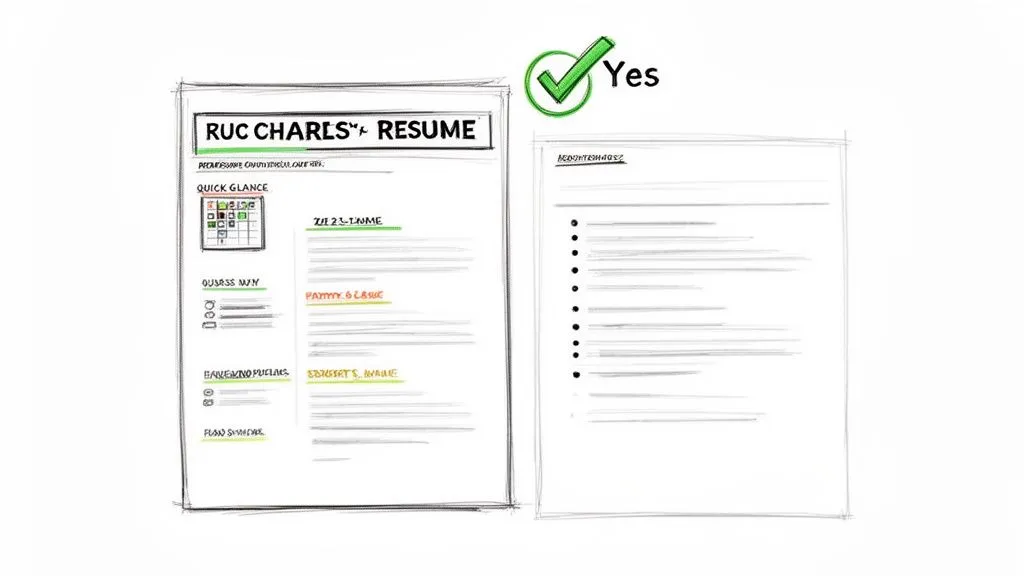
Your Career Stage Dictates the Length
Your experience level is the biggest factor here. A recent graduate and a senior director with 15 years of leadership experience have completely different stories to tell. Forcing that director to squeeze a decade of project wins, promotions, and quantifiable results onto a single page is a terrible strategy. It forces them to delete the very proof that makes them valuable.
The right resume length is the one that best tells your professional story without filler. Every line must earn its place by showcasing your value to a potential employer.
Ultimately, it’s a strategic choice. If you have enough relevant, compelling experience to fill a second page without fluff, you should absolutely use it. That extra space is your opportunity to build an undeniable case for why you're the one they need to hire.
To make it simple, here's a quick guide to help you decide.
Resume Length Guide by Career Stage
This table breaks down the standard advice on resume length based on where you are in your career. Use it as a starting point to make the right call for your situation.
| Career Stage | Recommended Length | Primary Focus |
|---|---|---|
| Student / Recent Graduate | 1 Page | Potential, education, internships, and key skills. |
| Early-Career (1-5 years) | 1 Page | Demonstrating core competencies and early achievements. |
| Mid-Career (5-10 years) | 1-2 Pages | Showcasing career progression and significant results. |
| Senior / Executive (10+ years) | 2 Pages | Highlighting leadership, strategic impact, and extensive experience. |
As you can see, the more you've accomplished, the more space you've earned. Don't be afraid to use it.
So, Why Is the One-Page Resume Rule Dead?
The whole "one-page resume" thing feels like a law of physics, but it’s really just a dusty old relic. It comes from an era of paper applications, creaky filing cabinets, and purely manual review. Back then, a hiring manager might get hit with hundreds of physical resumes, and a single page was just faster to handle, sort, and file away.
That logic made total sense when every piece of paper had to be physically managed. But let's be real—the hiring world has completely changed. We live in an age of digital resumes and Applicant Tracking Systems (ATS), which makes the physical limits of a piece of paper totally irrelevant.
From Paper Piles to Digital Profiles
Modern careers just aren't that simple anymore. People have complex work histories packed with project-based gigs, specialized roles, and a laundry list of technical skills. Trying to cram a decade of high-impact work onto a single page means you end up cutting the very details that prove you’re the right person for the job.
You're stuck making impossible choices, like deciding between listing a key project or explaining the killer result it delivered. It's a false choice that ultimately weakens your application because you leave out the context that makes you stand out.
The goal isn’t to fit into a tiny box anymore. It’s to provide undeniable proof of what you can do. A well-crafted second page isn't clutter; it's evidence of significant, relevant experience.
This isn’t just a theory, either. It’s what recruiters actually want to see. While the one-page myth hangs around, the data paints a very different picture of how hiring works today.
What Recruiters Really Think About Resume Length
Recruiter habits have changed right alongside the technology. All that recent data shows the strict "one page or else" rule has pretty much dissolved. In fact, a huge analysis of the US job market found that for experienced roles, a two-page resume is actually preferred by around 90% of recruiters and hiring managers.
The same report found that while anything over four pages was a definite turn-off, the market has naturally landed on an average resume length of 1.6 pages. This tells us a sharp, well-organized two-page resume is now standard—and often expected—for anyone with a solid track record. You can dig into more of the numbers in the full resume statistics report.
The data confirms it: the fear of page two is officially outdated. If you have substantial, relevant experience, using that second page isn't just okay—it's a smart move to build a stronger case. The trick is making sure everything on that second page is just as powerful as what’s on the first.
When a Two-Page Resume Creates a Strategic Advantage
Deciding on a two-page resume isn't about filling space—it’s a strategic choice to give your career the room it deserves. For certain professionals, that extra page isn't just helpful. It’s a competitive edge that lets you tell a complete and compelling story.
Think of it this way: a movie trailer is great for grabbing attention, but you need the full film to understand the plot. For experienced candidates, a one-page resume is the trailer. A two-page document is the feature film, providing the depth and evidence needed to prove your value.
Mid-Career Professionals
Once you have 5-10 years of experience, your career narrative gets more complex. You’ve likely switched roles, earned promotions, and led significant projects. A two-page resume gives you the breathing room to detail this progression, connecting the dots for a recruiter and showing a clear pattern of growth.
The extra space lets you quantify your impact over time without making the page feel cramped. Instead of just listing job titles, you can provide the concrete examples and metrics that prove you deliver results.
This decision tree shows a simple rule of thumb for resume length based on your years in the workforce.
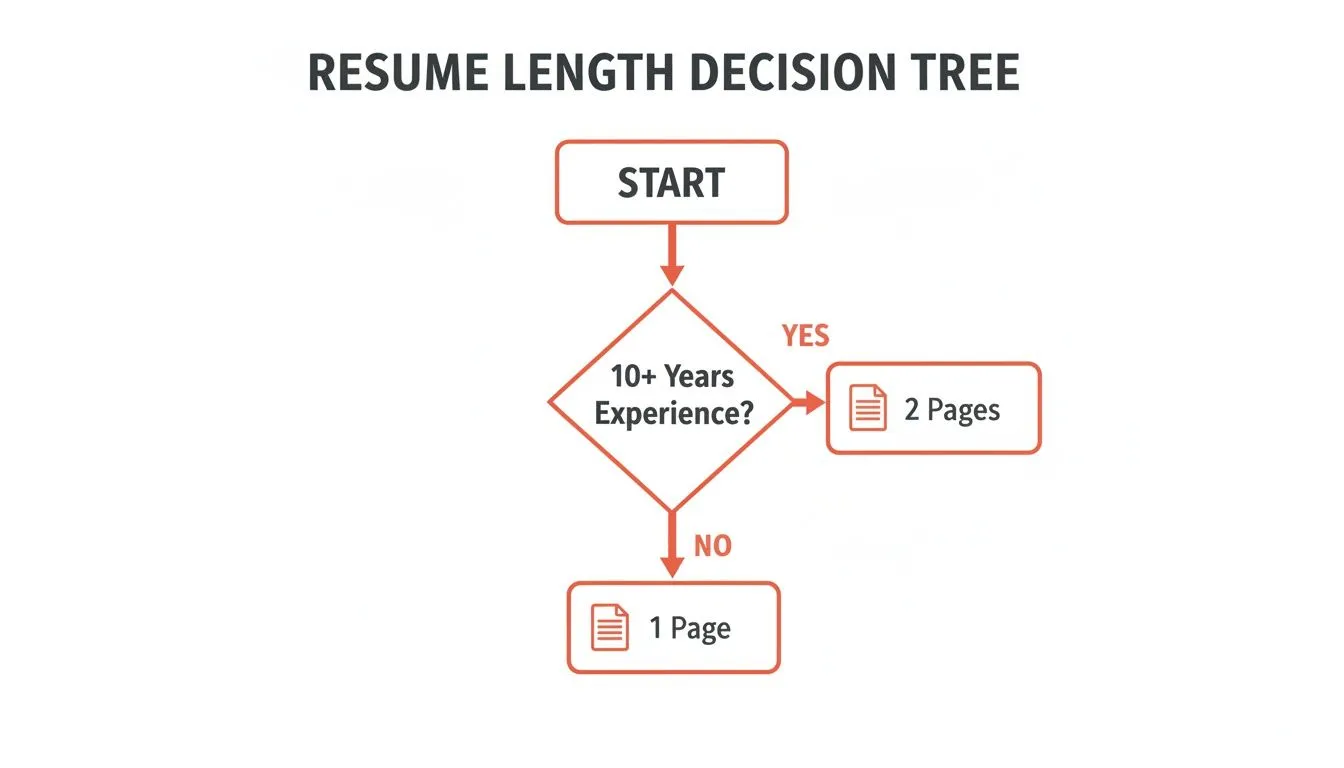
As you can see, once you cross that ten-year threshold, a two-page resume often becomes the standard for showing the full scope of your career.
Senior Leaders and Technical Experts
For senior leaders, a two-page resume is practically a necessity. Condensing 15+ years of strategic initiatives, leadership milestones, and budget management onto a single page is nearly impossible without cutting out critical information. The second page is where you elaborate on your leadership philosophy, mentorship successes, and high-level contributions.
It’s a similar story for technical experts—like software engineers, data scientists, or research scientists—who often need more real estate. Their value is demonstrated through a portfolio of projects, publications, and deep technical skills.
A second page gives them a dedicated area for:
- Detailed project lists with specific outcomes.
- Comprehensive skills sections organized by technology stacks.
- Links to portfolios or public code repositories like GitHub.
For most experienced professionals today, a two-page resume isn't just acceptable—it is often statistically advantageous.
Research actually confirms this. One huge analysis of 10,240 applications found that among professionals with over seven years of experience, two-page resumes had a 37% callback rate. That’s a significant jump from the 21% rate for one-page documents.
Career Changers
When you're pivoting to a new industry, your resume has to do more than just list past duties. It has to build a bridge between your old career and your new one.
A second page gives you the room to weave a compelling narrative, showing how your seemingly unrelated experiences have equipped you with valuable, transferable skills. For anyone navigating this kind of transition, a practical guide on how to change careers can offer a solid framework for telling that story—which often needs more than a single page.
This extra space allows you to add a project section or an expanded summary that explicitly connects your past accomplishments to the requirements of your target role.
When to Keep Your Resume to One Page
While a two-page resume gives seasoned professionals room to breathe, you should never underestimate the power of a sharp, single-page document. For some people, brevity isn’t just a style choice; it’s a strategic weapon.
The logic is simple: when you have less experience, every word has to count. A one-page resume forces you to be ruthless with your editing, ensuring a recruiter sees only your most relevant qualifications, with zero fluff. It sends a powerful, concentrated message, which is exactly what you want when your story is more about future potential than a long list of past wins.
Students and Recent Graduates
If you're a student or just tossed your graduation cap in the air, a one-page resume is almost always the right move. Right now, your resume's job is to sell potential. It needs to highlight your academic wins, internships, and key projects.
Trying to stretch this out to two pages is a classic mistake. It usually means padding it with irrelevant high school awards or messing with huge fonts and margins. Recruiters can spot that a mile away.
A tight, one-page format forces you to focus on what actually matters:
* Relevant Coursework: Show them you've already studied the concepts they care about.
* Internships and Co-ops: Detail what you did, but more importantly, what you accomplished.
* Academic Projects: Talk about that significant project where you put theory into practice.
For those just starting out, telling a compelling story is everything. We have more specific advice in our guide on how to write a resume for an internship, which is all about making the most of limited experience.
Early-Career Professionals
Have less than five years of experience? A one-page resume is the industry standard. Your career story is still taking shape, and a single page is plenty of space to make a strong impression.
Frankly, it also shows you can be concise and prioritize what’s important—a skill every employer values.
When your experience is concentrated, a single page acts like a spotlight, drawing immediate attention to your most significant contributions without distraction.
There are also times when one page isn't just a suggestion; it's a hard rule. Some companies, especially in more traditional fields, will explicitly ask for a one-page resume. If you ignore that instruction, your application might get tossed before a human ever sees it. Always follow directions. When they say one page, stick to one page.
How to Craft a High-Impact Two-Page Resume
Alright, so you’ve decided a two-page resume is the right move. Smart. But now comes the real work: building one that actually gets you the interview. A great two-page resume isn't just about dumping more information onto a second page. It’s about being strategic. You have to tell a clear, compelling story that grabs a recruiter’s attention and doesn’t let go.
Think of it like a newspaper. Page one is your headline and lead story—the flashy, can't-miss stuff designed to make an instant impact. Page two is the deep-dive feature article. It’s where you provide the evidence and context that prove your headline wasn't just clickbait. This structure respects a recruiter's time while showcasing the full scope of what you bring to the table.
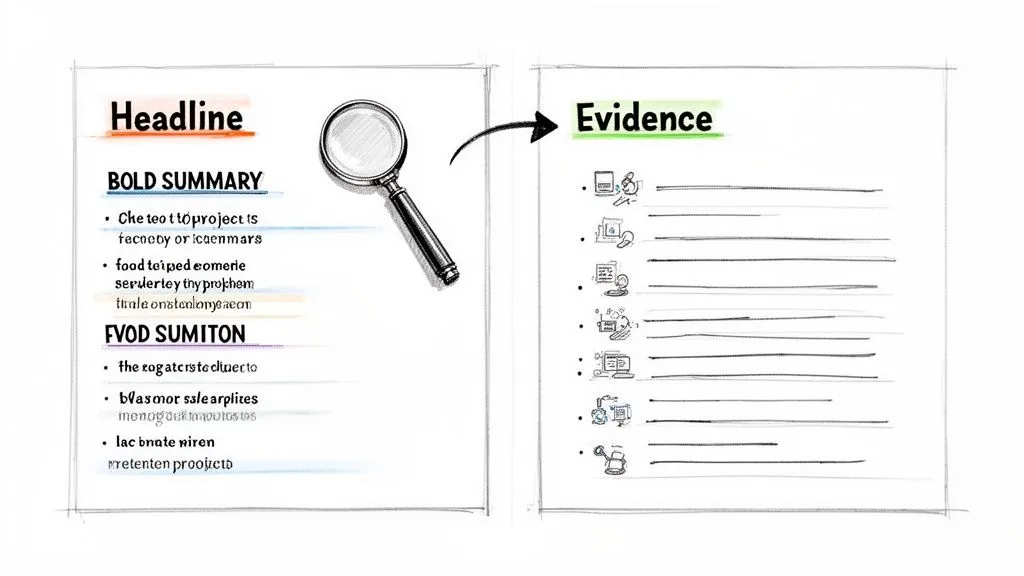
Prioritize Page One for the Six-Second Scan
You've probably heard this before, but it bears repeating: recruiters spend an average of just over seven seconds on their first scan. That’s it. Your first page has to be optimized to deliver the most critical information within that tiny window, making it impossible for them to toss your resume aside.
Here's what absolutely must be on page one:
- Contact Information: Keep it clean, professional, and dead easy to find right at the top.
- Professional Summary: This is your elevator pitch. It needs to be sharp and to the point. We've got more tips on how to describe yourself in a resume if you need to make this section punchier.
- Most Recent and Relevant Roles: Detail your last two or three positions, but focus ruthlessly on quantifiable achievements and impact. Numbers, numbers, numbers.
This front-loaded approach ensures that even if a recruiter only skims page one, they still walk away with a solid understanding of who you are and what you can do.
Use Page Two for Strategic Depth
The second page is not a dumping ground for leftovers. It’s where you provide the supporting evidence for the big claims you made on page one. It’s the space for depth, not filler. This is where you can move beyond your most recent roles to build a more complete, compelling picture of your expertise.
Good candidates for page two include:
- Earlier Career History: You can briefly list older roles here to show your career trajectory without getting bogged down in the details.
- Detailed Project Lists: For technical or project-based careers, this is gold. List key projects with their scope, your role, and the outcomes.
- Technical Skills or Certifications: A dedicated, organized section for skills, software, or professional credentials adds a ton of value.
- Professional Development: Include relevant training, publications, or speaking gigs that reinforce your expertise.
When you structure your resume this way, you create a cohesive narrative. Page one captures their interest with your most recent impact. Page two solidifies that impression with a history of consistent achievement.
And the data backs this up. A recent analysis from Huntr’s job search report found that two-page resumes actually score the highest interview rate at 3.45%, beating out shorter formats. The report also noted that candidates who land interviews have resumes averaging 1.6 pages, while those who don't average just 1.24 pages.
The takeaway is clear. When used correctly, that second page provides the crucial evidence that turns a "maybe" candidate into a "must-interview" professional.
Common Two-Page Resume Mistakes and How to Avoid Them
Deciding to go with a two-page resume is just the first hurdle. Executing it poorly can actually hurt your chances more than help. A weak second page is almost always worse than a strong one-page resume—it tells recruiters you either can't prioritize information or you're just trying to pad out thin experience.
The most common mistake? Using filler just to take up space. This is the classic move of bumping up font sizes, widening the margins, or adding fluffy, vague descriptions to crawl your way to the bottom of page two. Every single line on your resume has to earn its spot by proving its value.
Another critical error is leaving that second page looking empty and awkward. If your content just barely spills over by a few lines, it looks unprofessional and messy. It signals that you couldn't be bothered to edit your own work, which isn't exactly a quality that impresses hiring managers.
Keeping Your Two-Page Resume Strong
To avoid these traps, you need to become a ruthless editor. Stop thinking of your resume as a complete life story. It's a marketing document with one single goal: getting you the interview. Does that job from 15 years ago with totally irrelevant duties really help build your case for this job? Probably not. Cut it.
Your resume should be as long as it needs to be to tell a compelling story, and not a single word longer. The second page is for strategic depth, not for clutter.
This means ensuring your second page has real substance. It should ideally be at least half full with valuable content—things like detailed project breakdowns, a comprehensive technical skills section, or earlier career history that clearly shows your growth over time.
A Quick Dos and Don'ts Checklist
Use this simple checklist to audit your two-page resume and make sure it’s making the right impression. Following these guidelines is a key step toward crafting my perfect resume that highlights your strengths effectively.
Do:
* Put your most critical information on page one. Your summary, most recent roles, and key skills absolutely must be front and center.
* Add a header with your name on the second page. Something simple like "Jane Doe - Page 2" keeps everything organized if the pages get separated.
* Ensure the second page has meaningful content. You should aim to fill at least half the page with relevant projects, skills, or earlier experience.
Don't:
* Use large fonts or wide margins to fill space. Recruiters see right through these tricks, and it just looks amateur.
* Include irrelevant or outdated roles. If an old job doesn't directly support your current career goals, cut the details or remove it entirely.
* Leave just a few lines dangling on page two. Either edit your content down to one solid page or find more valuable information to add.
Got More Questions About Resume Length?
We've walked through the strategy, but a few nagging questions always seem to pop up. Let's tackle them head-on with some quick, practical answers.
Will an ATS Just Throw Out My Two-Page Resume?
Nope. This is an old myth that just won't die. Modern Applicant Tracking Systems (ATS) are built to read multi-page documents just fine. The software is hunting for keywords and professional history, not punishing you for crossing onto a second page.
Your real focus should be on clean formatting and rock-solid, relevant content. The bot can handle the length.
What if I’m Just a Few Lines Over One Page?
If your resume spills just a little onto page two, your first instinct should be to edit it back down to one. That's the right move. Trim wordy phrases, combine similar bullet points, and cut anything that doesn't scream "value."
But if every single word is absolutely essential? Don't leave a nearly blank second page. That looks sloppy. Instead, strategically add more valuable content—like a dedicated projects or skills section—to fill at least half the page.
A second page that’s mostly empty looks like you couldn't be bothered to edit. Either commit to a powerful single page or make that second page pull its weight with substantial content.
Do I Need to Put My Name on the Second Page?
Yes, you absolutely should. It’s a small detail that looks incredibly professional.
Just add a simple header with your name and the page number (e.g., ‘Jane Smith - Page 2’). You don’t need your full contact information again. This simple step keeps your document organized if it's printed and gives it a polished, complete feel.
For a deeper dive into your professional journey, you can find a ton of helpful career development resources to guide you.
Ready to tell your career story with confidence? StoryCV acts as your intelligent writing partner, guiding you to articulate your real impact beyond just keywords. Start for free and create a compelling, professional resume in minutes. Unlock your best career narrative today at https://story.cv.