Most advice about hiring a resume writer tells you to compare samples, certifications, and turnaround times first.
Wrong order.
If you’ve already decided to get help, the main question isn’t whether paid help can work. It can. Candidates who used professionally written resumes reported a 32% higher rate of finding a job, 68% secured employment within 90 days, 42% moved to higher-level positions, and they saw a 7% boost in earning potential, according to Life Working’s resume writer data roundup. The question is narrower and more useful:
What exactly are you buying?
Sometimes you’re buying real editorial judgment. Sometimes you’re buying a polished rewrite of bullets you already had. Those are not the same product, and they should not cost the same.
You Need Help With Your Resume. What Kind?
A lot of people frame this choice as human writer versus DIY template. That’s too crude.
The better frame is this: do you need thinking help, positioning help, or just cleanup? If you can already explain your impact clearly and you mainly need a sharper presentation, paying for a full-service writer may be overkill. If your experience is strong but hard to translate into a clear story, the format is not the problem.
That matters because resumes sit inside a brutal funnel. Research summarized by Cultivated Culture’s resume statistics says 75% of resumes are rejected by ATS software, less than 1 in 10 reach the hiring manager, and candidates include only 51% of relevant keywords and skills from job descriptions. The same source says 8 in 10 resumes are rejected for spelling mistakes, bad grammar, or typos, 3 in 10 are discarded for unprofessional email addresses, and resumes in the 475 to 600 word range generate double the interview rate compared with resumes outside that range. So yes, the document matters.
But the document is not the whole problem.
If you’re targeting larger employers, specialized roles, or distributed teams, your challenge is often translation. You need to turn messy experience into clean signal. That’s especially true if you’re applying to remote companies, where written communication and role clarity matter more because nobody is sitting next to you to fill in the gaps.
If you want a baseline definition of what these services are even supposed to do, this explanation of what a resume writer is is useful. Then come back to the harder point: not all “help” is the right help.
A prettier resume can still be a weak resume if the thinking underneath it is thin.
So don’t ask, “Should I hire a resume writer?” You’ve moved past that. Ask, “Do I need a strategist, an editor, or a translator?”
The Intake Process Is The Actual Product
The single best question to ask a resume writer is simple.
What does your intake process actually look like?
That question cuts through almost everything.
A weak writer asks for your current resume, target role, and maybe a few accomplishments. Then they rewrite what’s already there. That’s not useless. It’s just expensive copy-editing.
A serious writer tries to uncover the logic behind your work. They ask what changed because of you. What you solved that others missed. What was politically hard. Where you influenced without authority. What your manager trusted you with. What you’re aiming for next, and what parts of your background need to be reframed to support that move.
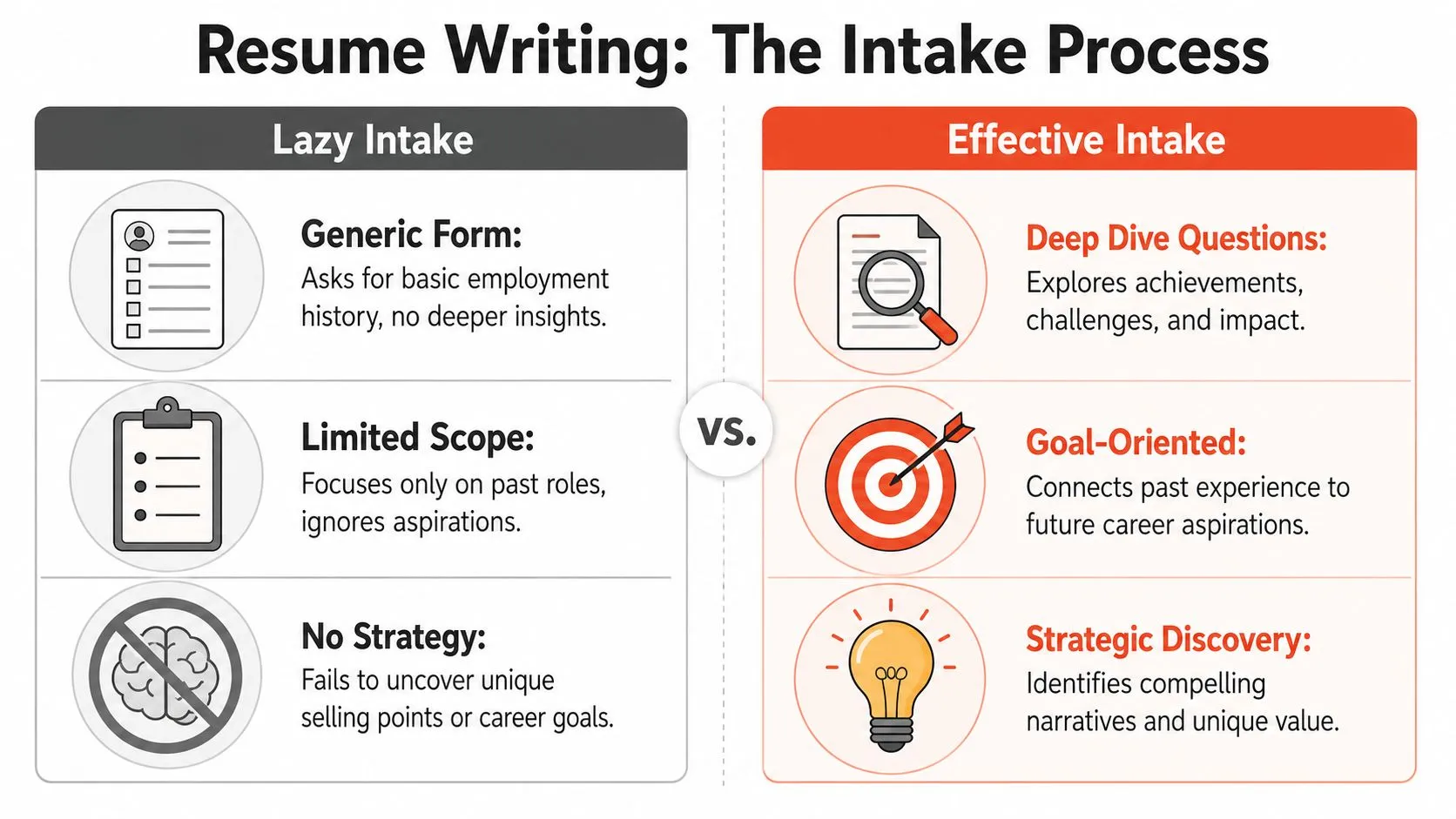
Lazy intake versus real intake
Here’s the difference in plain English.
| Type | What they ask | What you get |
|---|---|---|
| Transactional writer | Job titles, dates, responsibilities, target role | Cleaner bullets, better formatting, modest repositioning |
| Strategic writer | Wins, tradeoffs, judgment calls, patterns, future direction | A sharper narrative, stronger framing, clearer market signal |
The problem is that the industry has huge quality variance. As Jody Michael’s guide to hiring a professional resume writer notes, some sources warn against cheaper packages and point people toward credentialed writers, but there’s little data showing certification reliably improves interview outcomes. There’s also little clarity on what recourse you have if a “certified” writer gives you something flat. That’s why process matters more than badges.
The red flag most people miss
The biggest red flag isn’t bad design. It’s a writer who leads with turnaround time and sample documents.
Fast turnaround is a production metric. It tells you how quickly they can process your existing material. It doesn’t tell you how thoroughly they’ll engage with your actual work.
Before you hire anyone, listen for these signals:
-
They sell speed first. “Delivered in 24 hours” sounds efficient. It also suggests they’re not doing much discovery.
-
They obsess over before-and-after formatting. Nice layout helps. But formatting isn’t where the hard thinking happens.
-
They can’t describe their interview method. If the intake is vague, the output usually is too.
-
They ask surface questions only. Responsibilities are easy. Judgment, impact, and positioning are harder. That’s where value lives.
If a writer can’t explain how they uncover substance, they probably don’t.
Decoding Pricing and Process Timelines
Price confusion happens because people compare unlike things. A junior manager with a straightforward path is not buying the same service as a senior operator making a cross-industry move.
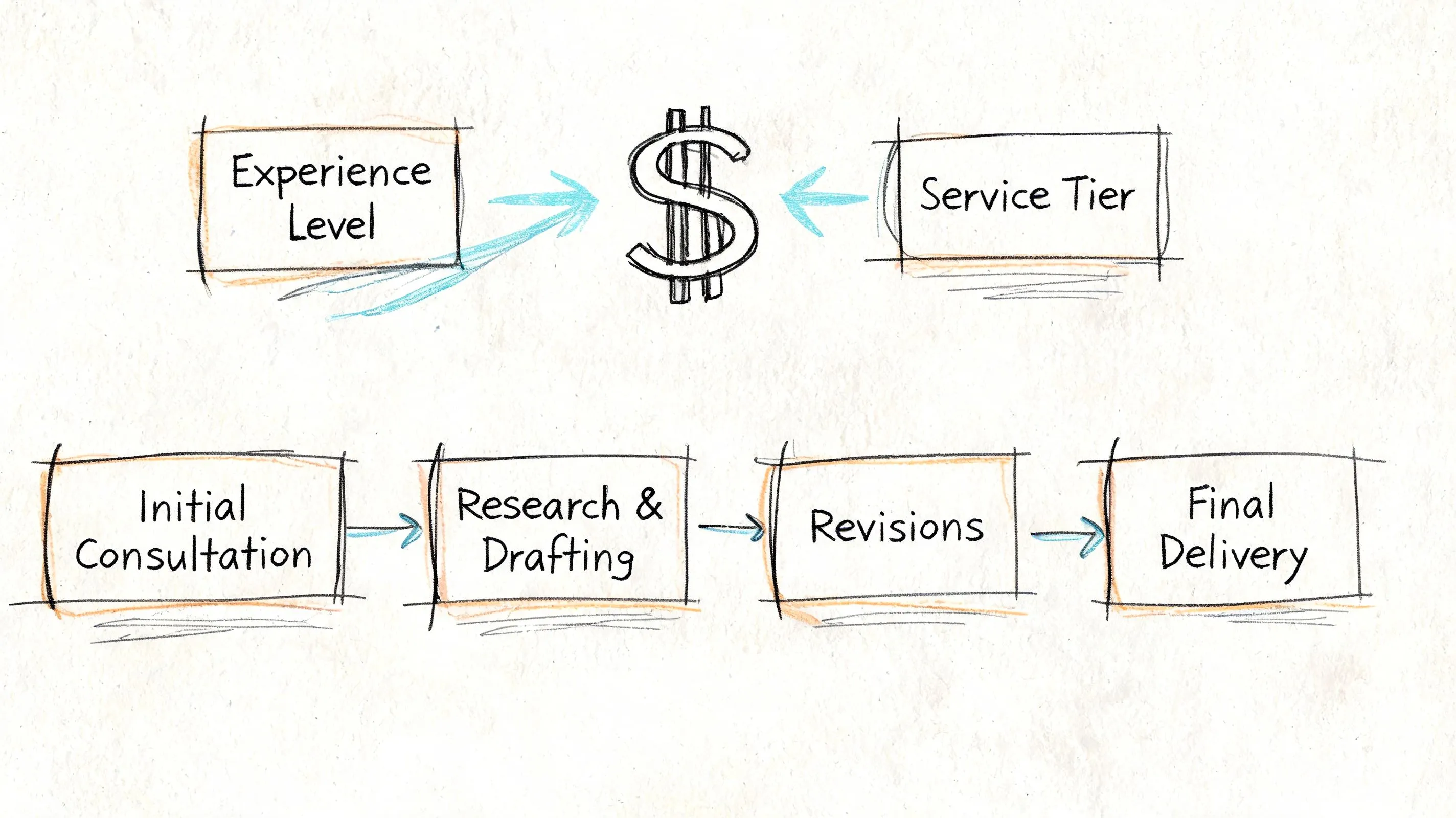
What you’re usually paying for
The author brief mentions a common market spread of $200 to $1,000+ depending on experience level and turnaround. Treat that as a practical shopping range, not a research claim. The documented part is this: PathForward’s overview of resume writer pros and cons says standard services cost hundreds of dollars, specialized resumes can run much higher, and the total investment can exceed $1,000 once you account for revision overages and expertise premiums.
That means “price” is rarely just price.
A fair quote depends on your situation:
-
Straightforward background. Linear career, same function, clear target role. This is the easiest case.
-
Narrative complexity. Career changer, returner, veteran, multi-industry path. Harder story. More work.
-
Specialized domain. Federal, executive, technical, or niche roles often cost more because the writer needs context, not just prose.
-
Urgency. Rush delivery usually means either a surcharge or a thinner process.
If you’re comparing options, this breakdown of affordable resume writing services can help you benchmark what’s included and what’s excluded.
What a normal engagement should look like
A solid process usually follows this sequence:
-
Initial review
They look at your current resume and target direction. -
Discovery intake
This is the core work. Could be a call, a guided questionnaire, or both. -
Drafting
They turn raw material into positioning, not just better sentences. -
Revision round
You correct nuance, add missing context, and tighten claims. -
Finalization
They deliver the polished document and often a matching LinkedIn summary or cover letter option.
Here’s a useful walkthrough of how resume writing services generally operate:
Hidden costs that annoy people later
Most disappointment starts in the contract, not the draft.
Watch for these points before paying:
-
Revision limits. Many writers cap rounds of edits. If your first draft misses the mark, extra changes may cost extra.
-
Call limits. A low base package may include less live discussion than you assumed.
-
Scope creep. Resume only is different from resume plus cover letter, LinkedIn, and coaching.
-
Timing assumptions. Good work takes time from both sides. If you’re slow to respond, your timeline slips too.
You’re not just buying pages. You’re buying access, iteration, and judgment. Make sure the proposal says so.
When Hiring a Human Is the Right Call
A human writer earns their fee when they bring context you don’t have, not just cleaner sentences.
That usually happens in a few cases.
The move is big enough to break your own framing
Say you’re moving from executive finance into nonprofit leadership. Or from military operations into private-sector program management. Or from a niche technical role into a broader business role. In those situations, the risk isn’t grammar. It’s positioning mistakes.
A writer who understands that target world can help you avoid emphasizing the wrong signals, using the wrong language, or underselling transferable authority.
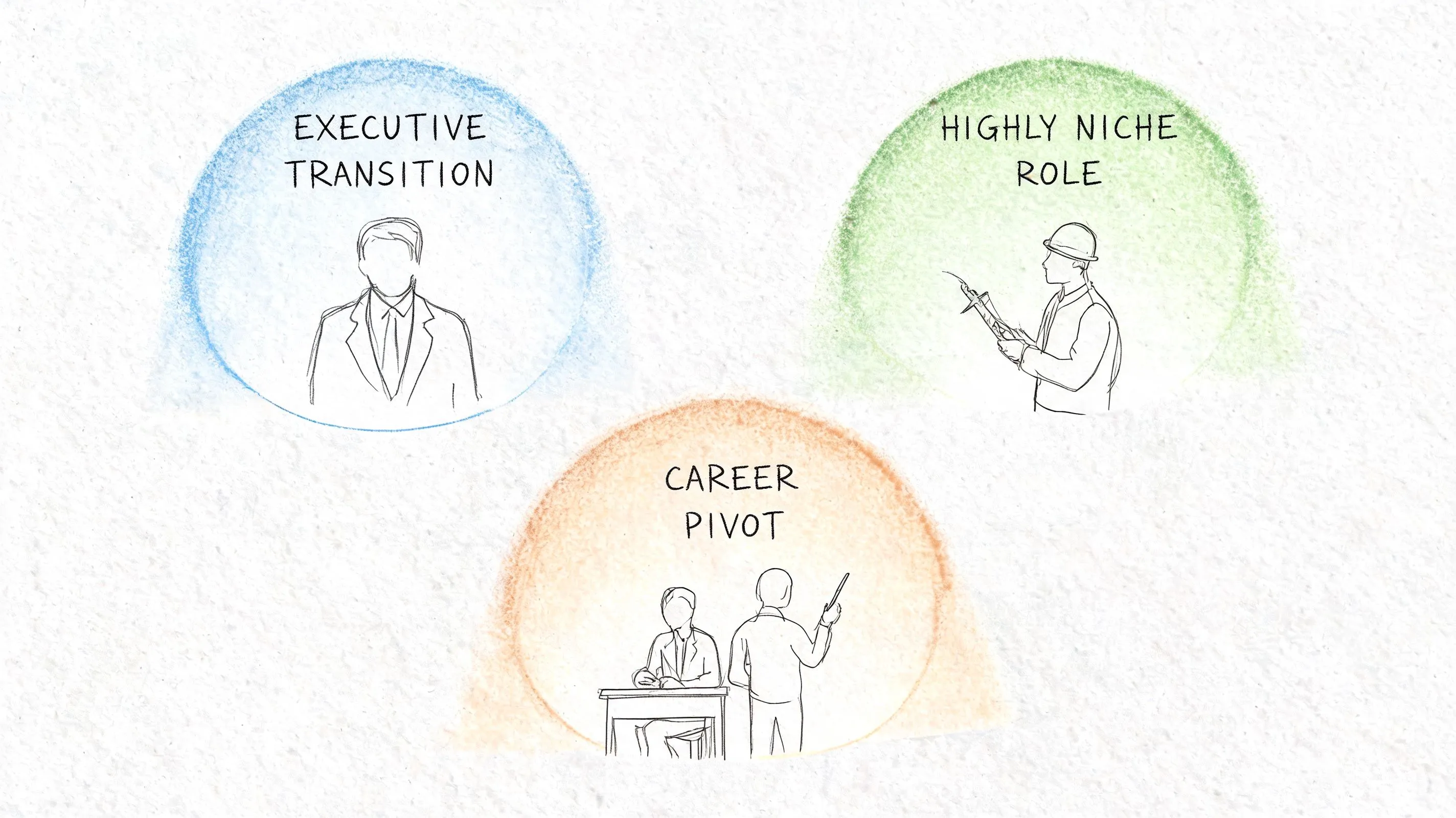
The role is niche enough that generic advice will hurt you
This includes technical leadership, heavily regulated fields, public sector roles, and jobs where the buyer needs to understand a very specific mix of domain knowledge and seniority.
In those cases, a human who has seen similar backgrounds before can save you from sounding generic.
The right human writer is not a wordsmith first. They’re an interpreter.
The honest limit of human writers
There’s also a ceiling here, and you should know it before you spend serious money.
A 2024 recruiter study summarized by CVwizard found that recruiters in the sample often made screening decisions within 30 seconds, focused heavily on surface signals like top-tier company or school names, and a fabricated resume with absurd content still got a 90% callback rate. That should sober you up.
If your target market screens heavily on pedigree, title history, or specific employer logos, a beautifully written resume may have limited power. A writer can solve a positioning problem. They can’t solve a credential problem.
So hire a human when expertise and interpretation matter. Don’t hire one because you think premium prose alone changes the game.
The Smart Alternative for Most Professionals
Most mid-career professionals don’t need a boutique human writer. They need help extracting their own value from work that feels obvious to them because they lived it.
That’s a different problem.
If you’ve done solid work in product, operations, marketing, finance, customer success, people leadership, or tech, your bottleneck usually isn’t industry translation. It’s that your experience lives in your head as messy memory. You need prompts, structure, and editorial judgment to turn it into signal.
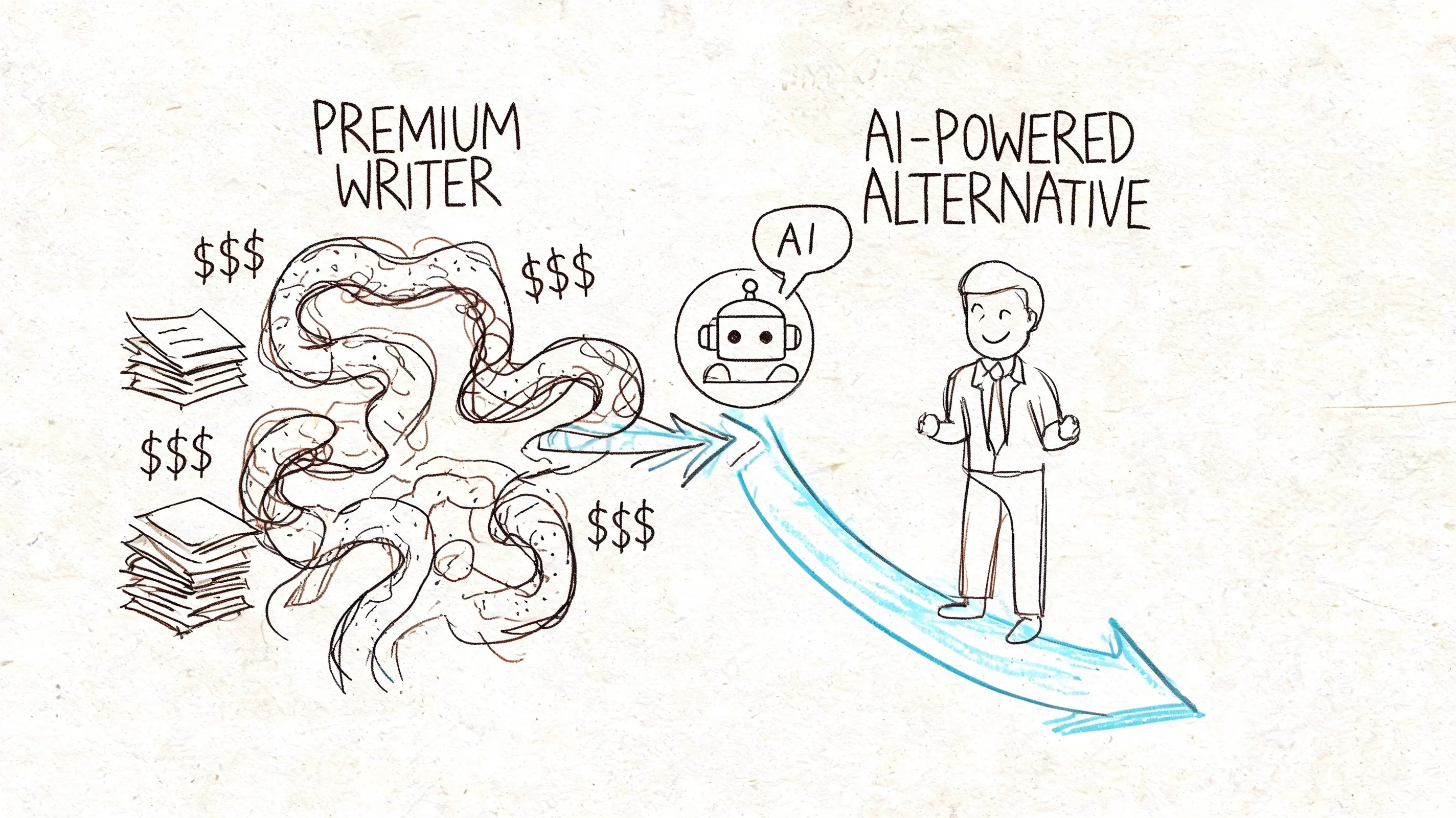
That’s where a digital resume writer makes sense. Not a blank template. Not a generic chatbot. A guided system that interviews you, pulls out context, and writes from substance instead of recycling corporate filler.
If your search also depends on showing work beyond the resume, this practical guide to online portfolios and digital portfolios is worth reading. A stronger resume and a clearer proof-of-work presence usually reinforce each other.
One option in this category is StoryCV’s comparison of AI resume writer versus human writer, which reflects the broader point: there’s a middle path between overpriced handholding and dead-eyed templates. That middle path is useful when you want strong narrative help without paying for niche consulting you don’t need.
Most professionals don’t need someone to “fix” their resume. They need a process that helps them say what they already know, but haven’t articulated well.
Your Simple Resume Writer Hiring Checklist
Use this when you’re evaluating anyone for hiring a resume writer.
-
Ask about intake first. “What does your intake process look like?” If they can’t answer clearly, move on.
-
Look for depth in the questions. Good signs include questions about impact, judgment, obstacles, tradeoffs, and future direction.
-
Treat speed claims carefully. Fast delivery is convenient. It is not evidence of insight.
-
Check what the fee includes. You want clarity on draft count, revision limits, call time, and any extra documents.
-
Match the writer to the problem. If you’re making a serious industry or function jump, domain knowledge matters. If you’re not, don’t overpay for it.
-
Ignore shiny samples unless the process is strong. Samples prove they can write. They don’t prove they can understand you.
-
Be realistic about outcomes. A writer can improve signal, clarity, and positioning. They can’t manufacture credentials you don’t have.
-
Read the contract like a buyer, not a hopeful applicant. Most bad experiences come from vague scope and limited revisions.
A simple rule works well here.
Buy the conversation, not the document.
If the conversation is thin, the final resume usually is too.
If you want help without the cost and lag of a traditional service, StoryCV is built around that exact problem. It works like a digital resume writer, using a guided interview to pull out your real impact and turn it into a clear draft you can use.