Most advice on ai resume writer vs human writer is lazy. It treats the problem like you’re choosing between a faster typist and a smarter typist.
That’s not the problem.
Your resume usually doesn’t fail because the writer was silicon or carbon-based. It fails because the story is weak. The positioning is fuzzy. The achievements sound like tasks. And the whole thing reads like nobody made an actual decision about what matters.
AI can produce polished junk fast. Humans can produce expensive junk slowly.
If you’re a mid-to-senior professional, that’s the issue. You don’t need prettier bullets. You need a resume that explains who you are, what you’re good at, and why your experience matters for this role.
Here’s the blunt version. Use AI for speed, use humans for judgment, and stop confusing formatting with strategy.
| Factor | AI resume writer | Human writer | What actually matters |
|---|---|---|---|
| Speed | Very fast | Slower | Useful if you're applying at volume |
| Cost | Low | High | Matters if you need multiple versions |
| ATS optimization | Strong | Usually solid if the writer knows what they're doing | Necessary, but not enough |
| Narrative quality | Often generic | Usually stronger | This is where interviews are won |
| Handling messy careers | Weak | Stronger | Pivots, layoffs, and scope shifts need context |
| Iteration | Easy | Slower and pricier | Helpful when testing different targets |
| Risk | Robotic tone, generic claims | Variable quality, expensive | Bad judgment kills both |
Your Resume Doesn't Need a Writer It Needs a Strategy
The binary question is wrong.
You’re not really asking whether AI or a human should write your resume. You’re asking who can extract the clearest, most credible version of your career story. Those are different problems.
Most professionals with solid experience have the same issue. They know the work they did. They don’t know how to frame it. So they either dump responsibilities into an AI tool and get polished filler, or they hire a person who rewrites the same weak inputs in better English.
Neither fixes the core problem.
The real bottleneck is story
A strong resume is a positioning document. It decides what to leave out, what to emphasize, and how to connect your past work to the job you want next.
That’s why generic advice falls apart. “Use keywords.” Sure. “Show impact.” Obviously. But if you can’t explain the business context, your decision-making, or why your work mattered, none of that lands.
The best resume writer is the one that forces clarity. Not the one that gives you prettier sentences.
If you want a useful outside lens on how professionals learn to ask sharper career questions, this breakdown of what a career coach does is worth reading. Different service, same lesson. Good outcomes come from better extraction and framing, not wordsmithing alone.
Why the AI vs human debate misses the point
Cheap AI misses nuance because it works from surface-level inputs. Expensive humans can miss nuance because many rely on intake forms, canned structures, or assumptions about your industry.
The common failure is identical. No one got to the truth of your work.
If your resume sounds broad, vague, or strangely polished, that’s usually not a writing issue. It’s a strategy issue.
The Rise of AI Resume Writers Speed and Scale
AI resume writers took off for one simple reason. They remove friction.
By mid-2025, over 78% of job seekers globally had used AI tools such as ChatGPT, Teal, or Kickresume to draft or refine resumes, and the AI-powered resume builders market was valued at USD 400 million in 2024 and projected to grow at a 20% CAGR to USD 1,800 million by 2032, according to Alibaba’s analysis of AI-generated resumes in 2025.
That adoption isn’t hard to explain. Many find writing about themselves challenging. AI gives them a draft in minutes, cleans up grammar, and turns a blank page into something usable.
What AI is actually good at
AI writers are strong at mechanical work.
They can:
- Generate a first draft fast from messy notes, an old resume, or a LinkedIn profile
- Mirror job description language so your resume looks relevant on paper
- Standardize structure with clean sections, consistent tense, and readable formatting
- Support high-volume applications when you need versions for several roles
That’s why they’re useful. Not because they “know your story,” but because they remove the grunt work.
If you're comparing specific platforms for technical roles, this list of AI resume tools for the tech industry is a practical place to start.
Where AI starts to flatten your value
AI works best when the career path is straightforward. Same function. Same industry. Clear progression. Obvious keywords.
It struggles when your advantage depends on interpretation.
Examples:
- You moved from operations into product
- You led work across teams without a formal leadership title
- You want to explain a layoff without sounding defensive
- Your impact was real, but hard to summarize in one metric
In those cases, AI often defaults to safe, generic phrasing. It produces resumes that are technically clean and emotionally dead.
Practical rule: Use AI to draft what happened. Don’t trust it to decide why it mattered.
AI is a drafting engine, not a strategist
That distinction matters.
An AI resume writer is great for getting from zero to first draft. It is not great at deciding which achievement proves executive judgment, which bullet signals progression, or which project best supports your pivot.
That’s why so many AI-generated resumes sound competent but forgettable. The tool can optimize wording. It can’t reliably make the strategic trade-offs that a strong resume requires.
The Enduring Value of Human Writers Nuance and Narrative
A good human writer earns their fee by doing something AI usually can’t. They ask the next question.
They don’t stop at “managed cross-functional teams.” They ask which teams, under what pressure, for what business outcome, and what changed because you were there.
That’s the true case for hiring a person. Not “premium writing.” Judgment.
According to CVPolis on AI vs human resume writing, human writers’ fees average $100 to $300 per hour, and projects often take days or weeks. That’s expensive. But they outperform AI on narrative flow and emotional intelligence, especially when a resume needs to explain pivots, layoffs, or a non-linear career in a way that makes sense during a recruiter’s quick scan.
What you’re actually paying for
The best human writers do three things well.
- Extraction: They pull detail out of you that you wouldn’t volunteer on your own.
- Framing: They decide what the reader should conclude from your experience.
- Restraint: They know which claims sound impressive on paper but weak in an interview.
That combination matters more as your career gets more complex.
Human writers are strongest when the path isn’t obvious
If you’re applying for leadership roles, changing functions, returning after a break, or trying to translate broad operational work into sharper positioning, a person can often do what a generic AI draft can’t.
They can make your experience cohere.
A good writer can turn:
- “Worked across finance and product”
into
- “Bridged commercial priorities and delivery trade-offs across finance and product teams”
That’s not just better wording. It’s better interpretation.
Human writers don’t just improve sentences. They decide what your career means on the page.
The downside nobody likes to admit
Human writing is inconsistent.
Some writers are excellent. Some are glorified copy editors with a discovery call. Some give you polished generalities that sound expensive and say nothing. And because the process takes longer and costs more, bad fit hurts more.
So yes, humans have an edge in nuance. But “human” is not the same as “good.”
If you hire one, you’re buying judgment. Make sure they have some.
AI vs Human A Head-to-Head Comparison
The right question isn’t “Which is better?” It’s “Which wins on the thing I need?”
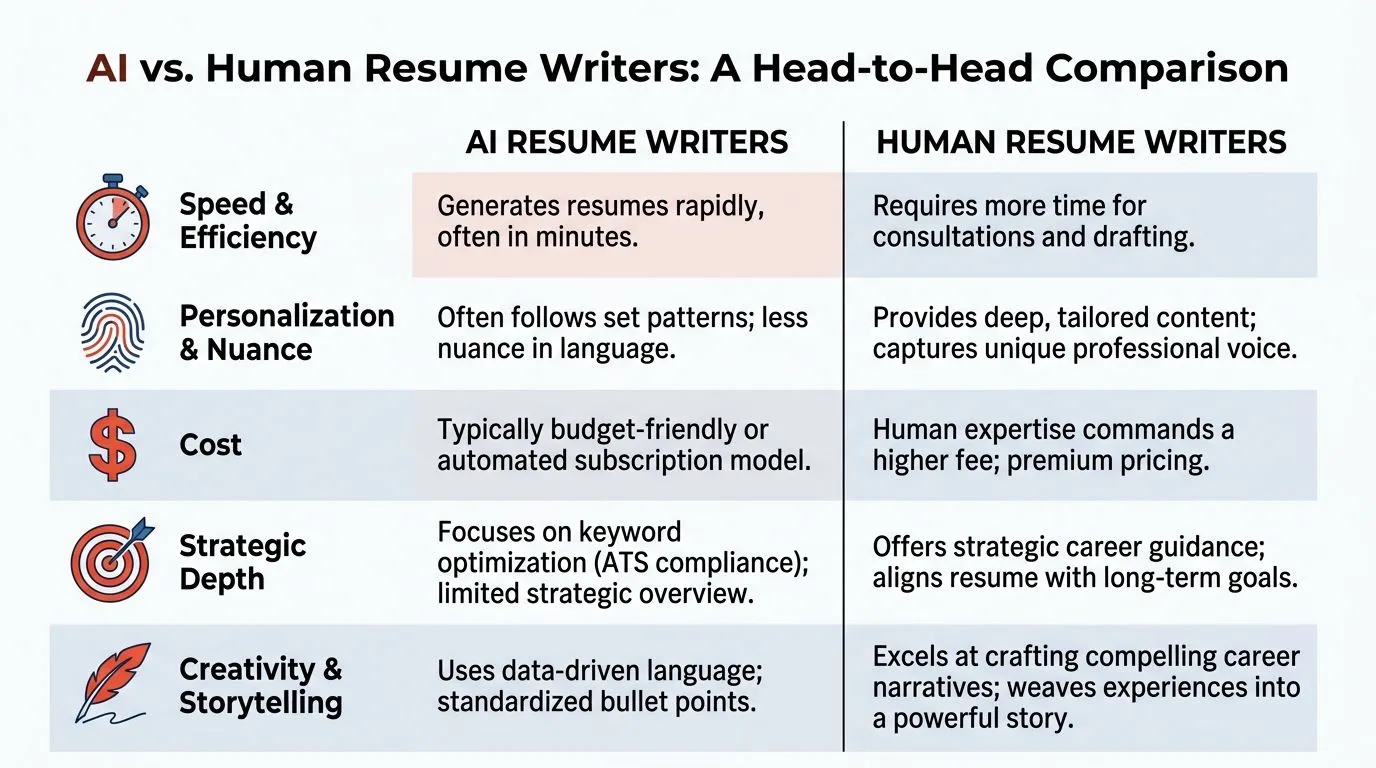
Quality and personalization
AI can rewrite. Humans can interpret.
That’s the whole game.
AI is good at making rough content cleaner. It’s bad at deciding which part of your background should carry the narrative. Human writers usually do better because they can ask follow-up questions and notice when your strongest material is buried in a throwaway comment.
| Criterion | AI | Human | Winner |
|---|---|---|---|
| Surface polish | Strong | Strong | Tie |
| Personal voice | Weak to mixed | Stronger | Human |
| Complex career framing | Weak | Strong | Human |
| Iterating multiple versions | Strong | Mixed | AI |
Speed and cost
AI wins this easily.
You can get a draft almost immediately. You can spin up several role-specific versions without paying someone each time. That matters if you’re job searching under pressure.
Human writers are slower and more expensive by design. They trade speed for interpretation.
If your main constraint is time, AI is the practical choice. If your main constraint is clarity, speed won’t save you.
ATS performance
Here’s where people get sloppy. They act like ATS performance is the whole resume.
It isn’t.
Per Scale.jobs on ChatGPT resumes vs human-written resumes, AI builders hit 85% to 95% ATS keyword match rates, but they also produce 23% fewer interview callbacks than human-written resumes because 67% of recruiters can identify and penalize generic tone. The same analysis says hybrid approaches achieve the highest callback rates at 21.5%.
That tells you exactly what matters. ATS compliance gets you through the first gate. Human credibility gets you through the second.
Privacy and data security
This category is less discussed, but it matters.
When you paste your full work history into any platform, you’re trusting that system with salary history, company names, internal projects, and sometimes confidential scope. That risk exists with AI tools and with human services.
The difference is operational. With a human, you’re trusting a person and their process. With AI, you’re trusting a platform and its handling of your data.
The practical takeaway is boring but important:
- Read the privacy policy
- Don’t upload confidential material you can’t defend sharing
- Strip out sensitive internal language before pasting
The story factor
At this point, most resumes live or die.
A great resume doesn’t just say what you did. It helps the reader infer your level, judgment, and relevance. AI usually struggles here because it defaults to pattern matching. Human writers often do better because they can identify the hidden thread across your roles.
There’s also a middle path. If you’re curious how this compares with plain prompting, this breakdown of AI resume writer vs ChatGPT is useful because not all AI workflows fail in the same way.
A useful parallel comes from broader AI evaluation work too. This piece on a novel approach to assessing AI creativity is worth a skim because it highlights a core issue in resume writing as well. Raw generation is not the same thing as contextual originality.
Here’s a quick video version of the debate if you want another angle before deciding.
Bottom line on ai resume writer vs human writer
Use AI when volume, speed, and baseline polish matter most.
Use a human when your value depends on nuance, not just wording.
Use a hybrid when you want both. That’s usually the smartest answer.
Real-World Resume Examples AI vs Human vs StoryCV
Abstract advice is useless here. Let’s use one achievement and write it three ways.
Same candidate. Mid-level Product Manager. Same underlying reality:
- led onboarding improvements
- worked with design and engineering
- reduced friction for new users
- helped activation
That raw material can become three very different bullets.
Example one, generic AI output
This is what cheap AI often produces when the input is thin.
- Optimized user onboarding experience by leveraging cross-functional collaboration, data-driven insights, and strategic product enhancements to improve activation and user engagement.
Looks polished. Says very little.
Problems:
- Keyword-heavy
- No real context
- No clear decision-making
- No concrete sense of ownership
This is the classic AI trap. It sounds competent enough to pass a quick glance, but it doesn’t feel lived-in.
Example two, typical human writer output
A decent human writer usually improves specificity and rhythm.
- Partnered with design and engineering to redesign onboarding, simplifying the new-user journey and improving activation through a more intuitive product experience.
Better. Much more readable.
Still, this version can stay a little safe. It sounds professional, but it could belong to a lot of product managers. It tells me what happened, but not much about the business problem, trade-off, or why this person was effective.
A resume bullet gets stronger when it shows judgment, not just participation.
Example three, StoryCV-style output
Interview-based writing changes the result. Instead of guessing, the system pulls for context first. What was broken? What did you change? What resistance existed? What was your role?
That produces something like this:
- Reworked onboarding after seeing new users stall at setup, aligning design and engineering around a simpler first-session flow that reduced early friction and made activation easier for lower-intent signups.
This one does a few things the other versions miss:
- Starts with a problem
- Shows observation and judgment
- Names cross-functional leadership without bragging
- Sounds like a real person did real work
That difference matters. Recruiters still prefer resumes that feel personalized rather than mass-produced, even though AI can scale aggressively. As noted by Curriculo on AI builders vs human writers vs templates, AI resume builders can generate 50 customized resumes for the cost of one human-written version, and 82% of AI-assisted applicants received interview invitations, but personalized applications still carry more weight when they avoid generic output.
One more example with a career pivot
Raw input:
- Worked in finance
- Moved into edtech ops
- Improved reporting
- Supported decision-making
AI version
- Results-driven professional with transferable skills in data analysis, stakeholder management, and operational excellence across finance and education sectors.
Bad. Generic summary language. Zero signal.
Typical human version
- Transitioned from finance into edtech operations, applying analytical rigor to improve reporting and support more informed business decisions.
Solid. Clean. Understandable.
Story-first version
- Brought finance discipline into edtech operations, tightening reporting and giving leaders a clearer view of where execution was drifting from plan.
That last one has a point of view. It frames the pivot as an asset, not a detour.
That’s the difference customers are paying for, whether they realize it or not.
The Decision Framework When to Use Each Option
You don’t need a philosophical answer. You need a usable one.
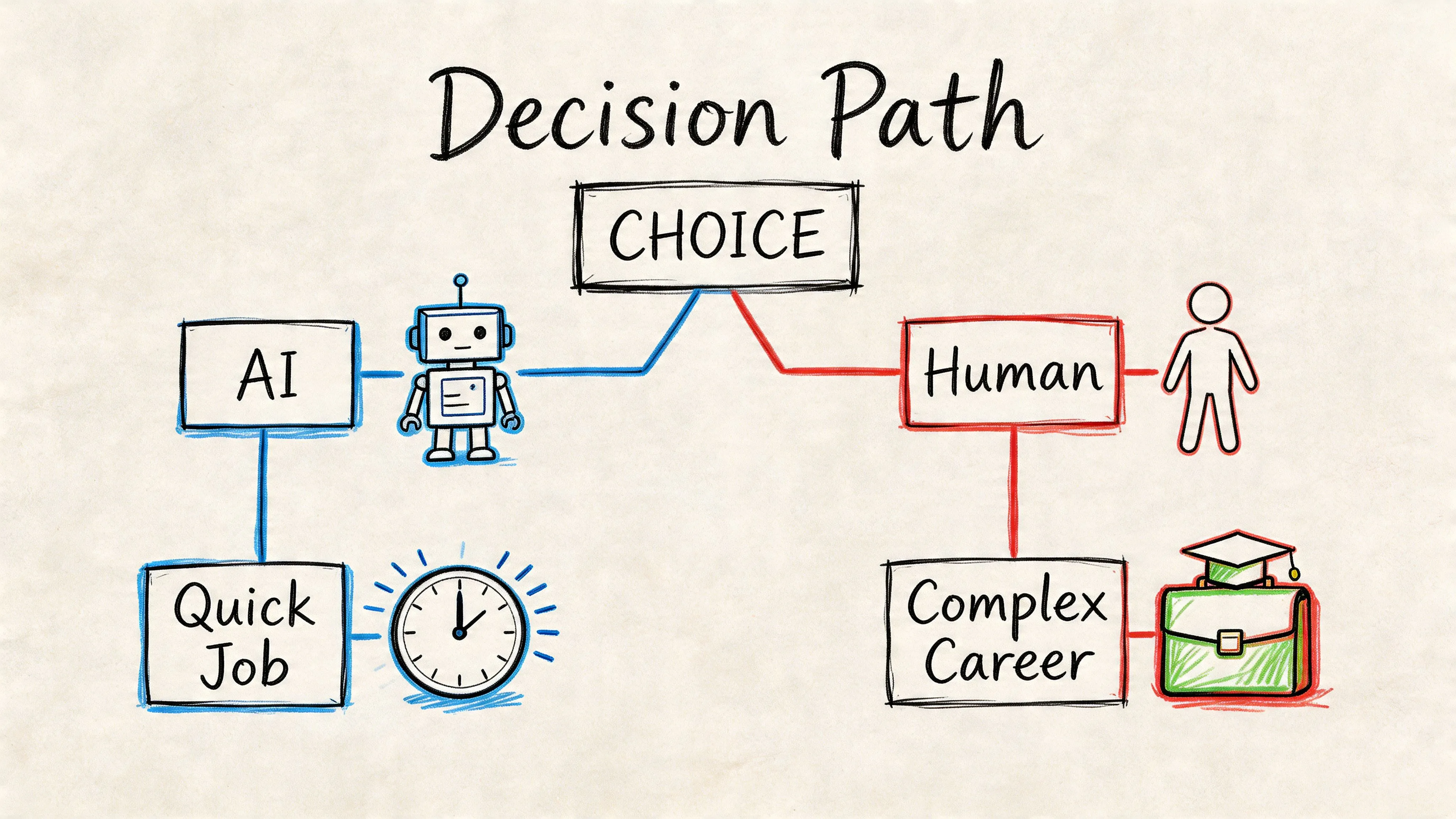
Use a generic AI resume writer when
Go this route if your career path is straightforward and your main problem is speed.
- You need a solid draft now: You were laid off, your resume is old, and you need something functional fast.
- You’re applying across similar roles: Same title family, same industry, similar requirements.
- You can self-edit well: You know when wording sounds fake, inflated, or empty.
- Budget is tight: You need output, not a long consultative process.
Generic AI is fine for baseline production. Just don’t confuse a decent draft with a finished strategy.
Hire a human writer when
Pay for a person when the context is the hard part.
- Your story is messy: Career pivot, gaps, layoffs, mixed titles, consulting work, or broad operational roles.
- You’re targeting senior positions: Leadership resumes need sharper framing around scope, decision-making, and influence.
- You undersell yourself: You keep listing tasks because you struggle to extract impact.
- You want a thinking partner: Not just a writer. Someone who can challenge weak positioning.
This matters even more for groups whose experience needs translation. According to JobSparrow’s cost-benefit analysis, for career changers and military veterans, hybrid approaches that combine AI drafts with targeted human-like review can boost interview rates by an estimated 20% to 30% compared to pure AI.
Choose a digital resume writer when
This is the middle ground often needed.
A digital resume writer makes sense if you want stronger narrative than a generic builder, but you don’t want the cost, wait time, or inconsistency of a traditional writer. That’s where StoryCV fits. It uses a guided interview to pull out context and turn it into a written draft, which is different from a template tool and different from a done-for-you human service.
That model fits well if:
1. You’ve done strong work but explain it badly
2. You want editorial judgment without booking calls
3. You need role-specific clarity, not just prettier formatting
4. You’re stuck between DIY effort and premium human fees
If you’re comparing budget-conscious options more broadly, this guide to affordable resume writing services is a useful reference point.
The right choice depends less on the document and more on how much interpretation your career needs.
When not to use StoryCV
Be honest about fit.
Don’t use it if:
- You need an academic CV with publication-heavy formatting and discipline-specific conventions
- You’re a C-suite candidate who needs deep executive branding, board-level positioning, or niche industry networking support
- You want someone else to run the entire process with live consultation, custom outreach strategy, and heavy back-and-forth
- You already have a sharp story and only need light cosmetic edits
In those cases, a specialized human service is usually the better call.
Your Resume Is Not the End Goal
A resume is not the win.
The win is getting into the room and being able to defend the story on the page without sounding rehearsed, vague, or surprised by your own claims.
That’s why bad resumes create interview problems even when they get callbacks. The wording sounds polished, but the candidate can’t back it up. Or the resume compresses years of work into generic corporate sludge, so the interview never gets to the interesting part.
Use your resume as an interview prep tool
Don’t just submit it. Stress test it.
Take your top five bullets and ask:
- What problem was I solving
- Why did it matter
- What trade-off did I manage
- What would I say if someone asked how I know this worked
If you can answer those cleanly, your resume is doing its job.
Keep the document honest and alive
Your resume should be a working narrative, not a one-time artifact.
Update it when projects end. Save proof while it’s fresh. Rewrite bullets after big launches, team changes, or role expansions. The more current your raw material is, the less likely you are to rely on generic filler later.
The point is simple. Whether you choose AI, a human, or a hybrid process, the document is only useful if it helps you tell the truth clearly and confidently.
That’s what gets you hired.
If you want a resume that captures your actual impact without forcing you into templates or a slow, expensive writer process, StoryCV is built for that middle ground. It uses a guided interview to help turn your experience into a sharper, more credible narrative at software speed.