Most rezi vs storycv comparisons make the same mistake. They compare features like you're shopping for a toaster.
That's the wrong frame.
You're not picking a resume tool. You're picking a job search strategy. One strategy says your main job is to satisfy software. The other says your main job is to make a human care. Both matter. But they are not the same thing, and pretending they are leads people into dumb decisions.
If your resume already has substance and you just need cleaner ATS alignment, one kind of product wins. If your resume looks fine but says almost nothing memorable about your actual value, a different kind wins. Also, your resume doesn't live alone. Recruiters and hiring managers often check your broader presence too, which is why it helps to understand what employers see when they Google you before you obsess over one more keyword.
Your Resume Doesn't Need Another Tool It Needs a Philosophy
The bad advice goes like this: pick the tool with the most templates, the nicest UI, or the longest feature list.
No. That's shopping by surface area.
A resume fails for two very different reasons. First, it doesn't survive the filter. Second, it survives the filter and still doesn't persuade anyone. Those are separate problems. A lot of people treat them like one.
Two resumes can both be polished and still fail
You can have a beautifully formatted resume that says nothing. You can also have a keyword-heavy resume that reads like it was assembled by a nervous robot. Neither gets interviews consistently.
That's why rezi vs storycv is worth discussing at the philosophy level, not the checklist level. These products solve different failures.
| Question | Rezi | StoryCV |
|---|---|---|
| Core philosophy | Machine optimization | Human-centered writing |
| Main problem it tackles | ATS alignment and formatting | Articulating impact and narrative |
| Best fit | High-volume applicants | Mid-to-senior professionals with real experience but weak phrasing |
| Workflow | Score-driven building | Guided interview and writing |
| Best outcome | Faster tailoring | Stronger positioning |
The best resume tool is the one that solves your actual bottleneck, not the one with the loudest feature page.
Stop asking which tool is better
Ask which problem is killing your applications.
If you're getting ignored because your resume is messy, generic, or poorly matched to job descriptions, optimization matters. If you're getting ignored because your bullets are lifeless and your value is buried under vague corporate sludge, storytelling matters more.
Most professionals with a few solid years of experience don't have a formatting problem. They have an articulation problem. They did meaningful work. They just don't know how to write it without sounding flat.
The Machine Hacker vs The Digital Writer
Every resume product ends up serving one of two camps.
One camp tries to beat the machine. The other tries to convince the human.
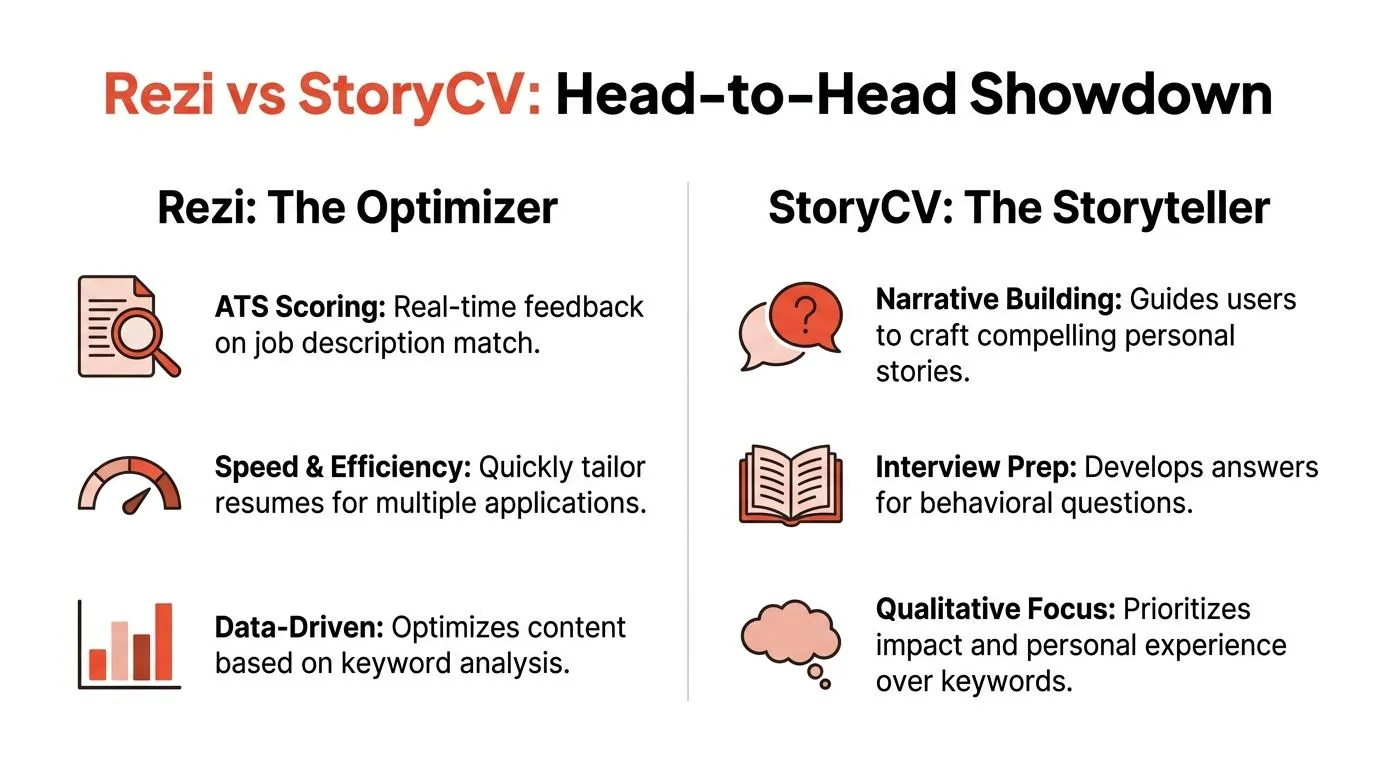
Rezi sits firmly in the first camp. It treats the resume as a matching problem. You feed in your background, compare it against a role, and tune the document for stronger ATS fit.
StoryCV sits in the second camp. It treats the resume as a writing problem. You probably have enough experience already. The issue is that your current bullets undersell it, flatten it, or strip out the context that makes the work matter.
The machine hacker mindset
This mindset isn't stupid. It's practical.
A lot of applications never get serious human attention. Rezi leans into that reality. It focuses on keyword matching, structure, and measurable alignment. In practice, that means your resume becomes something closer to a system to optimize.
That works best when speed matters, volume matters, and your background maps pretty clearly to the jobs you're targeting.
The digital writer mindset
This one starts with a different assumption. The biggest problem isn't lack of keywords. It's weak expression.
A lot of capable professionals write bullets like this:
- Generic task list: Managed cross-functional projects
- Soft claim: Worked with stakeholders to improve processes
- Flat output: Built internal tools for team efficiency
None of these are false. They're just dead on arrival.
StoryCV's approach is built around extracting what happened, why it mattered, and how to say it in a way a person remembers. That's a different category of help. It's less about playing the application game harder and more about saying something worth reading.
If your resume already says strong things, optimize it. If it doesn't, optimization just sharpens weak material.
Why this split matters
People waste time because they buy a machine optimizer when they need editorial help. Or they buy a storytelling product when they really just need to crank out customized applications.
That's the core of rezi vs storycv. Not features. Not branding. Not who has a cleaner dashboard.
It's this: Are you trying to pass screening, or are you trying to express value?
Rezi The ATS Optimization Engine
Rezi is what you use when the problem is execution. You already have decent material. You need a system that forces alignment, cleans up structure, and helps you tailor fast.
That philosophy matters.
Rezi does not try to pull your best stories out of you. It assumes you already know the story and need help packaging it for screening software and fast-moving recruiters. The product revolves around optimization signals, resume scoring, and job-description matching. If your bottleneck is formatting, targeting, or volume, that approach works.

What using Rezi feels like
Using Rezi feels mechanical in a good way.
You paste in a target role. You compare your resume against the job description. The system points out missing skills, keyword gaps, and places where your wording is too loose or too generic. It also pushes cleaner formatting choices, including spacing, margins, and font consistency. That sounds boring. It is. It also matters.
This setup fits candidates who already think in deliverables, metrics, and role alignment. Product managers. Engineers. Operations people. Anyone applying into environments where recruiters scan fast and expect obvious relevance.
Where Rezi is strong
Rezi turns resume writing into a process instead of a vague self-expression exercise. That is its edge.
If you're applying to a lot of roles, that matters. If you already have solid bullets and just need sharper targeting, it matters even more. Rezi keeps you from sending the same sleepy resume everywhere and pretending that counts as tailoring.
Its strengths are pretty clear:
- Immediate direction: You get feedback while editing, not after you've guessed wrong.
- ATS-centered structure: Layout and wording are treated like screening variables because they are.
- Faster iteration: Once your base resume is decent, adapting it gets much quicker.
- Strong fit for technical and execution-heavy roles: The tool rewards concrete language, specific skills, and direct relevance.
If you want broader context on ATS-focused products, this roundup of AI resume tools for the tech industry is a useful comparison point.
Where Rezi falls short
Rezi can train people into bad habits.
Scoring systems always do. Once a tool rewards match signals hard enough, users start writing for the score instead of the reader. The result is predictable. Repetition. Bloated phrasing. Keyword stuffing dressed up as strategy.
That is the limit of machine optimization. It improves alignment. It does not improve judgment.
A weak resume with better keyword coverage is still weak. A vague candidate story with cleaner formatting is still vague. If your real problem is that your experience sounds flat, Rezi will polish the surface and leave the core issue untouched. That is exactly why the bigger Rezi vs StoryCV debate is philosophical. One tool helps you pass filters. The other helps you say something a human might remember.
This is also where ideas from narrative analysis become useful. Screening software looks for patterns and signals. Human readers look for meaning, credibility, and a thread that makes your career make sense. Rezi is built for the first job more than the second.
For a quick look at the product in action, this demo gives a decent feel for the workflow.
StoryCV The Narrative-First Interview
StoryCV starts from a simple idea. Most professionals don't need another blank box. They need better questions.
Instead of opening with a score, it opens with an interview. That changes the whole experience. You're not dragged into formatting decisions first. You're pushed to explain what you did, what changed because of your work, and what context makes the achievement matter.

Why the interview format matters
Mid-career people usually don't struggle because they have no experience. They struggle because they compress good work into bad bullets.
They write things like "led initiatives," "partnered cross-functionally," and "improved operations." That's not communication. That's camouflage.
StoryCV's guided interview methodology is designed to extract context-specific achievements and turn generic bullets into metric-driven, human-readable narratives, as described in this review roundup. The important part isn't the AI label. It's the editorial behavior. The system forces recall.
It pulls out the details people usually skip
A decent interview process works a lot like good qualitative research. It keeps probing until vague language breaks and specific evidence shows up. If you're curious why that matters, this explainer on narrative analysis gives useful background on how meaning emerges from context, sequence, and framing rather than isolated facts.
That shows up clearly in resume writing.
Compare these two versions:
- Before: Built internal tools
- After: Built internal debugging tooling cutting tracing time for failed jobs
The second version gives a human reader something to picture. It has purpose. It has consequence. It sounds like work someone did.
Where this approach shines
StoryCV is strongest for people whose careers contain nuance.
That includes professionals with several years of experience, career changers who need to reframe transferable work, and senior candidates whose value lives in decisions, influence, and complexity more than in obvious keywords.
Its approach also fits people who hate resume builders because resume builders often reduce everything to field completion. That's fine for data entry. It's lousy for judgment.
Good resume writing isn't about filling boxes faster. It's about surfacing the parts of your experience that other people will actually care about.
This isn't the right approach if all you need is a clean document by tonight. But if your current resume "looks fine but feels empty," the interview model goes after the underlying problem.
Rezi vs StoryCV A Head-to-Head Showdown
Resume comparisons usually fail for one reason. They compare features instead of worldview.
That misses the point.
Rezi and StoryCV are solving different problems. Rezi assumes your resume is mostly there and needs better translation for hiring systems. StoryCV assumes the bigger issue is that your experience is under-explained, flattened, or buried under generic wording. One tool optimizes signals. The other extracts meaning.
Workflow
The starting point shapes everything that follows.
Rezi begins with the job description. StoryCV begins with you. That sounds subtle. It isn't. It changes how you think, what the tool asks for, and what kind of draft you get back.
| Criteria | Rezi | StoryCV |
|---|---|---|
| Starting point | Job description match | Guided conversation |
| User posture | Tuning and adjusting | Reflecting and articulating |
| Best for | Clear target roles and repeat applications | Ambiguous achievements and underwritten experience |
| Friction point | Can push users into over-optimizing | Can feel slower if you only want formatting |
Rezi asks, "How do we improve the match?"
StoryCV asks, "What did you do, and why did it matter?"
That difference is the whole story.
If your problem is formatting, targeting, and iteration speed, Rezi fits. If your problem is that your resume sounds like a tax form, StoryCV is the better bet.
Content quality
At this point, the split gets obvious.
Rezi usually gives you tighter language for a role. Useful. Efficient. Sometimes flat. If the raw material is vague, the output can still sound like polished filler.
StoryCV attacks the raw material itself. It pushes for context, consequence, and specifics that a hiring manager can picture.
Here is the same rough input from a mid-level operations candidate.
Raw input: Worked on internal process improvement and helped teams solve workflow issues.
Rezi-style output:
- Improved operational workflows across cross-functional teams
- Supported process improvement initiatives to increase efficiency
- Collaborated with stakeholders to streamline internal operations
StoryCV-style output:
- Reworked an internal workflow that had slowed handoffs between teams, making routine coordination easier and reducing day-to-day friction
- Identified recurring process breakdowns, then helped teams standardize how work moved from one function to the next
- Turned a vague "process improvement" responsibility into visible operational fixes that people used
The Rezi version is cleaner than the input. The StoryCV version sounds like a person describing real work. That matters because hiring managers do not interview bullet points. They interview implied judgment, ownership, and impact.
ATS compatibility
Candidates get this wrong all the time.
Narrative writing does not automatically hurt ATS performance. Bad structure hurts ATS performance. Keyword stuffing hurts credibility. Those are different problems.
Rezi is the more aggressive ATS tool. It is built for matching, scanning, and revising around role language. That makes it strong for candidates running targeted, high-volume application cycles and willing to tweak each draft.
StoryCV takes a stricter line on readability. It keeps the resume ATS-safe without turning every bullet into a keyword pile. That is usually the smarter trade for experienced candidates, career changers, and anyone whose value depends on judgment rather than exact phrase matching.
Keyword alignment matters. Mechanical repetition does not persuade anyone.
Customization style
Both tools customize. They just customize for different readers.
Rezi customizes for the filter. It adjusts language, emphasis, and structure around the target job. StoryCV customizes for the human on the other side. It sharpens what was difficult, what changed because of your work, and what your role involved.
Here is a product manager example.
Raw input: Led product work for internal reporting.
Rezi-style output:
- Led product development for internal reporting solutions
- Managed reporting feature enhancements across stakeholders
- Drove reporting initiatives aligned with business needs
StoryCV-style output:
- Led an internal reporting product effort that gave teams clearer visibility into performance and reduced time spent chasing updates
- Worked across stakeholders to define what reporting was needed, then translated those needs into a product teams could use without extra explanation
- Turned reporting from a recurring complaint into a more reliable operating tool
One version is optimized for pattern matching. The other is optimized for human trust.
Pick the one that fixes your actual bottleneck.
Speed versus depth
Rezi is faster for churn. StoryCV is better for substance.
That is the trade.
If you are applying to many similar roles and already have strong material, Rezi helps you move. If you are stuck with a resume that looks acceptable but says very little, StoryCV earns the extra time by producing bullets with actual weight.
People obsess over speed and ignore what speed produces. Fast edits to weak source material still give you a weak resume.
Who each product makes more effective
Rezi works best for candidates who already know their target, already have decent bullets, and need a machine-aware system to tighten fit.
StoryCV works best for candidates whose experience keeps getting reduced to bland task language. That includes career changers, experienced operators, and senior professionals whose value sits in decisions, cross-functional influence, and messy real-world outcomes.
Here is the blunt version:
- Rezi helps strong applicants tailor faster
- StoryCV helps underwritten applicants sound credible
- Rezi is better when the problem is fit signaling
- StoryCV is better when the problem is meaning
- Rezi rewards disciplined editing
- StoryCV rewards honest recall
Neither tool wins by default. Your diagnosis decides the winner.
Choose Rezi if your resume already says something useful and you need cleaner alignment. Choose StoryCV if the document is technically fine but dead on arrival.
The Real Cost Pricing Plans and Your Time
Price is the bait. Time is the bill.
People compare resume tools like they are buying storage space. They are not. They are buying a way of working. That is the whole point of this Rezi vs StoryCV split. One tool helps you beat a system faster. The other helps you say something worth reading.
The pricing picture
The monthly gap is small. Rezi Pro sits below StoryCV's Full Story tier. StoryCV also gives you one fully written job role on the free plan. Rezi offers a lifetime option, which makes sense for people who revise often and want a one-time purchase.
None of that decides the winner.
What decides it is the kind of waste you are trying to remove. If your bottleneck is tailoring, Rezi can save hours. If your bottleneck is weak storytelling, StoryCV can save weeks of half-useful edits, second-guessing, and bland bullets that never get traction.
That is a better filter than price.
Cheap tools get expensive fast
A lower monthly fee means nothing if you spend three extra nights rewriting bullets that still sound generic.
Rezi is cheaper if it solves the right problem. StoryCV is cheaper if it solves the right problem. This is not complicated. Match the tool to the failure point.
Use Rezi when your resume already has substance and you need cleaner targeting. Use StoryCV when your experience is stuck in task language and you need help turning it into proof. If you want the broader logic behind that tradeoff, read this comparison of an AI resume writer vs human-style writing help.
The most expensive resume product is the one that leaves you with a document that still fails to earn interviews.
Your time cost depends on the tool's philosophy
Feature comparisons often miss the plot. Rezi and StoryCV do not just charge differently. They consume your time differently because they are built on different beliefs.
Rezi assumes the raw material is mostly there. Your job is to refine, tailor, score, tweak, and keep pushing toward fit. That can be efficient. It can also turn into score-chasing if your base content is weak.
StoryCV assumes the bigger problem is extraction. You have done better work than your resume shows, and the hard part is getting that value out of your head and onto the page. That takes more reflection upfront, but often cuts down the endless loop of editing a document that says very little.
Here is the cleaner way to judge the cost:
| Hidden cost | Rezi | StoryCV |
|---|---|---|
| Time spent editing | Lower if your bullets are already strong | Lower after the story is clear |
| Time spent figuring out what to say | Still high if your source material is weak | Lower if articulation is the core problem |
| Main risk | Obsessing over optimization | Using a deeper process for a simple resume |
One more blunt point. If your search is blocked by filters, keyword match, and volume, machine-first logic earns its keep. If your search is blocked by a flat, forgettable resume, more optimization is just polishing weak copy.
Formatting problems call for Rezi.
Storytelling problems call for StoryCV.
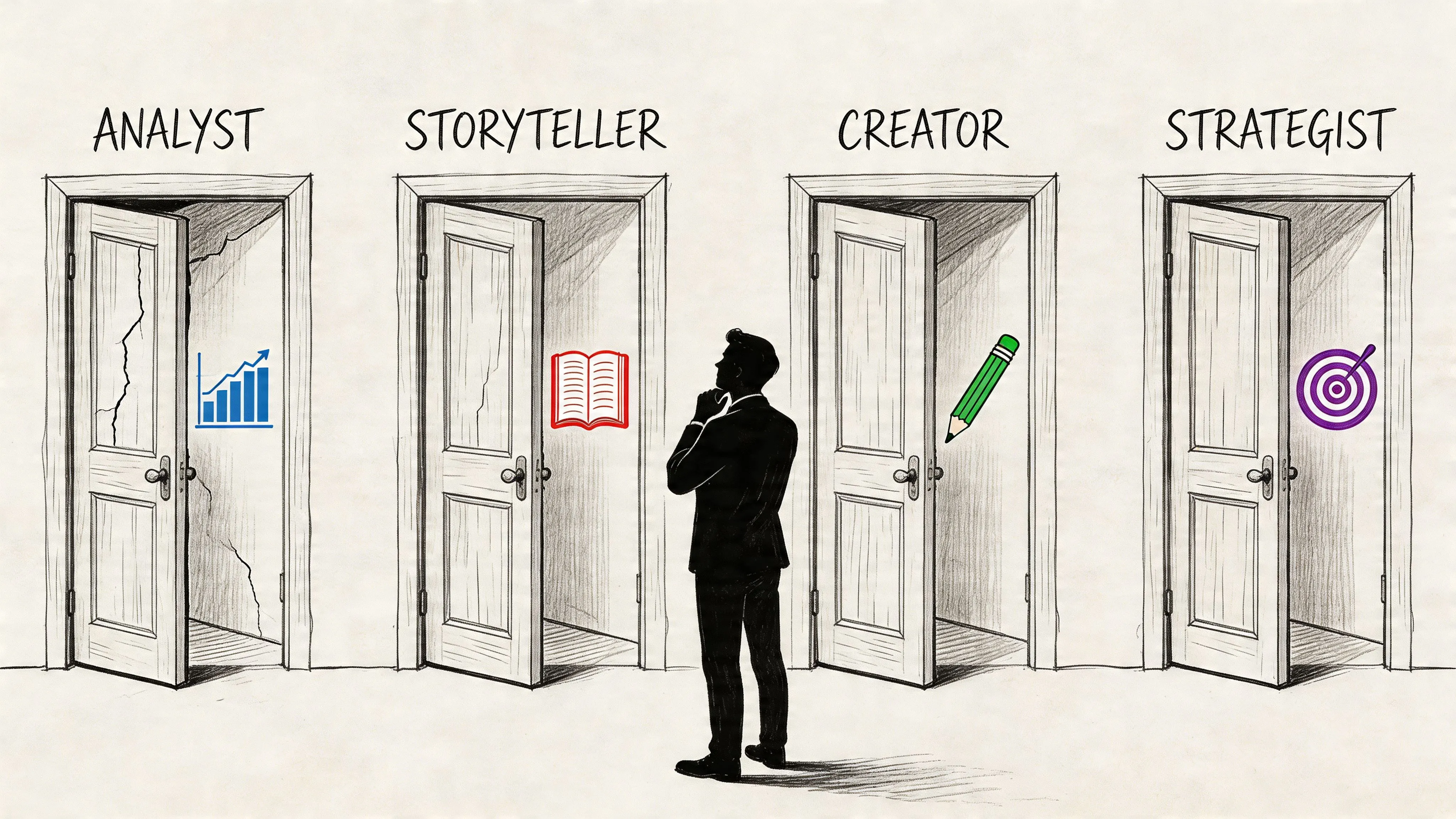
Which Tool Is for You The Right Choice by Persona
This is the only part most readers need.
Not everyone should use the same product. "Best" is lazy language. Fit is what matters.
The volume applicant
Pick Rezi.
You're applying broadly. You need speed. You're probably targeting roles with clear keywords and predictable job descriptions. You don't need a writing partner as much as you need a system that helps you tailor fast and stay ATS-aware.
Typical fit:
- Early-career applicants: You need to move quickly.
- Technical roles: The language map is relatively clear.
- High-volume searchers: You care about efficient targeting more than deep narrative nuance.
The senior professional who undersells themselves
Pick StoryCV.
You've done solid work for years, but your resume reads like a committee wrote it. Your bullets are safe, flat, and bloodless. The problem isn't effort. It's translation.
Interview-based writing helps. It pulls the missing context back into the document.
The career changer
Usually pick StoryCV.
Career changers don't just need to list experience. They need to reinterpret it. That's a writing problem before it's an optimization problem.
If you've done relevant work in a different context, you need a tool that helps you frame skills in a way a new audience understands. This is also the point where comparing an AI resume writer and a human writer becomes useful, because the core issue is judgment, not just generation.
The executive or strategic operator
Pick StoryCV, unless you're doing a quick tactical refresh.
Senior roles are won on framing. Scope. Judgment. Change leadership. Cross-functional influence. None of that fits neatly into checklist writing.
Executives need a coherent career argument, not a pile of role-shaped bullets.
The more senior you are, the less your resume is about tasks and the more it's about narrative control.
When not to use StoryCV
Don't use StoryCV if your need is basic and immediate.
Skip it if:
- You already know exactly what to say: You just need formatting and ATS cleanup.
- You're sending lots of applications fast: You care more about throughput than depth.
- Your current resume has strong substance already: The problem is targeting, not writing.
- You hate reflective workflows: If being asked detailed questions annoys you, you'll fight the process.
Use Rezi in those cases. That's what it's better at.
My blunt recommendation
If you're underwritten, choose the tool that acts like a writer.
If you're under-optimized, choose the tool that acts like a scanner.
Most mid-level and senior professionals think they need more optimization when what they need is stronger language. That's the trap. They keep polishing weak bullets instead of fixing them.
Final Verdict Stop Hacking Start Storytelling
Rezi is good at what it is. If your resume problem is alignment, formatting, and ATS tuning, it's the better fit.
But most experienced professionals don't have a software problem. They have a communication problem. Their resume doesn't sound wrong. It sounds empty. And no score fixes empty.
That's why rezi vs storycv comes down to one hard question. Are you trying to game a screening layer, or are you trying to present a compelling case for why someone should talk to you?
Use Rezi when the challenge is matching.
Use StoryCV when the challenge is meaning.
If your resume already has substance, optimize it. If it doesn't, stop pretending another template will save you. A better-looking document won't rescue weak storytelling. Better writing will.
If your resume looks polished but still doesn't sound like you at your best, try StoryCV. It works like a digital resume writer, not another template builder, and helps turn vague experience into a sharper, more credible career story.