
You’ve done the work. You ran campaigns, fixed funnels, wrote the copy, cleaned the tracking, sat in the meetings, and probably explained attribution to people who didn’t want to hear it. Then you open your resume and it all turns into mush. “Managed digital campaigns.” “Worked on SEO.” “Handled social media.” Dead language.
That’s the core problem with most digital marketer resume example articles. They give you boxes to fill, not thinking to borrow. They show generic bullets with no stakes, no context, no proof. Meanwhile, hiring managers don’t just want activity. They want impact. Resume examples that quantify work with outcomes like traffic growth, lead form gains, lower bounce rate, stronger click rates, and revenue impact consistently stand out because they show what changed, not just what you touched, as shown in these digital marketing resume examples from Resume Worded.
A good digital marketer resume example does two things at once. It proves results, and it explains enough context that the result means something.
That’s what this list is for. Not pretty templates. Actual resume angles for real digital marketing roles, with example bullets you can adapt if you’ve got the receipts to back them up.
1. Content Marketing Manager Resume
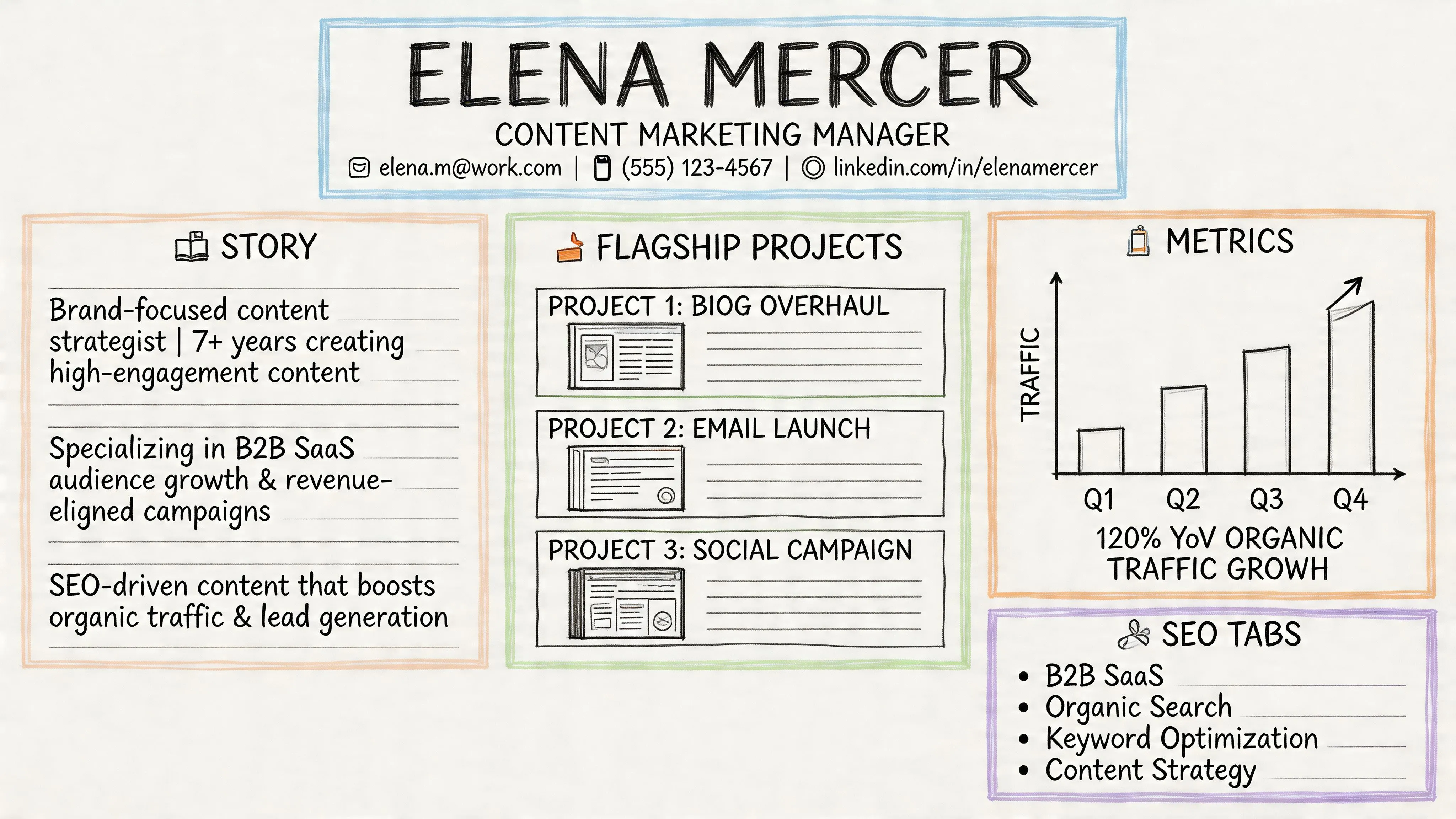
A hiring manager scans your resume for ten seconds and sees “wrote blogs,” “managed content calendar,” and “supported brand awareness.” That reads like a task list, not a business case. A content marketing manager resume needs to show how your content moved someone from attention to action.
Content works like a bridge between audience interest and pipeline. Your resume should make both sides visible. Show your editorial choices, the channels you owned, and the result those choices produced. That is what separates a writer with marketing exposure from a marketer who uses content to drive growth.
What recruiters look for in this role
Strong content marketing resumes usually answer three questions clearly:
- What did you create or manage? Blog program, landing pages, case studies, webinars, email nurture content
- How did you decide what to publish? Search intent, product launches, sales objections, lifecycle stage, conversion data
- What changed because of it? Better traffic quality, stronger engagement, more demo requests, higher form completion, lower bounce rate
That middle piece is where many resumes get weak. “Published weekly content” says output. “Built an editorial calendar around high-intent comparison keywords and customer objection themes” says judgment.
A clearer way to write your bullets
Here is the difference.
Bad bullet:
- Managed blog strategy and wrote articles for brand awareness
Stronger bullet:
- Built an SEO-led editorial calendar around high-intent topics, then worked with design and demand gen to turn priority articles into landing page and email assets
The second bullet gives the reader a working model of how you operate. It shows planning, cross-functional execution, and channel awareness.
A useful test is simple. If your bullet could describe a junior copywriter, a social media coordinator, and a PR intern, it is too broad.
Example content marketing resume bullets
- Led editorial planning: Built monthly content plans based on search intent, product priorities, and sales objections across blog, email, and landing pages
- Improved underperforming pages: Reworked page structure, keyword alignment, and readability on key website pages, helping reduce bounce rate and improve on-page engagement
- Connected content to lead generation: Partnered with demand gen and design to strengthen form-page messaging, refresh content offers, and support higher-quality conversions
- Repurposed efficiently: Turned one core asset, such as a webinar or research post, into email copy, social snippets, and sales enablement content to extend reach without rebuilding from scratch
If you want stronger bullets, list the systems behind your work, not just the outputs. CMS platforms, analytics tools, keyword research tools, content briefs, testing workflows, and collaboration tools all help define your level of ownership. This guide to technical skills to include on a resume can help you describe that stack in a way recruiters can scan quickly.
If you are applying to different kinds of content roles, adjust your examples to match the channel mix in the job description. A B2B SaaS company may care about case studies, nurture content, and product pages. A media brand may care more about publishing cadence, audience growth, and engagement depth. That is why tailoring your resume to the job description matters more than adding another summary line.
2. SEO Specialist Resume
A recruiter opens your resume and sees “performed keyword research,” “improved rankings,” and “worked on technical SEO.” That reads like a tool checklist, not proof of judgment. An SEO specialist resume works better when it shows how you diagnosed a search problem, chose the right fix, and tied the result to traffic quality, conversions, or revenue.
One useful benchmark comes from a digital marketing director resume featured by BeamJobs. It stands out because the bullets connect SEO work to business outcomes, including monthly traffic, funnel improvement, and revenue. That is the standard to study. Hiring managers want to see that you understand where search performance fits inside the full customer journey.
Show how your work changed the outcome
SEO is often invisible when it is written poorly. “Optimized pages” could mean anything from updating title tags to leading a full site architecture cleanup.
A stronger bullet gives the reader a chain they can follow:
- What problem did you spot?
- What did you change?
- What improved after the change?
- Why did the business care?
That structure matters because SEO work rarely lives in one tool. You might use Search Console to find pages losing impressions, Screaming Frog to catch indexation issues, GA4 to check landing-page engagement, and a CMS to ship updates. If your bullets only name the tools, the reader still does not know whether you found a minor issue or solved a meaningful one.
Example SEO resume bullets
- Diagnosed search performance problems: Audited ranking drops, crawl issues, and landing-page behavior using Search Console, GA4, and site crawls, then prioritized fixes based on pages closest to conversion
- Improved technical foundations: Worked with developers on schema markup, internal linking, page speed, and mobile usability updates that supported stronger visibility and a better on-site experience
- Matched pages to intent: Reworked page structure, headings, and copy to align with what users were searching for, helping attract more qualified traffic instead of broader but weaker visits
- Connected SEO to pipeline: Partnered with content, paid media, and web teams to improve landing pages and reduce friction between search entry points and lead capture
Your skills section should support these bullets. It should not carry the whole case by itself. If you know GA4, Search Console, Ahrefs, SEMrush, Screaming Frog, or technical auditing workflows, list them clearly, then show where you used them. This guide to listing technical resume skills clearly and naturally can help you phrase that stack without sounding generic.
A good SEO resume reads like problem solving under constraints. You found weak pages, messy site signals, or mismatched intent, then improved what mattered first. That level of specificity is what separates “knows SEO terms” from “can handle SEO ownership.”
3. Social Media Manager Resume
A hiring manager opens your resume and sees three familiar lines. Managed Instagram, LinkedIn, and Facebook. Created weekly posts. Reported on engagement. That reads like activity, not ownership.
A stronger social media resume shows how you handled attention, tone, and audience behavior at the same time. Social work is part publishing desk, part customer-facing support, and part brand protection. Your bullets should make that mix visible.
What a strong social media resume needs to prove
Good social bullets show motion. They explain how you adjusted content formats, responded to what audiences cared about, and kept the brand voice steady across channels. If your work included community moderation, approval workflows, or rapid response during launches, include that. Those details make the role feel real.
Here is the difference:
Instead of:
- Managed social media accounts for brand channels
Write:
- Shifted channel mix toward short-form video, recurring content series, and creator-style creative, then used engagement trends to refine cadence and topic selection
The second version shows decision-making. It tells the reader you were not just filling a calendar. You were reading signals and changing the plan.
Example social media manager resume bullets
- Adjusted channel strategy: Reworked the content mix around short-form video, repeatable series, and audience-led themes to improve engagement quality and follower growth
- Protected brand voice in public: Managed publishing schedules, comment moderation, approval rounds, and escalation paths during launches and high-visibility campaigns
- Used reporting to guide creative: Reviewed performance by format, hook, topic, and posting window, then turned those patterns into better briefs for design and content teams
- Coordinated with adjacent teams: Partnered with design, product marketing, PR, and lifecycle teams so social campaigns matched broader messaging, including campaigns tied to marketing automation for B2B
What to include besides metrics
Metrics help, but context carries the weight. A line about engagement means more when the reader understands what changed. Did you introduce a new video format? Tighten community response standards? Build a review process that let the brand respond faster without going off-message?
Include details like these when they match your experience:
- Voice consistency: Show that you can keep one brand personality across different platforms and audience expectations
- Community judgment: Mention replies, moderation, escalation handling, or crisis-sensitive moments if you owned them
- Editorial decision-making: Note how you chose content themes, series structure, creator partnerships, or posting cadence
- Cross-functional coordination: Social performance often depends on design assets, campaign timing, product context, and legal or PR review
Social hiring managers know the work can get messy fast. That is why believable specificity matters. A clean metric alone is easy to doubt. A bullet that explains the channel problem, the content shift, and the audience response sounds like someone who has done the job.
4. Marketing Automation Specialist Resume
A hiring manager opens your resume and sees words like workflow, segmentation, lead scoring, and CRM integration. Those terms are familiar, but they do not answer the core question. What changed because you built those systems?
That is the core challenge of an automation resume. The work happens behind the curtain, so your bullets have to make the effect visible.
Marketing automation specialists sit in a role that feels a lot like traffic control. You set the rules, route people to the right next step, and make sure handoffs happen at the right moment. A strong resume shows that you understood the full path, not just the software screen in front of you.
What hiring managers want to see
Platform names matter, but they are only the starting point. Anyone can write “used HubSpot” or “built Marketo workflows.” What stands out is proof that you improved how leads moved through the funnel, how clean the data stayed, or how reliably sales received qualified follow-up.
For example, this bullet is too thin:
- Built nurture flows in HubSpot
This version gives the reader something to picture:
- Reworked nurture logic, audience segmentation, and lead handoff rules so sales received better-context leads and follow-up happened faster
The difference is cause and effect. The first bullet names a task. The second shows a system you shaped.
Example automation resume bullets
- Built lifecycle systems: Created nurture journeys for inbound leads, trial users, onboarding sequences, and re-engagement campaigns across CRM and email tools
- Improved handoff quality: Set lead scoring rules, lifecycle stages, and routing logic so sales reps got clearer intent signals instead of a raw list of form fills
- Cleaned tracking and segmentation: Fixed tagging, list rules, and campaign naming conventions so reporting stayed accurate across channels
- Used behavior data to refine journeys: Reviewed drop-off points, form completion patterns, and email engagement to adjust timing, messaging, and audience paths
- Connected tools across teams: Managed integrations between forms, CRM records, email platforms, and sales alerts so campaigns ran without manual patchwork
If you want stronger bullets, study how to present resume metrics in a way that shows business impact. Automation work often sounds abstract until you tie it to speed, conversion quality, reporting accuracy, or pipeline flow.
B2B experience deserves extra clarity here because hiring managers often care about sales alignment as much as campaign execution. If your background includes MQL definitions, routing logic, or nurture paths tied to account stages, that language maps well to roles centered on marketing automation for B2B.
The goal is simple. Show that you built systems people could trust, and that those systems moved prospects forward instead of leaving them stuck between marketing and sales.
5. PPC/Paid Advertising Manager Resume
A hiring manager opens two paid media resumes. The first says, “Managed Google Ads campaigns.” The second says, “Restructured account groups, tightened search terms, cut wasted spend, and improved lead quality by matching ads to landing pages.” One sounds like dashboard access. The other sounds like ownership.
That difference matters in PPC because money moves fast. A good resume needs to show that you can control spend, read signals early, and make changes before performance slips. Hiring teams are not only scanning for platform names. They want proof that you understand the machine behind the dashboard: bids, query intent, audience quality, creative fatigue, and landing page fit.
What strong PPC bullets usually show
Start with the operating problem you handled, then name the action, then the business result.
- Handled account complexity: Managed search or paid social programs across multiple campaigns, regions, products, or audience segments
- Reduced wasted spend: Reviewed search terms, placement quality, audience exclusions, and bid adjustments to cut traffic that was unlikely to convert
- Improved conversion path quality: Matched keyword intent and ad messaging to landing page content so clicks had a better chance of turning into leads or sales
- Ran disciplined testing: Compared copy, creative, offers, and landing pages with a clear testing structure instead of changing everything at once
- Protected unit economics: Watched cost per acquisition alongside lead quality, close rate, or customer value rather than treating cheap clicks as a win
That last point gets skipped in many resumes. It should not. Paid traffic can look efficient at the ad-platform level and still be expensive for the business if those leads do not turn into revenue.
A simple way to strengthen weak PPC bullets
Weak bullet:
- Managed Google Ads for lead generation
Stronger bullet:
- Managed paid search campaigns for lead generation, refined bidding and keyword targeting based on conversion trends, and improved alignment between ad copy and landing pages to raise lead quality
Notice what changed. The stronger version gives the reader a process. It shows what you paid attention to and how you made decisions. That is often more persuasive than dropping a tool name and hoping the brand carries the bullet.
If you want better phrasing, study examples of resume metrics that show business impact clearly. PPC resumes get stronger when they connect spend decisions to efficiency, lead quality, pipeline contribution, or revenue.
A paid media resume should sound like someone who knows where budget gets wasted, how to spot it, and what to change first.
6. Email Marketing Specialist Resume
A hiring manager opens two resumes for an email role. Both say “built campaigns” and “improved engagement.” Only one gives enough detail to trust the person behind the work.
That is the challenge with email marketing resumes. Email looks simple from the outside because everyone receives it. The actual job is closer to running a system with many moving parts. You are choosing who gets which message, in what order, under what conditions, and with what checks in place so the campaign reaches the inbox and works on the screen.
Your resume should make that system visible. Show how you influenced reader behavior, how you handled audience logic, and how you reduced common failure points before launch.
Example email resume bullets
- Improved click behavior: Redesigned email templates with clearer content hierarchy, stronger calls to action, and better visual support, leading to a clear lift in click rate
- Built segmented sends: Created campaigns by lifecycle stage, recent behavior, and offer fit so subscribers received messages that matched their context
- Owned campaign QA: Checked links, personalization rules, rendering across devices, and mobile layout before launch to catch mistakes that can hurt performance fast
What strong email resumes usually include
A strong email bullet often works like a mini workflow. It names the audience, the change, and the outcome. That matters because email results rarely come from one line of copy alone. A click rate increase might come from better segmentation, cleaner template structure, a more relevant offer, or fewer distractions in the layout.
Three details tend to separate stronger resumes from generic ones:
- Lifecycle coverage: Welcome, nurture, onboarding, upsell, and win-back campaigns show that you understand how email supports different business goals
- Decision-making signals: Subject line testing, click map reviews, send-time observations, and list segmentation show how you diagnosed performance
- Operational care: QA, deliverability checks, suppression logic, and mobile rendering show that you can protect performance before problems reach customers
Business model matters here too.
An ecommerce email specialist may highlight promotional calendars, abandoned cart flows, and repeat purchase campaigns. A SaaS email specialist may focus on onboarding, activation, product education, and renewal support. A B2B nurture specialist often needs to show handoff awareness, such as how email engagement connected to demo interest or sales readiness.
That kind of specificity helps a resume feel real. It tells the reader you understand email as a channel with rules, not just as a place to write copy.
7. Growth Marketing Manager Resume
You launch a new signup flow on Monday. By Friday, signups are up, activation is flat, and paid acquisition looks better only because low-intent traffic increased. That is growth work in real life. A strong growth marketing resume should show that you can sort through that kind of messy signal and make a better decision.
Polish alone does not help much here. Hiring managers want proof that you can run experiments, judge result quality, and separate activity from progress. Growth is less about claiming wins and more about showing how you tested a system.
What growth bullets should reveal
The strongest bullets read like short case studies. They usually make four things clear:
- The constraint: Slow activation, weak conversion between steps, high CAC, poor retention, or unclear channel efficiency
- The test: A pricing page change, onboarding experiment, referral prompt, signup form revision, audience segment, or channel mix adjustment
- The learning: Which friction point mattered, which user group responded, or which metric looked good at first but failed later
- The business result: Better activation quality, lower acquisition cost, stronger retention, or a process the team could repeat
That structure matters because growth roles sit between channels, product, and revenue. A bullet that says “increased conversions” leaves too much unanswered. Increased which conversion. For whom. At what cost. And did those users stay.
Example bullets:
- Tested full-funnel growth ideas: Ran experiments across landing pages, signup flows, referral prompts, and lead magnets to find higher-quality acquisition paths
- Measured quality, not just volume: Tracked activation and retention after signup so channel tests were judged on downstream performance, not raw lead count
- Turned experiments into operating process: Documented winning tests, rollout conditions, and failure patterns so paid, lifecycle, and product teams could reuse what worked
Growth resumes get stronger when they show restraint, too.
For example, “grew signups by 22%” sounds useful until a hiring manager wonders whether those users activated. A better bullet would say that you simplified the signup flow, increased completed registrations, then checked week-one activation before expanding the change. That extra sentence shows judgment. Many resumes skip it, even though it is often the difference between surface growth and durable growth.
A good rule is simple. Write each bullet so the reader can see your hypothesis, your method, and your standard for success. Growth marketers are hired to turn uncertainty into evidence.
8. Analytics/Marketing Data Specialist Resume
A hiring manager opens your resume and sees GA4, SQL, Looker Studio, attribution, and event tracking. Good start. Then they ask the question that decides whether you get an interview. What changed because of your analysis?
That is the standard for this role.
Analytics and marketing data specialists are not hired just to collect numbers. They are hired to make messy performance data usable for marketers, leaders, and channel owners who need to choose what to cut, what to scale, and what to fix. A strong resume makes that chain visible. It shows the tracking problem, the analysis, and the business decision that followed.
One useful way to write these bullets is to treat your work like instrumentation on a dashboard in a car. The gauges matter because they help the driver act in time. In the same way, your dashboard, tagging plan, or attribution model matters because someone used it to change budget, improve campaign setup, or spot a reporting error before it spread.
This video gives a practical look at how marketers present analytical thinking clearly:
Example analytics resume bullets
- Built reporting people could act on: Created dashboards for channel leads that clarified traffic quality, conversion paths, and drop-off points across campaigns
- Cleaned up measurement at the source: Audited event naming, UTM tagging, and attribution rules so reports reflected real user behavior instead of setup mistakes
- Connected analysis to marketing decisions: Reviewed content and social performance, identified which topics and formats were gaining traction, and helped the team adjust distribution and editorial priorities
The strongest analytics resumes add one detail many candidates skip
They show translation.
If you taught marketers how to read assisted conversions, explained why last-click reporting was distorting paid social performance, or helped leadership understand why a dashboard changed after a tracking fix, put that on the page. Companies rarely need another person who can export charts. They need someone who can prevent bad decisions caused by misunderstood data.
That point is easy to miss. Technical skill gets attention, but explanation builds trust. On an analytics resume, trust often comes from simple details such as who used your reporting, what confusion you cleared up, and what changed after the team understood the numbers correctly.
8-Role Digital Marketer Resume Comparison
| Role | 🔄 Complexity | ⚡ Resources & Efficiency | 📊 Expected Outcomes | 💡 Ideal Use Cases | ⭐ Key Advantages |
|---|---|---|---|---|---|
| Content Marketing Manager Resume | Moderate, narrative + metrics balance, ATS-aware | Moderate resources (CMS, analytics, portfolio); moderate execution speed | Audience growth, engagement, leads, campaign ROI | Inbound/content-driven brands, editorial strategy, thought leadership | Balances creative storytelling with measurable business impact |
| SEO Specialist Resume | High, technical audits, ongoing optimization | High resources (SEO tools, technical fixes); slower sustainable gains | Improved rankings, organic traffic, revenue from search | Sites needing organic scale, e‑commerce, technical SEO remediation | Clear, quantifiable technical wins and long-term ROI |
| Social Media Manager Resume | Moderate, creative, real‑time community work | Low–Moderate resources (content creation, platform tools); fast iteration | Follower growth, engagement rates, brand voice consistency | Brand awareness, community building, trend-driven campaigns | Shows personality and measurable engagement metrics |
| Marketing Automation Specialist Resume | High, platform setups, integrations, workflows | High resources (automation platforms, CRM, integrations); high efficiency after setup | Increased MQLs, improved lead nurturing, revenue uplift | B2B SaaS, sales-marketing alignment, scalable lifecycle programs | Direct impact on funnel efficiency and revenue conversion |
| PPC/Paid Advertising Manager Resume | Moderate, tactical optimization and testing | High resources (ad spend, bidding tools); fast, measurable results | ROAS, CPA, conversion uplift, scalable revenue | Performance-driven acquisition, e‑commerce, rapid scaling | Highly quantifiable results with clear revenue attribution |
| Email Marketing Specialist Resume | Moderate, copy, segmentation, deliverability work | Moderate resources (ESP, lists); high ROI per effort | Revenue per email, open/CTR improvements, retention lift | Retention, monetization, lifecycle & nurture campaigns | Strong direct revenue attribution and high ROI potential |
| Growth Marketing Manager Resume | High, cross‑functional experiments and scaling | Variable resources; requires cross-team support; rapid testing cadence | Rapid user/acquisition growth, reduced CAC, retention gains | Startups, PLG, rapid-scaling initiatives, experimentation cultures | Experimental, data-driven approach to scalable growth |
| Analytics/Marketing Data Specialist Resume | High, data engineering, modeling, visualization | High resources (analytics stack, instrumentation); indirect but high long-term ROI | Improved decision-making, attribution clarity, optimized spend | Data-driven enterprises, attribution projects, strategic reporting | Translates data into strategic insights that improve marketing outcomes |
Final Thoughts
The best digital marketer resume example isn’t the prettiest one. It’s the one that makes your work legible.
That’s the whole game. Not decoration. Translation.
If you’re a content marketer, show the business effect of your editorial choices. If you’re in SEO, connect technical fixes to traffic and revenue. If you run paid campaigns, show scale and judgment. If you own analytics, prove that your insights changed action, not just reporting. Different role, same principle. Your resume should explain what changed because you were there.
There’s another point most articles miss. Metrics alone aren’t enough. A bullet stuffed with numbers but missing context feels cold or inflated. A bullet with only story feels soft. You need both. That’s why narrative-driven bullets matter, especially for mid-level professionals whose work spans channels, stakeholders, and shifting business goals. One verified summary of the gap in current resume advice notes that many resume examples focus on metrics but miss storytelling elements that explain why those metrics matter, especially for career changers and experienced professionals trying to show strategic impact in plain language, as discussed in this Indeed digital marketing specialist resume analysis.
So if your current resume sounds like a task list, don’t tweak it. Rewrite it.
Start with these questions:
- What problem did I walk into?
- What did I change?
- What proof do I have?
- Why would a hiring manager care?
That’s how a real digital marketer resume example gets built. Not from templates. From evidence, judgment, and a bit of backbone.
If you’ve done strong work but hate turning it into resume bullets, StoryCV helps you do the hard part. It writes with editorial judgment, not template logic. You answer smart prompts, it pulls out the context, impact, and language that candidates often leave buried. That means a resume that sounds like you, proves what you’ve done, and gives hiring managers a reason to keep reading.