Your resume isn't a job description. It’s a sales pitch. And bullet points in a resume are the headlines. Recruiters spend seconds, not minutes, deciding if you're worth their time. If your bullets read like a list of chores, you've already lost.
Your Bullet Points Are Costing You Interviews
Let's be direct. The problem isn't your experience. It's how you frame it. Most people just describe their tasks instead of showcasing their impact. This turns a powerful document into a passive list that gets ignored.
The numbers are brutal. In 2024, U.S. small and medium businesses saw an average of ~180 applicants per hire. That's a 182% increase since 2021.
With applicant-to-interview rates stuck around 5%, your resume has to cut through an insane amount of noise. Instantly.
How Recruiters Read Resume Bullet Points
Recruiters don't read resumes; they scan them. They use an "F-pattern," their eyes darting down the left side and then across, hunting for keywords, numbers, and impact verbs. They’re looking for evidence of value, not a list of duties.
A resume is a proxy for what you can do. The content is the proof. Your bullet points are that proof, compressed. They need to show, not just tell.
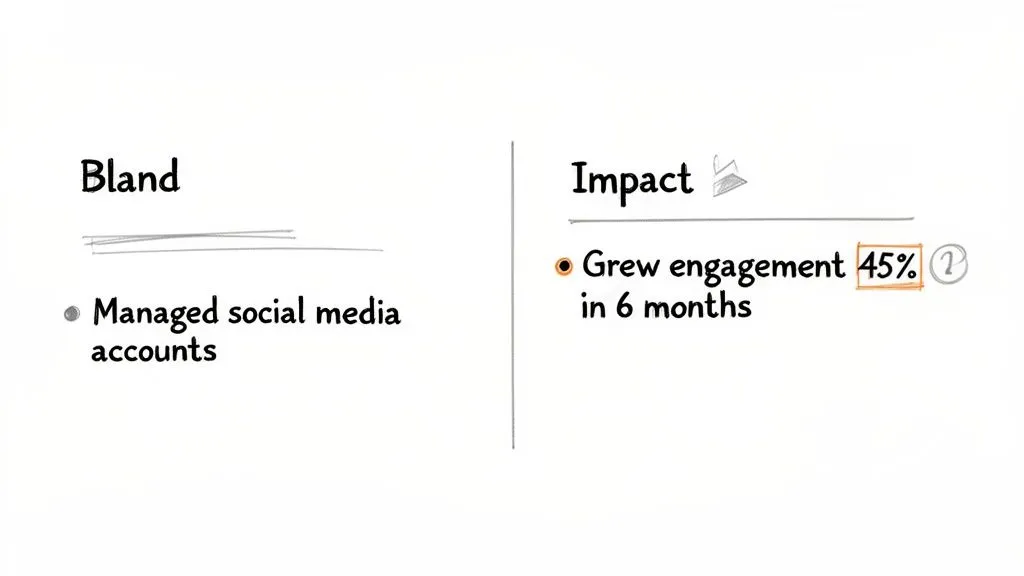
Every bullet point is prime real estate. Wasting it on "Responsible for managing social media accounts" is a huge missed opportunity. A recruiter already assumes you did that—it's in your job title. What they want to know is how well you did it.
Of course, meticulously crafted bullet points are just one piece of the puzzle. Your entire professional image matters. For instance, a recent survey on how recruiters perceive AI headshots reveals just how much scrutiny every detail is under.
Should I Use Bullet Points in My Resume?
Yes. That's it. That's the answer.
Paragraphs belong in novels, not resumes. Handing a recruiter a dense block of text is a fast pass to the trash folder. It’s not just a preference; it’s about how our brains work.
We process lists far more easily than paragraphs. It cuts the mental effort, letting the reader grab what's important instantly. When a recruiter spends six seconds on your resume, scannability isn't a nice-to-have. It's everything.
Think about the difference.
The Paragraph Version:
"In my role as Senior Project Manager, I was responsible for overseeing a cross-functional team of eight developers and designers. I managed the project budget, allocated resources, and created the project timeline. I successfully launched a new mobile application that led to increased user engagement and received positive feedback from stakeholders."
The Bullet Point Version:
* Led a cross-functional team of 8 to launch a new mobile application ahead of schedule.
* Managed a $500K project budget, reallocating resources to save 10% on projected costs.
* Increased user engagement by 25% within three months of the app's launch.
The difference is night and day. The second version is faster to read, makes the numbers pop, and screams results. It’s also far more effective for the first reader of your resume: the Applicant Tracking System (ATS).
The ATS is designed to parse structured information. Bullet points are perfect for this. Paragraphs just confuse the parser, causing it to miss key details. If you want to dive deeper, you can explore how many bullet points per job on your resume is most effective.
Using bullet points is a strategic decision. It shows you respect the reader's time and understand how modern hiring works. It signals you're a clear communicator who gets straight to the point.
Task vs Impact: The Biggest Resume Bullet Point Mistake
This is where most professionals get stuck. They write a list of their job duties, not their accomplishments. It’s the single biggest mistake holding your resume back.
A task is what you did. An impact is what happened because you did it. One is a responsibility; the other is a result. Recruiters don’t care about your responsibilities—they assume you had them. They care about the results you can deliver for them.
Let's break down the difference.
- Weak (Task): "Responsible for weekly sales reporting."
- Strong (Impact): "Delivered weekly sales reports that identified a 15% cost-saving opportunity in Q3."
See the difference? The first one is passive. The second one is active. It shows you created value. This isn't about exaggerating; it's about translating your work into the language of business value.
How to Find Your Impact
You've done great work. The challenge is articulating it. Most people undersell themselves because they don't know how to mine their own experience for measurable outcomes.
Start by asking yourself "so what?" after every task you list.
- "I managed the company blog." -> So what? -> "We got more traffic." -> How much? -> "40% increase in six months."
- "I trained new hires." -> So what? -> "They got up to speed faster." -> How much faster? -> "Reduced ramp-up time by 3 weeks."
This exercise forces you to connect your daily activities to a meaningful business outcome.
This infographic shows why getting this right is non-negotiable for passing both robot and human scans.
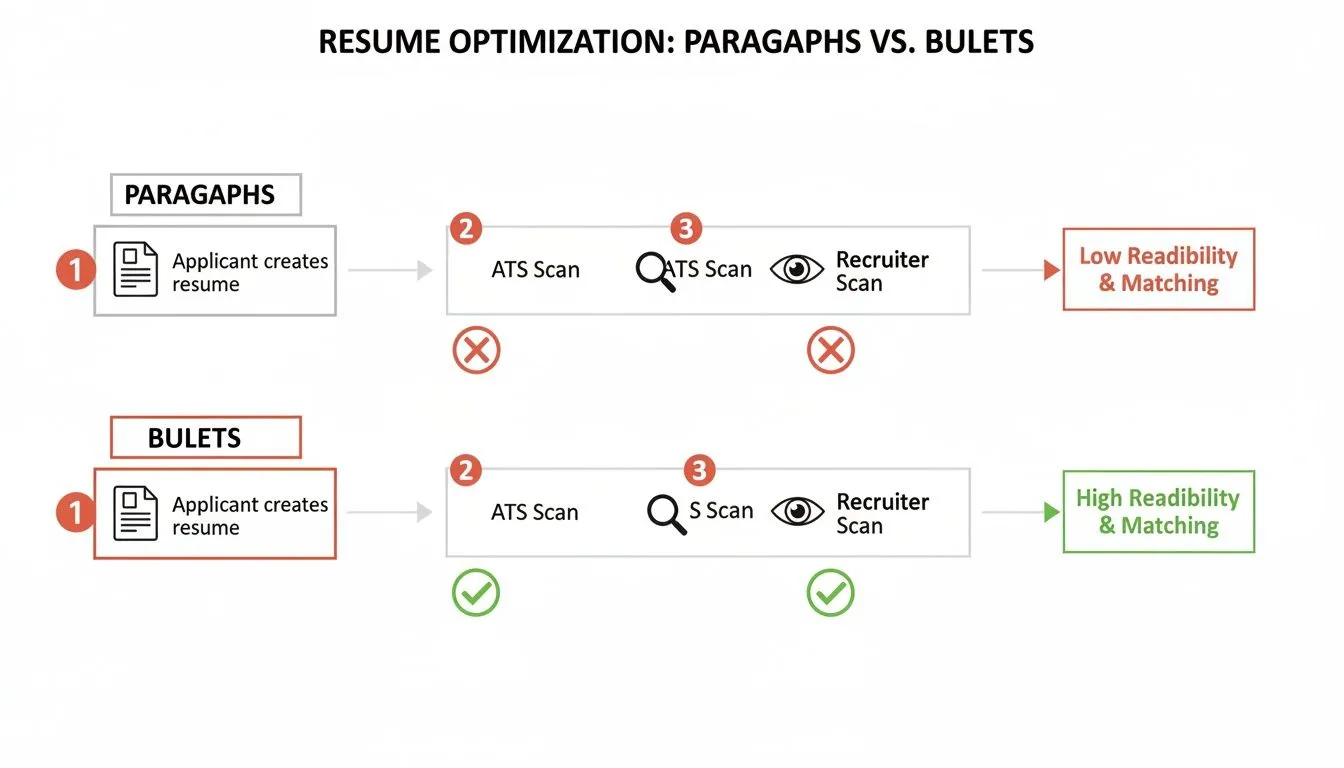
The flowchart makes it clear: paragraphs are a dead end. Well-structured bullet points create a clear path to the recruiter.
The Simple Formula for Powerful Bullet Points
Once you've identified your impact, framing it is easy. Follow this simple formula:
Action Verb + Quantifiable Result + Context
Let’s apply it:
- Action Verb: Optimized
- Quantifiable Result: a 20% reduction in page load time
- Context: by refactoring legacy CSS and compressing images.
Result: "Optimized website performance for a 20% reduction in page load time by refactoring legacy CSS and compressing images."
This structure is a game-changer. It’s direct, powerful, and gives recruiters exactly what they’re scanning for. If you need more help, our guide on how to write achievements in a resume offers more strategies.
Should Resume Bullet Points Be in Past Tense or Present Tense?
This feels confusing, but it’s simpler than you think. There's a straightforward rule that cleans up your timeline and makes your experience instantly clearer.
No need to overthink it. Here’s the deal:
- Past Jobs: Always use the past tense.
- Current Job: Use the present tense for ongoing duties.
It’s just logical. Using past tense verbs like "Managed" or "Developed" for a previous role signals that the work is finished.
For your current job, present tense verbs like "Manage" or "Develop" show what you’re actively doing right now. This isn't just a grammar quirk; it’s a sign you're an organized professional.
The One Exception to the Rule
What about completed projects at your current job? You launched a product three months ago. Should that be in the present tense?
Nope. And this is the one nuance that matters.
For specific, completed accomplishments within your current role, switch to the past tense. This signals a finished project with a concrete result.
This small shift is surprisingly powerful. It separates your day-to-day responsibilities from your standout achievements. More importantly, it draws the recruiter's eye to a finished story with a measurable outcome.
Putting It All Together
Here's an example for a current role.
Current Role: Senior Product Manager | Acme Inc. | 2022 - Present
* Lead a cross-functional team of 12 to define the product roadmap and feature prioritization.
* Analyze user feedback and market trends to identify new opportunities for product growth.
* Launched a new mobile feature in Q1 that increased user engagement by 25%.
* Spearheaded a platform migration project, completing it three weeks ahead of schedule.
See the mix? Ongoing responsibilities ("Lead," "Analyze") are in the present tense. Finished projects ("Launched," "Spearheaded") are in the past tense. This structure gives a recruiter a dynamic view of both your current duties and your proven accomplishments.
Examples of High-Impact Resume Bullet Points
Theory is great, but seeing it in action makes it click. You know the formula—Action Verb + Quantifiable Result + Context. Let's break down some real-world examples. The goal here is to see the pattern so you can frame your own accomplishments with the same impact.
Software Engineer Examples
Engineers often get trapped describing features. Don't. Focus on the performance, stability, or user experience you improved.
- Weak: Worked on the backend API.
-
Strong: Slashed average API latency by 300ms by refactoring legacy code, boosting user satisfaction scores by 15%.
-
Weak: Wrote unit and integration tests.
-
Strong: Boosted backend test coverage from 65% to 92%, catching 40+ critical bugs pre-production.
-
Weak: Collaborated with the product team on new features.
- Strong: Engineered a new real-time data processing feature that let customers generate reports 80% faster.
Marketing Manager Examples
Marketing is a numbers game. Connect your actions back to a tangible business goal.
- Weak: Managed the company’s SEO strategy.
-
Strong: Grew organic search traffic by 40% in 6 months by executing a content strategy targeting high-intent keywords.
-
Weak: Responsible for email marketing campaigns.
-
Strong: Increased email CTR by 25% and generated $150K in attributable revenue by personalizing campaign messaging.
-
Weak: Ran social media advertising.
- Strong: Cut Cost Per Lead (CPL) by 30% while scaling lead volume by 18% on a $50K/month budget.
Operations Lead Examples
Operations is about efficiency. Your bullet points need to quantify that impact.
- Weak: Handled inventory management.
-
Strong: Implemented a new inventory system that cut warehouse processing time by 20% and reduced order errors by 95%.
-
Weak: Coordinated with vendors and suppliers.
-
Strong: Renegotiated contracts with 3 key suppliers, securing 12% cost reductions and saving the company over $200K annually.
-
Weak: Oversaw daily logistics.
- Strong: Redesigned the primary fulfillment workflow, increasing team output by 35% without adding headcount.
Project Manager Examples
Your job is to deliver projects on time and under budget. Your bullet points should be a highlight reel of that.
- Weak: Led project team meetings and tracked tasks.
-
Strong: Delivered a critical platform migration project 3 weeks ahead of schedule and 10% under budget.
-
Weak: Managed project scope and stakeholder communication.
-
Strong: Mitigated scope creep by rolling out a new change request process, keeping the project within its $1.2M budget.
-
Weak: Created project plans and documentation.
- Strong: Guided a cross-functional team of 15 to launch a new product line that captured 8% market share in its first year.
The takeaway: Every bullet point is a mini case study of your value. If it doesn't show a clear, positive outcome, it's just taking up space.
These examples prove writing powerful bullet points in a resume is a learnable skill. It’s about shifting your mindset from tasks to results. For more, explore these practical methods for crafting resume bullet points that get jobs.
A Quick-Edit Checklist to Make Your Bullet Points Ruthless
You’ve written your bullet points. Now it's time to make them count. This is a quick, honest edit to guarantee every line screams value.
Run every bullet through these questions. If the answer is "no," that bullet gets a rewrite or it gets cut. No exceptions.
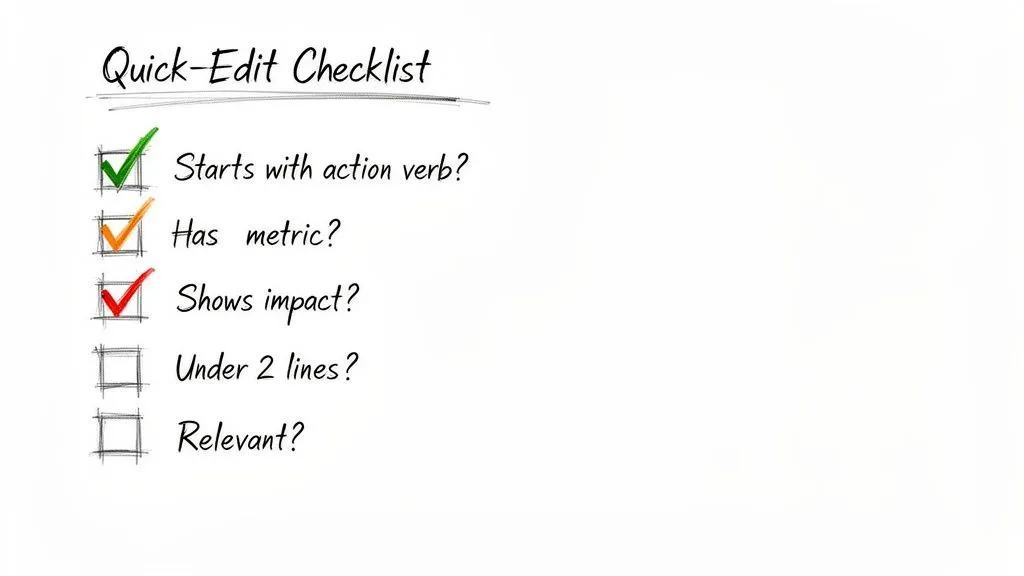
This isn't just tidying up. It's a strategic gut-check to force clarity and impact.
The Six-Point Bullet Audit
Grab your resume. For each bullet, ask yourself:
-
Does It Start With a Strong Action Verb?
Scrap "Responsible for." Lead with a power verb: "Launched," "Engineered," "Slashed." -
Does It Have a Number or Metric?
Numbers communicate scale and impact fast. Add percentages, dollar amounts, or time saved. Even an estimate (~15%) is better than nothing. -
Does It Show Impact, Not Just a Task?
This is the most critical check. Don't just list what you did; explain what happened because of it. Ask yourself, "So what?" -
Is It Under Two Lines Long?
Brevity is your friend. A long bullet gets skipped. Keep your points sharp and direct. For more, check our guide on if resume bullet points should be one line. -
Is It Relevant to the Job You're Applying For?
Every bullet should feel like an answer to a need in the job description. If it doesn't, cut it. -
Is It Written in the Correct Tense?
Easy win. Past jobs get past tense. Current job gets present tense for ongoing duties, past tense for completed projects.
The brutal truth: If a bullet point fails more than one of these checks, it's hurting your resume.
This checklist puts you in the editor's seat. Be ruthless. Trim the fat. What's left will be a sharp, compelling story of your impact.
A Few Final Questions on Bullet Points
Let's clear up some common questions.
How Many Bullet Points Should I Use Per Job?
Aim for 3-6 bullet points for your most relevant roles.
More than six dilutes your best achievements with filler. Less than three makes the role look insignificant. Quality over quantity, always.
How Long Should a Bullet Point Be?
One line is perfect. Never more than two.
A long bullet point is just a paragraph in disguise, and it gets skipped. Your goal is to make each point sharp, direct, and impossible to miss.
If you can't say it in one or two lines, you haven't defined the impact clearly enough. Edit ruthlessly.
What if I Can't Put a Number on My Achievements?
Not every accomplishment has a hard metric. That’s fine. When you can't find a number, focus on the qualitative impact or the scale of your work.
Instead of just stating a task, show the purpose or outcome. Use framing language that demonstrates value:
- "To improve team collaboration..."
- "To streamline the onboarding process..."
- "By launching the company's first-ever..."
So, "Trained new hires" becomes: "Developed a new-hire training program that became the standard for the entire department." You’re still showing impact—initiative, scale, and a lasting result—without needing a specific number.
Struggling to turn your hard work into compelling bullet points? It’s the toughest part of the process. StoryCV is a digital resume writer, not a template. We act like a strategist, interviewing you to pull out these exact achievements and turn your experience into a story that shows recruiters your real impact.
Get your first role written for free at https://story.cv.