The philosophy is simple: Be as short as possible, but no shorter. A two-liner is never a failure of editing, provided every single word is earning its keep.
If a word isn't adding value, it's just baggage. Trim the fat and keep the muscle.
The discipline of the bullet point: why brevity wins
Your resume isn’t your job description. It’s an ad for your best work. Long, rambling bullets are lazy. They read like a list of duties, not a highlight reel of wins.
Keeping it to one line forces you to be ruthless. You have to kill the fluff and get straight to the metric. This discipline makes your achievements pop. But some wins have a story that needs a bit more room to breathe. A second line is perfectly fine, provided it adds weight, not just more words.
It’s the difference between:
-
"Was responsible for managing the quarterly marketing campaign." (Passive. Weak.)
-
The One-Line Win: "Drove 40% QoQ lead growth by launching a targeted marketing campaign." (Active. Sharp.)
-
The Two-Line Power Move: "Drove 40% QoQ lead growth by launching a targeted marketing campaign that synchronized five regional teams and captured $2M in new pipeline." (Context. Scale.)
One line is the default. Two lines is for when the achievement is too big to stay small. If you hit three, you’re just writing a story.
One Line or Two for Bullet Points?
One line is the default. Only consider spilling to a second line if the achievement is a career-defining win that absolutely cannot be split.
When in doubt, choose one line. Brevity is your friend.
| Scenario | Stick to One Line (Your Default) | Consider Two Lines (Rarely) |
|---|---|---|
| Standard Achievement | A clear win with one key outcome (e.g., Increased sales by 15%). | Never. It just adds noise. |
| Complex Project | Focus on the single most impressive metric from the project. | The project had multiple, inseparable outcomes that define the achievement. |
| Technical Work | You improved a system with a clear result (e.g., Cut server costs by 20%). | Explaining the technical "how" is critical to understanding the massive "what." |
| Leadership Impact | You led a team to a specific goal. | You led a major cross-functional initiative with company-wide impact that needs context. |
Why Recruiters and ATS Demand Short Bullets
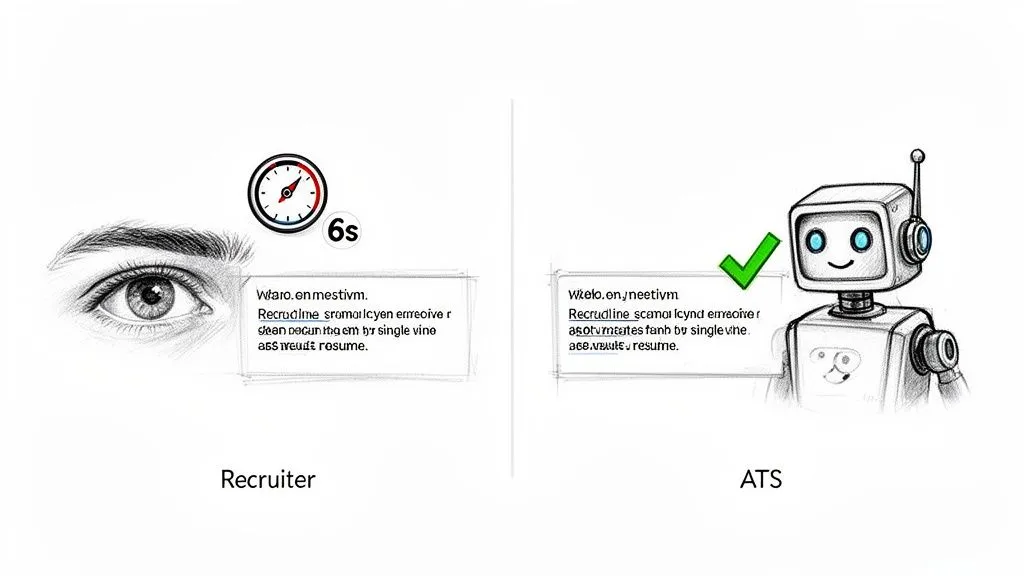
You have two readers: a person and a machine. Neither has any patience for fluff.
The recruiter gives you six seconds. Their eyes are hunting for numbers and keywords. A dense block of text is a visual wall and they’ll just climb over it and move to the next candidate. Short, punchy bullets serve up your value on a silver platter.
Then there's the Applicant Tracking System (ATS). It doesn’t read; it parses. It tries to sort your experience into data fields. Long, complex bullets full of clauses confuse the software. If the machine can’t categorize you, the human will never even see you.
An ATS isn't reading for nuance. It's scanning for data. Confusing bullets cause parsing errors. That can get you rejected before a human even knows you exist.
Optimize for Both Audiences
Smart resume writing is about pleasing both the human and the machine. Short, single-line bullets do just that.
Around 75% of resumes are filtered out by ATS alone. This stat tells you everything. Clean formatting isn’t optional. Your goal is to make your value instantly obvious to anyone, or anything, that scans it. You can see a full breakdown of these resume statistics to understand how critical this is.
-
How to win with both:
-
For the Human: Use one or two lines to create white space. Make your impact scannable.
-
For the Machine: Keep the structure simple. Subject, action, result.
-
Tight bullets force you to focus on the result, not the process. Think of each one as a tiny, powerful headline. Make it count.
Can Resume Bullet Points Be Two Sentences? A Hard No.
Let's get this out of the way. Can resume bullet points be two sentences?
No. Absolutely not.
There’s a difference between a two-line bullet and a two-sentence bullet.
A two-line bullet is often necessary. It gives a big idea the room it needs to land. But two sentences? That’s usually where things fall apart.
When you drop a period in the middle of a bullet, you’re asking the reader to stop, reset, and start a new thought. On a resume, momentum is everything. You want the recruiter’s eyes to slide effortlessly from the action to the result. Two sentences create a speed bump.
Length is about space. Sentences are about focus. You can take up two lines, but keep it to one cohesive thought. If you have a second thing to say, give it its own bullet.
A resume bullet is a headline, not a paragraph. Its job is to deliver one powerful idea, fast. Two sentences create a competing narrative and kill the point.
One Idea, Not Two Sentences
The real question isn’t about length; it’s about focus. The issue isn't multiple lines, it's multiple ideas.
The solution isn't adding a second sentence. It’s mastering the "one-idea, two-line" structure. The second line must be a direct continuation of the first, adding critical context or a supporting metric that strengthens the main achievement.
-
Bad: Led a major product launch. The campaign achieved a 150% ROI. (Two ideas, two sentences).
-
Good: Led a major product launch that exceeded revenue targets by 50% in Q3 and achieved a 150% ROI on a $2M marketing budget. (One cohesive idea, one sentence, two lines).
This keeps the thought unified while giving you space to show the full scale of a massive win. It’s clean, scannable, and powerful. We dive deeper in our guide on how to write achievements in your resume.
Bullet Point Examples: Before & After
Talk is cheap. Let’s see it in action.
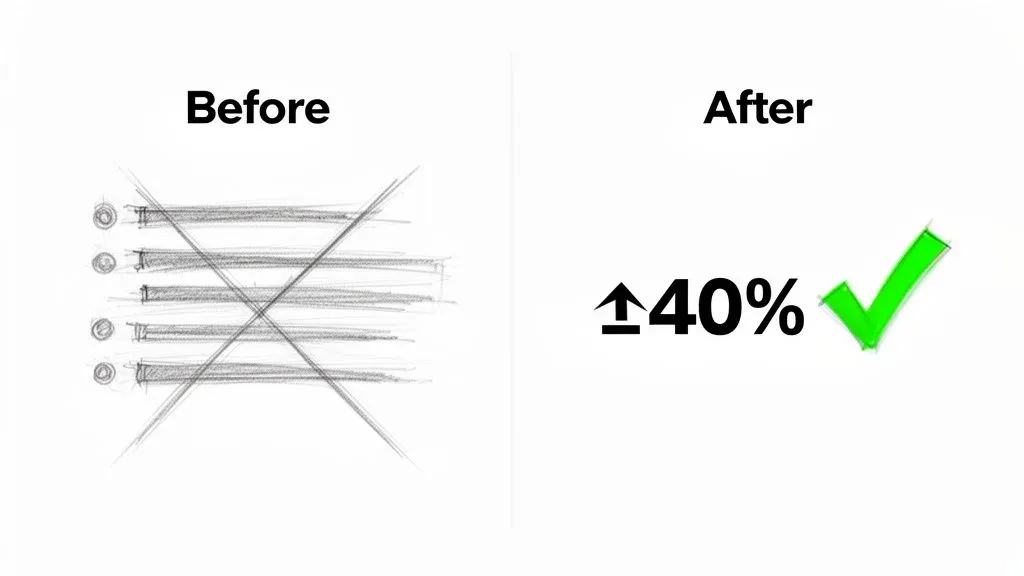
The goal is to turn passive duties into active, quantified wins. Here’s how to cut the fluff and get to the impact.
Product Manager Example
This is a classic process description. It’s long, vague, and says nothing about the results. It just fills space.
- Before: Was responsible for conducting extensive user research and collaborating with the engineering and design teams to develop a new feature for the mobile application, which was then successfully rolled out to our user base.
It’s a mouthful. Let’s focus on what actually happened.
- After: Launched a new mobile feature that boosted user engagement by 25% and reduced churn by 10% in Q1.
Shorter. Stronger. It screams value.
Data Scientist Example
Here, the writer gets lost in technical jargon. They describe the tools but forget to say why it mattered. A recruiter cares about the business outcome, not the process.
- Before: Utilized Python libraries like Pandas and Scikit-learn to build and deploy a predictive model designed to analyze customer behavior patterns and identify potential opportunities for upselling.
This reads like a textbook. Let’s translate it into a business win.
- After: Built a predictive model that identified high-value upsell opportunities, directly adding $500K in quarterly revenue.
The “After” version connects a technical skill to a hard number. It proves the work created value.
Your resume isn’t for explaining methodology. It’s for proving your work made money or saved money. Ditch the jargon. Lead with the number.
Digital Marketer Example
This one is painfully common. It lists activities without any sense of scale or success. "Managed" and "created" are passive words. You can find more powerful resume bullet points in our guide, but let's fix this now.
- Before: Managed the company's social media accounts, created content for various platforms, and ran several digital advertising campaigns to promote our new product line.
So what? Did it work? Let’s rewrite it with a single, powerful metric.
- After: Drove a 40% increase in marketing qualified leads (MQLs) by launching a multi-channel campaign with a 150% ROI on ad spend.
This is what recruiters want. It’s specific, quantified, and proves you deliver results.
And if you're deciding how many points to include, our guide on how many bullet points per job on a resume helps you find the right balance.
Quick Answers to Your Bullet Point Questions
You have the rules. Now for the details.
How many bullet points per job?
3-5 bullet points for your most recent jobs. For roles older than ten years, 2-3 is fine. Your resume is a highlight reel, not a documentary. Focus on recent, relevant wins.
Should every bullet start with an action verb?
Yes. Every. Single. One. No exceptions. Words like ‘Architected,’ ‘Negotiated,’ or ‘Automated’ put you in the driver’s seat. Passive phrases like “Responsible for” are resume poison. Hunt them down and kill them.
Can resume bullet points be two sentences?
Nope. Never. One bullet = one idea. Two sentences mean you’re jamming two ideas together. This kills readability and weakens both achievements. If you have two separate wins, give them two separate bullets.
Your goal is clarity, not density. Make your impact instantly obvious.
More short bullets or fewer long ones?
More short bullets win, every time. A crisp list of five one-line bullets is far more scannable and effective than two dense, paragraph-like bullets. Brevity shows you know what matters.
Tired of fighting with bullet points? StoryCV isn't a template or a tool. We're a Digital Resume Writer. We interview you, uncover your real impact, and write the story you’ve struggled to tell. Stop filling out boxes. Start telling your story. Get started for free at https://story.cv.