The popular advice is wrong: don't ask AI to write your resume. Ask it to interview you, challenge you, and edit what you did.
That distinction matters. A randomized controlled trial covering 480,948 job seekers found that AI résumé assistance increased hiring by 7.8% when it helped applicants sharpen wording, highlight relevant experience, and align documents with job requirements (JobCannon's summary of the study). The useful part wasn't blind generation. It was better translation.
StoryCV is built around that idea. We're not a template library or a button that decorates weak material. We're an Online Resume Writer that applies editorial judgment at software speed. Your work comes first. AI helps you make its value easier to see.
The Two Versions of AI Resume Writing
AI resume writing has two outcomes.
The first is a compounding career asset. You start with real work. The system asks what changed, who was involved, what constraint you faced, and what happened next. You leave with clearer bullets, but you also understand your own career better. Each new application gets easier because you've built a reusable record of your decisions and impact.
The second is one-shot slop. You paste a job description into a chatbot, ask for a resume, and receive polished filler. It sounds capable. It says almost nothing. The same phrases appear across applications, and the document describes an imaginary candidate who can't defend the claims in an interview.
The threshold is simple:
If AI never forces you to remember a number, a stakeholder, a tradeoff, or a reaction, it's probably producing slop.
ATS screening makes the distinction more important. Industry summaries report that about 75% of resumes are filtered out before a human recruiter sees them, while 99.7% of recruiters use ATS filters to sort candidates (OneHour Digital's resume statistics summary). Separate reporting says 98.4% of Fortune 500 companies use ATS software, so clear structure and role-specific language matter. But keyword matching can't rescue vague experience.
Your resume needs to satisfy two readers. The ATS needs relevant, parseable language. The hiring manager needs proof that you've done meaningful work. AI should help you translate one into the other, not manufacture a better-looking fiction.
That's also why voice matters. If the draft sounds too polished to belong to you, you'll struggle to fix your AI cover letter tone later. The resume and cover letter should sound like the same thoughtful professional.
Read AI resume writer vs ChatGPT with one question in mind: does the process uncover your story, or merely rewrite the surface?
Four Ways Candidates Actually Use AI
Most candidates fall into one of four habits. Only one starts with the right raw material.
| Approach | Typical Output | Verdict |
|---|---|---|
| Paste the job description and request a rewrite | Keyword-heavy bullets based on the role, not your history | Slop risk |
| Run a guided interview about past work | Specific achievements with context, decisions, and outcomes | Asset |
| Use an AI resume builder to fill a template | Neat formatting with variable depth and generic phrasing | Depends on inputs |
| Tailor an existing draft to a target role | More relevant wording and reordered evidence | Asset when verified |
The riskiest shortcut
A job description tells AI what the employer wants. It doesn't tell AI what you did. When you ask for a resume from that single input, the model fills gaps with likely-sounding language. That can turn “supported a launch” into “led a cross-functional go-to-market initiative” without any evidence behind it.
This is how candidates lose control of their story. The document becomes optimized for the vacancy and detached from the person.
The strongest workflow
A guided interview reverses the order. It starts with your timeline, projects, problems solved, and consequences. The system can then identify which experiences match the role and express them in the employer's language.
Tailoring an existing resume also works well, but only after you've built a credible base. Ask AI to compare action verbs, spot redundancy, and identify missing role language. MIT Career Advising specifically recommends comparing action verbs in your resume with those in the job posting and checking whether stronger verbs could replace weaker ones (MIT's AI uses for resume writing).
Templates are neutral. A template can give you structure. It can't supply judgment. If the questions are shallow, the output will be shallow in a cleaner font.
Preparing Your Real Inputs Before You Prompt
AI can't recover what you never give it. Before opening a tool, create a rough career inventory.
Start with a timeline of roles, then add a loose brain dump under each one. Don't polish it. Capture launches, escalations, systems inherited, processes replaced, people persuaded, targets met, and mistakes corrected. Specificity beats elegance at this stage.
A useful input might look like this:
- Inherited system: Took over weekly reporting built across disconnected spreadsheets.
- Stakeholder: Persuaded finance and sales operations to agree on one definition of churn.
- Constraint: Rebuilt reporting while the team still needed the old process every Monday.
- Outcome: Surfaced a churn spike by customer segment before the next planning cycle.
Another might be:
- Starting point: New-hire onboarding took three weeks.
- Change: Reworked the checklist, recorded product walkthroughs, and removed duplicate approvals.
- Result: Reduced onboarding time from three weeks to nine days.
These details give AI something to work with. “Improved onboarding” doesn't. “Managed reporting” doesn't. A model can make vague language smoother, but it can't make vague evidence real.
Ask questions that recover the work
A useful interviewer should press for:
- What was broken, slow, expensive, risky, or unclear?
- What did you personally decide?
- Who had to agree?
- What changed afterward?
- How do you know it changed?
Harvard FAS advises starting with an existing draft or as many concrete details as possible, including impact and relevant numbers (Harvard's guidance on AI resumes). That's the right order. Gather substance first. Edit second.
Use career reflection before writing your resume if your work history feels scattered. The aim isn't to produce perfect prose. It's to remember enough truth that the prose has weight.
Rule: If you can't describe a result in one sentence with a number or named stakeholder, AI won't be able to either.
A Before and After You Can Copy
Start with a weak bullet:
Responsible for managing social media accounts.
Ask AI to improve it without supplying evidence, and it may produce:
Developed social media strategies and employed effective content initiatives to drive engagement and strengthen brand visibility.
The sentence sounds polished. It still tells a hiring manager almost nothing. The tool edited the wording, but it did not recover the work behind it.
The prompt created the problem. It requested quantified achievements without giving the model any facts. That invites invented metrics, inflated ownership, and routine activity disguised as a major achievement. AI should interview you for evidence before it drafts.
Use two passes
First, ask the tool to find what is missing:
Rewrite this resume bullet by identifying the specific achievements that need proof. Do not invent numbers, platforms, audience growth, campaign results, or responsibilities. Return five questions I should answer before rewriting it: scope, starting point, action, measurable result, and business relevance.
Then provide the answers:
Rewrite the bullet using only the context below. Keep every number and fact exactly as provided. Do not add claims. Use one strong verb, explain the action, and end with the measurable outcome.
Context: Grew Instagram from 4.2K to 18K followers in six months by shifting to short-form video. Increased weekly impressions from 80K to 410K.
The resulting bullet is:
Grew Instagram from 4.2K to 18K followers in six months by shifting to short-form video, increasing weekly impressions from 80K to 410K.
| Stage | Bullet Text | Prompt Logic |
|---|---|---|
| Starting point | Responsible for managing social media accounts. | Describes a duty |
| First AI pass | Developed social media strategies and employed effective content initiatives to drive engagement and strengthen brand visibility. | Polishes without evidence |
| Evidence-backed pass | Grew Instagram from 4.2K to 18K followers in six months by shifting to short-form video, increasing weekly impressions from 80K to 410K. | Uses supplied facts only |
The second version works because the candidate supplied the numbers and the actual change. AI did not discover those facts. It organized them into a defensible bullet.
That is the threshold. Give AI real work to edit and question, and it becomes a useful career asset. Give it vague duties, and it produces confident-sounding filler.
Editing AI Drafts Without Sounding Like AI
Never submit the first clean draft. Clean is not the same as credible.
Run every bullet through this checklist:
- Delete inflated verbs: Remove “spearheaded,” “leveraged,” “orchestrated,” and “championed” unless they describe a real level of ownership.
- Replace empty adjectives: Cut “robust,” “passionate,” “dynamic,” and “results-driven.” Show the result instead.
- Test defensibility: If an interviewer asked how you did it, could you explain the answer without inventing detail?
- Add scope: Name the team, system, customer group, budget category, geography, or operational area when it matters.
- Show the constraint: Mention the migration deadline, limited resources, conflicting stakeholders, or inherited process that shaped the work.
- Answer “so what?”: Connect the task to a business, customer, operational, or team outcome.
“Improved reporting” fails the test. “Rebuilt weekly reporting in Excel and SQL so finance and sales operations used the same churn definition” gives the reader something real to understand.
Restore your natural voice
AI tends to smooth away the texture that makes your experience believable. Add back one detail it couldn't know without your input: the tool you used, the stakeholder you convinced, the workaround you created, or the decision that changed the result.
Read the resume aloud. If you'd never say “drove strategic alignment across dynamic stakeholder ecosystems,” delete it. Use the sentence you'd say to a smart colleague.
A short guide to practical writing drills can help if your writing feels stiff before AI ever touches it. The goal isn't casual language. It's language you can own.
StoryCV's guide to identifying AI-generated resume writing gives you another useful check. Artificial writing often hides behind smoothness, repetition, and claims that lack a concrete anchor.
Thirty-second test: Read each bullet aloud once. If you stumble, simplify it. If you can't explain the result, cut the claim.
Privacy, Data, and What You Should Never Paste
Treat resume inputs as sensitive by default. Public AI tools can be useful, but convenience doesn't remove your responsibility to protect personal and employer information.
Never paste:
- Identity data: Full Social Security numbers, national ID numbers, or full birth dates.
- Home details: Your complete home address when a city and region are sufficient.
- Credentials: Employer login details, API keys, passwords, or internal access information.
- Confidential figures: Internal financial data that your employer hasn't released publicly.
- Unreleased plans: Product roadmaps, pricing changes, strategy documents, or private customer information.
- Confidential search material: A job description from a restricted search if sharing it could reveal hiring intent or company plans.
The last category gets overlooked. Even a job description can contain information you shouldn't send into an unknown shared inference environment.
Use a simple tiered rule
You can generally paste the public text of a job description. You can also paste anonymized versions of your own resume bullets and name former employers when that information is already part of your professional history.
Everything else is opt-in. Remove customer names, replace internal product labels with neutral descriptions, and round or generalize sensitive figures when exact precision isn't necessary for the writing task.
Privacy rule: If exposing the detail could create personal, legal, competitive, or employment risk, don't paste it until you've reviewed the tool's data policy.
Paid access doesn't automatically guarantee safe handling. Check retention, training, deletion, and access terms before uploading a full career history. A practical AI privacy guide is useful background, especially when you're comparing consumer tools.
Prompts to Keep and a Final Word on the Asset
AI gives weak resumes when the prompt gives it weak evidence. Keep prompts narrow, supply real details, and state what the tool must not invent. Use AI as an interviewer and editor first. Let it generate prose only after you have supplied the facts.
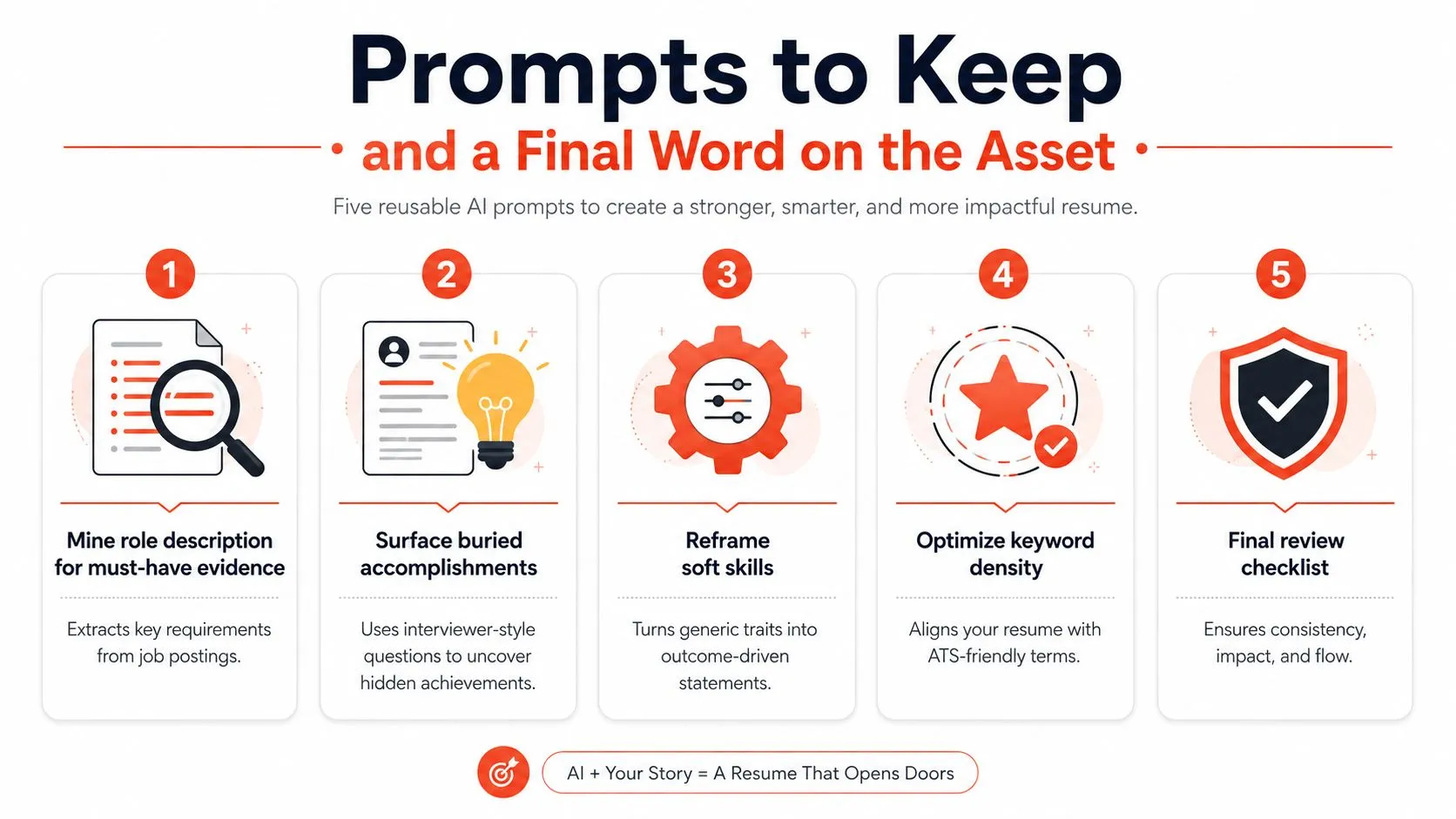
1. Mine the role description
Extract the five most important responsibilities and skills from this job description. For each one, list the kind of evidence a strong candidate should show. Don't rewrite my resume yet.
This separates job requirements from polished wording. You see what proof to find before tailoring anything.
2. Interview me for buried accomplishments
Act as a resume interviewer. Ask one question at a time about this role. Focus on problems I solved, decisions I made, stakeholders I influenced, constraints I handled, and measurable outcomes. Don't summarize until you've asked enough questions to identify specific evidence.
This is the highest-value prompt in the set. It retrieves work you have stopped noticing because you performed it repeatedly. The tool should make you remember the situation, your choice, and the result. That evidence becomes useful in a resume, an interview, and a performance review.
3. Rewrite one vague bullet
Rewrite this bullet using only the facts provided. Replace the duty with an action and outcome. Preserve every number. If evidence is missing, ask a question instead of guessing.
A good rewrite makes your contribution easier to see. It does not turn routine work into inflated leadership or attach an outcome you never measured.
4. Remove AI filler
Edit this bullet for plain, natural English. Remove clichés, inflated verbs, generic adjectives, and repeated phrasing. Keep the meaning, facts, and my level of ownership unchanged. Give me two versions with different rhythms.
Your voice is a credibility check. Read both versions aloud. Keep the one you would say, then remove any phrase that sounds borrowed from a template.
5. Align with ATS language without stuffing
Compare my resume with this job description. Identify relevant terms I already support with evidence, terms I should add only if they're truthful, and terms that don't belong. Suggest where each supported term could fit naturally. Don't repeat keywords unnecessarily.
ATS tools influence who gets reviewed. The summaries cited earlier report that about 75% of resumes are filtered before human review, and 99.7% of recruiters use ATS filters (OneHour Digital's data). Use relevant language where your experience supports it. Repeating a keyword cannot replace proof.
Resume length depends on signal density, not a magic page count. Resume Genius reports that 54% of hiring managers expect a resume to be two pages, 43% don't read resumes longer than two pages, and 20% say overly long or dense resumes can stop a candidate from moving forward (Resume Genius's resume statistics). Another guide reports that ATS systems don't penalize longer resumes by page count alone, while resumes under 400 words score lower on average and gains flatten beyond about 600 words (Ajusta's resume-length analysis). Include enough evidence to prove fit. Cut everything that does not.
AI-assisted writing can improve outcomes under human control. One randomized controlled trial found access to AI resume support increased hiring by 8% and wages by 10%, supporting a workflow based on diagnosis, questioning, rewriting, and verification rather than empty-page generation (algorithmic writing assistance study).
A resume built from real inputs becomes a career asset. You can reuse its evidence across roles, interviews, performance reviews, and future applications. A generic draft is disposable. It may sound confident, but it gives you no stronger story to develop.
AI should help you understand what you did and why it mattered. That threshold separates a compounding career asset from a one-shot slop generator.
StoryCV is an Online Resume Writer that interviews you about your real work, then turns the details into clear, role-specific resume content. Start with one fully written role for free at StoryCV, and build a career story you can keep improving instead of generating the same disposable resume again.