The most popular advice is to lead with your achievements. That's incomplete. Hiring managers rarely reject a business owner because they lack corporate experience. They hesitate because they suspect flight risk. They wonder whether you'll leave in a year to start something else.
A standard achievements-led resume never answers that question. Each business owner resume sample below answers the exit question first, then proves competence with specific work. Titles get a reality check too. Calling yourself CEO of a four-person company reads as inflation. Naming the function you ran reads as credible.
Ownership is mainstream work, not a strange gap. The U.S. Census Bureau reported 36.4 million employer and nonemployer businesses in 2023, including approximately 30.4 million nonemployer businesses. Your job is to translate that work into evidence a hiring manager can evaluate.
1. The Pivot Resume From Founder to Corporate Role
A completed business chapter needs a clean ending. Don't make the reader infer whether the company failed, stalled, or still consumes your attention. State the reason plainly, then show why the target role is the next logical move.
Practical rule: Explain the exit in your summary or cover letter. Use the experience section to prove what you ran.
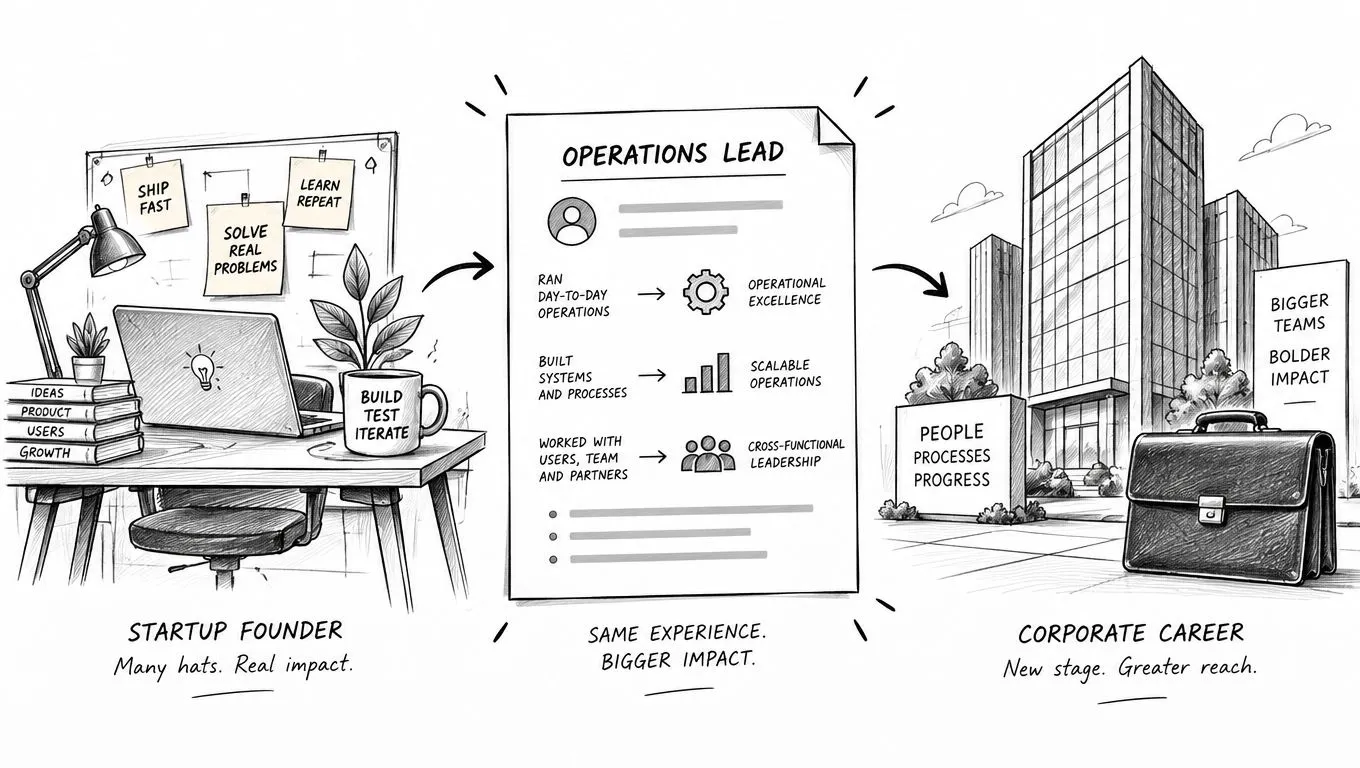
Use the title that matches your operating work. A SaaS founder who handled operations across product, finance, and customer success might write:
VP Operations, B2B SaaS Platform
- Led operations across product, finance, and customer success for a bootstrapped platform through Series A conversations.
- Chose to pursue operational leadership inside an established organization where systems and teams could scale.
An e-commerce owner who closed after market saturation could use:
Supply Chain Lead, E-commerce Business
- Built and managed end-to-end supply chain operations across three fulfillment centers.
- Transitioned from ownership after market saturation to deepen procurement expertise in an established logistics environment.
The point isn't to hide ownership. It's to make the relevant function obvious. Recruiters can compare operations leadership, procurement, or strategy with the job description. “Founder and CEO” gives them less usable information.
Describe the closure with deliberate language. “Decided to close after market saturation” is clearer than “forced to shut down.” “Chose to exit consulting to deepen enterprise strategy expertise” makes the move sound intentional. Don't write an essay about why you're leaving. Put the full reasoning in your cover letter or summary, then keep the bullets focused on scope and outcomes.
This career change resume examples guide can help you frame the transition without burying the work that makes you qualified.
2. The Portfolio Owner Resume for a Creator Economy Exit
Creators often undersell the operating system behind their work. “Content creator” says output. It doesn't show partnerships, product sales, client delivery, scheduling, or retention. A strong resume turns the portfolio into a function.
A creator moving into marketing might write:
Marketing Lead, Independent Media Business
- Built and monetized a platform to 180K subscribers and $45K annual revenue through sponsorships and courses.
- Developed content, partnership, and conversion playbooks for a team-based marketing role.
- Seeking to apply those systems inside a marketing organization rather than continue operating alone.
A freelance consultant targeting operations can be more direct:
Consultant, Independent Advisory Practice
- Managed projects for 12–15 enterprise clients, owning contracts, delivery, and client communication across $200K annual revenue.
- Built repeatable onboarding, scheduling, and delivery processes to keep concurrent work organized.
- Moving into operations to apply those systems across a larger team.
A self-employed designer could use Creative Director if that was the actual work, not “CEO.” The bullets should show delivery, systems, and collaboration:
- Delivered 40+ client projects annually across brand and digital design.
- Built a design system used by contractors to maintain consistency across client work.
- Transitioned to specialize within one company and contribute to a shared product roadmap.
The exit explanation matters here because independence can look like a preference rather than a chapter. “Scaling beyond solo operation” is stronger than “ready for a new challenge.” Explain what you want from a team: shared priorities, deeper specialization, or the chance to scale a process you built alone.
“Self-employed” is a work arrangement. It isn't a job title.
Separate revenue by the capability it required. Sponsorship revenue demonstrates partnerships. Course sales demonstrate product development. Consulting revenue demonstrates sales and delivery. Include only two or three portfolio pieces when they directly support the target role.
For more detail on translating independent work, use this guide to a resume for the self-employed.
3. The Serial Entrepreneur Resume for Multiple Ventures
Serial founders face the strongest flight-risk objection. A list of ventures can look like a warning label. The resume has to show progression, learning, and a credible reason to commit to someone else's priorities.
Start with a compact venture timeline. Give each company a clear status and one meaningful result.
Head of Strategy Candidate
Co-founder, B2B SaaS Company
- Co-founded three B2B SaaS companies across separate market stages.
- Bootstrapped the first two to $500K ARR and sold them.
- Seeking to apply multi-market strategy experience without starting another company.
Advisor or Board Candidate
- Founded a marketplace that was acquired.
- Built an analytics platform that became profitable.
- Shut down a recruiting tool after it failed to reach a sustainable path.
- Seeking an advisory or board role focused on pattern recognition, governance, and practical operating judgment.
Long-Term Operations Candidate
- Built and sold a SaaS company for $8M.
- Founded a second profitable company and retained a small operating role.
- Seeking a long-term operations position where depth of impact matters more than launching another venture.
Don't blur dates. List each company's founding and exit or closure year. Use “co-founded” when someone else started it with you. Use “founded” when you led it from zero. For an unsuccessful venture, write “shut down,” “wound down,” or “acquired for technology.” Facts are less damaging than evasive language.
Your summary should address commitment without sounding defensive:
Operations leader and former founder seeking a long-term role where sustained execution, team development, and operational depth matter more than launching a new venture.
That sentence won't solve a weak record. It does remove an obvious question. The bullets must then show how you made decisions, handled constraints, and improved the business.
If your resume includes several short ventures, this advice on a resume with multiple short stints will help you make the chronology readable.
4. The Lifestyle Business Resume for Profitable Stability
A deliberately small business isn't a lesser business. It proves judgment, especially when you chose sustainable profitability over expansion. The resume must make that choice visible.
A digital agency owner moving toward client services could write:
Owner and Client Services Lead, Digital Marketing Agency
- Founded and operated the agency for 8 years, generating $350K annual revenue with 85% client retention.
- Built delivery playbooks, managed client relationships, and maintained service quality through repeatable workflows.
- Seeking to apply those systems across a larger client services organization.
A consulting practice owner targeting operations could use:
Operations Director, Independent Consulting Practice
- Ran a consulting practice for 6 years with $180K annual revenue.
- Owned client intake, project delivery, invoicing, capacity planning, and process improvement.
- Moving into a larger operations environment to apply independent practice discipline across teams.
For an e-commerce owner, the relevant evidence might be:
Supply Chain and P&L Lead, Direct-to-Consumer Business
- Operated a DTC business for 7 years, reaching $500K annual revenue with 35% margins.
- Managed suppliers, inventory, fulfillment, and logistics decisions affecting the P&L.
- Seeking a supply chain role where logistics expertise can influence operations at greater scale.
Use profitability as evidence of strategic control. State margins when you can verify them. State team size when you managed people. Mention deliberate choices, such as resisting venture funding, only when they explain how you operated.
The hiring manager doesn't need to see every financial detail. They need to see stability, decision quality, and a clear reason you're considering employment. “Seeking to scale my expertise” is useful. “Looking for a new opportunity” is empty.
A large resume analysis found that 36% of resumes contained no measurable metrics, while only 26% included at least five measurable metrics. That finding is cited in this analysis of 125,000 resumes. For owners, the lesson is simple. Replace “managed a profitable business” with revenue, retention, margins, staff, delivery volume, or cost control.
5. The Acquisition Resume for a Founder Post-Exit
Selling a company doesn't end the story. The post-acquisition role is often the strongest proof that you can adapt to a larger organization. Don't bury it under the founder title.
A founder moving into product management might write:
Senior Product Manager, Acquired Marketing Automation Business
- Sold a marketing automation startup and stayed for 2 years as Senior Product Manager during integration.
- Managed product decisions across the acquired platform, customer needs, and integration requirements.
- Seeking a growth-stage product role where acquisition and integration experience supports roadmap execution.
For an operations candidate:
VP Operations, Acquired Supply Chain Software Unit
- Sold supply chain software business and served as VP Operations for the acquired unit.
- Managed a 15-person team and $8M budget after the acquisition.
- Built experience operating within corporate planning, reporting, and approval processes.
- Seeking a COO or head of operations role with broader operational scope.
An investor or analyst candidate could frame a shorter tenure this way:
Senior Strategy Manager, Acquired Fintech Company
- Sold fintech startup and stayed 18 months as Senior Strategy Manager.
- Completed earnout requirements and remained through product launch.
- Pursuing investor and analyst work focused on early-stage fintech.
Dates matter. A vague “post-acquisition advisor” label creates suspicion. State how long you stayed, what changed, and what you learned that you hadn't learned as a founder.
Use adaptation language. “Transitioned from founder to functional team member” is stronger than “survived the acquisition.” Name the corporate processes you learned, such as planning cycles, integration work, stakeholder reporting, or scaling beyond the original product.
Your acquisition story should prove you can commit after the founder chapter ends.
Connect the next role to that experience. If you learned how product teams integrate acquired systems, apply for product roles that value integration. If you operated a larger unit after the sale, target operations roles that need organizational scale. Don't make the reader invent the connection.
6. The Side Hustle to Full-Time Resume
A side business gives you a useful advantage. It shows you built something while maintaining professional stability. It can also create confusion if the dates make it look like you disappeared from your primary job.
Show concurrent work clearly. Separate the skills learned in each role. Then name the inflection point that changed the arrangement.
A software engineer could write:
Founder and Product Lead, SaaS Side Business
- Built a SaaS product while employed full-time as a software engineer.
- Reached 150 paying users and $8K MRR, then transitioned to the business full-time after consistent growth.
- Owned product discovery, development priorities, customer feedback, and subscription operations.
A marketing manager might use:
Consultant, Independent Marketing Practice
- Advised 8 clients and generated $45K annual revenue while employed full-time.
- Built client agreements, delivery workflows, and referral systems alongside a corporate marketing role.
- Transitioned after the client base stabilized, with a focus on scaling the practice.
A product designer could write:
Founder and Designer, Print Goods Brand
- Built a print goods brand to $35K annual revenue through product design, inventory planning, and fulfillment.
- Developed repeat-customer processes and managed production from concept through delivery.
- Moved full-time into the business to scale design, inventory, and fulfillment operations.
Avoid language that sounds covert or apologetic. You built a business. Don't call it a distraction. Don't hide the overlap. The dates should show that you managed both commitments responsibly.
Use the business to demonstrate entrepreneurial thinking, but keep the resume usable if you later return to corporate work. Name what the day job taught you and what the side business taught you. “Reached product-market fit” is stronger than “ready for a new challenge” because it identifies the decision point.
7. The Franchise Owner Resume for a Proven System
Franchise ownership isn't passive operation. You worked inside a defined system while controlling staffing, vendors, local marketing, customer experience, and financial performance. The resume should show both sides.
A single-unit operator targeting operations could write:
Operations Manager and Franchise Owner, Fast-Casual Location
- Operated a location generating $650K annual revenue with a 12-person team.
- Improved average unit volume through staff training, local execution, and workflow improvements.
- Managed staffing, vendor coordination, local customer initiatives, scheduling, and P&L performance.
A multi-unit owner has a stronger scaling story:
Director of Operations, Franchise Locations
- Scaled from one to three locations, growing revenue from $400K to $1.2M.
- Implemented inventory systems across locations and reduced turnover by 40%.
- Standardized training, staffing, and operating reviews for managers.
For a consulting transition:
Regional Operations Lead, Franchise Business
- Operated two locations with $800K combined revenue and 30% margins.
- Controlled staffing, local marketing, vendor performance, and operating execution within a franchisor system.
- Pursuing management consulting to apply operational problem-solving across multiple businesses.
Don't claim credit for corporate-set pricing, national campaigns, or brand systems. Claim what you controlled. That distinction makes the resume more credible.
If you improved margins from 22% to 28%, say so. If you sold the locations, write “sold to regional operator.” “Closed location” leaves the reader wondering whether the business failed. Translate franchise P&L ownership into terms the target employer understands, such as regional business unit, multi-site operations, or location-level P&L.
Use this Franchise Fast Track franchisee solutions resource if you need language for the operating side of franchise ownership.

7 Business-Owner Resume Samples: Side-by-Side Comparison
| Resume Format | 🔄 Complexity | ⚡ Resource Requirements | 📊 Expected Outcomes | ⭐ Key Advantages | 💡 Quick Tip |
|---|---|---|---|---|---|
| The Pivot Resume: Founder to Corporate Role | Medium, reframing narrative & editing founder language | ⚡ Low–Medium, honest reflection, focused achievements | 📊 Reduced flight-risk; clearer corporate fit | ⭐⭐⭐⭐ Disarms flight-risk; shows adaptability and credibility | 💡 Use factual closure language; adopt a functional day-to-day title |
| The Portfolio Owner Resume: Creator Economy Exit | Medium, translate varied outputs into corporate functions | ⚡ Low, select portfolio pieces, revenue breakdowns, systems evidence | 📊 Makes creator work legible to hiring teams; shows systems & multi-project management | ⭐⭐⭐ Demonstrates self-direction and cross-functional skills | 💡 Quantify revenue streams and emphasize systems over output |
| The Serial Entrepreneur Resume: Multiple Ventures | High, curate multiple ventures, show progression and learning | ⚡ Medium, exit details, one strong metric per venture, clear dates | 📊 Signals pattern-recognition & resilience but higher scrutiny on commitment | ⭐⭐⭐⭐ Highlights repeated success/learning; attractive for strategy/board roles | 💡 Date ventures clearly; pick one meaningful metric per company and address flight-risk |
| The Lifestyle Business Resume: Profitable and Stable | Low–Medium, emphasize intentional choices and profitability | ⚡ Low, financials, team size, strategic constraints documented | 📊 Conveys profitability, consistency, and operational discipline | ⭐⭐⭐ Proves P&L understanding and steady performance; lower perceived risk | 💡 Lead with margins and years of operation; explain why you kept the business small |
| The Acquisition Resume: Founder Post-Exit | Medium, show post-acquisition role shift and learnings | ⚡ Medium, acquirer name, dates, changed scope, integration outcomes | 📊 Demonstrates enterprise adaptation and integration experience | ⭐⭐⭐⭐ Shows ability to operate inside larger organizations and apply founder insight | 💡 State exact post-acquisition tenure and concrete skills learned in the acquirer |
| The Side Hustle to Full-Time Resume: Building the Transition | Low–Medium, clarify concurrency and separation of responsibilities | ⚡ Low, concurrent dates, revenue/users, explicit inflection point | 📊 Proves execution under constraints and validated traction | ⭐⭐⭐ Shows time management, discipline, and validated demand | 💡 Use concurrent dates and quantify the threshold that justified going full-time |
| The Franchise Owner Resume: Proven System, Individual Operator | Medium, translate system-driven results into individual contributions | ⚡ Medium, revenue, margins, unit metrics, staffing and operational decisions | 📊 Proves P&L ownership, operations scaling, and staff management | ⭐⭐⭐⭐ Demonstrates reliable unit economics and ability to optimize within constraints | 💡 Lead with revenue/profitability and clarify what you controlled vs. corporate mandates |
Answer the Exit Question First
Before you touch a bullet, write two sentences:
- Why did the business end, change, or become secondary?
- Why is this role the next chapter?
That explanation is not decoration. It addresses the hiring manager's main concern. If you're a former founder, the employer wants evidence that you can commit to the role instead of treating it as a temporary stop before another venture.
Then choose the sample that matches your ownership type. A pivot founder needs a coherent transition. A creator needs functional translation. A serial entrepreneur needs commitment evidence. A lifestyle business owner needs to show intentional stability. An acquired founder needs to prove adaptation. A side-hustle owner needs clean dates. A franchise owner needs to show what they controlled inside the system.
Rebuild your titles around the work you performed. Operations Lead beats inflated CEO language when you ran operations. Client Services Lead beats Owner when client delivery was the center of the job. Down-titling isn't weakness. It gives the reader a familiar function to evaluate.
Write bullets using context, action, outcome:
- “Managed customer service” is a responsibility.
- “Redesigned response workflows and introduced service-level tracking, reducing customer response time by 60%” shows a constraint, an intervention, and a result, as illustrated in this recruiter evaluation guidance.
Use one verifiable number per achievement where you can. Revenue, customer volume, margin, team size, retention, time saved, and cost control all work. Don't force confidential figures into the resume. You can describe scale through clients served, operating scope, process ownership, or team responsibility.
Business ownership is substantial commercial work even without formal staff. The Census Bureau's data on nonemployer businesses reinforces that point, but your resume still has to translate it into the language of the target job. The strongest business owner resume samples don't ask employers to admire entrepreneurship. They show what changed because you were there.
If the exit story is tangled, understanding exit strategies for entrepreneurs can help you name the chapter clearly. Then use StoryCV to work through the details. Guided questions can pull decisions, constraints, and outcomes out of your own experience and turn them into resume-ready writing.
StoryCV is an online resume writer that asks about the work you did, then helps turn the answers into clear bullets. For a business owner resume, use it to explain the exit, choose credible functional titles, and connect ownership decisions to the role you want next. Try StoryCV and write your first role from the evidence you already have.