Most advice on a resume for the self employed is backwards.
It tells you to document everything. Every client. Every gig. Every random project. That creates a messy timeline and leaves the recruiter doing the hard work of figuring out what you are.
Don't do that.
If you've been freelancing, consulting, contracting, or running your own thing, your problem usually isn't weak experience. It's weak framing. You need a resume that reads like a coherent professional story, not an archive.
Stop Listing Gigs Your Resume Needs a Story
The common advice says to list freelance work project by project. That sounds thorough. It usually reads as chaos.
Recruiters don't reject self-employed candidates because self-employment is invalid. They reject vague resumes. Recruiter surveys show 62% reject self-employed candidates due to vague impact descriptions, not a lack of skills, according to Indeed's guide on self-employed resumes.
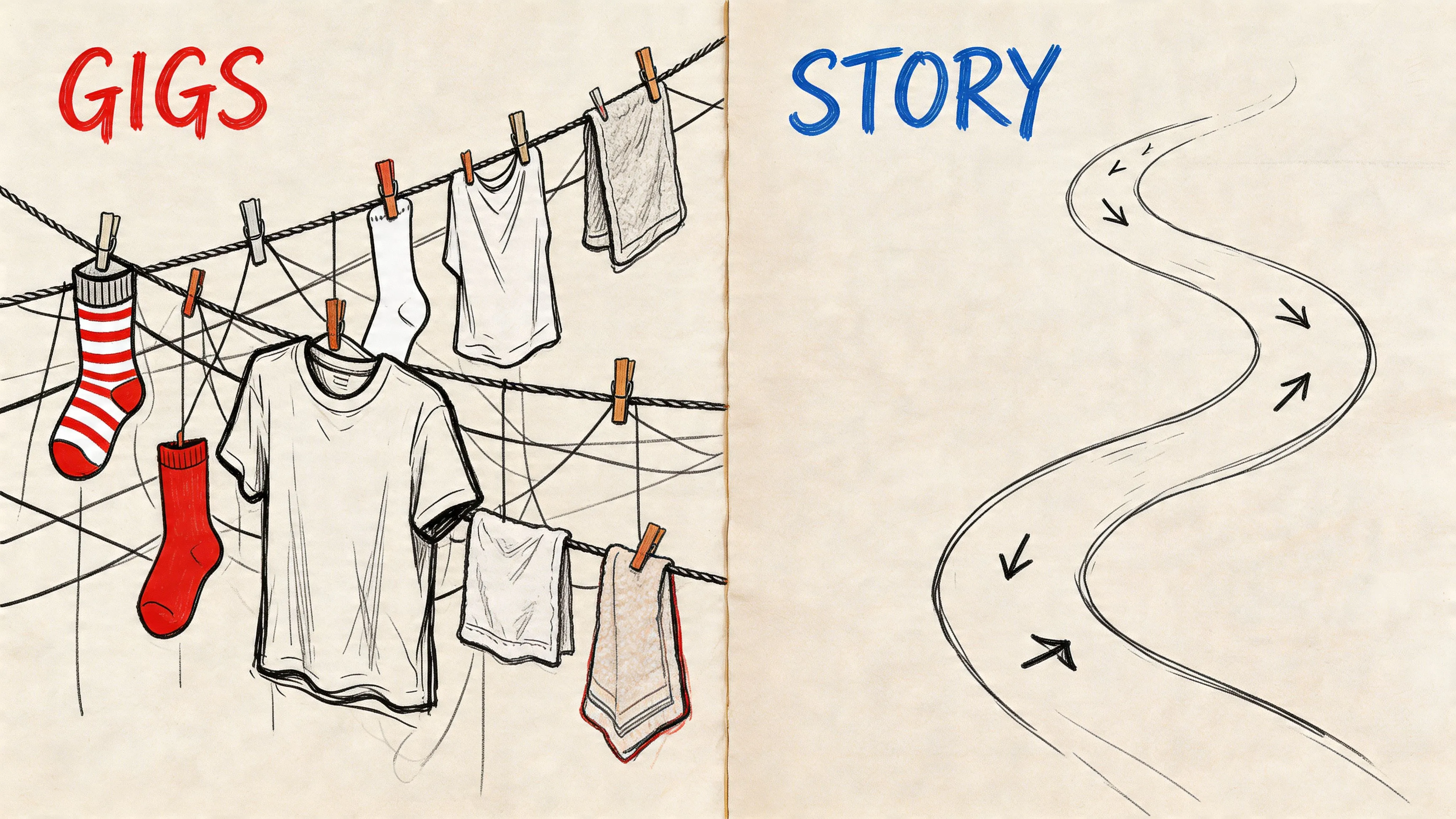
Why gig lists fail
A long stack of small projects creates the wrong impression:
- It looks fragmented. Even if you were fully booked, the resume can make you look unstable.
- It hides your level. Ten tiny entries flatten senior work into task work.
- It forces interpretation. The reader has to connect the dots between clients, tools, and outcomes.
That's your job, not theirs.
What hiring managers actually need
They need to know three things fast:
- What role you perform
- What business problems you solve
- What results you produce
That's all.
A strong self-employed resume doesn't pretend your work was traditional. It translates it into language a hiring manager can scan in seconds. If you've struggled with the opening summary, describe yourself on a resume in terms of value, not personality.
Practical rule: Your resume should explain your freelance years better than you explain them out loud.
Stop thinking like an archivist. Start thinking like an editor.
“Worked with many clients across different industries” is not a story.
“Marketing consultant who helped SaaS and e-commerce teams improve campaign performance, reporting, and client retention” is a story.
That second version sounds like a hire.
The Three-Part Structure for a Cohesive Resume
A self-employed resume works best when it feels stable. Clean. Easy to scan.
That matters more now because self-employment is not some weird edge case. The U.S. Bureau of Labor Statistics projected the self-employed workforce would reach 10.3 million by 2026, a 7.9% increase, as noted in the BLS overview of self-employment. This is mainstream work. Your resume should reflect that.
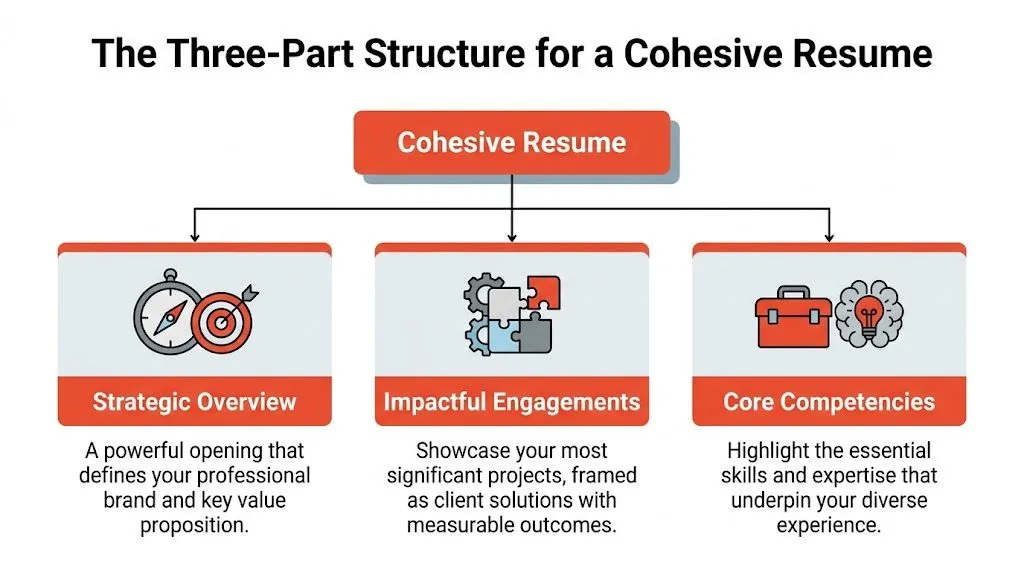
Part one is your professional summary
Skip objectives. Nobody cares that you're “seeking a challenging opportunity.”
Use the top of the page to position yourself.
A good summary answers:
- Your niche. What kind of work do you do?
- Your market. Who do you help?
- Your edge. Why do people hire you?
Example:
Freelance UX Designer with 5+ years of experience helping early-stage startups improve conversion and user engagement through research, wireframes, and product design collaboration.
That's specific. It sounds deliberate.
Part two is your core skills
This section exists for two readers. The recruiter scanning in seconds, and the ATS looking for relevant terms.
Keep it tight. Group skills into recognisable buckets.
| Skill group | Example terms |
|---|---|
| Strategy | UX Research, Conversion Optimization, Positioning |
| Delivery | Wireframing, Prototyping, Project Management |
| Collaboration | Client Management, Stakeholder Communication, Cross-functional Work |
Don't dump every tool you've touched. Pick the skills that match the role.
Part three is one cohesive experience entry
This is the part often done poorly.
Don't split your work into ten mini-jobs unless the roles were truly different. If you spent several years doing the same kind of work for different clients, present it as one continuous role.
Example:
Freelance UX Designer | Self-Employed | 2020 to Present
- Led UX research, wireframing, and product design work for startup and growth-stage clients
- Partnered with founders, designers, and developers to improve user flows and product clarity
- Delivered end-to-end design support across audits, prototypes, testing, and launch preparation
A resume for the self employed should feel like a career, not a pile of invoices.
This structure works because it creates continuity. It shows you weren't bouncing around. You were operating a professional practice.
How to Frame Your Role Not Your Gigs
Your title matters more than people admit.
“Self-Employed” is technically true. It's also weak. It's an employment status, not a professional identity. Lead with what you do.
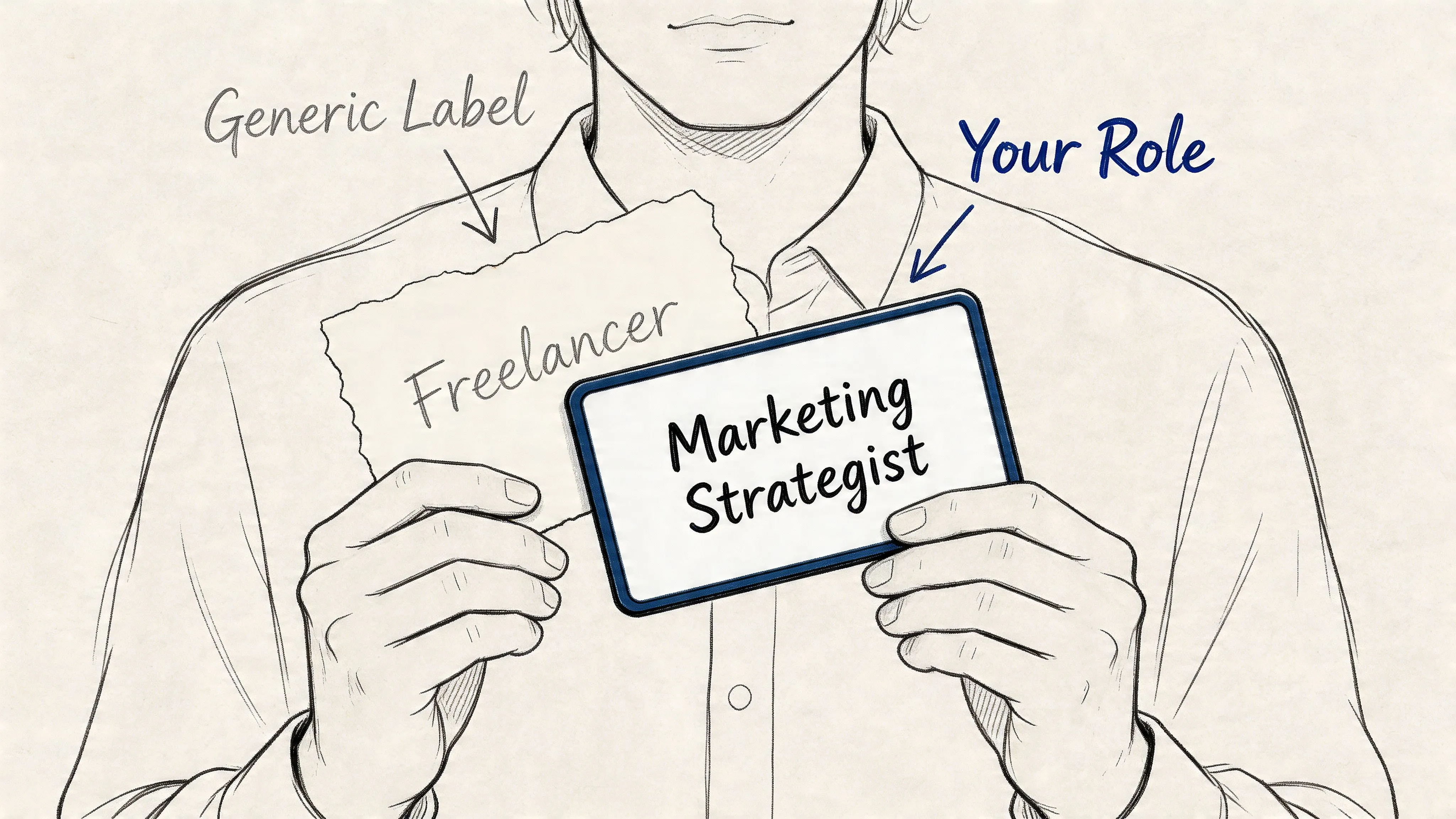
A better title looks like this:
- Marketing Consultant
- Product Designer
- Operations Consultant
- Content Strategist
- Software Developer
Then use your business name, if you have one, or “Self-Employed” as the company line.
Use the label that helps the reader
A lot of people now have multiple income streams. A 2026 survey found 72% of U.S. workers rely on at least one secondary income source, according to MyPerfectResume's survey write-up. So don't act apologetic about independent work.
But don't make the recruiter decode it either.
Use this format:
Marketing Consultant | Self-Employed | 2021 to Present
That tells the truth and keeps the focus where it belongs.
Group by role, not by invoice
If the work shared a common theme, merge it.
Bad:
- Freelance SEO project
- Contract email project
- Startup content project
- Paid ads audit for small business
Better:
Growth Marketing Consultant | Self-Employed | 2021 to Present
- Delivered marketing strategy, campaign execution, and performance analysis across SaaS and e-commerce clients
- Managed paid media, email, SEO, and reporting as part of integrated growth engagements
- Advised founders and small internal teams on messaging, funnel issues, and launch planning
That reads like a real role because it was a real role.
Sound collaborative, not solitary
Self-employed candidates often sound like lone operators. Fix that with verbs.
Use:
- Partnered with
- Collaborated with
- Worked closely with
- Advised
- Led with
Example:
Partnered with founders, designers, and developers to deliver product and marketing work aligned with business goals.
That one line changes the tone completely. It shows you're used to teams, feedback, and shared goals.
Writing Bullets That Prove Your Impact
Task-based bullets kill momentum.
If your bullets say “managed,” “handled,” “supported,” and “worked on,” you're giving activity without proof. For self-employed candidates, that isn't enough.
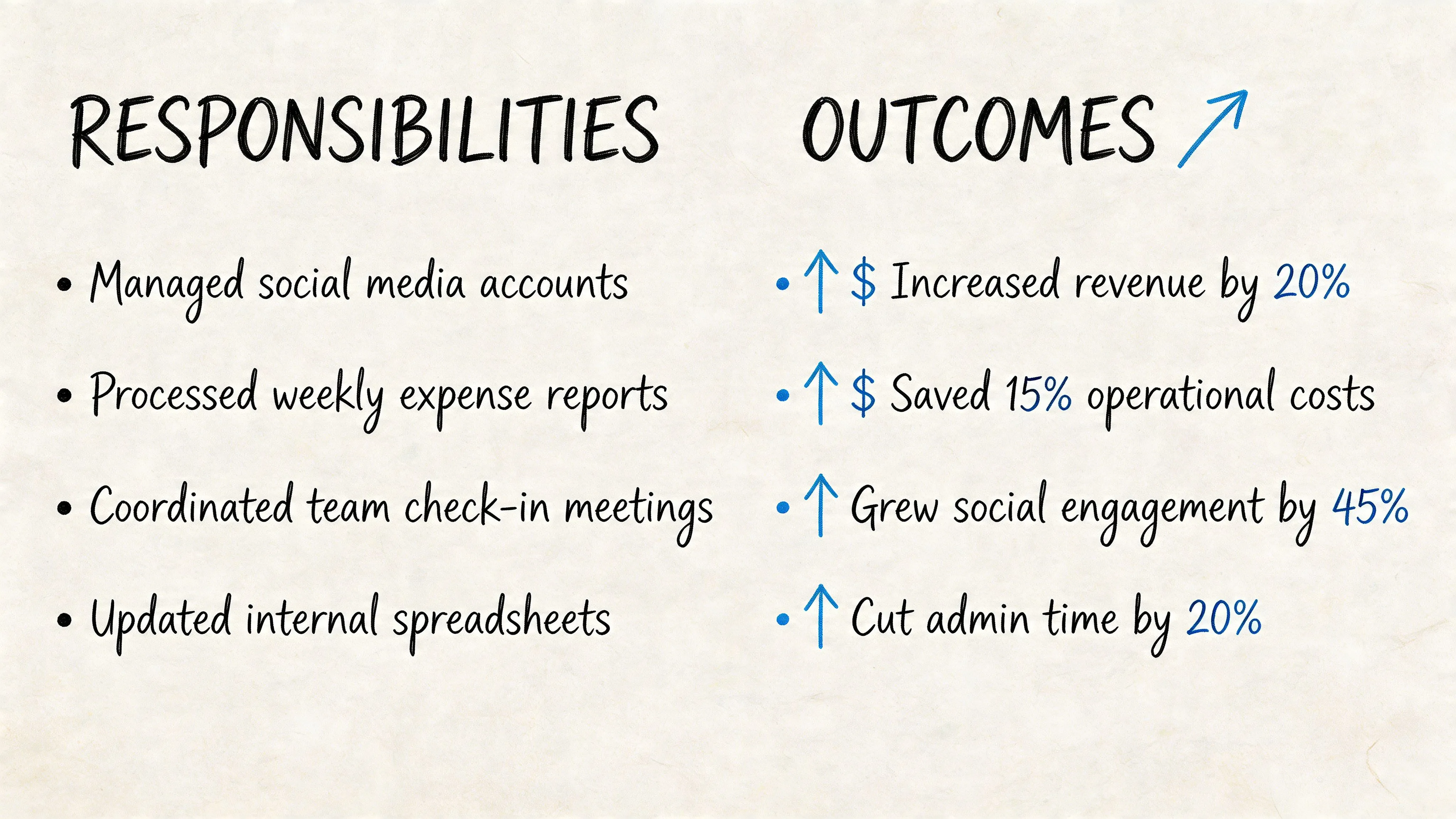
The bar is higher because the reader wasn't there. They can't infer your impact from a job title alone.
Expert analysis shows that including quantifiable accomplishments can increase interview callbacks by 2-3x for self-employed applicants, and resumes with 3+ metrics per role correlate with a 35% higher ATS pass rate, according to Zety's self-employed resume guide.
Use a simple bullet formula
Write bullets like this:
Action + scope + outcome
Or, if you need more shape:
What you did + who it helped + what changed
That forces you to move beyond chores and into results.
Before and after examples
Here are the kinds of rewrites that make a real difference.
Before
- Managed social media accounts for several brands
After
- Managed content calendars and campaign execution across multiple client accounts, improving reporting clarity and engagement visibility for internal teams
Before
- Built websites for clients
After
- Designed and launched client websites from discovery through handoff, aligning structure, messaging, and conversion paths with business goals
Before
- Worked with startup founders on marketing
After
- Advised startup founders on messaging, launch planning, and channel execution to support clearer go-to-market decisions
Notice the shift. The second version of each bullet sounds commercial. It shows stakes.
When you have numbers, use them hard
If you have metrics, lead with them. Revenue impact. repeat business. project volume. delivery speed. cost reduction. conversion improvement.
Examples:
- Delivered 20+ client projects while maintaining a 95% repeat engagement rate
- Helped 8 startup clients improve website conversion rates by 30% to 65%
- Generated over $150K in freelance revenue through repeat engagements and referral-based client growth
Those examples work because they remove doubt. If you want help picking the right proof points, this guide on metrics in resume writing is worth reading.
Your bullets should answer the silent recruiter question: “Why should I believe this person can do the job here?”
If you don't have hard metrics
Don't force fake precision. Use evidence you can stand behind.
Good alternatives:
- named deliverables
- project scope
- client type
- repeat engagement
- ownership from start to finish
- cross-functional collaboration
For example:
- Led discovery, process mapping, and reporting redesign for operations clients with messy workflows
- Owned client onboarding, project scoping, delivery, and revision cycles across ongoing consulting engagements
- Collaborated with design, product, and marketing stakeholders to align execution with deadlines and business priorities
A fast edit test
Cut any bullet that only describes a duty.
Keep bullets that prove one of these:
- Scale
- Complexity
- Ownership
- Business outcome
- Collaboration
If a bullet doesn't prove one of those, it's filler.
Handling Gaps Clients and Confidentiality
Self-employment creates resume edge cases. That's normal. Don't get cute. Name the situation clearly and frame it professionally.
The touchiest one is gaps.
Data shows 55% of hiring managers view gaps over six months with skepticism, according to CVAnywhere's discussion of resume gaps. If you took time to build a business, test a venture, or do independent work between salaried roles, say so plainly.
How to frame a gap without sounding defensive
Bad:
- Took time off to figure out next steps
- Worked on personal projects
- Tried freelancing
Better:
- Independent Consultant | 2022 to 2023
- Business Development and Client Consulting | 2022 to 2023
- Self-Directed Consulting and Professional Development | 2022 to 2023
Then add bullets that prove the period was productive.
Examples:
- Advised small business clients on operations, positioning, and vendor coordination during a period of independent consulting
- Built client proposals, managed scopes, and delivered project work while refining service positioning
- Completed portfolio work, process documentation, and hands-on client delivery during a self-directed transition period
If your venture didn't work out, don't hide it. Strip out the drama and keep the skills.
A failed business isn't a character flaw. On a resume, it's evidence that you sold, built, managed risk, and learned fast.
How to handle confidential clients
If you're under an NDA, don't name the client. Describe them in a way that still signals credibility.
Use lines like:
- Advised a venture-backed SaaS company on onboarding and lifecycle messaging
- Delivered reporting and process design work for a regional healthcare provider
- Partnered with a consumer brand on website restructuring and conversion-focused copy
That gives enough context without crossing a line.
If you're formalising independent work, keeping contracts, invoices, and other legal documents organised also makes it easier to verify timelines and client relationships later.
How to show you're not working alone
A lot of self-employed resumes accidentally make the person sound isolated. Fix that with language.
Try bullets like:
- Partnered with founders to shape project priorities and delivery timelines
- Collaborated with internal marketing teams on campaign execution and reporting
- Advised cross-functional stakeholders on rollout decisions and customer communication
That wording matters because salaried hiring is about fit inside a team.
How to show dates cleanly
Don't get sloppy with timelines. Month and year are enough. Stay consistent.
If you're unsure how to present overlapping projects, current consulting work, or transitions back into salaried roles, review practical guidance on dates on a resume.
A clean timeline lowers suspicion. A fuzzy one creates it.
Beyond the Document ATS Formatting and Your Portfolio
A good resume for the self employed needs two things. Clean parsing and visible proof.
For ATS formatting, stay boring. That's a compliment.
Keep the layout plain
Use:
- Single-column structure so the system reads top to bottom
- Standard fonts like Arial or Calibri
- Simple headings like Summary, Skills, Experience
- No tables, text boxes, icons, or fancy graphics in the actual resume file
Save the design energy for your portfolio.
Let the portfolio do the heavy lifting
Your resume makes the case. Your portfolio closes it.
If you have independent work, include a link to a portfolio, personal site, GitHub, case study page, or selected work sample. Put it in the header with your contact details so the recruiter can go deeper without hunting for it.
Use the portfolio to show:
- project snapshots
- writing samples
- product work
- campaign examples
- process thinking
- before-and-after outcomes
The resume earns attention. The portfolio turns curiosity into confidence.
Don't overload the resume trying to cram in every project detail. That's what the portfolio is for.
Frequently Asked Questions
Should I use my business name or Self-Employed
Use your business name if it's real, registered, or consistently used with clients. Use “Self-Employed” if the business name adds confusion. The title should do the heavy lifting, not the company line.
What if my business failed
List it if the work was real and relevant. Focus on what you built, sold, managed, or delivered. Leave out the emotional postmortem. Hiring managers care more about capability than whether the venture became a long-term company.
How do I handle lots of short projects
Group them under one role if they reflect the same professional identity. Then mention client volume, industries, or recurring project types in the bullets. If you're building a simple site to hold those samples, this guide to the best website builder for a resume portfolio can help you get something presentable online fast.
If your experience is strong but your resume still reads flat, StoryCV helps turn messy work history into clear, credible narrative. It's a digital resume writer that helps you articulate what you did, why it mattered, and how to frame it like a serious professional.