Yes, you need dates on your resume. Leaving them off doesn't make you look mysterious. It makes you look like you're hiding something.
It forces recruiters to guess. In a flooded market, that’s an easy reason to toss your resume and move on.
Why Resume Dates Still Matter
Dates aren't some old-fashioned rule. They're the backbone of your career story. They give recruiters instant context. Stability, progression, relevance—all in a few seconds. Without them, your resume is just a list of claims with no proof.
This isn't about tradition. It's about clarity in a hyper-competitive world. The volume of applications has exploded.
Employers now get roughly 180 applicants per hire. That's a 182% surge since 2021. This overload forces recruiters to use automated screening tools before a human ever sees your file. Discover more insights about these application trends.
Dates Build Your Career Story
Think of dates as chapter markers. They create a logical flow that both hiring managers and Applicant Tracking Systems (ATS) can follow. A clear timeline helps them quickly see:
- Your Career Progression: Dates show how you’ve moved from one role to the next. It’s the fastest way to show growth.
- Your Stability and Commitment: How long you spent in each role offers a glimpse into your reliability.
- The Relevancy of Your Skills: Dates instantly tell a recruiter if your experience is recent and up-to-date.
Leaving dates off forces a recruiter to do detective work. They don't have time for that. A confusing timeline makes them assume the worst: you're hiding a huge employment gap or a string of short-term jobs.
Satisfying the Robot Gatekeepers
Before a human reads your story, a machine has to approve it. Applicant Tracking Systems are literal. They need structured, predictable data. Dates are a primary data point they use to sort and rank you.
If your dates are missing or formatted weirdly, the ATS gets confused. This can make your resume invisible. Clean, chronological dates are the first step to getting past this filter. For a full look at crafting your application, see this guide on how to write a professional resume.
The Best Resume Date Formats to Use
Stop overthinking this. There are only two formats you need: Month-Year and Year-Only.
Choosing the right one is a strategic move. It makes your timeline instantly scannable for bots and humans. Get it wrong, and you create friction—the last thing you want when a recruiter gives your resume a six-second glance.
Your format should be a deliberate decision, not an afterthought.
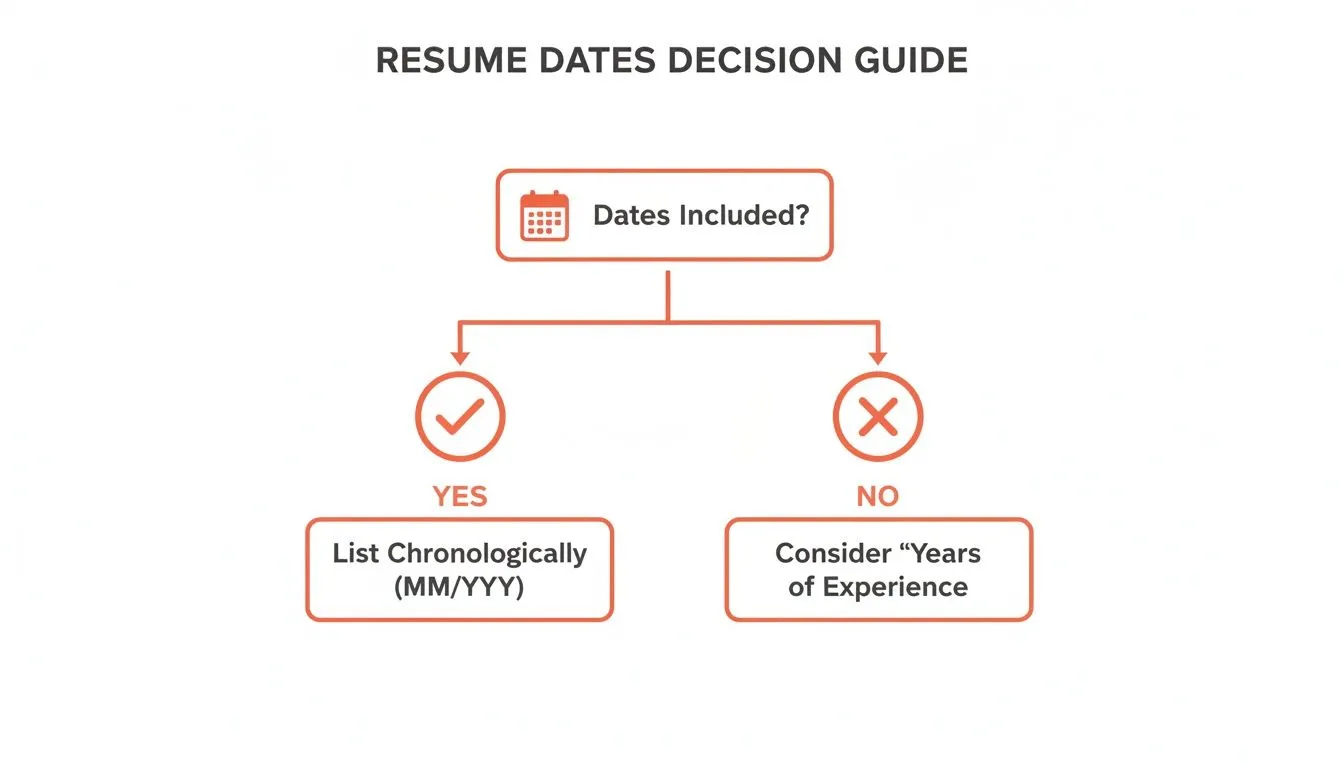
The logic is simple. Do you need to show precision, or smooth over a few bumps in the road?
The Standard Month-Year Format
The default format is Month, Year – Month, Year. It’s the standard for a reason.
- Example: May 2020 – Present
- Example: August 2018 – May 2020
This format shows confidence and a clear career path. Recruiters prefer it because it leaves no room for guessing. If your work history is straightforward, always use this format. It’s what Applicant Tracking Systems (ATS) and hiring managers expect.
Consistency is non-negotiable. Use the same style for every entry. Don’t write “May 2020” for one job and “5/20” for the next. Pick one style and stick to it. And don't add fluff just to fill space. If you're wondering about length, learn when a resume can be two pages.
The Strategic Year-Only Format
The Year – Year format is a tool, not a default. Use it to downplay short-term roles or minor employment gaps.
- Example: 2021 – 2023
- Example: 2019 – 2021
This format zooms out on your timeline. A three-month gap between a job ending in November 2020 and a new one starting in February 2021? It disappears when you list “2018 – 2020” and “2021 – 2023.”
Using the Year-Only format isn't about deception. It’s about controlling the narrative. You prevent recruiters from getting distracted by minor gaps. The goal is to keep their focus on your accomplishments, not on a few months you took off.
But use it with caution. If your entire resume uses year-only dates, it looks like you’re hiding something. It’s most effective when used for just one or two positions to smooth over an otherwise strong history.
Choosing Your Resume Date Format
Which format is right for you? This should make it clear.
| Format | Best For | Why It Works | Potential Risk |
|---|---|---|---|
| Month-Year | Standard Format: Professionals with a consistent work history. | It’s transparent, ATS-friendly, and what recruiters expect. Shows confidence. | Highlights any employment gaps, even short ones. |
| Year-Only | Strategic Use: Hiding minor gaps, de-emphasizing short jobs, or for senior pros. | It smooths your timeline and keeps the focus on the big picture. | Can look evasive if used for every role. Recruiters might assume you're hiding something. |
The goal is to present your story in the most compelling way. Month-Year builds trust through transparency. Year-Only steers the conversation away from minor timeline details and back to your achievements. Choose wisely.
How to Handle Employment Gaps Without Hiding
Career gaps happen. Layoffs, family leave, sabbaticals—they're normal.
The mistake isn't having a gap. It's trying to hide it. Fudging dates raises red flags. Instead of hiding, own your story. Address gaps honestly. It shows confidence and turns a potential weakness into a non-issue.
Frame your time off as intentional, not as a period of stagnation.
Formatting Your Gaps
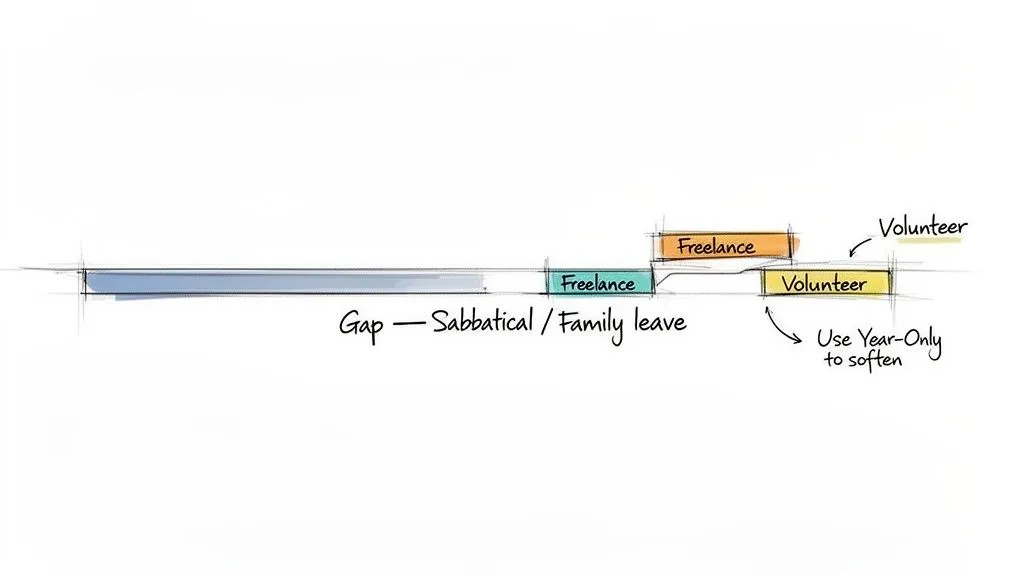
The simplest way to handle short gaps (a few months) is the Year-Only format.
A job that ended in October 2021 and a new one that started in March 2022 looks like a five-month gap. With Year-Only, it just looks like you left one role in 2021 and started another in 2022. Problem solved.
This little trick keeps the reader focused on your experience, not your timeline. No explanation needed.
For longer gaps of six months or more, you need more strategy. Hiding it isn't an option. Address it directly on your resume.
You don't need a long, defensive paragraph. A single, concise line is all it takes to provide context. This stops negative assumptions before they form.
Here’s how to frame different longer gaps:
- Family Leave: Planned career break for family care (2022 – 2023)
- Sabbatical/Travel: Professional sabbatical for international travel and language study (2022 – 2023)
- Skill Development: Career development focused on advanced certifications in project management (2022 – 2023)
- Layoff: Don’t mention the layoff on your resume. Save that for the interview. Let your end date stand on its own.
Addressing Gaps in an Interview
Your resume gets you the interview. The interview is where you tell the full story. If asked about a gap, have a simple, positive answer ready.
Don't apologize. Don't sound defensive. State the facts, explain what you learned, and pivot back to why you're the right person for the job now.
Example Answer for a Sabbatical:
"After five years at my last company, I took a planned six-month sabbatical to travel. It was a great opportunity to recharge, and now I’m eager to bring that renewed energy to a new challenge like this one."
Show that the gap was a deliberate part of your journey, not an aimless period. By addressing dates on a resume with confidence, you control the narrative and keep the focus on your value.
Dating Non-Traditional Career Paths
Your career isn't a straight line. So why does your resume pretend it is?
A linear timeline is a terrible fit for freelancers, contractors, or career changers. Forcing your experience into that rigid format just looks confusing.
Stop trying to make your story fit the template. Make the template fit your story.
For Freelancers and Contractors
Listing every short-term project separately is a disaster. It makes you look like a job-hopper and hides the continuity of your skills.
The fix is simple: group your projects under a single entry.
Create one self-employment entry with a broad date range. Then, use bullet points to highlight the killer projects and big-name clients.
Example for a Freelance Marketer:
Marketing Consultant (Self-Employed) | 2019 – Present
* Client A (2022-2023): Led a content strategy overhaul that increased organic traffic by 40% in six months.
* Client B (2020-2022): Managed a $50k PPC budget, improving conversion rates by 15%.
* Client C (2019-2020): Developed a new brand identity, resulting in a 25% increase in social media engagement.
This format transforms a scattered list of gigs into a powerful portfolio of continuous work. It screams stability and expertise.
For Career Changers
When you're changing careers, your most recent job is often your least relevant. A strict reverse-chronological order buries the experience that matters most.
Bend the rules.
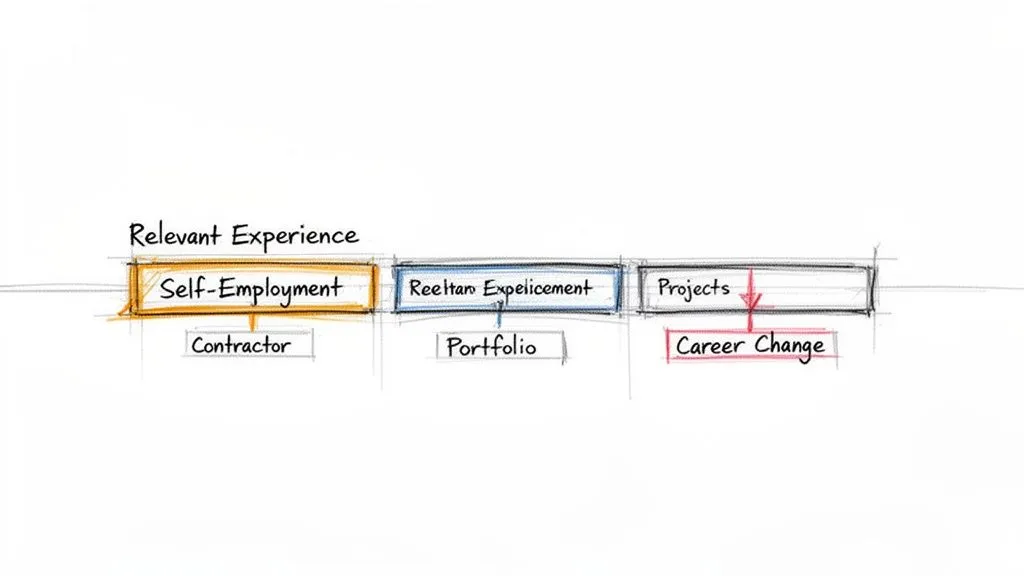
Create a "Relevant Experience" section at the top of your work history. Pull your most relevant roles into this section. Don't ditch the dates, but lead with the experience that makes you the obvious choice. For more on this, see our guide on the career change resume.
This approach tells the recruiter what they need to know, right away. It shows you’ve done your homework. And with 76% of hiring managers now believing work experience matters more than education, framing your tenure is strategically vital.
Your resume is a marketing document, not a legal affidavit. Its job is to tell a clear story about why you’re the best person for this role. Use dates on a resume strategically to build the strongest narrative you can.
Dealing with Age Bias and Older Experience
Let's be blunt: age bias is real. But your experience is your greatest asset. Hiding it is the wrong move. The goal isn't to pretend you're younger. It's to force the recruiter to focus on what matters right now.
You want them thinking about your recent accomplishments, not calculating your age from a degree you earned decades ago. It's about strategic curation, not deception.
The 10-15 Year Rule of Thumb
Recruiters care most about what you’ve done lately. Your work from 20 years ago is less relevant. This is where the 10-15 year rule comes in.
It's a guideline, not a law. Focus detailed, bullet-pointed experience on your last 10 to 15 years of work. This keeps your resume sharp, relevant, and centered on your most potent achievements.
But what about the valuable experience before that? You don't delete it.
Summarizing Earlier Experience
For roles older than 15 years, condense them into a brief summary. This acknowledges your deep history without bogging the reader down in outdated details.
Create a subsection at the bottom of your work history. Call it "Prior Experience" or "Early Career Experience." List the company, your title, and the dates—no bullet points needed.
Example of an "Early Career" Summary:
Prior Professional Experience
* Senior Marketing Manager, Global Tech Inc. (2004 – 2008)
* Marketing Specialist, Innovate Solutions (2001 – 2004)
This approach signals a long, stable career without inviting bias. It shows you have deep experience but respects the reader’s time by focusing on recent wins.
How to Handle Old Education Dates
Your education section can give away your age. If you graduated more than 15 years ago, you have a simple choice.
Just drop the graduation year.
It’s that easy. The degree is what matters, not the year it was awarded. An ATS won’t flag it, and a human won’t be prompted to do the math.
- Before: B.S. in Business Administration, State University, 1998
- After: B.S. in Business Administration, State University
This small tweak keeps the focus on your qualifications, not your age. Every choice you make about dates on a resume should frame your experience as the perfect solution to the employer's problem. You control the story.
How AI Gatekeepers Read Your Dates
Before a human sees your resume, an Applicant Tracking System (ATS) reads it first. These AI gatekeepers are literal, unforgiving robots. They aren't impressed by fancy designs; they need clean, structured data.
Your date format is critical.
Weird formatting or inconsistent styles are the fastest way to get your application tossed. The ATS is programmed to look for specific patterns, like "Month Year – Month Year". When it can’t parse your timeline, it often throws an error, knocking you out before a person even knows you exist.
Giving the Machine Clean Data
The ATS uses your dates to map your career. It calculates how long you stayed in each role and flags any gaps. This data is then used to rank you against other applicants. A clean, reverse-chronological format is your safest bet. It’s the language these systems speak.
This isn’t about keyword stuffing. It’s about structural integrity. For a deeper dive, this guide on how to write a tech resume that beats ATS is a fantastic resource.
You wouldn't submit a tax form with numbers scattered randomly. You follow the boxes. An ATS needs the same predictable structure to read your professional history.
Why This Matters More Than Ever
AI in hiring has made precise formatting non-negotiable. Technology is no longer just a filter; it's a core part of the evaluation.
A messy resume gets scrambled by the ATS, presenting a confusing profile to the recruiter. If you’ve ever wondered why your perfectly crafted resume gets no response, this is often the culprit.
You need a resume that works for both the AI and the human. For guidance on creating a resume that tells a clear story, you can explore what goes into building my perfect resume. Get this right, and a human will finally get the chance to see your value.
Got More Questions About Dates?
You're not alone. Here are quick, straight-to-the-point answers for common curveballs.
How Do I Handle Overlapping Job Dates?
If you were juggling two jobs, list them chronologically by start date. Be clear about what you were doing.
If you had a full-time gig and a freelance hustle, create a separate "Consulting Work" section. This stops a recruiter from thinking you were trying to work two demanding full-time jobs at once—a potential red flag.
What If I Can’t Remember the Exact Months?
Don't guess. If a job was long ago and the months are foggy, just use the Year-Only format (like 2012 – 2014) for that one entry.
It is always better to be a little vague than to be wrong. A background check that turns up an incorrect date can kill your job offer. Honesty is your best policy.
Should I Include a Job I Only Had for a Few Months?
Probably not. If a role lasted less than six months and doesn't add a critical skill for the job you want, you’re better off leaving it out.
Packing your resume with short-term gigs can make you look like a job-hopper. Your resume is a highlight reel, not a legal transcript. Focus on the jobs where you made a real impact.
Do I Need Dates on My Education and Certifications?
It depends on when you earned them.
- Education: If you graduated more than 15 years ago, drop the year. This is a standard move to sidestep age bias. The degree matters, not the date.
- Certifications: Absolutely include the date for recent certs, especially in tech. It proves your skills are fresh. For older ones, the date isn't as important.
Your resume isn't just a list of jobs. It's your career story. If you're struggling to frame your timeline, let StoryCV help. We're a Digital Resume Writer. We use a guided interview to turn your experience into a clear narrative that gets results. Stop fighting with templates. Start telling your story. Build your high-impact resume at StoryCV.