
You've done great work. Your resume says you "managed projects" and were "responsible for growth." So does everyone else's.
Templates and online generators force you into boxes. They are designed to be generic. They crush the details that make your work impressive. This isn't about finding the perfect bullet point to copy. It's about understanding the logic behind a great one. So you can write your own.
We’re going to dissect sample resume bullet points and show you why they work. No generic advice. Just the strategies that turn a bland duty into a compelling achievement.
This guide gives you a clear, repeatable process to articulate your value. We will cover:
* The simple formula for showing results.
* Framing impact with the Problem-Action-Result (PAR) model.
* Using scope and scale to show the size of your contributions.
* Telling a clear before-and-after story.
The goal is to stop sounding like a template and start sounding like you. We'll give you bullet points in resume examples and the thinking behind them. No fluff. Let's get to it.
1. Action Verb + Quantifiable Result Format
This isn't a template. It's a formula for impact. Stop listing job duties and start showing what you actually accomplished.
Passive descriptions like "Responsible for social media" are resume dead space. They tell a hiring manager what you were supposed to do, not what you did. The Action Verb + Quantifiable Result format shifts the focus to your direct contributions. It combines a strong verb with a hard number to prove your value. This is how you craft sample resume bullet points that get noticed. It speaks the language of business: results.
Example Breakdown
Here are some bullet points in resume examples using this structure:
- Before: Managed customer onboarding process.
-
After: Led a cross-functional team of 8 to redesign customer onboarding, reducing time-to-activation by 40% and improving retention by 23%.
-
Before: Handled social media accounts.
- After: Increased social media engagement by 156% in 6 months through a targeted content strategy, growing the follower base from 15K to 39K.
How to Apply This
This method forces you to think like a storyteller, not just an employee. It's the core of how a Digital Resume Writer works: moving from tasks to narrative.
- Start with the Action: What did you do? Use a powerful verb ("Architected," "Negotiated," "Automated").
- State the Outcome: What changed because of your action? Use numbers. Percentages, dollar amounts, time saved, user growth.
- Add Context (The "How"): Briefly explain the method, like "through a targeted content strategy." This adds credibility.
Key Takeaway: Don't just list responsibilities. Lead with a strong action verb and follow it immediately with a metric. This simple shift turns a passive duty into a powerful story of your achievement.
2. PAR Framework (Problem-Action-Result)
The PAR framework adds strategic storytelling. It answers the "why" behind your action, giving context that showcases your business sense. This structure frames your accomplishments as solutions to specific problems. That's highly compelling.
The PAR (Problem-Action-Result) framework turns a bullet point into a mini-case study. It shows you don’t just perform tasks; you identify issues, devise solutions, and deliver measurable outcomes. It’s an ideal way to construct sample resume bullet points that prove you think like a leader.
Example Breakdown
Let’s look at some bullet points in resume examples using the PAR structure:
- Problem: Engineering team facing a 3-week deployment cycle bottleneck.
- Action: Implemented a CI/CD pipeline and automated testing framework.
-
Result: Reduced deployment time to 2 hours, enabling 10x faster feature releases.
-
Problem: Career transition with no direct marketing experience.
- Action: Led a pro-bono digital marketing overhaul for a nonprofit, applying project management expertise to a demand generation campaign.
- Result: Generated 250 qualified leads and established a portfolio of marketing work.
How to Apply This
Using the PAR method is powerful for career changers or roles in project management and consulting. It's about uncovering the narrative behind your work.
- Identify the Problem: What was the business pain point? Keep it concise.
- Describe your Action: What specific steps did you take? This is where your powerful action verb goes.
- Show the Result: Quantify the outcome. How did your action solve the problem?
Key Takeaway: The PAR framework gives context to your metrics. By starting with the problem, you establish the business value of your actions, showing you connect your work to the company’s bottom line. For more on this, see our guide on good bullet points.
3. Industry-Specific Language and Terminology
Generic language makes you sound like an outsider. Using precise, role-appropriate terminology shows you speak the language of the business. It demonstrates instant credibility and helps you pass through ATS filters. "Improved customer retention" is forgettable.
Speaking the language of your target industry is non-negotiable. It signals that you require less ramp-up time. This approach to crafting sample resume bullet points separates experts from generalists.
Example Breakdown
Here are bullet points in resume examples that use industry-specific terms:
- Before: Improved system performance.
-
After: Reduced API latency by 200ms through query optimization and database indexing. (Tech)
-
Before: Managed inventory.
-
After: Optimized SKU rationalization strategy, reducing inventory carrying costs by $240K while maintaining service levels at 96%. (Operations)
-
Before: Improved quality of new hires.
- After: Designed an employer branding initiative, improving the quality-of-hire score from 2.8 to 3.6 and reducing time-to-productivity by 3 weeks. (HR)
How to Apply This
This isn't about stuffing your resume with jargon. It's about using the precise terms that define success in your field. For specialized fields like remote writing jobs, using terms like "SEO content briefs," "SERP analysis," or "conversion copywriting" is crucial.
- Isolate Core Metrics: What KPIs define success in your role? For SaaS, it's churn and LTV. For finance, it's variance analysis.
- Borrow from Job Descriptions: Scour job listings for your target role. Note the specific nouns and verbs they use. Integrate them.
- Translate Your Actions: Reframe your accomplishments using that specific language. "Helped the sales team" becomes "Enabled sales with battle cards and one-pagers."
Key Takeaway: The right terminology is a signal of belonging. It proves you’re not just a candidate but a peer who already understands the business. It’s the difference between "I worked on the car" and "I calibrated the fuel injectors."
4. Scope and Scale Indicators
"Increased sales by 20%" is good. But 20% of what? A hundred dollars or a million? Scope and scale indicators provide the context that proves your level of responsibility. They answer the "how big?" question. How big was your team, budget, or user base? This helps recruiters calibrate your seniority.
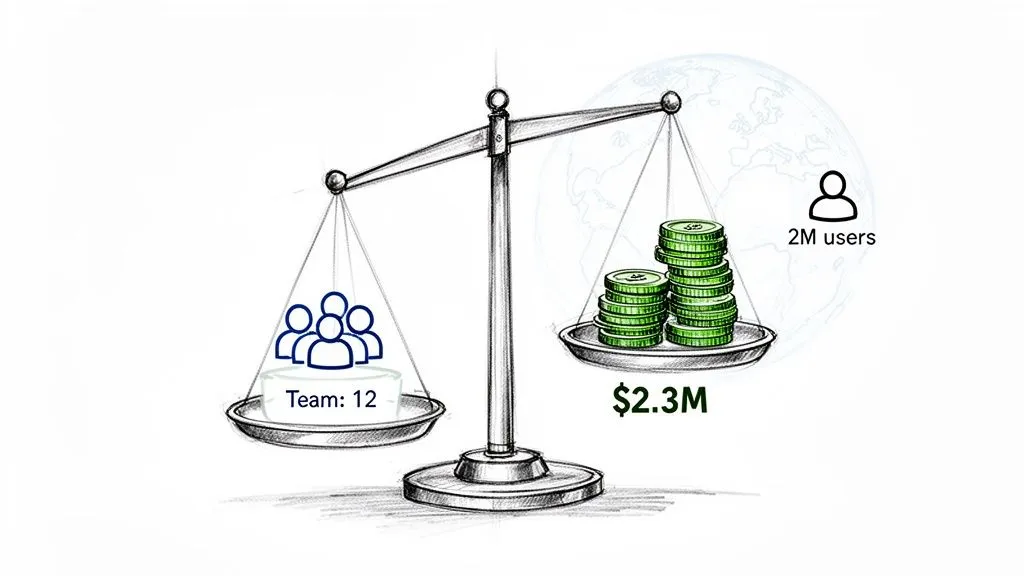
Without scope, accomplishments feel abstract. Adding indicators like budget managed, number of users, or team size gives your achievements tangible weight. It turns a statement into a powerful demonstration of your capability.
Example Breakdown
Here are some bullet points in resume examples that effectively use scope and scale:
- Before: Managed marketing budget for regional campaigns.
-
After: Managed a $2.3M annual marketing budget across 5 regional campaigns, driving a 38% ROI increase year-over-year.
-
Before: Led an engineering team.
- After: Led a team of 12 engineers across 3 time zones, delivering 4 major platform releases affecting 2M+ daily active users.
How to Apply This
This technique anchors your achievements in reality. You can learn more about framing these numbers in our guide on using metrics in your resume.
- Identify Key Scopes: What numbers define your work's scale? Think budgets, team size, number of accounts, or geographic reach.
- Lead with Impactful Scope: For a manager role, lead with team size. For a finance role, lead with budget.
- Combine Scope with an Outcome: Don’t just state the scale. Connect it to a result. "Oversaw a 150-person operations center... with 99.8% accuracy."
Key Takeaway: Stating the scale of your work is non-negotiable for experienced professionals. It provides immediate context for your accomplishments, helping recruiters understand the gravity of your role.
5. Before-and-After Storytelling
Great accomplishments don't happen in a vacuum. This method frames your work as a clear transformation. It shows the situation you inherited and the outcome you created. It’s pure storytelling.

"Improved CSAT to 4.2/5" is good. Showing you started with a 2.1/5 score tells a much more powerful story. This approach provides context. It proves you can step into a challenging environment, diagnose the issue, and deliver a turnaround. These are some of the most compelling sample resume bullet points you can write.
Example Breakdown
Here are bullet points in resume examples using this narrative structure:
- Before: Inherited underperforming sales region ranked 47th of 50.
-
After: Grew region to a top 5 performer within 18 months by implementing a new coaching framework, generating $3.2M in new annual recurring revenue.
-
Before: Took over a legacy codebase with 40% test coverage and 3-week deployment cycles.
- After: Refactored testing strategy and infrastructure to achieve 89% coverage and cut deployment cycles to 2 days, improving stability and developer velocity.
How to Apply This
This technique makes you the hero of your own career story. It’s a core principle of our Digital Resume Writer: showing the problem you found and the solution you built.
- Establish the "Before": What was the initial challenge? Use words like "Inherited," "Took over," or "Identified." Describe the problem with a metric (e.g., low-ranking region, poor test coverage).
- Describe Your Action: What was your intervention? Briefly state the key actions you took ("by implementing a new coaching framework").
- Show the "After": What was the new reality? Present the final, improved state with a hard number.
Key Takeaway: Context is everything. Frame your accomplishment as a journey from a clear problem to a measurable solution. This narrative structure turns a simple metric into a compelling story of impact.
6. Cross-Functional Collaboration Emphasis
No one works in a silo. High-impact work involves other teams. Showing you can align different departments—product, engineering, finance, legal—proves you can drive results without direct authority. It shows influence and big-picture thinking.

This approach focuses on your role as the connector who bridges gaps. It’s not just about teamwork; it’s about strategic partnership that creates measurable value. This is a critical skill our narrative prompts are designed to uncover.
Example Breakdown
Here are bullet points in resume examples that showcase cross-functional wins:
- Before: Worked with other teams on a new vendor process.
-
After: Coordinated with legal, finance, and operations to establish a new vendor management process, cutting contract approval time from 8 to 2 weeks and improving the compliance score from 72% to 98%.
-
Before: Helped fix customer issues.
- After: Led a cross-functional working group (sales, support, product) to resolve the top 20 customer requests, achieving a 94% resolution rate and a 15% improvement in NPS.
How to Apply This
This strategy highlights your ability to be a force multiplier. It’s a core element of building sample resume bullet points that show leadership potential.
- Identify the Partners: Which teams did you work with? Name them (e.g., "engineering," "marketing," "legal").
- State the Shared Goal: What project did you work on together?
- Quantify the Collective Win: What was the final result of this partnership? Use a clear metric to show the impact.
Key Takeaway: Don't just mention "teamwork." Prove it by naming the specific teams you partnered with and tying that collaboration to a significant, quantified business outcome.
7. Learning and Growth Indicators
This isn't about a "skills" section. This is about showing your commitment to growth and proving you can apply new knowledge. Especially for career changers, demonstrating you are a fast learner is a major advantage. It shows ambition.
"Completed Google Analytics certification" is incomplete. The powerful move is connecting that learning directly to a business outcome. This turns a passive credential into an active story, making your sample resume bullet points far more compelling.
Example Breakdown
Here are bullet points in resume examples that showcase growth:
- Before: Earned AWS Solutions Architect certification.
-
After: Developed cloud expertise by earning AWS Solutions Architect certification and independently migrating 6 legacy systems to AWS, improving uptime from 98.2% to 99.97%.
-
Before: Promoted to management and completed a coaching program.
- After: Promoted to first management role; completed an executive coaching program and applied new frameworks (radical candor, OKR setting), improving team engagement scores from 3.1 to 3.8/5.
How to Apply This
This approach frames your career as a trajectory, not a static list of jobs. It shows you're not waiting for tasks but are actively building skills to solve future problems.
- Identify the Learning: Pinpoint a specific skill, certification, or new competency.
- Connect to Application: How did you immediately use that new knowledge on the job?
- Quantify the Result: What was the measurable impact of applying that new skill?
Key Takeaway: Don’t just list certifications. Pair every instance of learning with a concrete example of its application and the resulting business impact. This proves you not only learn but create value from that knowledge.
8. Customer and User Impact Framing
Companies exist to serve customers. Showing you understand this is a massive advantage. This method moves beyond internal metrics to focus on the end-user outcome. It shows customer-centric thinking and creates an emotional connection.
Focusing on customer impact proves you understand the "why" behind your work. This approach is perfect for crafting sample resume bullet points that tell a story of empathy and value.
Example Breakdown
Here are bullet points in resume examples framed around the user:
- Before: Fixed bugs in the complaints process.
-
After: Redesigned the complaints process, reducing average resolution time from 14 days to 2 days and improving satisfaction from 2.8 to 4.3/5.
-
Before: Was part of the product roadmap planning.
-
After: Built a customer feedback loop into the product roadmap, ensuring the top 20 user-requested features shipped quarterly and improving feature adoption from 18% to 67%.
-
Before: Worked on user accessibility features.
- After: Developed accessible onboarding for users with disabilities, expanding the addressable market by 8% (240K potential users).
How to Apply This
This technique is powerful for roles in product, customer success, design, and marketing.
- Identify the User: Who was the ultimate beneficiary of your work? A customer, an internal user, a partner?
- State the User Benefit: How did their experience improve? Use clear, empathetic language like "enabling customers to" or "helping users avoid."
- Connect to a Business Metric: Link the user benefit back to a business goal like satisfaction, retention, or revenue.
Key Takeaway: Translate your internal achievements into external customer wins. By framing your impact around the end-user, you demonstrate a deep, strategic understanding of the business.
9. Strategic Initiative Ownership
This is where you move from executor to strategist. Senior roles require you to identify opportunities, build a business case, and lead an idea from conception to impact. Simply stating you "led an initiative" is not enough. You must show the why.
Strategic Initiative Ownership shows you think like a leader. It shows you can spot a market gap or an internal inefficiency and marshal resources to solve it. These are some of the most powerful sample resume bullet points because they prove your direct influence on the company's direction.
Example Breakdown
Here are some bullet points in resume examples that show true ownership:
- Before: Launched a new segment for mid-market companies.
-
After: Identified a market opportunity in the mid-market segment; designed and led the go-to-market strategy, generating $4.2M ARR within 18 months (15% of total company revenue).
-
Before: Helped the company deal with a competitor.
- After: Recognized a competitive threat from an open-source solution; developed a product roadmap prioritizing key differentiators that prevented an estimated 20%+ customer churn.
How to Apply This
This framework is crucial for aiming for director-level positions. It’s about framing your work in the context of business strategy.
- Start with the "Why": What was the trigger? State the problem or opportunity you identified ("Recognized competitive threat," "Identified market gap").
- Describe Your Strategic Action: What did you propose or design? Mention the business case or roadmap you created.
- Show the End-to-End Result: Connect your vision to a concrete business outcome. Use high-level metrics like revenue or market share.
Key Takeaway: Show your full strategic arc. Start with the initial insight, detail your leadership in creating the solution, and end with the business impact. This proves you don't just complete tasks; you create value.
10. Adaptability and Resilience Under Change
Change is a constant. Employers know it. Highlighting your ability to navigate ambiguity isn't just a soft skill; it's a core competency. You must prove it by showing how you maintained or improved performance during disruption.
This approach frames adaptability as a strategic strength. It tells a hiring manager you don't just survive change; you use it as a catalyst for improvement. These sample resume bullet points tell a story of resilience and tangible results.
Example Breakdown
Here are bullet points in resume examples that showcase this skill:
- Before: Helped team work from home during the pandemic.
-
After: Pivoted a 25-person team to fully distributed in 2 weeks during COVID-19, redesigning workflows for async collaboration and maintaining productivity at 102% of pre-pandemic levels.
-
Before: Responsible for bringing in new business after a client left.
-
After: Managed a sudden 35% revenue reduction by rapidly identifying alternative growth streams, landing 12 new mid-market customers and recovering 85% of lost revenue in 6 months.
-
Before: Took on extra duties during a leadership change.
- After: Transitioned to a new tech stack (Salesforce to HubSpot) mid-project; led data migration for 500 accounts and completed the transition 2 weeks ahead of schedule.
How to Apply This
This method requires you to identify a specific moment of unexpected change and connect it to a positive outcome.
- Isolate the Disruption: Pinpoint the event (e.g., leadership change, budget cut, tech migration).
- Describe Your Proactive Response: Start with an action verb showing you took control ("Pivoted," "Redesigned," "Stabilized").
- Quantify the Stability or Growth: What was the result? Show how you maintained productivity or recovered revenue despite the chaos. Metrics are non-negotiable.
Key Takeaway: Don't just claim you're adaptable. Find a crisis, a pivot, or an unexpected challenge. Frame your actions as the solution and prove your effectiveness with hard numbers. This demonstrates leadership under pressure.
Top 10 Resume Bullet Point Comparison
| Approach | Implementation Complexity 🔄 | Resource Requirements ⚡ | Expected Outcomes 📊⭐ | Ideal Use Cases 💡 | Key Advantages ⭐ |
|---|---|---|---|---|---|
| Action Verb + Quantifiable Result Format | Low–Medium; formulaic but repeatable | Needs reliable metrics and keyword optimization | High measurable impact; strong ATS pass; quick recruiter attention | Universal; roles with measurable outputs; all seniorities | Clear, verifiable impact; concise and ATS‑friendly |
| PAR Framework (Problem‑Action‑Result) | Medium; requires context and reflection | Requires situation details and longer bullets | Increases credibility; shows problem‑solving and strategy | Career changers, mid‑level roles, veterans, strategic positions | Contextualizes achievements; explains why results mattered |
| Industry‑Specific Language and Terminology | Low–Medium; needs domain research | Requires accurate jargon and targeted keywords | Better ATS matching; signals technical fluency to specialists | Technical, operations, finance, niche industry roles | Demonstrates insider knowledge and role credibility |
| Scope and Scale Indicators | Low; straightforward if figures available | Needs team size, budget, user or geographic metrics | Clarifies seniority and impact magnitude for recruiters | Leadership, product, ops, mid‑to‑senior roles | Communicates responsibility and aids leveling decisions |
| Before‑and‑After Storytelling | Medium; needs credible baseline and attribution | Requires before‑state data and outcome metrics | Compelling transformation narratives; memorable impact | Turnarounds, new leaders, process improvements, career pivots | Makes change vivid; emphasizes measurable improvement |
| Cross‑Functional Collaboration Emphasis | Medium; balance individual vs. team credit | Needs examples of stakeholders and coordination | Shows influence, stakeholder management, and alignment | Product management, ops, program leadership, matrix orgs | Demonstrates ability to drive results without direct authority |
| Learning and Growth Indicators | Low; must tie learning to applied results | Requires certifications, training, and applied examples | Signals upskilling, learning agility, and potential | Recent grads, career changers, veterans, returners | Highlights growth mindset and demonstrated capability |
| Customer and User Impact Framing | Medium; requires customer context and empathy | Needs user metrics, feedback, and business linkage | Creates emotional resonance; links features to user value | Product, customer success, consumer roles, healthcare | Humanizes impact; shows customer‑centric decision making |
| Strategic Initiative Ownership | High; needs strategic rationale and business case | Requires planning, executive buy‑in, and cross‑func delivery | Positions candidate for senior roles; shows measurable strategic ROI | Mid‑senior leaders, director/executive tracks, strategic hires | Differentiates strategic thinkers; full ownership from idea to impact |
| Adaptability and Resilience Under Change | Medium; must be authentic with outcomes | Needs concrete change examples and outcome linkage | Demonstrates resilience, rapid learning, and stability under change | Startups, restructuring, transitions, fast‑moving industries | Signals ability to thrive in ambiguity and recover from disruption |
Stop Copying. Start Talking.
You’ve seen the sample resume bullet points. You’ve seen the formulas, the action verbs, the "before and after" stories. The goal was never to find the perfect bullet point to steal. It was to understand why certain bullet points work. So you can create your own.
A great resume is a story of impact, not a list of duties. It’s evidence of problems you've solved and value you've created. The frameworks here are your tools for unearthing that evidence from your career. They are a starting point, not a destination.
Your Story Is Your Differentiator
Every example we analyzed boils down to a few core principles. Internalize these, and you'll never need to hunt for another generic template.
- From "What" to "So What?": Don't just state the task. Explain the outcome.
- Numbers Tell the Story: Metrics are the most direct way to prove your value.
- Context is King: A bullet point without context is just a claim. Scope, scale, and strategic importance give it weight.
- Speak Their Language: Using industry-specific terminology signals you're a genuine insider.
The problem with most sample resume bullet points online is they encourage you to think like a machine. Fill in the blanks. Swap out a few words. This produces generic, soulless documents that blend into a sea of sameness.
The Big Mistake: Filling Boxes
Your career wasn’t a template. You faced unique challenges. A resume that just fills boxes ignores the most valuable part of your story: the context, the struggle, and the specific impact you made.
True articulation of your value comes from a conversation. It comes from someone asking, "Okay, but what was the real problem you were trying to solve? How did you know it worked?" This is how you create a narrative a hiring manager connects with. Your resume should be the script for the interview you want.
Stop looking for the perfect words to copy. Start talking about your work, your challenges, and your wins. That’s how you write a resume that does its job—getting you yours.
Tired of staring at a blank page? StoryCV is a digital writer that interviews you about your work, guiding you to uncover the impact and metrics that matter. It helps you tell your story, not just list your tasks. Start your conversation with StoryCV.