
You've done the work. But your resume says you "managed projects" and were "responsible for reports." That's why it's being ignored.
Great resume bullet points aren't a list of duties. They're concise stories of your achievements. They prove your value in the few seconds a recruiter gives you.
Why Your Resume Bullets Are Being Ignored
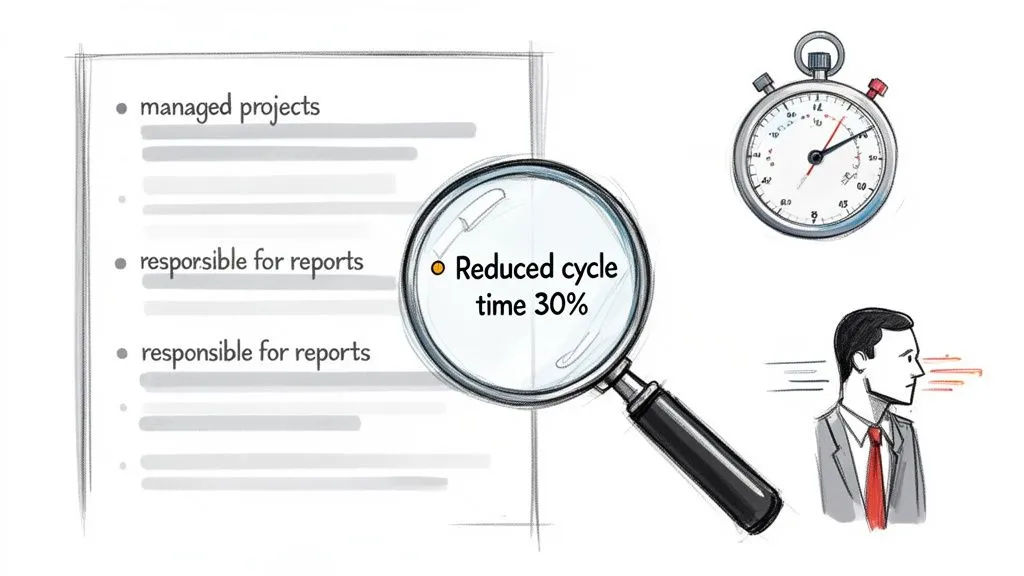
Recruiters spend about seven seconds on your resume. They aren’t reading. They’re pattern-matching. Hunting for proof of impact, not a lazy copy of your job description.
When your bullet points are a passive task list, you blend in. Phrases like "responsible for," "duties included," or "involved in" are dead weight. They describe what you were hired to do, not what you actually accomplished.
This creates two problems for you. One human, one robotic.
The Human Problem
Hiring managers want people who make things happen. They need to see how you saved time, cut costs, or drove revenue.
A bullet point like "Managed social media accounts" tells them nothing.
Did you increase engagement by 40%? Drive a 15% lift in lead generation? Without that context, your work is invisible. You look like you did the bare minimum.
The mindset shift: move from "what I did" to "what I achieved." This isn't tweaking words. It's reframing your professional story around results.
The Robot Problem
Before a human sees your resume, an Applicant Tracking System (ATS) scans it. These bots are simple filters. They match keywords from the job description to your resume.
Vague, responsibility-focused bullets lack the specific, action-oriented keywords and metrics these systems look for. The best resume bullet points pass a two-part test: they satisfy the machine with the right terms while telling a compelling story to the human who reads it next.
Your bullets are failing because they’re written from your perspective—a list of things you did. Write from the employer's perspective. Show them the value you created.
If you need a broader look at crafting your entire document, you can find more strategies on how to write a professional resume. For now, stop listing and start proving.
A Simple Framework for Powerful Bullet Points
Stop guessing. There's a logical way to structure your accomplishments. It doesn't involve staring at a blank page. Forget the fluff.
The method is simple: Context, Action, Result (CAR). It’s a no-BS framework for turning a vague task into a high-impact statement. This isn't a trick. It's a repeatable system that helps you build powerful resume bullet points every time.
Let's break it down.
Set the Stage with Context
Every good story has a setting. For your resume, Context is the problem or situation you faced. It gives the reader a reason to care about what you did next.
Without context, your actions mean nothing. "Increased website traffic" is empty. But "Increased website traffic after a major algorithm update tanked our organic reach"—now that’s a story.
Think about the "why" behind your work.
* Was the company losing money on a product?
* Was a critical process slow and inefficient?
* Was the team struggling with low morale after a re-org?
* Was there a market opportunity everyone was ignoring?
This is your starting point. Briefly describe the business pain. Set the hook.
Describe Your Action
This is where you detail what you actually did. Use strong, dynamic verbs. Kill passive phrases like "responsible for" or "assisted with." They suck the energy from your accomplishments.
Choose words that show ownership.
- Instead of: Helped with a project.
-
Try: Spearheaded a cross-functional initiative.
-
Instead of: Was in charge of the budget.
- Try: Overhauled the departmental budget.
Your action should directly respond to the context you established. If the problem was a slow manual process, your action might be that you automated, re-engineered, or redesigned it.
For a deeper dive into crafting impactful achievements, check out our complete guide on using bullet points in a resume.
Your goal isn't just to list a task. It's to connect a specific action to a specific problem. This transforms a duty into a compelling accomplishment.
A weak verb can undermine an impressive achievement. You’re swapping a generic word for one with weight and specificity. Small change, huge difference.
Swap Weak Verbs for Stronger Alternatives
| Instead of This | Try This | Example Usage |
|---|---|---|
| Led | Orchestrated | Orchestrated the transition to a new CRM, migrating 25,000+ customer records. |
| Managed | Directed | Directed a team of 5 engineers to launch a new feature in under 6 weeks. |
| Improved | Overhauled | Overhauled the onboarding process, reducing new-hire ramp-up time by 30%. |
| Created | Architected | Architected a scalable data pipeline to support real-time analytics. |
| Handled | Navigated | Navigated complex vendor negotiations, securing a 15% cost reduction. |
| Helped | Championed | Championed a new QA protocol that cut critical bugs in production by 40%. |
Choosing the right verb is about precision. It’s the difference between telling a recruiter you were present versus showing them you were the driving force.
Prove It with the Result
This is the most critical part. The Result is the payoff—the measurable outcome of your action. It answers the recruiter's most important question: "So what?"
Good bullet points are built on proof. Quantify your impact. Use numbers, percentages, or clear outcomes. Condensing work into impactful points is a skill, much like learning how to summarize long-form podcasts. Both require distilling value into its most potent form.
To find your results, ask yourself:
* How much time did I save?
* How much money did I make or save?
* By what percentage did I increase efficiency?
* How many people (users, customers, team members) were impacted?
Even if your role isn't data-heavy, you can still show the result. A documented improvement in team morale, a successfully launched product, or a streamlined workflow everyone adopted are powerful outcomes.
Combine these three elements—Context, Action, and Result—to create a miniature story that proves your value in a single line.
Finding the Numbers That Prove Your Impact
“Quantify everything” is useless resume advice. It assumes you know how to find the numbers, especially if your job wasn't heavy on analytics.
Let’s be practical.
Numbers aren't just for salespeople. Every role creates measurable value. You just have to know where to look. Stop hunting for one perfect metric. Start thinking about the different types of impact you made. The goal isn't to invent numbers—it's to find the language to measure your real-world results.
This is where CAR (Context, Action, Result) helps. It’s less of a formula, more of a storytelling structure.
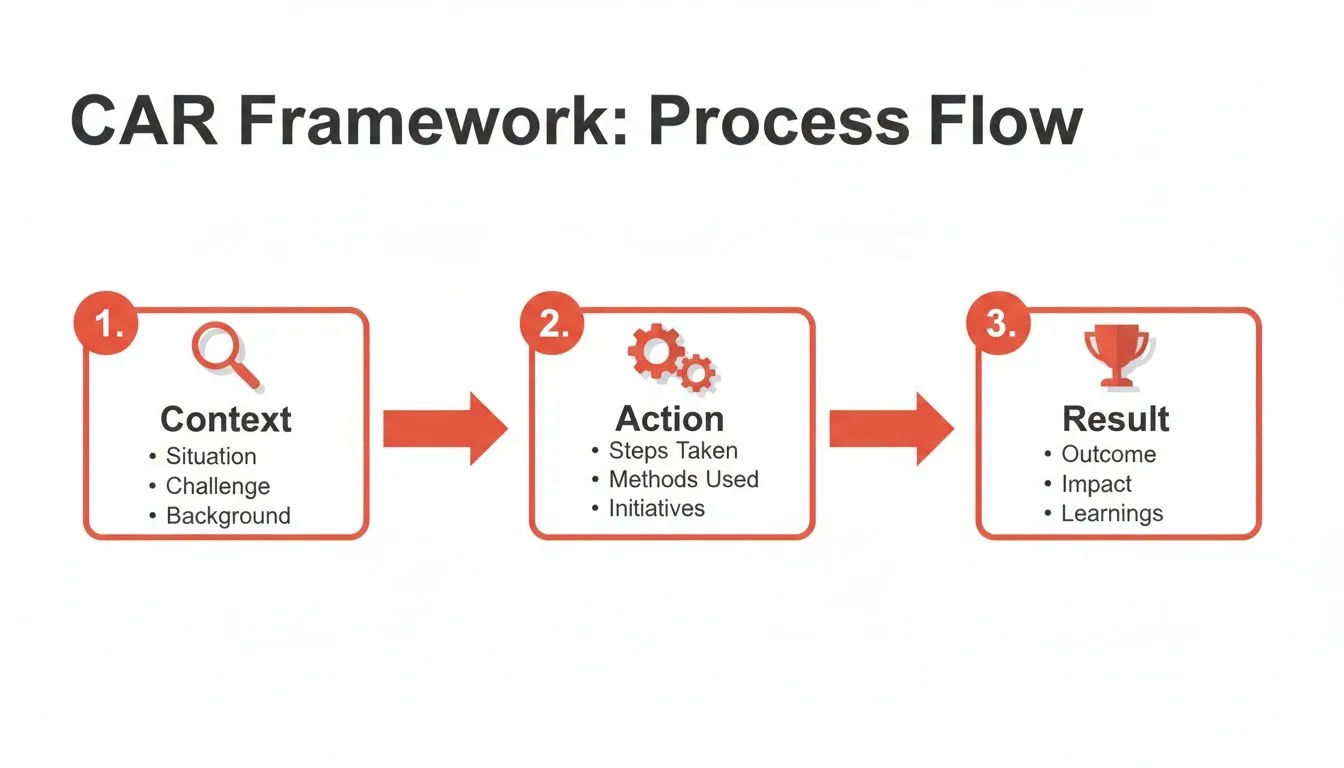
It’s just a way to connect the dots: start with the problem (Context), explain what you did (Action), and prove it worked (Result). That’s how you build a compelling story of achievement, one bullet point at a time.
Three Ways to Quantify Your Work
Not every achievement has a dollar sign. Impact takes many forms. Look for numbers that show scale, frequency, or efficiency.
- Scale: How big was it? Think budgets, team sizes, or customer numbers. Managed a $2M marketing budget or Supported 500+ enterprise clients.
- Frequency: How often did you do it? This highlights consistency. Think: Published 5 articles per week or Resolved 20+ support tickets daily.
- Efficiency: How much better, faster, or cheaper? This is about improvement. Think: Cut report generation time by 30% or Reduced customer onboarding steps from **10 to 6.
If you want to dig deeper, our guide on how to write achievements in a resume can help. The main takeaway: find data that makes your claims concrete.
How to Find Your Numbers
Still stuck? Use these questions as a checklist. Don't overthink it. Just write down what comes to mind.
Your past performance isn't a list of tasks. It's a collection of problems you solved. The numbers are the evidence you solved them well.
Time-Based Questions
* Did you deliver a project ahead of schedule? By how many weeks?
* Did you slash the time for a routine task? By what percentage?
* Did you automate something? How many hours did that save each week?
Money-Based Questions
* Did your work help increase revenue? By how much?
* Did you find a way to cut costs? How much did that save per year?
* Did you negotiate a better deal with a vendor? What was the discount?
Process-Based Questions
* Did you clean up a messy workflow? How many steps did you eliminate?
* Did you reduce errors in a process? By what percentage?
* Did you increase your team's output?
Even roles that seem "soft" have hard numbers. An HR manager can quantify a drop in employee turnover. An operations lead can measure a decrease in production errors.
The best resume bullet points are built on specific, undeniable proof of your value.
Seeing the Difference: Real-World Bullet Point Makeovers
Theory is fine. Seeing the change is what makes it click. Let's watch vague responsibilities morph into sharp, high-impact achievements.
We’ll take common, lazy bullet points and rebuild them. These examples for Tech, Marketing, and Operations use logic that works for everyone.
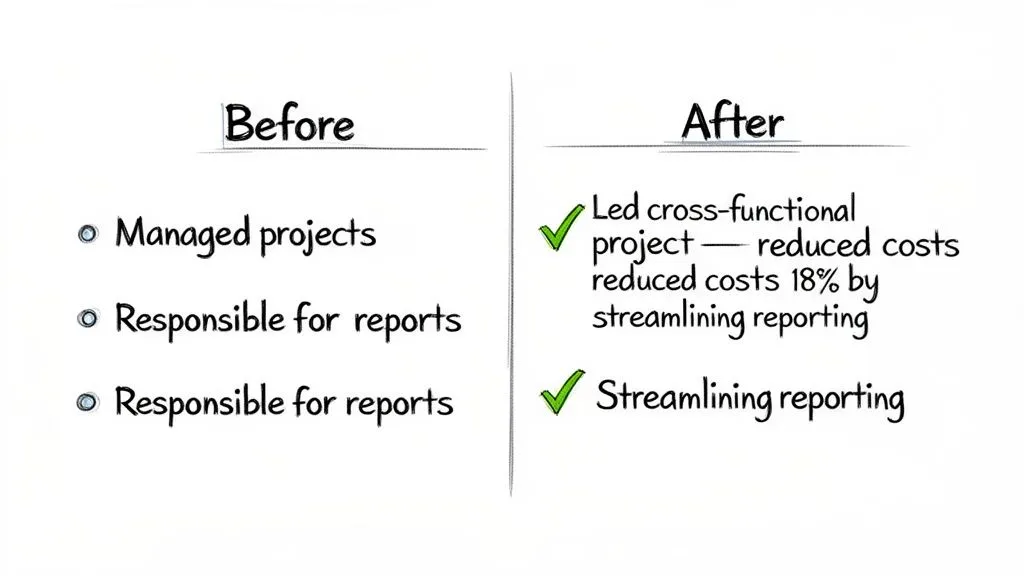
Every rewrite uses the CAR framework: Context, Action, Result. The "after" versions don't just list a task. They tell a quick, powerful story about the value you created.
For the Tech Professional
Tech resumes are often a mess of jargon and process. Translate your technical work into business outcomes. Don't just list technologies. Show what you built and why it mattered.
Before:
* Responsible for backend development and API maintenance.
This is a job description. It's passive. It tells me nothing about your skill, scale, or problem-solving. It's a guaranteed skip.
After:
* Architected and deployed a new microservices-based backend for the flagship mobile app, reducing API response times by 60% and supporting a 200% surge in user traffic.
Why it works:
The "after" bullet tells a complete story. "Architected" is a power verb. The context is clear—the company's most important app. The results are specific, quantifiable wins: a faster user experience and stability to handle growth. This proves your value goes beyond just writing code.
For the Marketing Professional
Marketing is results-driven, yet many marketing resumes are full of fuzzy activities. Connect every action to a core business metric like leads, revenue, or engagement.
Before:
* Managed social media channels and created content.
This sounds like a generic, entry-level task list. It ignores strategy, audience, and impact. It’s a bullet point just taking up space.
After:
* Overhauled the social media strategy, shifting from broadcast posts to community-focused content that drove a 45% increase in organic engagement and generated $50K in attributable sales pipeline in Q3.
This revision screams strategic ownership. "Overhauled" shows you didn't just maintain the status quo—you fixed something. The results are specific and tied to the bottom line, showing a clear return on investment.
For the Operations Professional
In operations, you're the engine of the business. Your world revolves around efficiency. Your bullet points must reflect that. Show how you made things faster, cheaper, or more reliable.
Before:
* Involved in improving supply chain logistics.
"Involved in" is one of the weakest phrases for a resume. It makes you sound like a bystander. The description is so vague it's meaningless.
After:
* Redesigned the end-to-end supply chain workflow by implementing a new inventory management system, which cut order fulfillment errors by 25% and reduced shipping costs by 15% within six months.
Why it works:
This version is active and specific. "Redesigned" shows initiative. The results—fewer errors and lower costs—are exactly what an operations manager looks for. It proves you understand the purpose of your role: to make the business run better. For more ways to frame achievements, explore other resume bullet points examples.
These before-and-afters show the best bullet points require a mental shift: from what you did to what you achieved.
Writing for Both Robots and Humans
Your resume has two audiences. You have to impress both. First is the Applicant Tracking System (ATS), a bot scanning for keywords. Second is the human who decides if you’re worth a call.
Too many people get this backward. They either stuff their bullets with keywords until they sound robotic, or they write a great story that gets filtered out before a human sees it.
Find the balance. Write compelling bullet points that satisfy the algorithm without sacrificing the clarity a human needs. Write for the human first, then tweak for the machine. Not the other way around.
Satisfying the Robot
The ATS isn’t smart. It's a matching tool. Your only job is to give it the keywords and skills from the job description.
For formatting, keep it simple.
* Use standard bullet symbols: A solid circle (●) or a hyphen (-) is best. Fancy symbols can get scrambled.
* Stick to common fonts: Use something clean like Arial, Calibri, or Helvetica.
* Avoid tables and columns: They confuse the parser, which can misread your info.
Once your formatting is clean, weave in the keywords. If the job description mentions "agile project management," find a natural way to include that exact phrase in your achievement-focused bullet points.
Captivating the Human
You made it past the bot. Now a person is scanning for proof you can solve their problems. This is where your strong verbs and quantified results do the work. A human wants to see your impact, not just a list of skills.
This is why achievement-focused writing is non-negotiable. Data shows 75% of recruiters prioritize resumes that pass ATS scans, which look for quantifiable impact. And with around 20 million job openings posted in 2023, competition is fierce. You can dig into these trends with these comprehensive resume statistics.
Think of it this way: keywords get you through the door. Quantified achievements get you the interview.
The best resume bullet points are built for both audiences. They use the language of the job description to frame a clear story of your accomplishments. It’s not about cheating the system. It’s about speaking the right language to both the machine and the manager.
Why a Digital Resume Writer Beats a Template
Resume templates are a trap. They look clean but offer zero help with the hardest part—finding the right words.
You end up staring at a blank box, trying to cram years of achievements into a pre-made format. It feels like telling a story using fill-in-the-blanks. This forces you into the generic, responsibility-focused language we’re trying to kill. Great bullet points aren’t about formatting; they’re about articulating your unique impact. A static template can't help with that.
The Problem with Most AI Tools
Generic AI text generators aren't an improvement. They scrape the internet for common phrases and spit back robotic, keyword-stuffed sentences that sound like everyone else’s. They have no idea about the context of your work.
They don’t know your "project management" involved navigating a brutal budget cut. You get a resume that feels soulless—precisely what hiring managers are trained to ignore.
The global resume writing service market is booming, on track to hit USD 3.64 billion by 2030. That’s a lot of people looking for a better way to tell their story. You can see the full research on this market growth and see how high the demand is.
A template makes you a box-filler. A digital resume writer turns you into a storyteller. It's the difference between listing what you did and showing what you’re capable of.
A good digital writer doesn’t just rephrase your words. It guides you through a focused conversation, asking the right questions to pull out the stories behind your achievements. It acts like an expert editor with the speed of software, helping you find powerful, honest language that truly reflects your career.
Tired of fighting with templates and generic AI? Let StoryCV interview you. We’ll help you uncover your best stories and turn them into bullet points that get you noticed. Start building your narrative for free.