The question isn't “what's the best AI resume writer for engineers.”
That's the wrong frame.
By 2026, AI resume tools were being compared as mature products rather than treated like an experiment. That matters because the market is crowded now. Fast drafting is normal. ATS claims are normal. Clean templates are normal. A ranked list won't help you much.
Engineers usually don't have a template problem. They have an articulation problem. Their resumes describe tools instead of decisions. They list projects without the constraint that made the work hard. They sound too junior or oddly inflated because the bullets never anchor scope, authority, or technical judgment.
If you're looking for the best AI resume writer for engineers, stop asking which tool looks best in a roundup. Ask what any tool should be judged against. That's the only question that matters.
Stop Looking for the Best AI Resume Tool
Stop treating this like a software shopping problem.
Engineering resumes fail for predictable reasons, and product roundups rarely touch them. They compare template libraries, export options, rewrite speed, and ATS badges. That is cosmetic. A hiring manager does not reject a resume because the layout was plain. They reject it because the candidate never made clear what they decided, what they owned, and why the work mattered.
That is why generic rankings miss the point. If you want a useful starting point, review a practical breakdown of AI resume writer options for engineers. Then ignore the winner labels and examine what the tool asks you to explain.
What most rankings get wrong
A weak engineering resume usually breaks in four places:
- It mistakes tools for impact. “Used Python, AWS, Docker, Kubernetes” is a stack list, not evidence of judgment.
- It strips out the constraint. No latency issue, no scaling limit, no reliability problem, no business pressure.
- It hides scope. The reader cannot tell whether you owned a script, a service, a migration, or a platform-level call.
- It polishes away credibility. The wording sounds clean, but no engineer can see the underlying tradeoff behind it.
That last point matters more than people think. The fastest AI tools are often the worst for engineers because they smooth everything into the same recruiting tone. You get readable bullets that say almost nothing.
The same problem shows up outside the resume. If you also want to improve your professional LinkedIn with AI, apply the same standard. Generic polish is cheap. Clear professional judgment is not.
What to evaluate instead
Use a stricter filter.
Pick the tool that helps you:
- Show the decision, not just the deliverable
- Name the constraint that made the work hard
- State your level of ownership
- Keep technical detail intact without turning every bullet into a keyword dump
If a tool cannot do that, it is not the best AI resume writer for engineers. It is a formatting assistant with good marketing.
Why Most AI Tools Make Your Engineering Resume Worse
Generic AI tools don't struggle with grammar. They struggle with engineering truth.
They take sharp, specific work and flatten it into acceptable corporate mush. That's the core failure mode. Existing “best AI resume builder” content usually focuses on keyword targeting and speed, but it rarely addresses the harder engineering problem of showing architecture decisions, systems impact, and tradeoffs without turning the resume into keyword sludge, which is exactly the gap described in this analysis of AI resume builder coverage.
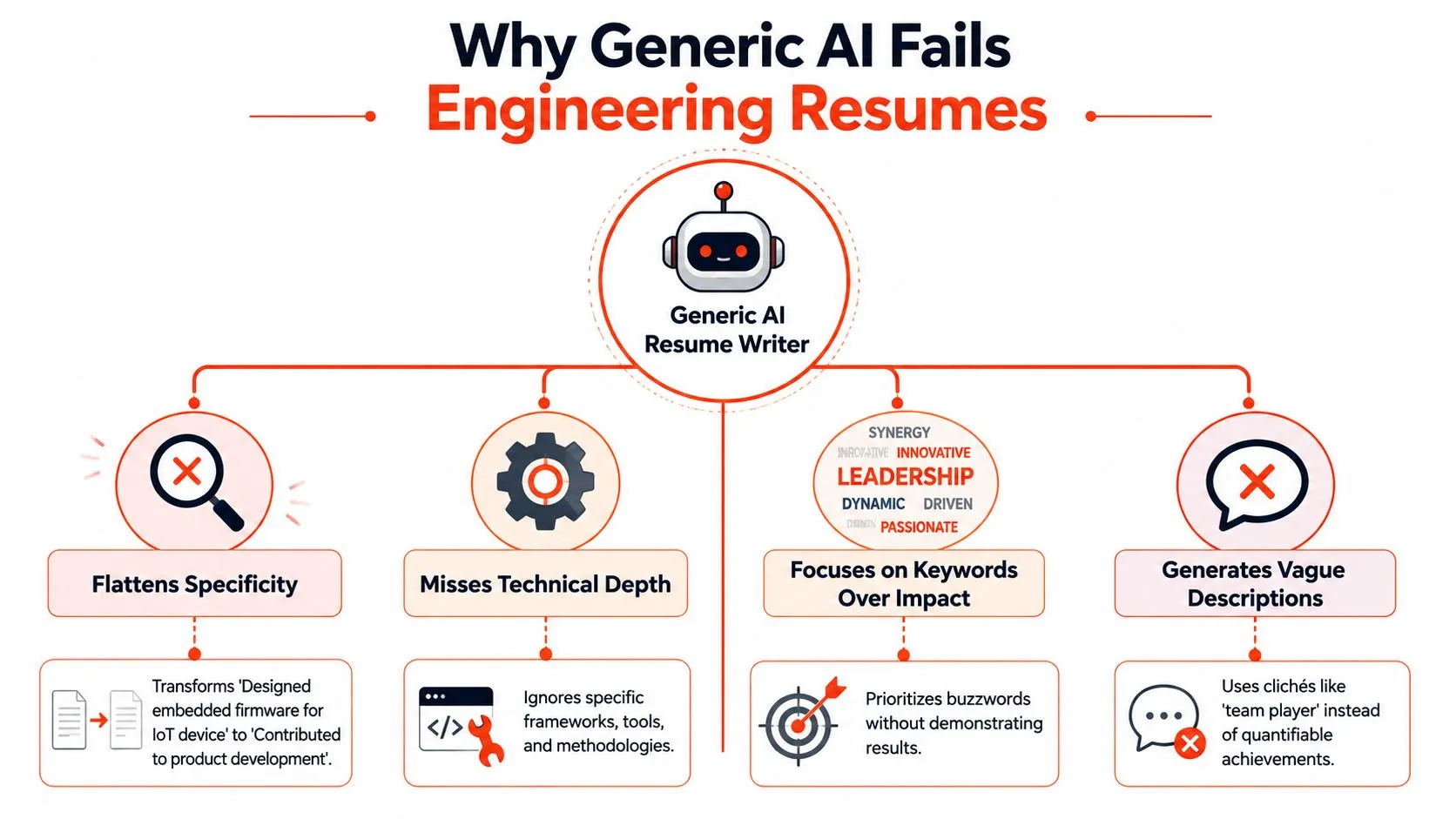
The flattening problem
Here's the pattern.
Your version
- Rewrote the order-processing service to use event sourcing because the previous polling architecture couldn't handle holiday-season load
Generic AI version
- Led architectural improvements to enhance system scalability
That rewrite sounds polished. It's also worse.
The original has a concrete system, a technical choice, and a reason for the choice. The AI version strips out all three. Another engineer reads that and learns nothing.
Why this keeps happening
Template-driven AI tools tend to optimize for broad applicability. Conversational AI tools often optimize for fluency. Both can produce text that looks professional and says almost nothing.
If you're also cleaning up your broader job search materials, this guide on how to improve your professional LinkedIn with AI is useful for profile positioning. Just don't make the same mistake there. Better wording isn't the same as better substance.
For a broader breakdown of how different product categories behave, StoryCV has a useful piece on top AI resume writer options. Read it with skepticism. Then test every tool yourself.
Practical rule: If a bullet could describe a backend engineer, product manager, and marketer equally well, the bullet is dead.
The Real Test Does It Ask About Decisions
The first thing to evaluate isn't the output. It's the interview.
The strongest resume products have moved beyond static templates toward guided AI interviews that extract achievements and ask the right questions. In one 2026 review of AI resume builders, that shift shows up in features like questionnaires, job-description parsing, keyword targeting, and guided coaching. For engineers, that matters because a decent bullet usually comes from follow-up questions, not first-pass input.
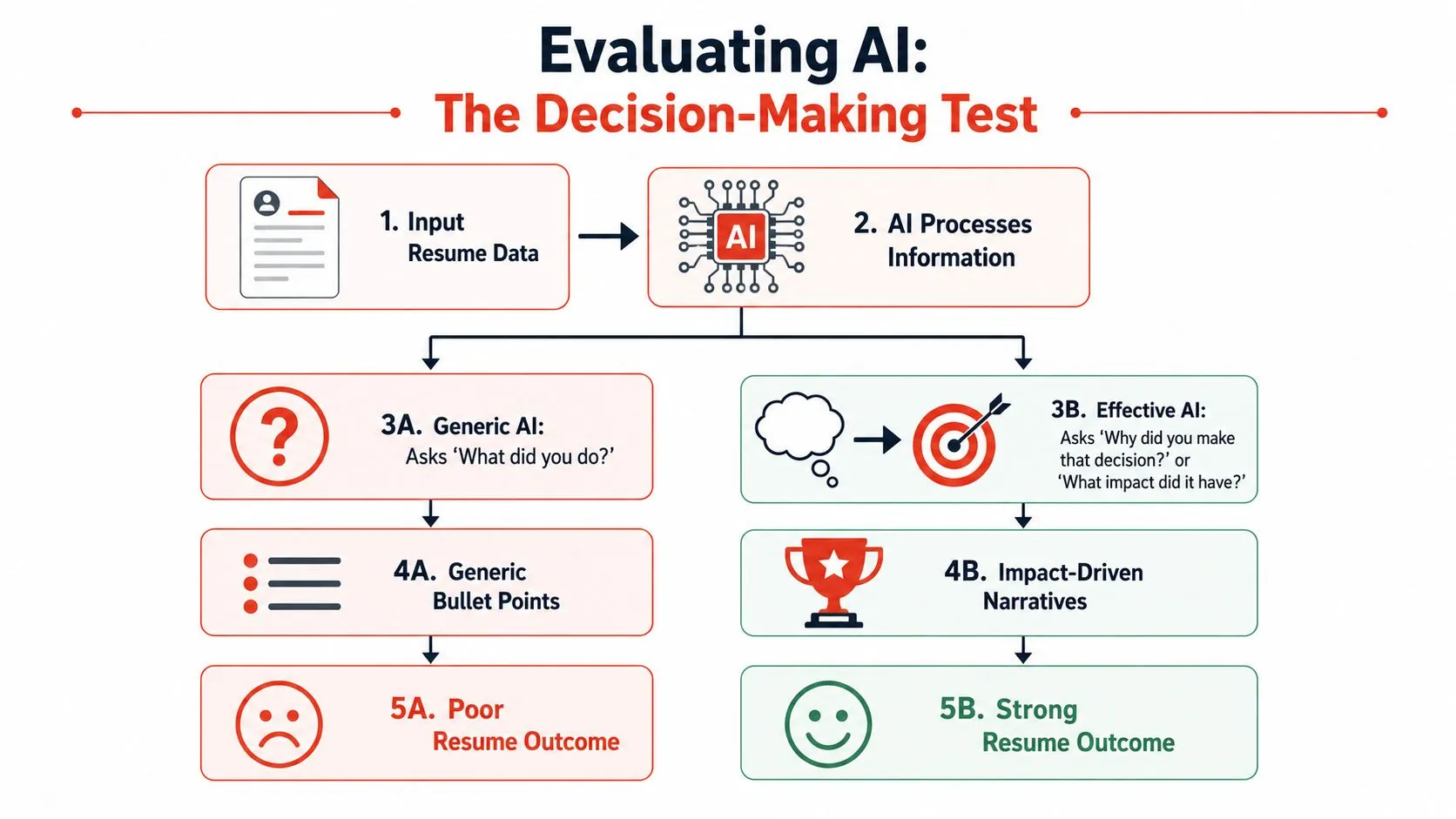
The one test that matters
Give the tool a real project. Not a toy prompt. Use something with tradeoffs.
Then watch what happens.
| Tool behavior | What it means |
|---|---|
| It asks “What did you build?” and stops | It's a paraphraser |
| It asks “Why this approach?” | It may understand engineering judgment |
| It asks about alternatives, constraints, or consequences | You're in the right neighborhood |
If the system never asks why you chose one path over another, it can't write a strong engineering bullet. It can only decorate your input.
A better bullet starts with a better question
Bad prompt path:
- Built microservices on Kubernetes
Better interrogation path:
- Why microservices instead of a modular monolith?
- What constraint pushed that decision?
- What got easier or harder after the change?
- Were you the decision-maker or an implementer?
That's the difference between a writing machine and a useful one.
If you work in hiring or just want a sharper lens for evaluating candidate evidence, these proven strategies for AI talent acquisition are worth reading. The same principle applies to resumes. Good evaluation starts with better questions.
For engineers rewriting their own experience, this guide to an engineer resume is a practical reference for the kind of detail worth surfacing.
A Tool Should Understand Engineering Scope
Scope is where seniority shows up.
A script used by one team and a service used across a company are not the same achievement. A migration you supported and a migration you drove are not the same sentence. If the tool can't help you express scale and authority, it will make strong work look smaller than it was, or worse, make modest work sound inflated.
Scope language that matters
A useful tool should push for context like:
- Decision authority. Did you recommend, lead, approve, or implement?
- System scale. Was this internal tooling, a customer-facing service, a data pipeline, a reliability initiative?
- Organizational reach. One squad, several teams, platform-wide, company-wide?
- Operational context. Latency pain, reliability risk, manual process, deployment friction, data quality issues?
You don't need to force numbers into every bullet. You do need to show the reader how big the problem was and how much ownership you had.
What to watch for in the tool
Some AI tools preserve very little context across a drafting flow, which is why this explainer on preserving full context in AI workflows is relevant even outside resume writing. If the system loses earlier details, it will collapse your work into generic claims.
Strong bullets don't just say what changed. They show how much was at stake and who trusted you to change it.
Write for the Engineer Not Just the ATS
Stop treating ATS compatibility as the deciding factor.
If a resume tool can parse cleanly, map keywords to a job description, and avoid mangling your formatting, it has cleared the easy part. A benchmark of 250 ATS parse tests across 10 resume tools found that job-specific optimization tools cleared 86%+ pass rates, while other tools landed between 61% and 75%, and the top performer reached a 94% ATS pass rate with a 91% average match score across Workday, Greenhouse, Lever, iCIMS, and Taleo, according to this ATS benchmark of AI resume tools.
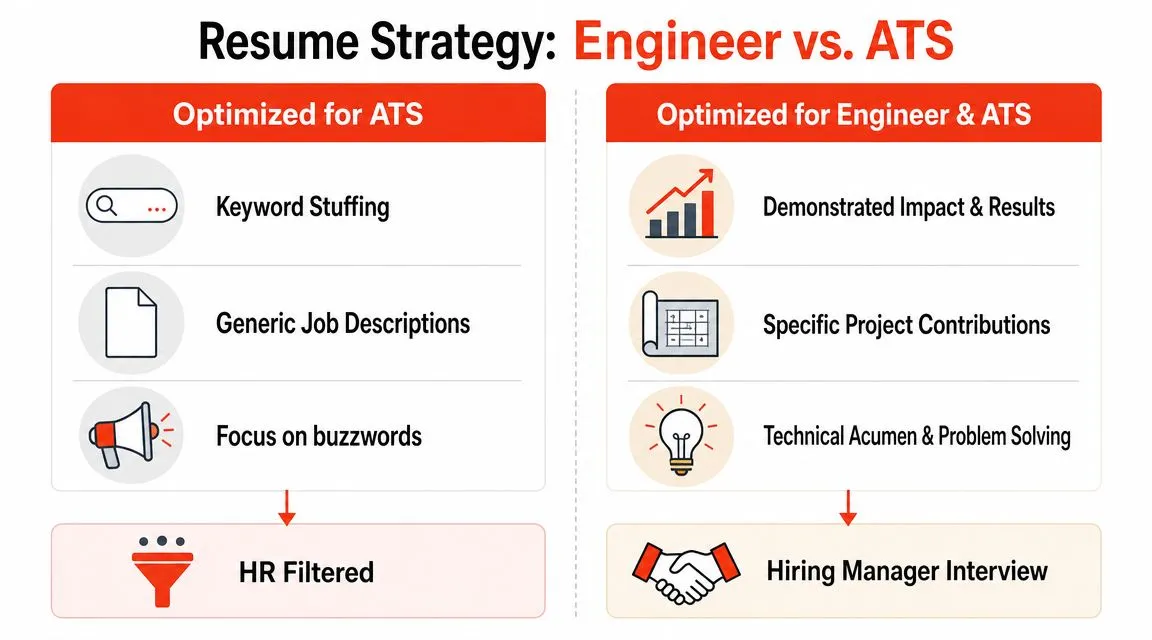
That matters. It does not tell you whether an engineer will want to interview you.
Engineering resumes usually fail in a more specific way. They describe tools instead of judgment. They list projects instead of explaining why the work mattered. Bad AI tools make that worse by turning every bullet into the same vague, optimized sludge.
A hiring engineer reads for signal like this:
- Did you make a real decision? Choice of architecture, migration path, tradeoff, rollout plan.
- Did you understand the problem? Bottleneck, failure mode, reliability risk, product constraint.
- Did your work change the system? Faster delivery, cleaner ownership, fewer incidents, easier operations.
- Can I trust the claim? Specific language beats inflated language every time.
That is why the resume has two jobs. It has to survive automated screening, then hold up under technical scrutiny. If the tool only helps with the first job, it is incomplete. If you want a useful comparison of tool categories, this guide to resume writer tools for drafting, optimization, and formatting is a good starting point.
Compare these bullets:
- ATS-shaped bullet: Implemented scalable microservices architecture using Kubernetes and cloud technologies
- Engineer-shaped bullet: Broke a tightly coupled service into smaller deployable components after release coordination kept slowing delivery and failure isolation was poor
The second bullet still contains searchable technical terms. More importantly, it gives the reviewer something to evaluate. There was a problem. You identified it. You changed the design for a reason.
That is the standard to use. Write for the person who has operated the kind of system you are describing. If the AI tool cannot help you express decisions, constraints, and consequences, it is helping you decorate weak content.
The Framework for Choosing Your Tool
You don't need a winner. You need a filter.
The best AI resume writer for engineers is the one that helps you express engineering work without sanding off the parts that make it credible. That's a narrower standard than most review sites use, and it's the right one.
Use this checklist
When you test a tool, run these four checks:
- Decision test. Does it ask why you chose an approach, or just paraphrase what you typed?
- Scope test. Does it push you to clarify ownership, reach, and complexity?
- Human-read test. Would a hiring engineer learn anything real from the bullet?
- Specificity test. Does it preserve the technical detail, or translate everything into executive fluff?
One option in this category is StoryCV, which positions itself as a digital resume writer rather than a template library. That distinction is useful if you want guided articulation instead of just formatting. But the point stands even if you choose something else.
Don't buy the wrong promise
Template-driven tools are fine for packaging. Conversational AI tools are fine for rough drafting. Optimization tools are fine for the final ATS pass. None of those are enough if the content is weak.
If you want a practical comparison of tool types before you decide, this roundup of resume writer tools is a reasonable starting point.
The right tool doesn't replace your judgment. It helps you surface it.
StoryCV is for people who've done strong work and are tired of watching it turn into vague bullets. If you want a digital resume writer that helps articulate decisions, scope, and impact without sounding machine-made, take a look at StoryCV.