The engineers with the strongest careers often have the weakest resumes.
Staff engineers. Principal engineers. Long-tenured ICs who held systems together, killed bad ideas early, and saved teams from expensive detours. They sit down to write an engineer-resume and end up with mush. Not because they're shy. Not because they hate self-promotion. Because the format is bad at carrying the kind of work they do.
A resume wants compact proof. Senior engineering work creates sprawling context. The deeper your work goes, the less visible it becomes. The important part usually isn't the code. It's the decision. Why this path. Why not that one. Why the rewrite got cut in half. Why the migration waited. Why the team spent a quarter on stability instead of shiny features.
That's what hiring managers need to understand. And that's exactly what most resume advice trains you to leave out.
Why Your Engineer-Resume Fails (It's Not You)
The usual diagnosis is wrong.
People say experienced engineers struggle with resumes because they're too modest, too technical, or too allergic to self-marketing. That's lazy advice. The problem is structural. A resume compresses context. Senior engineering work depends on context.
That mismatch gets brutal when hiring is crowded. In broad U.S. SMB hiring data, there were about 180 applicants per hire in 2024, and applications-per-hire were up roughly 182% since 2021 according to this resume statistics roundup citing ATS data. A city benchmark in the same source put San Jose at 153.77 applicants per job ad in a single week. Your engineer-resume isn't being read in a calm, generous setting. It's being scanned under pressure.
The bad advice that keeps failing senior engineers
The internet tells you to do three things:
- List your stack
- Quantify everything
- Show shipped work
That works better for earlier-career engineers because their impact is easier to point at. A feature launched. An endpoint got faster. A dashboard shipped.
Senior engineers don't just ship things. They shape what gets shipped, what gets delayed, what gets simplified, and what never gets built because it would have been a mess. A lot of that value lives in tradeoffs, not artifacts.
Practical rule: If your bullet could describe any engineer on any team, it isn't evidence. It's wallpaper.
A hiring manager may spend only 30 seconds on an initial resume scan, and Teal's engineering resume guidance makes the deeper point clear: coherent narrative matters because engineering work, especially systems and infrastructure work, is hard to explain quickly. That's why keyword-only advice breaks down.
If you're dealing with the same problem in another field, even something as structured as accounting, you'll see similar pressure to translate specialized work into employer-friendly language. This guide for UK accounting CVs is useful for that reason. Different domain, same issue. raw experience isn't self-explanatory.
The actual failure mode
You flatten a year of hard judgment into six safe bullets.
"Led platform work."
"Improved reliability."
"Partnered cross-functionally."
"Mentored engineers."
All true. All weak.
If your current resume feels dead on arrival, you're probably not underqualified. You're probably describing your role instead of your decisions. That's a fixable problem. If you want another angle on why technical resumes often stall, this piece on a tech CV not getting responses gets at the same pattern from the response side.
Your Real Work Doesn't Fit in a Bullet Point
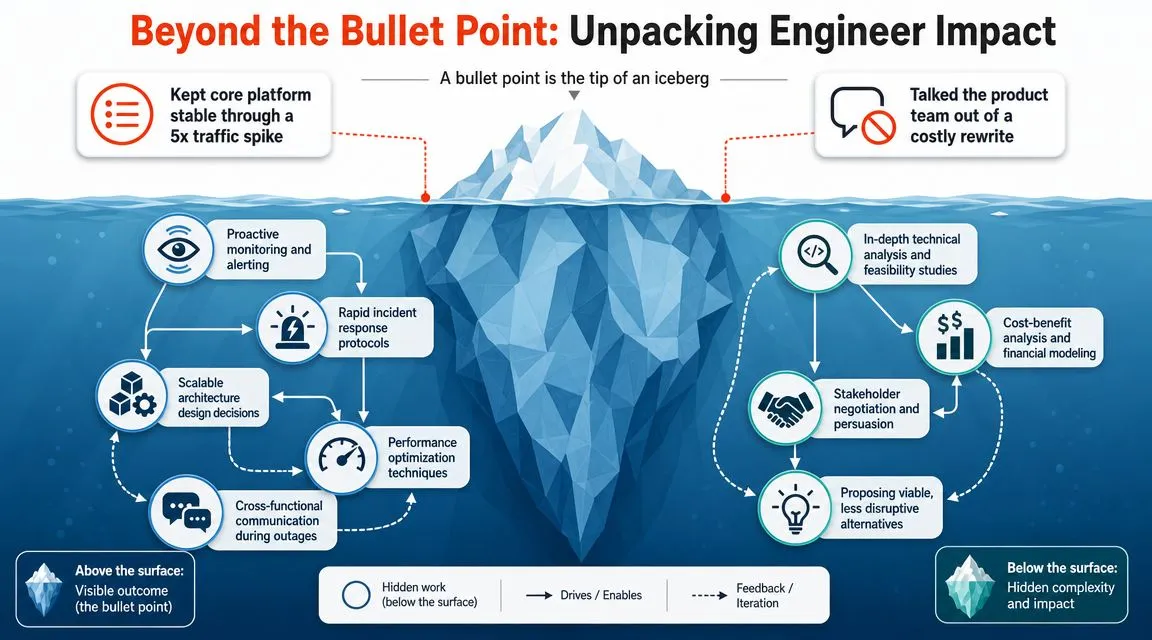
Take a hypothetical staff platform engineer. One year. No flashy product launch.
They kept the platform stable through a 5x traffic spike. They stopped a full rewrite that looked elegant on a whiteboard and terrible in reality. They helped an understaffed team sequence infra work so feature delivery didn't freeze. They mentored a newer engineer through a fragile service area that nobody else wanted to touch.
Now watch what happens when that year gets translated into normal resume language.
- Led platform team initiatives
- Improved system reliability
- Collaborated with product on roadmap
- Mentored junior engineers
Those bullets aren't false. They're just empty.
Why senior work disappears on the page
Junior engineers usually have visible outputs. The thing exists now. That's easy to summarize.
Senior engineers create significant impact through judgment. They decide scope. They reduce blast radius. They sequence work so the org doesn't choke on its own ambition. They say no to the migration that would have created permanent maintenance tax. They choose the adapter instead of the rewrite. They move the ugly but survivable fix ahead of the elegant but slow one.
None of that fits neatly inside a context-free bullet.
That's why the standard engineer-resume format feels unfair to experienced people. It rewards legible production, not sound judgment.
What employers are actually looking for
Hiring has shifted toward evidence of applied judgment. A 2026 report says 86% of employers prioritize problem-solving skills, and 81% of hiring managers consider AI-related skills a priority, including critical thinking for AI challenges at 35%, in Resume Genius HR statistics. Read that carefully. The signal isn't "list more tools." It's "show me how you think."
The deeper your engineering work gets, the less your value lives in code alone.
That's why "improved reliability" is such a bad bullet. It hides the interesting part. Did you add guardrails? Kill a brittle dependency? Refuse an unnecessary migration? Rework ownership boundaries? Build observability before scale broke production? Those are different stories. They imply different kinds of seniority.
A better lens for your own work
When you review your last year, stop asking, "What did I build?"
Ask better questions:
- What bad outcome did I prevent
- What alternative did I reject
- What constraint shaped the final decision
- What got easier, safer, or faster because of that choice
That's the material your resume needs. Not just output. Judgment under constraints.
Write Decision Bullets Not Task Lists
Your resume is not a work log.
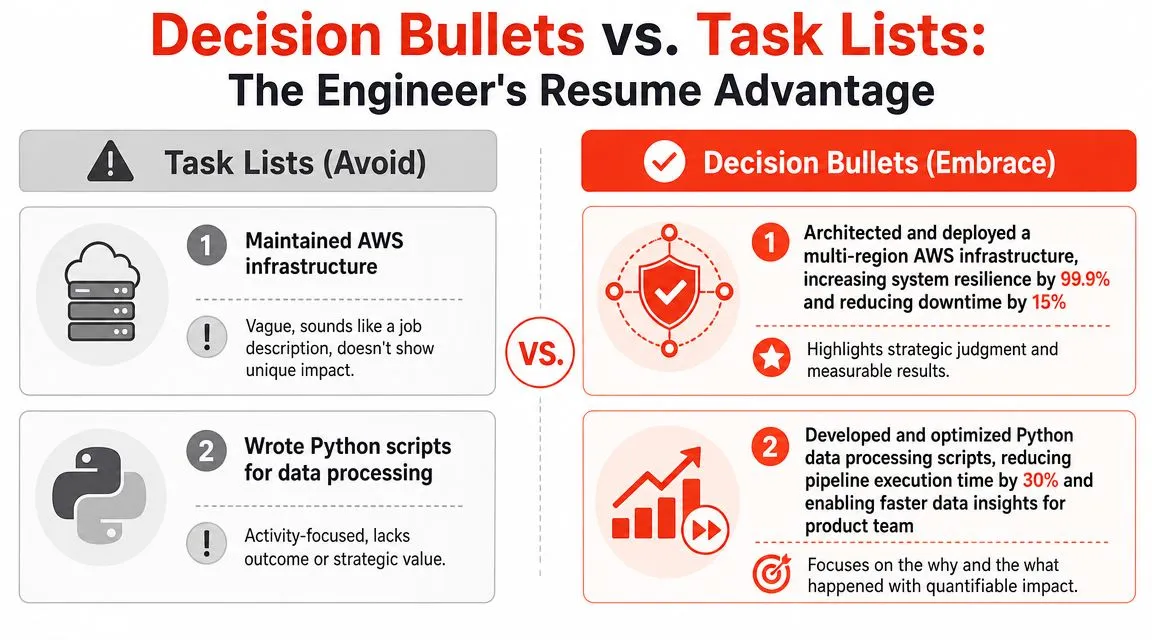
Task bullets describe activity. Decision bullets describe judgment. That's what separates senior engineers from people who executed assigned work.
A decision bullet usually contains four parts:
- The situation
- The choice
- The rejected alternative
- The result
You don't need all four in a rigid formula every time. But if your bullet only contains the activity, you've cut out the senior part.
What a task bullet sounds like
"Led migration of legacy service architecture."
"Improved platform reliability."
"Worked with product to define roadmap."
"Built Python automation for data workflows."
Nothing there shows why you mattered.
What a decision bullet sounds like
"Scoped a planned full-service rewrite down to an incremental adapter approach after the original estimate slipped 3x; delivered the required capability within a quarter while avoiding a year-long migration path."
That bullet works because it names the road not taken.
"Prioritized failure isolation and alerting over feature-side refactors ahead of seasonal load, which kept the platform stable through a 5x traffic spike and prevented the roadmap from turning into continuous incident response."
That sounds like a senior engineer because it is one. The code matters. The decision matters more.
Use this test: if the bullet doesn't reveal what you chose or what you ruled out, it's probably too junior for the work it describes.
Why this feels uncomfortable
Most experienced engineers are weirdly reluctant to write this way.
They think naming the bad option sounds political. They think explaining what they avoided feels defensive. They think "I decided not to do X" won't read as an achievement.
They're wrong.
At senior levels, your value is often in constraints, tradeoffs, and refusal. Companies don't hire staff engineers just to type faster. They hire them to avoid expensive mistakes.
If you want a useful companion piece for tightening bullet phrasing, this Narrareach LinkedIn strategy is worth skimming because the same principle applies outside resumes. bullets need consequence, not just action. For a direct resume-specific version, this guide on how to write resume bullet points is also useful.
A simple pattern that works
Try this sentence frame:
Decided [choice] instead of [alternative] because [constraint or risk], which led to [result].
Examples:
- Decided to phase service extraction over multiple releases instead of a hard cutover because the team couldn't absorb parallel maintenance and migration risk, which led to a safer transition with less operational drag.
- Decided to keep the monolith and isolate the failure-prone path instead of pushing a broad architecture rewrite, because the business case didn't justify the delay, which led to faster delivery and a more stable system.
- Decided to invest in observability first instead of scaling blindly, because incident cause was still unclear, which led to cleaner debugging and more confident performance work.
That's real engineering. Put that on the page.
Before and After Engineer-Resume Examples
Most engineer-resume advice dies in abstraction. Examples fix that.
One warning first. A common failure mode is listing a technology in a skills section without showing it in an experience bullet. A software-engineer ATS guide notes that up to 80% of resumes can be filtered out before a human sees them, and that mismatch between listed tech and demonstrated use is a major problem in this ATS-focused developer resume guide. If you say "Kubernetes," "Python," or "MATLAB," prove it in context.
Task bullets vs. decision bullets
| Discipline | Before (The Generic Task) | After (The Impactful Decision) |
|---|---|---|
| Staff Software Engineer | Led platform team and improved reliability | Chose failure isolation and targeted service hardening over a broad platform rewrite, focusing the team on the few changes most likely to break under load; kept the core platform stable through a 5x traffic spike |
| Backend Engineer | Migrated legacy services to new architecture | Scoped a planned full migration down to an adapter layer after the original plan expanded beyond what the team could support; delivered the required integration without locking the team into a long rewrite |
| Data Engineer | Built Python scripts for data processing | Reworked brittle manual reporting into Python-based pipelines and prioritized the highest-friction jobs first, removing repeated operational toil and making recurring reporting less dependent on tribal knowledge |
| Mechanical Engineer | Supported manufacturing improvements | Rejected a full fixture redesign in favor of targeted tolerance and workflow changes after reviewing where variation actually came from; improved line stability without forcing a disruptive tooling change |
| Electrical Engineer | Designed and tested control systems | Simplified the control architecture after early testing showed the original design added unnecessary maintenance burden; delivered a more supportable system with clearer fault isolation |
| Systems Engineer | Managed system integration activities | Sequenced subsystem integration around the highest-risk interfaces first, rather than following the original plan order, so the team could expose incompatibilities earlier and avoid late-stage rework |
A full example for a staff engineer role
Weak version:
- Led platform modernization initiatives
- Improved service reliability
- Partnered with product and infrastructure teams
- Mentored engineers
- Worked on roadmap planning
- Supported incident response
Better version:
- Scoped a planned platform rewrite down to incremental service isolation after the broader migration path proved too expensive to sustain; delivered the highest-risk improvements without freezing feature work
- Prioritized alerting, dependency hardening, and failure containment ahead of cosmetic cleanup, which kept the core platform stable through a 5x traffic spike
- Pushed roadmap discussions toward sequencing and maintenance cost, helping product avoid commitments that would have overloaded a team already carrying platform risk
- Mentored a junior engineer through ownership of a fragile service area, turning a bottleneck into distributed team knowledge instead of long-term single-threaded dependency
- Standardized incident review around repeat failure modes, which shifted reliability work from reactive heroics to deliberate engineering choices
How to rewrite your own bullets
Use this pass:
- Circle vague verbs like led, supported, collaborated, improved
- Ask what decision sat underneath
- Name the alternative you rejected or de-scoped
- Add the constraint that made the choice matter
- Embed the tech naturally inside the accomplishment
Good bullets don't just say what happened. They say why a senior engineer had to be there.
That applies outside software too. Mechanical, electrical, hardware, firmware, systems, infra. If your work involved tradeoffs, this framework fits.
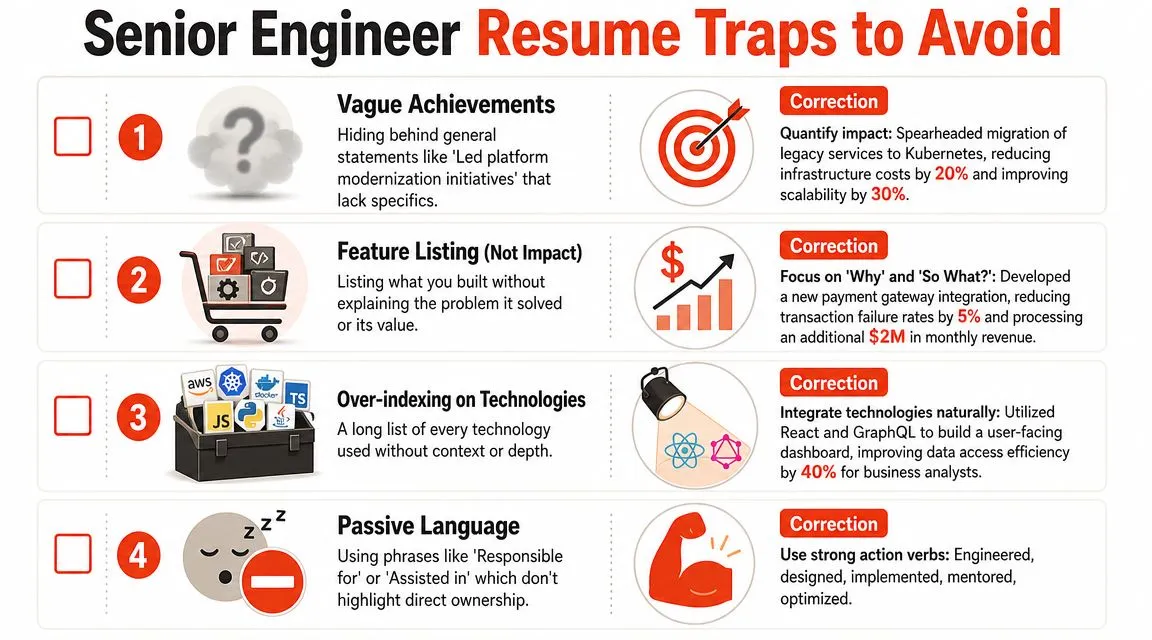
Common Traps for Senior Engineer Resumes
The worst resume mistakes for senior engineers come from following advice that was written for everyone.
Trap one: vague prestige language
"Led modernization efforts."
"Drove strategic initiatives."
"Owned cross-functional delivery."
This language sounds important and says nothing.
Hiring managers don't infer seniority from abstract verbs. They infer it from choices, constraints, and outcomes. Strip out every phrase that could survive unchanged on a stranger's resume.
Trap two: feature lists disguised as impact
A long list of launches can make a staff engineer look less senior, not more.
If your bullets read like a release note archive, you're presenting yourself as a very productive implementer. That's useful. It's not the strongest signal for higher-level IC roles. Those roles care about what you shaped, prevented, simplified, and clarified.
Trap three: ATS obsession without narrative
Yes, your resume needs to survive parsing. Do that. Then move on.
One ATS breakdown says keyword matching is roughly 30 to 40% of ATS score, and resumes scoring over 85% are about 3x more likely to generate an interview callback in this ATS scoring guide. The point isn't "game the bot harder." The point is that matching, structure, and readability all matter. A lifeless engineer-resume with perfect keyword coverage is still lifeless.
Trap four: treating the skills section like proof
Your skills block is not evidence. It's an index.
If you list Kafka, Terraform, Ansys, SolidWorks, Verilog, or PyTorch, tie those tools to a real decision in experience. Otherwise you're asking the reader to trust a claim with no story attached.
A practical workflow helps. Extract the exact skills and title variants from the target posting, mirror that phrasing, place those keywords in both a skills section and experience bullets, and keep the file parser-friendly. StoryCV approaches this by interviewing users for context first, then drafting bullets that combine role fit with narrative clarity. That's closer to the problem than another empty template.
Stop Describing Your Job. Start Narrating Your Decisions.
Your engineer-resume doesn't need to capture your whole career. It needs to earn the next conversation.
That won't happen if it reads like chores performed by a competent adult. "Maintained systems." "Supported roadmap." "Improved reliability." Nobody remembers that. Nobody learns anything from it.
What matters is the judgment behind the work. The rewrite you cut down. The migration you delayed. The failure mode you saw early. The stability work that kept the team out of on-call hell. The tradeoff you made because the elegant option was wrong for the moment.
That's the story.
If you need help seeing what that looks like on the page, review a few narrative resume examples and notice the difference. Strong resumes don't just record activity. They explain why the activity mattered.
Stop writing bullets that sound tidy. Write bullets that sound true.
StoryCV is a Digital Resume Writer that turns messy experience into clear narrative through a guided interview, then drafts resume content that stays readable for humans and usable for ATS. If your work is hard to explain because its impact lived in tradeoffs, scope calls, and quiet prevention, that's exactly the kind of material worth pulling into words.