
You adapted the CV. You matched the stack. You hit apply. Then nothing.
If your tech CV not getting responses feels like a permanent condition, stop blaming yourself and stop obsessing over ATS myths. Most strong candidates are not losing because they are unqualified. They are losing because their CV reads like a database export instead of a convincing case.
That is fixable.
Your CV Went Into a Black Hole Again
You are not crazy. The silence is real.
In 2025, the average job opening gets 242 applications, and recruiters usually review only the top 20, which means your CV has less than a 10% chance of even being seen in the first place, according to Business Insider’s reporting on application volume and recruiter review behavior.

So no, your application did not necessarily get rejected. It probably got buried.
The usual advice is useless. “Beat the ATS.” “Add more keywords.” “Use this magic template.” Most of that is cargo cult job hunting. It treats the problem like a formatting puzzle when the core problem is that your CV does not make a recruiter care fast enough.
ATS is not the main villain
ATS matters. You still need a clean format and the right language.
But the bigger issue is this: even when your CV is parseable, it still has to rank high enough and read clearly enough for a human to keep going. If your bullets are generic, your skills section is bloated, and your projects lack outcomes, you disappear into the pile.
What needs fixing
Most tech CVs fail in two boring, brutal ways:
- They describe tasks, not value
- They list experience, but don’t tell a coherent story
A CV should not read like your Jira history. It should read like proof that hiring you solves a problem.
You do not need more buzzwords. You need sharper framing.
That means showing what changed because of your work, why it mattered, and what kind of engineer you are. Backend specialist. Platform engineer. Product-minded full-stack developer. Security-focused SRE. Pick something real and make the document support it.
Why Your Tech CV Is Invisible
Let’s be blunt. Your CV is probably too vague to win.
Not because your work is weak. Because the writing is weak.
Only 3% of applicants secure an interview, while 92% of ATS systems rank resumes rather than auto-rejecting them, which points to a visibility problem, not a robot instantly deleting you, as summarized by CoverSentry’s ATS statistics roundup.
Responsibility bullets are dead weight
Recruiters do not care that you were “responsible for” something. That phrase is a warning sign.
Compare these:
| Weak bullet | Stronger bullet |
|---|---|
| Responsible for backend services | Built and improved backend services used by customer-facing products |
| Worked on cloud migration | Migrated core workloads to cloud infrastructure and reduced operational friction |
| Collaborated with cross-functional teams | Partnered with product and design to ship features with clear delivery ownership |
The second column is still not perfect. But it has motion, ownership, and consequence.
Narrative fragmentation kills trust
A lot of mid-career tech CVs look like this:
- React
- Python
- AWS
- Kubernetes
- Data pipelines
- Mobile
- DevOps
- AI
- Leadership
- Product strategy
That is not range. That is confusion.
When your CV tries to sell you as everything, hiring managers assume you are unfocused or inflating. The problem is not breadth itself. The problem is unexplained breadth.
If you have a varied background, good. Make it coherent. Show how one role led to the next. Show the pattern. Show the through-line.
Strong candidates often undersell themselves by dumping skills without explaining the direction of their career.
If you want a useful breakdown of how ATS ranking works in practice, this piece on the ATS filter 90 10 rule is worth reading.
What a good tech CV does
A good CV does two jobs at once.
First, it gives the system enough structure and language to categorize you correctly. Second, it gives a human enough evidence to believe you are worth a conversation.
That means:
- Clear positioning so the reader knows your lane quickly
- Relevant achievements instead of generic duties
- Focused skills tied to the target role
- Project framing that explains why the work mattered
The market is crowded. Fine. That just means your document has to earn attention instead of assuming it.
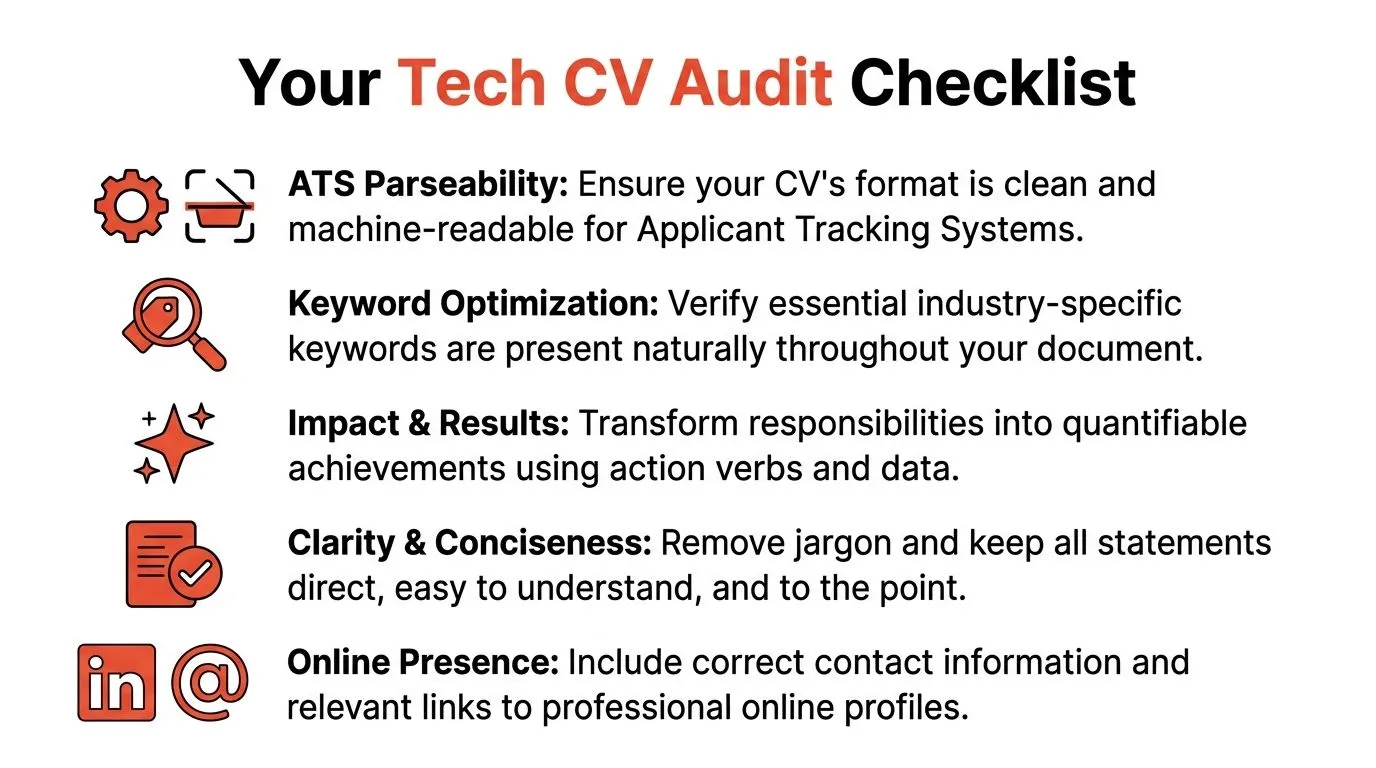
Your 5-Point Tech CV Audit Checklist
Stop rewriting blindly. Audit the document like an engineer.
Benchmark data says tech applicants often need around 100 applications for one interview callback, while 60% of rejected resumes lack quantifiable metrics and 30% fail basic ATS parseability tests, according to Caffeinated Kyle’s tech job response rate analysis.
Check 1 for ATS parseability
Your CV should be boring in format. Good.
Use a single column. Avoid tables, floating text boxes, decorative icons, and weird section layouts. Export cleanly and make sure your headings are obvious.
If your parser reads the company name as a skill and merges half your bullets into one paragraph, you already lost before content even gets judged.
Bad
- Two-column layout
- Graphics for skill ratings
- Header/footer packed with contact details
Better
- Single-column structure
- Standard section headings
- Plain text for dates, titles, companies, and bullets
Check 2 for keyword alignment
Keyword matching still matters. Just not in the dumb way people talk about it.
If the role says distributed systems, Go, and observability, and your CV says backend development, Golang exposure, and monitoring stuff, you are making the recruiter work too hard.
Mirror the language of the job description where it is truthful.
Do not stuff keywords into a skills graveyard. Put them inside real work.
Check 3 for impact and outcomes
Most CVs fall apart at this stage.
Every role should answer at least some version of these questions:
- What did you improve?
- What did you reduce?
- What did you ship?
- What got faster, more stable, easier, or more reliable?
- Who benefited?
A weak bullet says what you touched. A strong bullet says what changed.
Before
- Maintained CI/CD pipelines for engineering team
After
- Improved CI/CD pipelines used by the engineering team, reducing release friction and making deployments more predictable
If you have exact numbers, use them. If you do not, describe the operational or product impact clearly.
Check 4 for focus in your tech stack
Your stack section is not a museum of every tool you have ever opened.
If you are applying for backend roles, lead with backend technologies. If you are aiming at platform or infra roles, stop wasting prime space on old front-end frameworks you touched once during a sprint emergency.
Try this rule:
| If the technology is... | Do this |
|---|---|
| Core to your target role | Put it near the top |
| Used briefly or years ago | Drop it or move it down |
| Irrelevant to the role | Remove it |
Breadth is useful. Noise is not.
Check 5 for project framing
Projects need context. Not just a title and a stack.
This is weak:
- Built internal tooling using Python and Docker
This is better:
- Built internal tooling in Python and Docker to reduce repetitive support work and give engineers faster access to deployment diagnostics
The second version explains the why. That matters because technical work without business or team context sounds interchangeable.
A quick self-test
Read your CV and ask:
- Can a recruiter tell what role I want?
- Can a hiring manager see evidence of impact?
- Can an ATS parse this without tripping over formatting?
- Does the stack support the story, or distract from it?
- Do my bullets explain why the work mattered?
If the answer is “not really” to even two of these, your tech CV not getting responses is not mysterious. It is diagnosable.
Rewrite for Impact Not Just Keywords
Most CV bullets are dead on arrival because they describe motion without outcome.
That is the rewrite to make. Not prettier verbs. Better evidence.
A recruiter study found 92% involve manual human review, which kills the old myth that ATS auto-rejects most resumes on content alone. The same source says tailoring your CV with quantified impact can raise response rates from a 10% baseline to over 25%, based on Find My Jobs’ recruiter-backed resume response analysis.
Use a mini-story in each bullet
You do not need a full paragraph. You need one compact narrative.
A useful pattern is:
Action + scope + why it mattered + result
Here are a few rewrites.
| Before | After |
|---|---|
| Developed and maintained e-commerce platform | Led improvements to the e-commerce platform, making it more reliable during peak demand and easier to scale |
| Managed a development team | Led engineering delivery across a multi-person team, improving execution clarity and unblocking cross-functional work |
| Built dashboards for stakeholders | Built dashboards that gave stakeholders faster access to operational insights and reduced manual reporting work |
The “after” versions are better because they create consequence. They give the reader a reason to care.
A stronger technical example
Weak:
- Worked on API performance issues
Better:
- Diagnosed and resolved API performance bottlenecks by tracing slow queries and tightening request handling, improving reliability for downstream services
Why this works:
- Diagnosed and resolved shows ownership
- Tracing slow queries gives technical texture
- Improving reliability for downstream services translates engineering work into system impact
If you want a practical companion piece, Underdog has proven tips to write a tech resume that passes ATS without turning it into keyword sludge.
The rewrite test
A bullet is still weak if it could belong to anyone.
A bullet gets stronger when it answers at least one of these:
- What problem did you solve
- What changed after your work
- Who benefited
- What constraint did you work through
This short video is useful if you want another angle on how hiring teams read resumes:
If your bullet only names a tool, it is weak. Tools are inputs. Hiring decisions come from outcomes.
Stop Spraying and Start Targeting
A better CV sent to the wrong role is still a wasted application.
A lot of tech candidates lose because they apply like a script, not like a person with a point of view. They blast the same document across backend, DevOps, data, platform, and product engineering roles and hope one sticks. That strategy creates a muddy CV because the document has to pretend to fit everything.
Pick a lane and make the CV support it
Recruiters report that candidates who claim expertise across too many areas create narrative fragmentation and get dismissed. The fix is to choose a specific niche and present a coherent career story, as discussed in this recruiter-focused discussion on resume positioning and niche selection.
That does not mean lying about your background. It means deciding what you want to be hired for.
A sharper version looks like this:
-
Bad target
Software engineer open to backend, full-stack, DevOps, cloud, and AI roles -
Better target
Backend engineer focused on API design, distributed systems, and cloud infrastructure -
Also good
Platform engineer with a background in developer tooling, CI/CD, and reliability
Use a master CV, then tune it lightly
Do not rewrite from scratch for every job. That is slow and usually makes the document worse.
Instead:
- Keep a master CV with all strong bullets
- Choose one target role family
- Swap in the most relevant bullets and skills
- Adjust wording to match the job description truthfully
That is adaptation. Not cosmetic panic-editing.
If you need a practical guide to that process, this article on tailoring resume to job description is a solid walkthrough.
Referrals are not optional if you have them
Cold applications are noisy by nature. A referral or warm intro changes who sees your CV and when they see it.
You still need a strong document. But a focused CV plus targeted outreach beats random volume every time. Not because it is trendy advice. Because it gives the reader a clear reason to connect your background to the role.
A recruiter can forgive a missing keyword. They rarely forgive a candidate who seems unsure what role they want.
The Fix Comes From Talking Not Typing
The hardest part is not formatting. It is recall.
You know the work you did. But when you sit down to write, everything comes out flat. “Worked on migration.” “Helped improve reliability.” “Collaborated with stakeholders.” That is not because you lack substance. It is because writing your own achievements from scratch is weirdly hard.
Over 75% of rejected resumes fail to match job description keywords, but the deeper issue is poor achievement framing. Recruiters want measurable outcomes, yet many candidates struggle to translate technical work into business-impact language, as explained in Jobsolv’s analysis of why tech resumes disappear.
Templates do not solve that. They just give you boxes. Generic AI tools often do the same thing faster, which means they help you produce polished nonsense.
Talking works better because conversation surfaces context. You remember the outage, the ugly migration, the stakeholder conflict, the performance issue everyone ignored until you fixed it. That is where the effective bullet points live.
That is also why interview-style resume writing is more useful than template filling. StoryCV takes that approach. It acts as a Digital Resume Writer, using guided questions to uncover context, achievements, and the narrative through-line behind your work.
And yes, your online profile still needs to support that story. If you want help tightening that side too, this guide to building a standout personal brand on LinkedIn is practical. For offline traction, this piece on networking events in Singapore is useful if you are trying to turn cold applications into warmer conversations.
If your tech CV not getting responses is the problem, the fix is not another template. It is better framing. StoryCV helps by turning your experience into a clear, coherent narrative through a guided interview, so your CV sounds like real evidence instead of recycled bullet points.