
You're staring at a resume that shows three jobs in five years, none of them longer than eighteen months, and you're already drafting the explanation in your head for the interview that hasn't happened yet.
That's the trap.
Many assume the problem is the pattern. It usually isn't. The actual problem is the reaction. You start shrinking bullets, softening titles, hiding context, and writing like you're asking for forgiveness. That anxious tone does more damage than the timeline.
A resume with multiple short stints can still read as sharp, credible, and senior. But only if you stop treating each role like evidence for the defense.
The Real Problem with a Resume Full of Short Stints
Short stints make people nervous because older hiring logic trained everyone to use tenure as shorthand for commitment. That logic hasn't disappeared. Some employers still scrutinize roles shorter than about three years, especially when they want a coherent career story, as noted in this careers discussion on short stints and employer scrutiny.
But that doesn't mean your resume is doomed.
It means your narrative matters more than your panic. If your document reads vague, evasive, or over-managed, people assume there's more they aren't seeing. If it reads clear and grounded, the same history can look like a normal modern career.
Defensive writing is the real red flag
Most resumes with multiple short stints fail in the bullets, not the dates.
The pattern usually looks like this:
- The first role gets detail because the writer feels proud of it.
- The second role gets thinner because now they're worried about space and optics.
- The third role becomes generic mush with lines like “supported cross-functional initiatives” or “managed day-to-day operations.”
That progression tells a story. Not of growth. Of discomfort.
Practical rule: If each short stint gets shorter and vaguer on the page, the resume starts to sound anxious before anyone even judges the timeline.
That matters more than people think. Recruiters don't just read facts. They read confidence, clarity, and omissions.
Stop trying to solve the dates first
A lot of candidates obsess over formatting tricks before they fix the substance. That's backward. The dates are visible, yes. But the interpretation comes from the writing around them.
If you're tweaking months, compressing layout, or wondering whether to show years only, read when and how to handle dates on a resume after you've fixed the story itself.
The short version is simple. A short stint isn't automatically a problem. A short stint with no clear contribution, no signal of learning, and no credible context is the problem.
Why Conventional Resume Advice for Short Stints Backfires
The internet keeps giving the same tired fixes for a resume with multiple short stints. Group everything. Omit anything brief. Add “reason for leaving.” None of that makes you look stronger.
It makes you look like you're managing suspicion.
Bad fix one, group unrelated roles into one block
Yes, people often group multiple assignments under a heading like “Independent Consultant.” The tactic became popular because it reduces visual clutter. But it also creates a credibility problem when the work wasn't genuine consulting, as explained in this staffing guidance on grouping short assignments.
If you were an employee, don't pretend you ran a consultancy.
Recruiters know the move. They can spot when “consultant” is being used as camouflage. You lose trust right when you need it most.
Bad fix two, leave off anything under a year
This advice sounds clean. In practice, it often creates a gap that needs even more explanation than the original role.
A short job with solid work is usually easier to defend than a blank space. A blank space invites guessing. Guessing is never your friend.
Use omission sparingly. If a role was extremely brief and transitional, some advisors treat about 90 days as a different category and may omit it in specific cases. But that's an exception, not your default strategy. If the role mattered, write it.
Bad fix three, add reason-for-leaving lines
“Left due to layoff.”
“Company restructured.”
“Contract ended.”
That kind of line belongs in conversation, not as a recurring feature on the resume. It turns every entry into a departure story.
Your resume should be about why they should hire you, not a sequence of exit notes.
The more your resume explains why you left, the less space it gives to what you did.
What to do instead
Here's the better test:
| Common move | Why it weakens you | Better move |
|---|---|---|
| Combine roles into one fake consulting block | It hides detail and can look dishonest | Keep the real chronology |
| Delete brief jobs automatically | It creates gaps and drops proof | Keep relevant short roles |
| Add reason-for-leaving lines | It sounds defensive and negative | Save context for the interview |
The conventional advice tries to reduce scrutiny by hiding information. That usually increases scrutiny.
The Confident Reframe for Your Career Narrative
The fix is blunt. Write each stint like it mattered. Because most of them did.
That means you stop asking, “How do I make this look less short?” and start asking, “What changed because I was there?” That one shift changes the whole document.

Short tenure can signal range, not risk
In transformation-heavy fields, recruiters may prefer a candidate with three jobs in six years over someone who stayed in one place, because that pattern can show exposure to different operating models and tools, especially in fast-moving work like data and AI. That's noted in this recruiter roundup on whether short tenure is really a red flag.
That's the part conventional advice misses. A compressed career can show adaptability, pattern recognition, and the ability to land quickly in messy environments.
If your public profile also needs cleanup, this practical guide on how to boost LinkedIn views is useful because stronger positioning on your profile supports the same story your resume should tell.
Keep the chronology, strengthen the signal
Functional resumes and skill-grouped resumes almost always read like hiding. Keep the timeline. Then make each role earn its place.
A strong entry does three things:
- Names the core problem you inherited or tackled
- Shows the action you took
- Ends with the change your work created
That's why good narrative resume examples feel more persuasive than keyword piles. They don't fight the facts. They frame them.
Your resume doesn't need fewer short stints. It needs fewer weak bullets.
Writing Each Short Stint with Impact and Examples
Let's make this concrete.
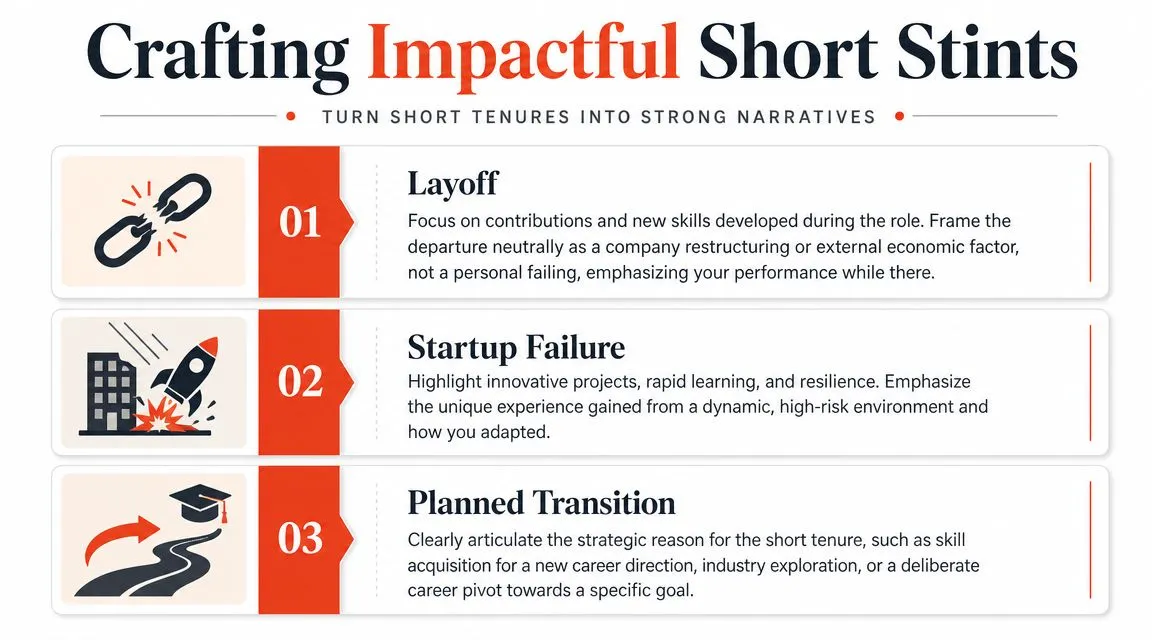
Say your last three roles were a layoff, a startup that ran out of money, and a contract role. That's exactly the kind of history people mishandle. They summarize all three in half a page and hope nobody asks.
Wrong move.
Example one, the layoff stint
Bad version:
- Marketing Manager. Managed campaigns, worked with sales, supported growth initiatives.
That bullet says almost nothing. It reads like you want the reader to move on quickly.
Better version:
- Marketing Manager. Inherited an underperforming lead-gen motion, rebuilt campaign structure and handoff with sales, and left behind a cleaner pipeline process before the company cut the team in a broader restructuring.
The key is that the layoff is context, not the headline.
Example two, the startup that ran out of money
Bad version:
- Head of Operations. Helped scale a startup and worked across multiple business functions.
That sounds padded. Everyone “worked across multiple functions” at a startup.
Better version:
- Head of Operations. Built the operating rhythm for a small team, tightened vendor and workflow handoffs, and created basic reporting so leaders could make decisions faster before the company lost funding.
Now the reader can see what you did.
Better framing: Treat the startup closure as a company outcome. Treat your bullets as evidence of judgment under pressure.
Example three, the planned contract role
Bad version:
- Program Manager, Contract. Supported implementation work for key clients.
That sounds disposable.
Better version:
- Program Manager, Contract. Joined for a defined delivery window, stabilized a delayed implementation, coordinated decisions across client and internal stakeholders, and handed off a cleaner operating process at the end of the engagement.
The contract label helps, but the bullet still has to show impact.
A simple formula that works
Use this structure for every short stint:
-
State the actual situation
Example: inherited a stalled process, joined during transition, stepped into a messy launch. -
Describe your intervention
Example: rebuilt workflow, aligned teams, introduced reporting, fixed handoffs. -
Show the result or value
Example: created clarity, accelerated execution, improved coordination, left stronger foundations.
If you're weak on this kind of writing, study strong examples of how to write achievements in a resume. The difference is usually not experience. It's sentence construction.
For involuntary short stints such as layoffs, acquisitions, or visa issues, the writing challenge is avoiding over-explaining while still creating a coherent, ATS-safe story. That framing problem is well captured in this piece on explaining short job stints and employment gaps.
Confident Scripts for Your Cover Letter and Interview
You don't need a long defense. You need a short, stable answer that sounds like an adult wrote it.

Cover letter line that works
Use one sentence. That's enough.
My recent roles were shorter than I would have planned, but each one added a different layer of operating experience, and that range is exactly why I'm confident in the value I can bring here.
It acknowledges the pattern without sounding spooked by it.
Interview answer that doesn't ramble
Use a two-part formula:
-
Part one, explain the move cleanly
“That role ended after a layoff.”
“The company ran out of funding.”
“That was a defined contract engagement.” -
Part two, pivot to the value
“What mattered is that I came out of it with stronger experience in cross-functional execution and stakeholder alignment.”
That's it.
Keep your tone calm. Don't tell a long story about bad leadership, budget chaos, or how unfair everything was. Even if it's true, it won't help you.
A quick example helps:
-
Weak answer
“It was complicated. The company was going through a lot of changes and leadership didn't really know what they were doing.” -
Strong answer
“The company restructured, so the role ended earlier than expected. While I was there, I built experience in a faster-moving environment and got sharper at delivering with less structure.”
If you want a quick walkthrough on speaking about this cleanly, this video is worth watching:
What not to say
Avoid these:
- “I know it looks bad” because now you're framing the pattern as a flaw
- “I can explain everything” because that signals a problem before you've been asked one
- “None of it was my fault” because it sounds defensive even when it's true
The right answer is brief, factual, and forward-looking. Executive-search advice on short stints consistently pushes the same interview behavior: answer briefly, confidently, and positively, with emphasis on what you learned and achieved. That's the standard you want to hit.
If your resume still reads like an apology, that's fixable. StoryCV is a digital resume writer that helps you turn messy chronology into clear, credible narrative without leaning on templates or filler. Start with one role and get the writing right.