Most advice on StoryCV vs Zety starts in the wrong place. It asks which app is better. I think that's the wrong question.
I built StoryCV, so read this knowing that. The comparison is still useful because these products solve different problems, and picking the wrong category wastes your money faster than picking the “wrong” brand.
If you already know what your bullets should say, Zety makes sense. If you don't know how to say what you did, a template won't rescue you.
The Honest Disclaimer
I'm not a neutral reviewer here. I built StoryCV. That means I have a point of view.
It also means I care about making the distinction clear, because most comparisons blur categories that shouldn't be blurred. Zety is a resume builder. It helps you assemble and format a resume quickly. That's a real job, and it's useful. StoryCV is an online resume writer. It applies editorial judgment at software speed.

Why this comparison still matters
The useful question isn't “Which one wins?” It's “What problem do you have?”
If your problem is layout, polish, and speed, then Zety is in the right category. If your problem is that your experience feels richer than the bullets you've managed to write, then you don't need more templates. You need help deciding what matters and how to phrase it.
That's why I don't think this is a small product trying to punch up at a big one. I think it's a category clarification. Builder versus writer. Formatting versus articulation.
The expensive mistake isn't choosing Zety over StoryCV, or StoryCV over Zety. It's choosing a layout tool when your bottleneck is writing.
The money part matters too
This choice has a real cost. Time first. Money second.
A lot of people also spend too long polishing the wrong thing. They tweak font weight, move spacing around, and fuss over sections before they've written a single sharp line. If you also need a headshot for roles or regions where that matters, the smarter way to get CV photos is a practical resource because it treats the photo as a presentation detail, not the substance of the resume.
That's my bias in plain English. I think content is harder than formatting. I think experienced professionals usually underestimate that gap. And I think comparing StoryCV vs Zety frankly means admitting they're not substitutes in the way most review posts pretend they are.
Builder vs Writer The Core Difference
Here's the one line I'd want you to remember:
Zety helps you format what you already know how to say. StoryCV works out what you should say in the first place.
That's the whole split.
| Question | Zety | StoryCV |
|---|---|---|
| Core job | Builder | Writer |
| Main focus | Layout, structure, templates | Content, articulation, narrative |
| Best for | People with clear bullets already | People who know their work but can't phrase it well |
| Input style | Step-by-step form filling | Guided interview and editorial extraction |
| Output | Formatted resume document | Resume bullet points and written content |
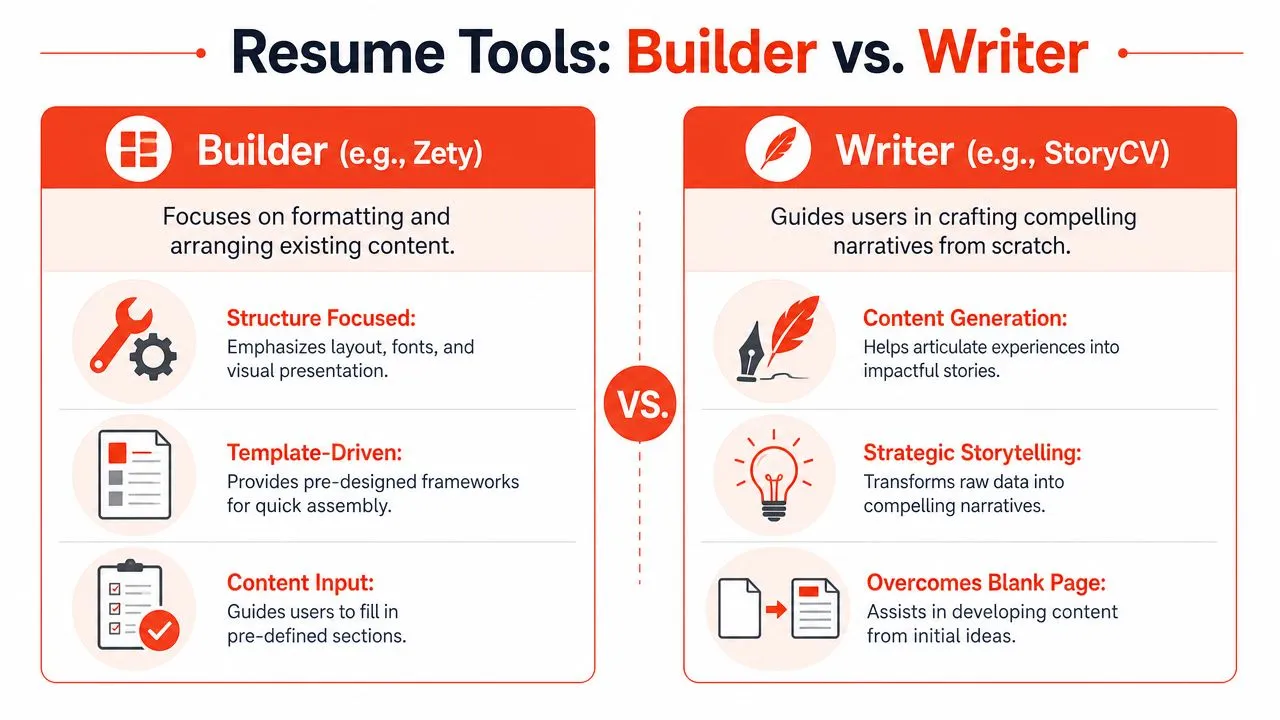
What Zety is actually good at
Zety's strength is obvious. It gives people a clean path from rough notes to a presentable document.
That's why it's so popular. A 2026 Enhancv comparison found Zety's template-driven, step-by-step wizard was preferred for ease of use with 98% statistical confidence. I believe that. Builders are easier to understand because they answer a visible problem. You can see layout. You can see templates. You can feel progress fast.
If you've ever used a focus product that wins by reducing friction, the logic is similar to what you see in Boss as a Service's Caveday review. The winning tool often isn't the deepest one. It's the one that gets you moving with the least resistance.
Why I think the category gets confused
A builder is like good shelving. Useful. Clean. Efficient.
A writer is closer to an editor. It asks what belongs on the shelf in the first place.
That's why I don't treat StoryCV vs Zety as a feature checklist fight. They operate on different layers of the problem. If you're also comparing other resume categories, my take in this Rezi vs StoryCV comparison comes from the same lens. First identify the bottleneck. Then choose the product.
A template can organize your material. It can't decide which part of your career is the story.
When a Template Is All You Need
I'll make the case for Zety plainly. Some people should pick it.
If you already have sharp bullets, know your story, and just want a clean layout fast, a builder is the sensible choice. Zety is good at that job. It packages content quickly and gives you a polished result without making you think too hard about formatting decisions.

Who should honestly choose Zety
You should lean toward Zety if this sounds like you:
- Your bullets are already clear. You know the achievements, the outcomes, and the phrasing is mostly there.
- Your main worry is visual presentation. You want something clean, structured, and recruiter-friendly.
- You need speed. You want a presentable document in one sitting, not a deeper writing process.
- You care about formatting more than editorial help. That's a builder problem, not a writer problem.
Many founder comparisons lose credibility by pretending the competitor is weak at everything. That's nonsense. Zety is strong where builders are strong. It helps people ship.
Where template-first works
For some jobs, this is enough. Say you're a project manager with a solid set of bullets from your last search. Or an engineer who keeps a brag doc and just needs to repackage it. Or an operations lead who already knows exactly how to describe process improvements and cross-functional work.
In those cases, the fastest path often wins.
Here's a walkthrough if you want to see the builder style in action:
Where people fool themselves
The trap is thinking a polished template means the writing problem is solved.
It isn't. A nice layout can hide thin content for a while. It can even make you feel done before you've said anything memorable. That's my real argument against the template-first approach. Not that Zety is bad. It's that many professionals use builders to avoid the hard part.
If your content is already sorted, use the builder. If it isn't, the builder helps you finish the wrong task beautifully.
When the Problem Is the Blank Page
A resume bullet is a decision, not a description.
That's the part most mid-career professionals feel but can't quite name. They did the work. They handled the mess. They made tradeoffs, fixed problems, led projects, calmed clients, shipped things, trained people, kept operations running. But when it's time to write it down, they flatten all of that into job duties.
That's not a design issue. It's an articulation issue.

The real bottleneck for experienced people
StoryCV's own framing of this category is the one I agree with most strongly: 60% of career changers and mid-level professionals report their primary bottleneck is “articulation” of experience, not design in this write-up on resume writer tools.
That tracks with what I see. The problem usually isn't “I need a nicer font.” It's “I can't compress years of work into bullets that sound specific, credible, and relevant.”
Here's what that often looks like in practice:
- The manager who undersells scope. They write “Managed onboarding process” and leave out the actual decisions, constraints, and improvements.
- The career changer who can't translate skills. They know the work matters but struggle to map it into the language of the target role.
- The senior individual contributor who sounds generic. Their work involved judgment, tradeoffs, and influence, but the resume reads like a list of tasks.
Why conversation beats templates here
A template asks you to fill in sections. A writing process asks better questions.
That difference matters. Semi-structured interviews, which are the model behind this kind of guided extraction, typically run between 30 minutes to over an hour according to MAXQDA's guide to semi-structured interviews. The reason they work is simple. Open questions pull out context that forms and boxes never get.
That's also why generic AI writers often disappoint people in this situation. They generate text. They don't always surface the missing detail. If you're sorting through that broader category, these free AI writer recommendations 2026 are useful as a sanity check on what writing tools can and can't do.
I'd put the distinction this way. A builder helps once you know the sentence. A writer helps you discover it. If you want the broader comparison against general-purpose prompting, this StoryCV vs ChatGPT piece gets at the same issue from another angle.
Experienced professionals rarely need more boxes. They need better extraction.
A Look at Process Pricing and Output
The StoryCV vs Zety comparison becomes practical.
Not philosophical. Not branding. Practical.
Process
Zety is a guided builder. You move through fields, templates, and wording prompts. That's efficient if you already know what belongs in each section.
StoryCV is a guided conversation that writes the content layer. Different motion. Different expectation. You're not mainly choosing layouts. You're working out what the bullets should say.
If you're comparing software to a human service, that's the middle ground I care about most. I wrote more about that tradeoff in this comparison with a professional resume writer.
Pricing
The money split is clear.
According to this Zety pricing comparison, Zety's free tier is limited to TXT downloads, and the Pro plan starts with a 14-day trial at $1.95 that auto-renews to $25.95 every 4 weeks, or an annual plan at $5.95/month. The same comparison notes that StoryCV offers a free single role model, and I'll state our founding price plainly here: $39/month.
I don't think subscription mechanics are a side issue. They change the buying decision. If you just need to export a formatted document quickly, a builder can feel cheaper at first. If what you need is writing help, paying for templates is paying for the wrong layer.
Output
This part gets missed in almost every comparison.
Zety gives you the finished document format. That includes the layout, the visual structure, and the export.
StoryCV gives you the written material itself. The bullet points. The narrative. The content you can paste into whatever template or format you use next.
Here's the cleanest way I can put it:
| Category | Zety | StoryCV |
|---|---|---|
| What you pay for | Building and exporting a resume | Writing the resume content |
| What you leave with | A formatted document | Drafted bullets and role content |
| Best value when | You already know what to say | You don't know how to say it yet |
That means the “better” option depends on what outcome you're buying. Formatting, or judgment.
Final Recommendation Which Problem Do You Have
I think most “StoryCV vs Zety” articles make a basic mistake. They compare two products as if they're competing for the same job.
They aren't.
Pick Zety if this is your real problem
Choose Zety if your content is already solid and your main need is packaging. You want a fast, presentable resume. You care about layout. You want a builder. That's a fair choice.
Don't pick StoryCV if you need another language
There's also one limitation I should say plainly. StoryCV supports only English as its current language interface, as listed on its Product Hunt profile. If you need a non-English interface, that matters.
Pick a writer if layout isn't the bottleneck
If your resume rewrite keeps getting postponed because you can't translate your actual work into convincing bullets, then your problem isn't formatting. It's content.
That's where I think people lose weeks. They keep shopping for templates when what they need is editorial help. They keep fixing the shell because the substance feels hard. They keep telling themselves they'll write the bullets later.
Don't do that.
Use a builder when the words already exist. Use a writer when they don't. That's the split. That's the useful answer. And that's why I don't think StoryCV vs Zety has a universal winner.
A template can give you a format. It can't decide what matters.
If your problem is articulation, not layout, StoryCV is built for that. It writes one role for free, then gives you a simple monthly path if you want more.