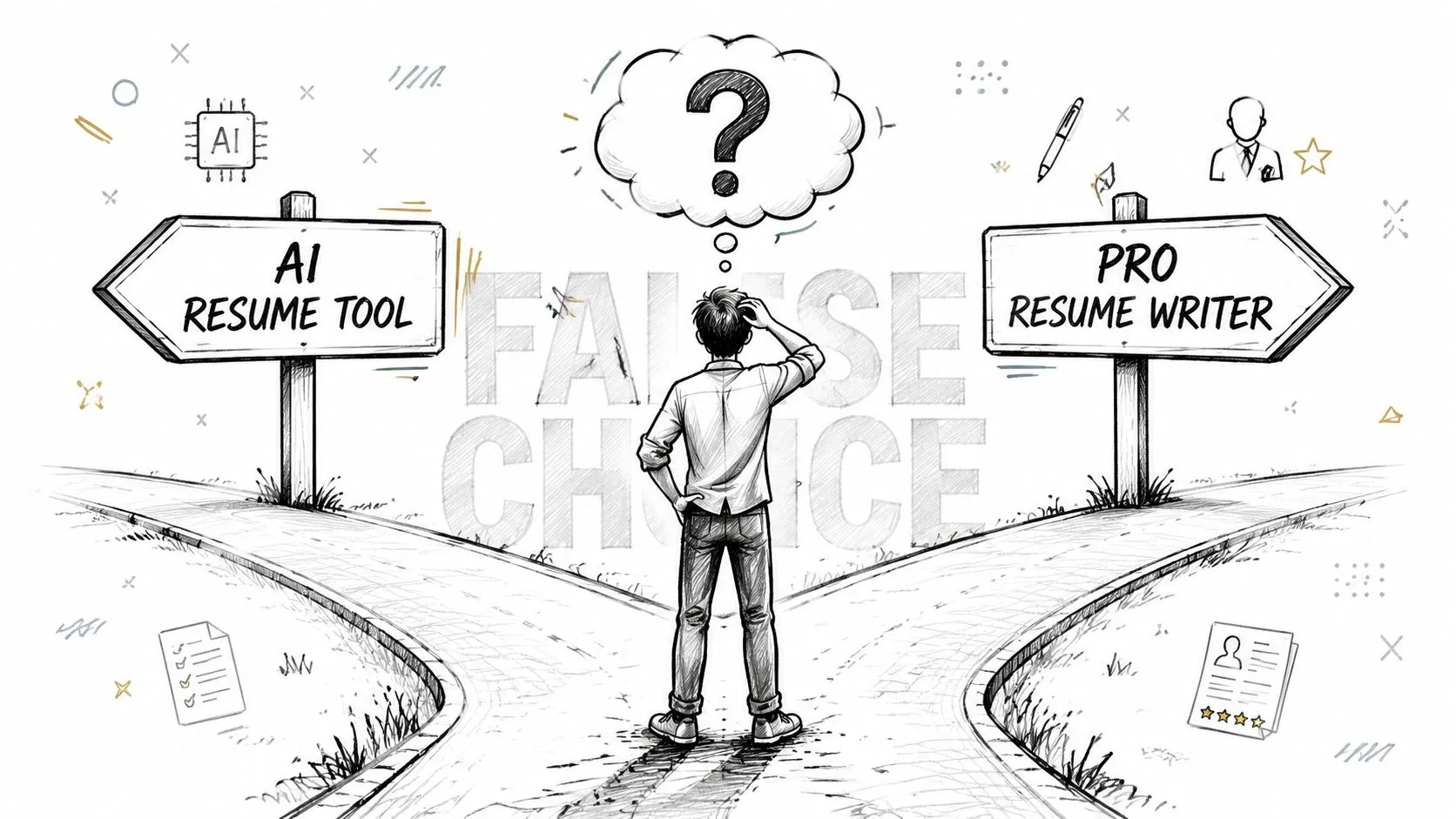
Most advice on this topic is lazy. It tells you to pick between an AI tool and a human writer, as if the category itself answers the question.
It doesn't.
Your real choice is simpler and more useful. Do you need help extracting your story, or do you need a boutique service to shape a story you can already tell? Those are different jobs. If you confuse them, you either overspend on polish or underinvest in strategy.
Here's the fast read.
| Criterion | StoryCV (Digital Writer) | Professional Resume Writer (Human Service) |
|---|---|---|
| Core job | Extracts your experience through guided questions and drafts from that material | Shapes, reframes, and edits your story through a high-touch process |
| Speed | First draft in minutes | Usually days or weeks |
| Process | Self-serve, structured, iterative | Intake forms, calls, revisions, scheduling |
| Best for | Strong professionals who struggle to articulate impact | Complex profiles that need strategy, voice reconstruction, and market judgment |
| Cost profile | Lower-friction than premium writing services. About $10 for 1 week pass. | Higher-cost, often starting around $397 to $800+ according to Growth Hack Your Career |
| Editing loop | Fast self-serve iteration | Revision cycles with another person |
| Main risk | If your situation is unusually complex, software may not give enough strategic framing | You can pay premium prices for work that mostly polishes what you already knew |
| Best outcome | Clear, ATS-compatible draft with real specifics | Deep narrative framing for high-stakes transitions |
The Choice Is Not AI vs Human
The internet loves bad framing. “Use AI” or “hire a writer” sounds neat, but it skips the only question that matters.
What's broken right now?
If your resume is weak because you can't pull your achievements out of your own head, that's not a wording problem. It's a story extraction problem. If your resume is weak because your content exists but reads flat, scattered, or badly positioned, that's a narrative framing problem.
A lot of people also obsess over formatting and keywords before they've said anything meaningful. That's backwards. Yes, structure matters. If you need a plain-English primer on how screening systems read resumes, this guide to understanding resume parsing is worth your time. But parsing is packaging. It is not the substance.
Diagnose the real bottleneck
Ask yourself which of these sounds more like you:
-
Blank-page problem. You've done solid work, but when you write, everything turns into “managed,” “supported,” or “worked on.”
-
Positioning problem. You can describe your work, but it doesn't sound senior enough, sharp enough, or targeted enough.
-
Complex-profile problem. Your background has pivots, gaps, federal requirements, military translation, or executive branding issues.
The first case usually needs a digital writer. The second might need either. The third often needs a human.
A resume usually fails before the wording stage. It fails when the candidate hasn't extracted the real evidence of value.
That's why the StoryCV vs writer debate is often muddled. One option is closer to editorial speed. The other is closer to boutique service. Those are not interchangeable.
If you want a broader take on that split, StoryCV's own comparison of AI resume writer vs human writer makes the same core point. Don't choose based on the label. Choose based on the job that needs doing.
First Extract the Story Then Polish It
Most resumes are bad for a boring reason. People polish weak material.
They rewrite bullets that were empty to begin with. They swap verbs. They tighten phrasing. They chase a nicer format. None of that fixes a resume built on vague memory and task lists.
Why the foundation matters
An analysis of 176,220 resumes created in 2022 found that 69% were between 200 and 400 words long, according to Kickresume's resume statistics roundup. That is brutal compression. In that little space, every line has to earn its place.
If your source material is weak, the final document will still be weak. Just cleaner.
There are really two jobs here:
-
Story extraction
Pull out what was broken, what you changed, what constraints you faced, and what happened after. -
Narrative polishing
Tighten wording, improve flow, sharpen positioning, and make the story easier to scan.
Many individuals jump straight to step two because it feels productive. It isn't.
Polishing can't rescue missing substance
A generic bullet like this doesn't fail because of grammar:
- Weak input: Managed a cross-functional project
It fails because nobody asked the obvious follow-up questions. What project? What was stuck? What trade-off did you make? What changed because of your work?
Once those questions get answered, the bullet usually improves fast:
- Better raw material: Drove a delayed systems rollout across ops and finance after resolving ownership conflicts and simplifying handoffs
That line still might need editing. But now there's something to edit.
Practical rule: If a bullet could belong to five people with your title, it's not a resume bullet yet. It's a placeholder.
People often confuse writing with thinking. Good resume language comes after good reporting. If you've seen how creative tools help people shape rough ideas into something usable, the logic is similar to how teams use best AI writing software for stories. The output gets better when the system helps surface the underlying material first.
What changes when you extract first
When you start with extraction, your resume gets sharper in ways formatting never can:
-
Specificity improves because you stop describing job duties and start naming decisions.
-
Credibility improves because the language sounds lived-in, not copied from job descriptions.
-
Targeting improves because you can choose the right evidence for each role.
That's the whole point. The hard part is not sounding polished. It's figuring out what your work proves.
A Practical Comparison StoryCV vs a Writer
Let's skip marketing language and compare the actual trade-offs.
StoryCV delivers a first draft in minutes through a guided interview, while professional resume writers usually work through intake forms, calls, and revision cycles that take days or weeks, as outlined in this comparison of Rezi vs StoryCV. That speed difference matters if you're applying now, not someday.
StoryCV vs Professional Resume Writer
| Criterion | StoryCV (Digital Writer) | Professional Resume Writer (Human Service) |
|---|---|---|
| Turnaround | Draft in minutes | Usually slower because the writer has to learn your background first |
| Collaboration style | Guided interview and self-serve revisions | Calls, questionnaires, feedback rounds |
| What it's really selling | Editorial speed | Boutique attention |
| Iteration | Easy to test versions quickly | Edits depend on writer availability and package limits |
| ATS output | Built around ATS-compatible bullets and summaries | Often ATS-aware, but varies by writer |
| Best fit | You need help turning messy experience into usable content fast | You need judgment for a nuanced or high-stakes narrative |
| Main downside | Less hand-holding if you want a live strategist | More cost and more waiting |
The practical trade-off
This isn't quality versus cheapness. That's the wrong lens.
It's speed and structure versus human strategy and support.
A digital writer works well when your issue is this: “I know I did valuable work. I just can't translate it into bullets without wasting a weekend.” A professional writer works well when your issue is this: “My profile is politically sensitive, unusually senior, or hard to position.”
The distinction is similar to that between a strong recording workflow and a full production studio. If you've ever had to understand transcription costs, you already know the pattern. Fast software handles repetitive extraction well. Higher-touch service costs more because a person is applying judgment, interpretation, and back-and-forth.
Where each option breaks
-
Digital writer breaks down when your story requires deep personal branding, heavy voice reconstruction, or unusual strategic framing.
-
Human writer breaks down when you pay premium prices for a process that mostly repackages details you could have surfaced yourself.
If your profile is straightforward but your writing is weak, paying for boutique service is often overkill.
That's the cleanest way to think about StoryCV vs a professional resume writer. One helps you get to a strong draft fast. The other helps you address edge cases where strategy matters more than speed.
Who Needs a Digital Writer like StoryCV
Some people shouldn't hire a writer first. They should fix their extraction problem.
If you've been doing solid work for a few years and your resume still reads like a task tracker, you're the right fit for a digital writer. This is common with people in tech, operations, business, customer success, product, and project-heavy roles. They make decisions all day, but write like they were just present in the room.

The ideal user
A digital writer fits you if these are true:
-
You've done meaningful work but default to duty-based language.
-
You need speed because you're applying soon or testing several roles.
-
You want control over your own narrative instead of waiting on a service provider.
-
You need prompting that asks better questions than “paste your experience here.”
StoryCV acts as a content extraction system that asks role-specific questions about decisions and outcomes, then turns those answers into ATS-compatible bullets, as described in this overview of resume writer tools.
A before-and-after example
Here's what weak source material looks like:
- Before: Managed a project to improve onboarding
That's not wrong. It's just dead.
A guided interview pushes for the missing facts. What was broken? What friction did new hires hit? What did you change? Who had to buy in? What improved?
Then you get something with signal:
- After: Reworked onboarding across hiring managers and ops, removing early-process confusion and giving new hires a clearer path through training and handoffs
Notice what changed. The second line has movement, context, and ownership. It sounds like someone who did the work.
Why this works better than blank-box AI
Generic AI tends to rephrase whatever you paste into it. If the input is thin, the output stays thin. A digital writer is more useful when it behaves like an interviewer, not a synonym machine.
That's also why this is different from freeform prompting. If you want that comparison, StoryCV vs ChatGPT is worth reading. The gap is not fluency. It's whether the workflow helps uncover the true story before it writes.
A digital writer is for professionals who don't need therapy, branding theater, or a long intake call. They need better questions, a sharper draft, and room to iterate.
When to Hire a Professional Resume Writer
A professional resume writer makes sense when the problem is positioning, not production.
If you already have the raw material but need someone to shape it into a credible, targeted narrative, pay for the specialist. That is the fundamental split in this article. StoryCV helps extract and organize your story fast. A boutique writer earns the fee when your story is hard to frame, risky to frame poorly, or needs judgment that goes beyond a guided workflow.
A human writer usually pays off in situations where success is critical and the narrative is messy. The National Resume Writers' Association notes that resume writers often support clients through career changes, senior-level branding, and other situations where strategy matters as much as wording, as explained in its overview of what certified resume writers do.
Cases where a human earns the fee
Hire a professional writer when your resume needs editorial judgment and market translation.
-
Career transitions
You are changing function, industry, or level. Your resume has to connect dots for the reader, not just list past work. -
Federal applications
Federal resumes follow their own rules. Length, detail, and compliance matter. Generic resume workflows can miss that. -
Military-to-civilian translation
This work requires interpretation, context, and audience awareness. Strong experience still gets ignored if the language stays too internal. -
Executive and leadership roles
Senior resumes carry more than facts. They signal judgment, scope, and credibility. Weak positioning costs interviews.
What you are actually paying for
You are not paying for prettier bullets.
You are paying for someone who can decide what belongs, what does not, and how to frame the through-line of your career. That matters when your background has overlap, gaps, title inflation, confidential work, or achievements that sound ordinary unless someone knows how to sharpen them.
A strong writer also gives you distance from your own career. That is useful when you are too close to the material and keep underselling the parts that matter.
Some resumes need authorship, not assembly.
If you are weighing that option, StoryCV's guide on how to hire a resume writer will help you judge the service, not just the sales pitch.
When not to hire one
Do not hire a professional writer if your background is straightforward and your real problem is self-expression.
If you can do the work, explain the work, and just need help pulling stronger detail out of your experience, boutique service is often overkill. In that case, speed and structured prompting beat a long intake process. Use the tool built to extract the story first. Save the premium service for situations where bad positioning will cost you.
Your Decision Checklist No More Guesswork
Stop treating this like an AI versus human debate. That framing is lazy and not useful.
Your choice is simpler. Do you need help getting your career story out of your head, or do you already know the story and need someone to tighten it? That is the difference between editorial speed and boutique service, as argued in this analysis of AI vs human resume writing.
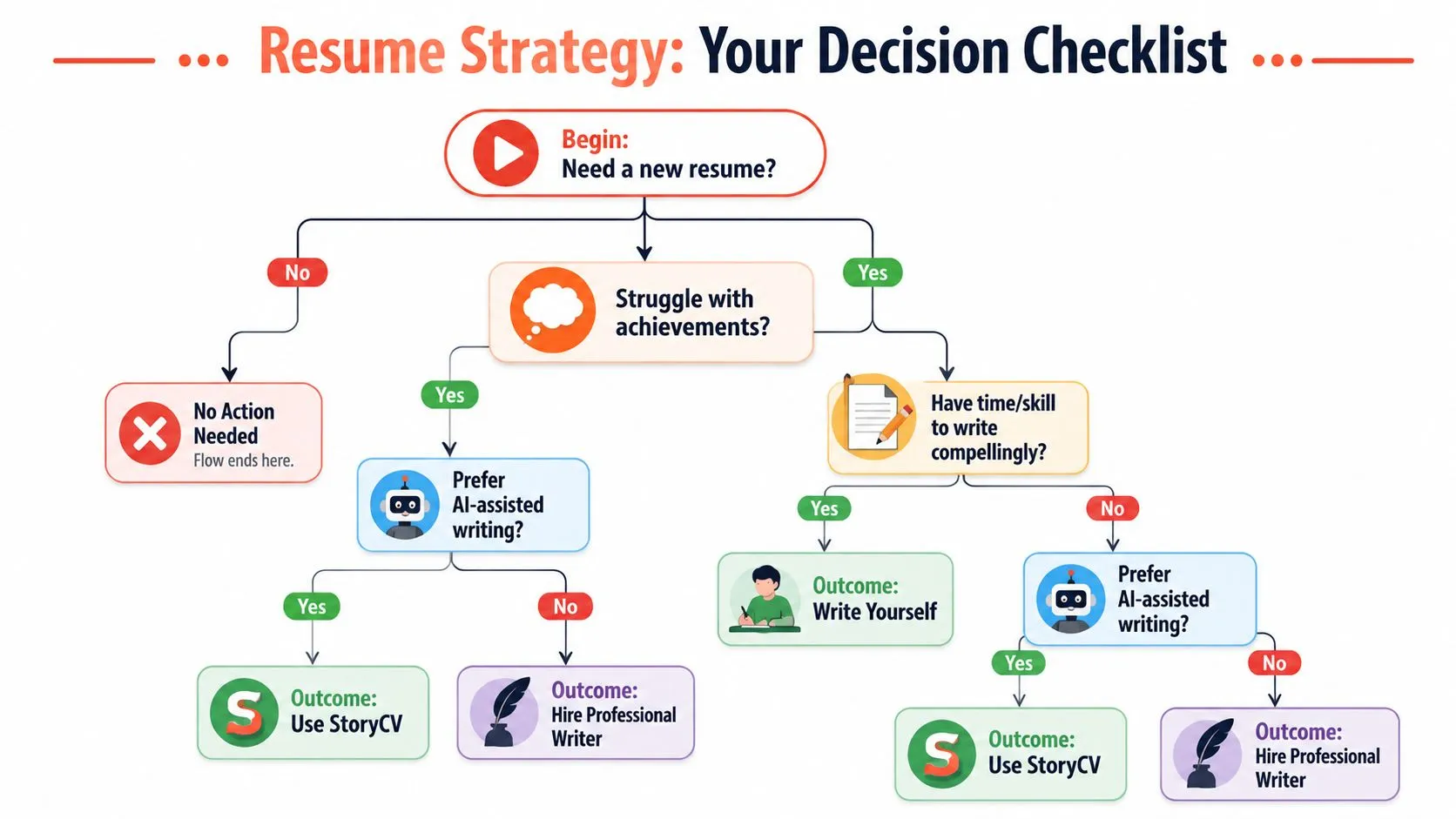
Use this checklist
-
Can you explain your strongest wins without rambling?
If yes, you probably need editing. If no, you need extraction first. -
Is your background easy to understand on paper?
Straightforward careers usually do fine with a digital writer or DIY revision. Complicated careers often do not. Career changes, gaps, federal applications, military translation, and senior leadership positioning usually need judgment, not just better phrasing. -
Do you need a usable draft quickly?
Choose the option built for speed if timing matters. Long intake calls and revision cycles are slow by design. -
Will you create several versions for different roles?
If yes, iteration matters. A tool you can reuse beats waiting for every update. -
Do you need a partner, or do you need a document?
Answer this. Some job seekers want coaching, reassurance, and strategic pushback. Others want a resume that finally says something specific.
The short answer
Here is the recommendation:
-
Write it yourself if you know your best examples, know the target role, and can describe your value clearly.
-
Use a digital writer if your experience is solid but translating it into sharp bullets is slow, frustrating, or inconsistent.
-
Hire a professional resume writer if your background is complex, high-stakes, or easy to misread.
The decision is that simple.
The StoryCV vs a professional resume writer choice is operational. Pick the option that fixes the bottleneck. If the problem is story extraction, use StoryCV. If the problem is high-level judgment on a nuanced career narrative, pay for a writer.
If your problem is articulation, not formatting, try StoryCV. It works like a digital resume writer: guided questions in, clear draft out, without the calls, delays, or boutique-service overhead.