You paste your job description into ChatGPT. You ask for sharper resume bullets. It replies in clean, polished English.
“Led cross-functional initiatives.”
“Drove operational excellence.”
“Improved customer satisfaction.”
It sounds right for about eight seconds. Then you read it again and realize it could belong to anyone with your title. Not just you. Anyone.
That's the whole problem with StoryCV vs ChatGPT. This is not really a fight between two writing tools. It's a fight between wording and research.
You Tried ChatGPT for Your Resume and It Felt Empty
You opened ChatGPT, pasted your experience, and got back something polished enough to look useful. Then you read it twice. Nothing in it sounded false, but none of it felt earned.
That reaction makes sense.
A lot of job seekers use ChatGPT for resume help, and hiring teams are also wary of resumes that feel AI-written, as noted earlier. The problem is not that the tool failed at grammar. It did the job you gave it. It produced clean wording from thin material.
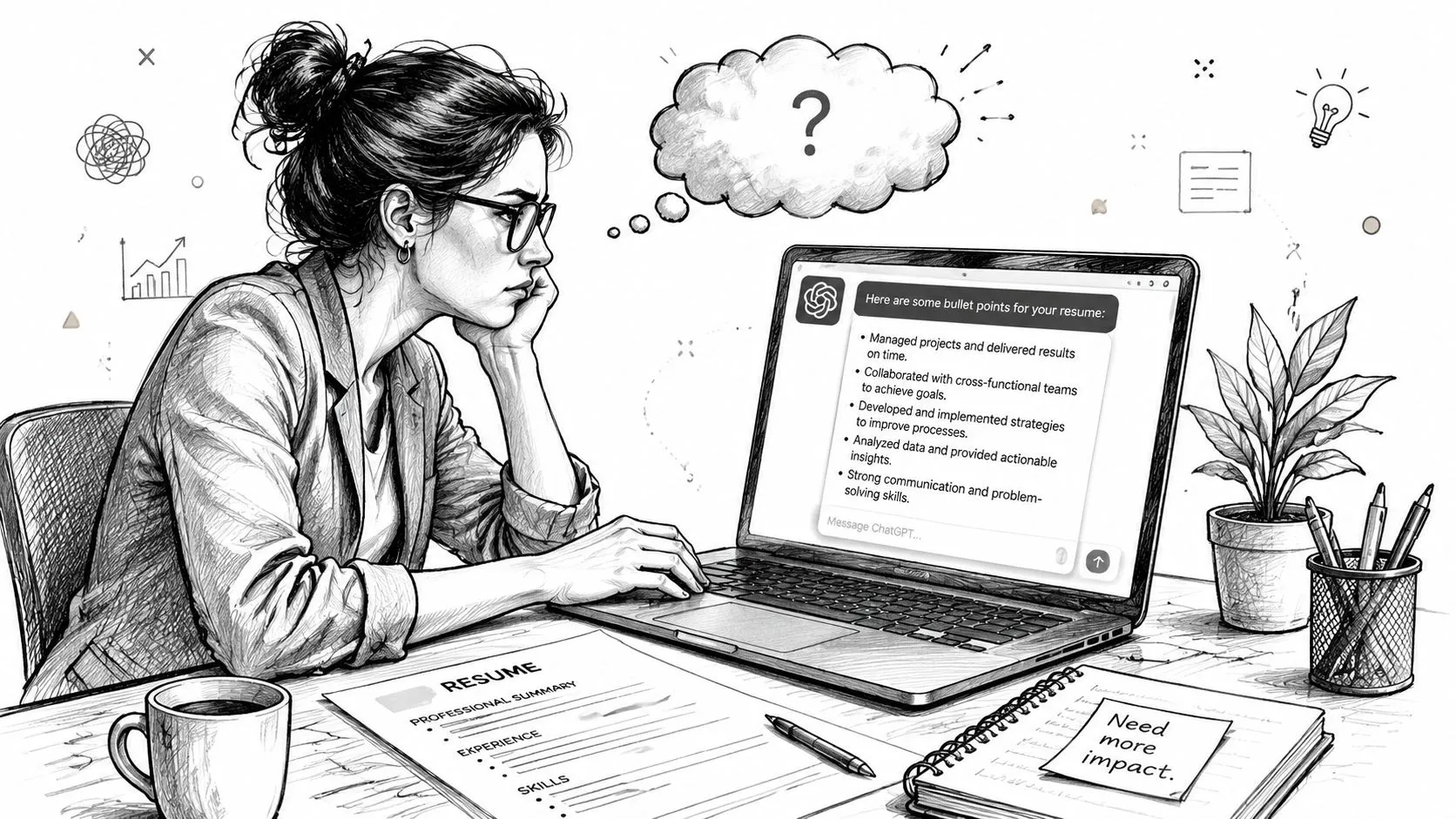
That is why the result feels empty. Resume bullets are small on the page, but they carry a lot. They have to prove judgment, ownership, and results in a line or two. ChatGPT can polish a sentence fast. It cannot tell which messy decision, trade-off, or win deserves the line unless you already figured that out first.
Early comparison
| Question | ChatGPT freehand | Guided resume workflow |
|---|---|---|
| What it does well | Rephrases, brainstorms, unsticks blank pages | Pulls out decisions, trade-offs, and impact |
| What usually goes wrong | Rewords your title instead of your work | Requires you to actually think through the story |
| Output style | Fluent, generic, a little inflated | More specific, more grounded |
| Best use | First draft language | Final resume narrative |
If you have already tried cleaning up AI phrasing elsewhere, you know the pattern. Resources on human-like AI for students and creators can help the text sound less robotic. Helpful, but secondary. A resume usually breaks earlier than tone. It breaks at the source material.
So ChatGPT fills the gaps. It grabs the safest language available. It mirrors your title, your job description, and the clichés that usually travel with both.
If you want to compare tools built for more than rewording, this roundup of AI resume writer options shows the split clearly.
Fluent is not the same as specific. On a resume, that difference decides whether anyone remembers you.
The Real Problem Is Thinking Not Writing
Bullets are a thinking problem, not a writing problem.
That's the frame often missed.
You don't struggle with resume bullets because verbs are hard. You struggle because your work lived inside meetings, trade-offs, deadlines, bad systems, political friction, and choices that never show up in a job description. Good bullets come from sorting that mess into a clear story.
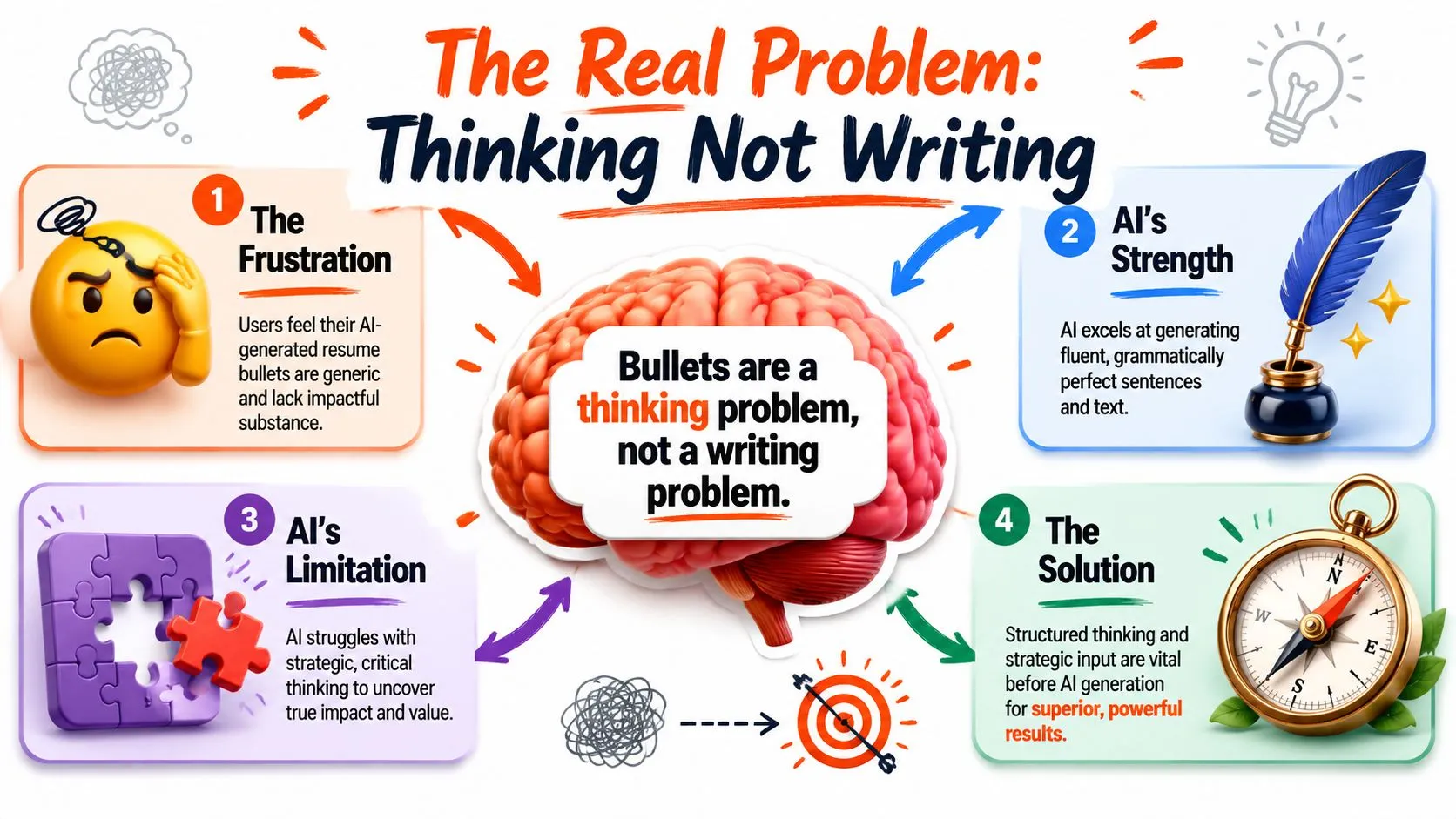
ChatGPT skips that work unless you force it. It can't know what mattered unless you already know. And if you already know, the hard part is mostly done.
Wording versus research
Here's the split:
- Wording is sentence polish. Better verbs. Cleaner flow. Less repetition.
- Research is finding actual material. What broke. What changed. What you chose. What pushed back.
A strong bullet usually sits on top of hidden questions:
- What was the mess? Not the task. The actual problem.
- What did you decide? Not “supported” or “assisted.” The move you made.
- Why did that choice matter? What changed because of it.
That's why generic prompting fails so often. You ask for better wording when the deeper issue is weak source material.
The loop most people get trapped in
An independent comparison found that a ChatGPT-only resume workflow was 3 to 4 times longer once formatting was included, and noted that ChatGPT is strongest for brainstorming, not for producing a finished resume document in this comparison of ChatGPT and dedicated resume tools. That tracks with what people experience.
You prompt.
It gives you something polished and thin.
You add more context.
It gives you a longer version of the same problem.
If you want to get sharper before you write, do the thinking first. This career reflection guide before resume writing is useful because it forces the material out of your head before you start polishing sentences.
I also like practical resources like Prompt Builder's AI prompt guide when you're trying to get better output from general models. But even great prompting can't replace missing insight. A better prompt won't uncover a story you haven't articulated.
Practical rule: Don't ask AI to “improve your bullet” until you can explain what changed because of your work in one plain sentence.
A Tale of Two Workflows StoryCV vs ChatGPT
You sit down to “fix” your resume. Twenty minutes later, ChatGPT has given you cleaner sentences, and you still don't know if any of them say something real.
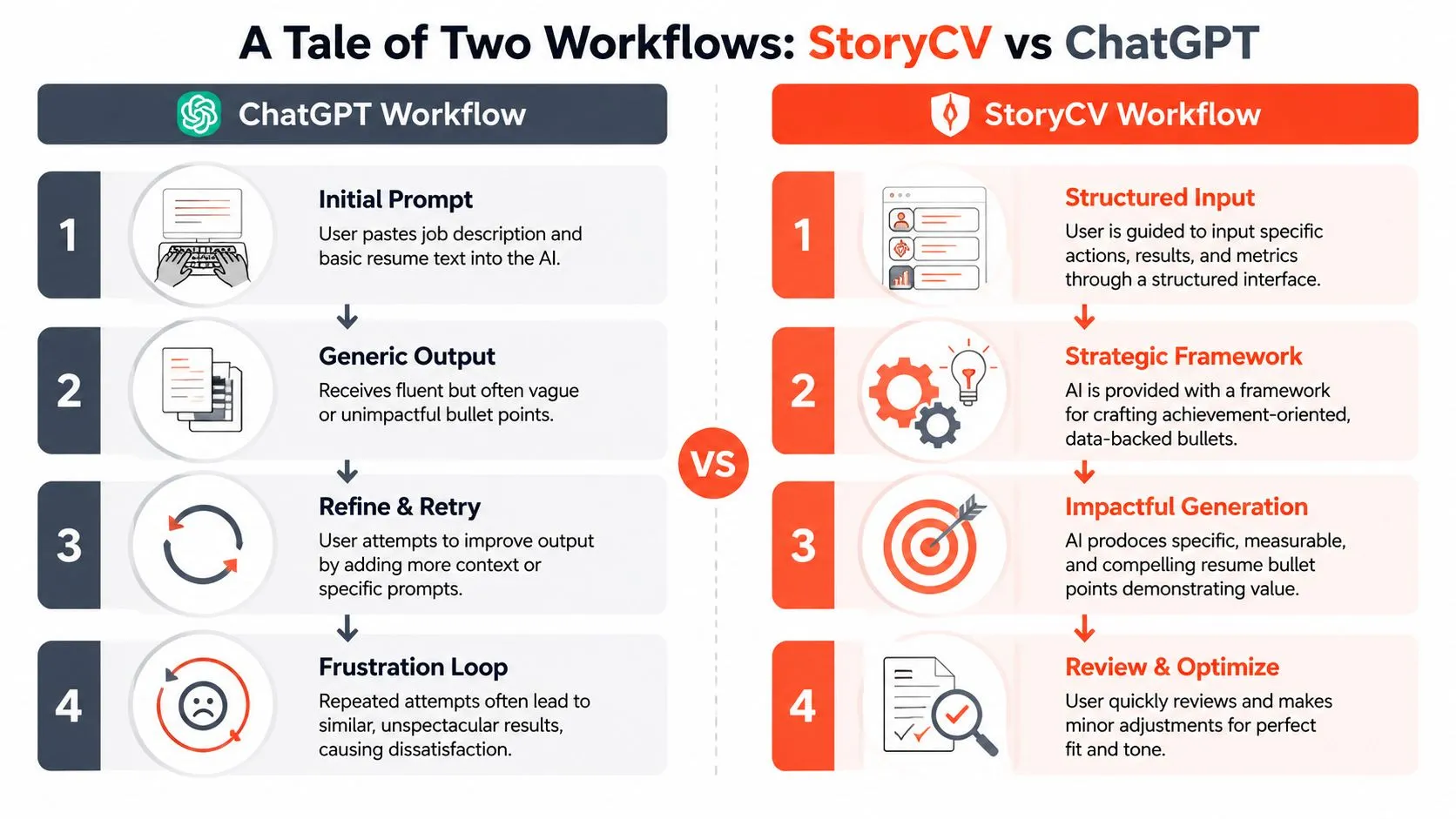
That's the actual split in storycv vs chatgpt. One tool helps with wording. The other helps you figure out what you did, why it mattered, and which details belong on the page.
The ChatGPT workflow usually goes like this:
- You paste a bullet, a job description, or your whole resume.
- It gives you something polished and vague.
- You ask for stronger impact.
- You add more background.
- It rewrites the same weak material with better grammar.
You can watch the pattern in action here:
The cost is not just time. It's confusion.
Polished language creates false confidence. The sentence sounds finished, so you stop questioning whether it proves anything. That's how people end up with resumes full of respectable-sounding filler.
A stronger workflow starts earlier. It asks for evidence before it writes. StoryCV does that by pulling specifics out of your experience instead of waiting for you to guess the perfect prompt.
The useful questions are simple:
- What was broken before you touched it?
- What decision did you make?
- What resistance or constraint did you deal with?
- What changed because of your work?
- What can you prove?
Those questions produce raw material. Raw material produces sharp bullets. If you want a clearer sense of what strong bullets look like, this guide on how to write resume bullet points that show impact is worth reading.
My blunt take
ChatGPT is fine for cleanup. Use it to shorten a line, smooth phrasing, or test alternatives.
Don't use it as your whole resume process. It writes from what you give it. If your inputs are thin, the output will be thin too.
StoryCV is useful for a different job. It helps you research your own experience, extract the signal, and turn messy memory into a draft with backbone. That's why the workflow matters more than the wording.
A Real Bullet Point Before and After
Here's the failure mode in one line.
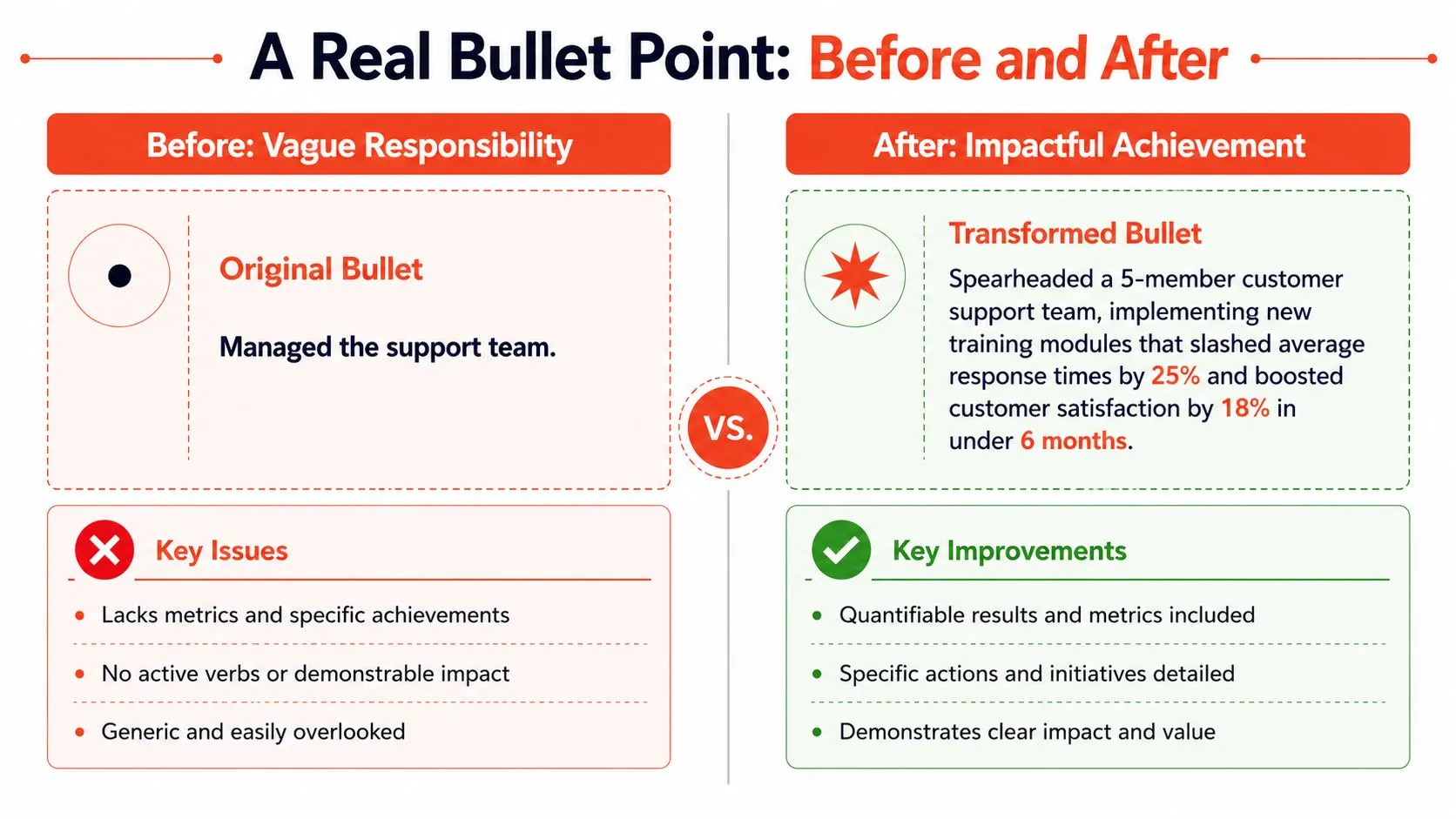
Original input: Managed the support team.
That's not bad because it's false. It's bad because it hides the work.
What ChatGPT usually does
It turns that into something like:
Led support operations to improve customer satisfaction.
Clean sentence. Worthless bullet.
It rewords the title. “Managed the support team” becomes “led support operations.” Same meaning. Better outfit.
What guided questioning uncovers
Now ask a few real questions.
- What was broken when you inherited the team?
- What kept the queue messy?
- What change did you make that others had avoided?
- What happened after?
Suddenly the actual bullet shows up:
Rebuilt the triage system nobody had touched in three years, dropping first-response time by half.
Same role. Same person. Completely different level of signal.
That's why this guide to writing better resume bullet points matters. The bullet isn't born from vocabulary. It's born from specificity.
Here's another quick pair:
| Version | Bullet |
|---|---|
| Generic | Managed cross-functional teams to deliver key initiatives |
| Useful | Pushed through a checkout redesign three PMs had deprioritized and cut cart abandonment 18% |
The first one sounds senior. The second one sounds real.
The resume bullet you want is usually hiding behind the question you didn't ask yourself.
When to Use ChatGPT and When to Use StoryCV
This part is simple.
ChatGPT is a general-purpose machine. OpenAI's usage research, summarized in this report on ChatGPT statistics, says ChatGPT had 200 million weekly users by mid-2024 and only about 30% of usage was work-related. That tells you what the product is. Broad. Flexible. Built for a huge range of tasks.
That's not a knock. It's just the wrong shape for final resume work.
Use ChatGPT for small jobs
ChatGPT is good when you already know what you mean.
- Brainstorming: You have rough notes and need options.
- Rephrasing: One bullet sounds clunky and you want cleaner wording.
- Tone checks: You want something less stiff, less repetitive, or shorter.
That's where it shines. It's fast. It's useful. No drama.
Use a guided resume process for high-stakes work
Don't rely on freehand prompting when you need the finished artifact that represents your career.
Use a guided process when:
- Your experience is messy: You've done more than your title suggests.
- Your path isn't linear: Career changes, overlapping work, stretch projects, return-to-work stories.
- Your bullets all sound the same: Everything reads like “responsible for” in better clothing.
- You know you did strong work but can't explain why it mattered: This is the big one.
The difference is not “AI versus no AI.” It's general assistant versus editorial process.
If you're staring at a blank page, ChatGPT can help you start. If you're trying to create a resume you'd send, you need something that forces sharper thinking before the wording phase.
Your Resume Is a Tool for Thinking
People treat resumes like packaging. That's too late in the process.
A resume is a thinking tool first. It forces you to decide what your work says about you. If you skip that part, the final document will be polished and empty.
That's also why blind trust in generic AI is risky. A University of Washington study found that ChatGPT consistently ranked resumes with disability-related honors lower than the same resumes without those honors in the university's report on AI bias in resume evaluation. That matters because the problem isn't just bland writing. It's that generic systems can flatten context, and sometimes distort merit.
Why context matters more than polish
A candidate with a career break.
A veteran translating military work.
A leader whose biggest contribution was preventing failure, not shipping a flashy launch.
A professional with disability-related credentials or signals that need careful framing.
These cases don't need prettier synonyms. They need context preserved.
That's the piece freehand prompting keeps dropping. It can produce language about your job. It can't reliably think through the meaning of your work for you.
The line I'd keep in mind
If your resume sounds generic, the problem usually isn't your grammar.
It's that nobody did the reporting.
If you want a resume process that asks the second and third question instead of just polishing the first answer, StoryCV is built for that. It works like a digital resume writer, not a template library, so the goal is to surface what changed because of your work and turn that into a draft you would send.