Your header isn't the problem. It's the safest, smallest place to spend time because it lets you avoid the harder question underneath it: what did you do that matters?
People fiddle with font size, spacing, whether to include an address, whether the phone number should sit left or centered. Meanwhile the bullets below still say “responsible for,” “worked on,” and “helped with.” That's the core issue.
Your Resume Heading Is a Trap
The average U.S. job posting gets 45 applicants, and hiring managers spend only 7 seconds on an initial scan, according to this resume headline analysis. That tiny window makes people obsess over the first line they can control.
That obsession is understandable. It's also a trap.

A resume heading is a bounded problem. Your name goes here. Contact info goes there. Maybe a positioning line under it. You can “finish” it quickly, feel productive, and still avoid the uncomfortable work of choosing which achievements belong on the page.
That's why smart professionals lose hours here. The header for a resume feels like a design choice. The bullets feel like judgment. One is easy to tweak. The other forces you to decide what your career really says about you.
You don't have a header problem. You have a prioritization problem.
So make this a five-minute decision. Get the resume heading clean, readable, and done. Then move on.
If you want to see where most resumes go wrong, look at these common resume errors people keep repeating. Spoiler: it's rarely the contact line.
The Only 5 Things Your Heading Needs
Most resume headings are overbuilt. You don't need clever formatting. You need a header a recruiter can read instantly and software can parse cleanly.
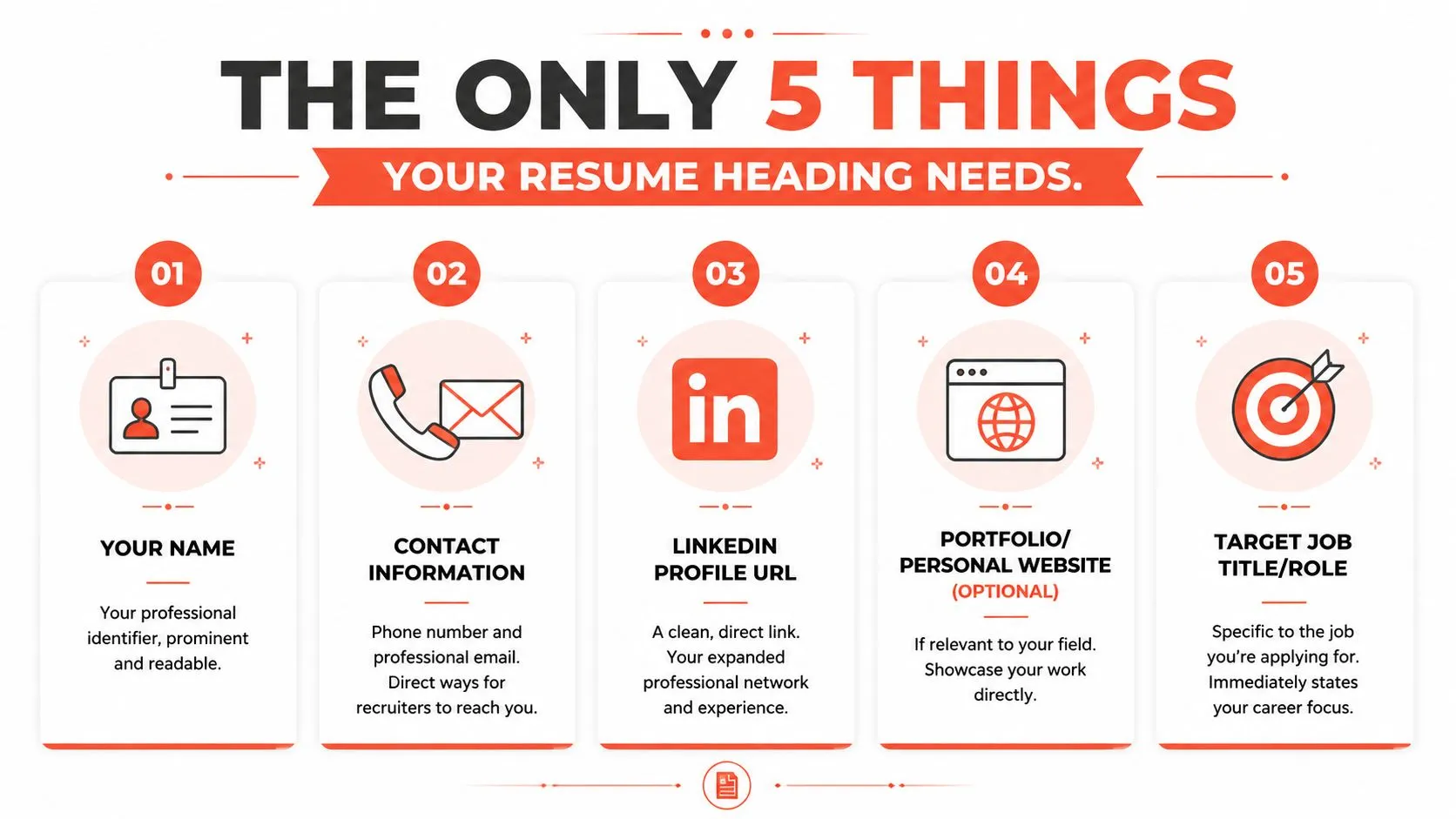
Your name
Put your name first. Make it the largest text in the header. Not huge. Just clearly dominant.
This is your professional identifier, not a branding experiment. Skip script fonts, decorative icons, and anything that makes the page look like a wedding invitation.
A role line, if it helps
A short role or positioning line under your name can help if it says something specific. “Operations Manager” is clear. “Operations Leader in Process Improvement” is better if that's indeed the role you want and the work supports it.
Keep it plain text. The standard branding formula is [Job Title] + [Years of Experience or Key Credential] + [Skill, Industry Focus, or Achievement], as outlined in Jobscan's guidance on resume headlines. Use it when it sharpens your positioning. Skip it when it turns into fluff.
A few good examples:
- Senior Product Manager | B2B SaaS | AI
- Finance Manager | CPA | FP&A
- Operations Lead | Supply Chain | ERP
A few bad ones:
- Results-Driven Professional
- Experienced Team Player
- Seeking New Opportunities
Contact info that actually matters
You need reliable contact details. That means the basics:
- Phone number you answer or check
- Professional email that doesn't look like it belongs to your teenage Xbox account
- LinkedIn URL if it's current
- Portfolio, GitHub, or personal site if your field benefits from it
For many professionals, adding city and state or Remote is enough. You do not need to publish your full street address.
Here's the mechanical part people ignore. Enhancv's ATS formatting guidance notes that complex formatting like text boxes and built-in header or footer tools can cause parsing failure rates of up to 50% in legacy systems. So keep the resume heading in plain text in the document body. Not in a fancy top banner. Not in a table. Not in columns.
Practical rule: If your resume heading looks like a graphic, it's probably doing too much.
If you're still unsure how to label the rest of the document after the header, use standard categories. This guide on resume section categories will keep you from getting cute in the wrong places.
A quick visual can help if you're overthinking layout:
Relevant links only
If the link strengthens your candidacy, include it. If it's there because you feel like you should have one, leave it out.
A software engineer can include GitHub. A designer can include a portfolio. A product manager can include LinkedIn. An operations leader probably doesn't need four different URLs fighting for space in the top third of the page.
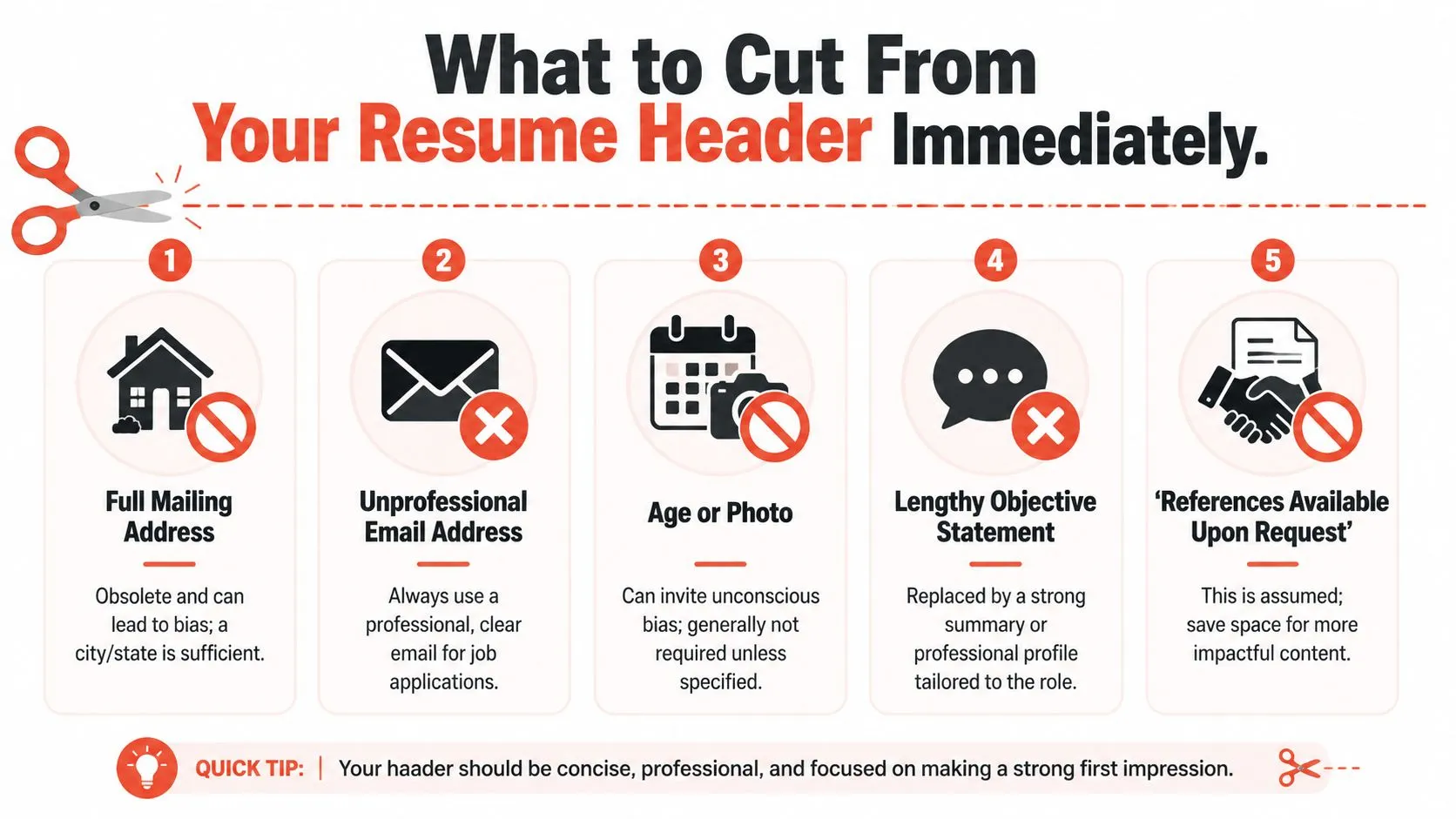
What to Cut From Your Header Immediately
A modern resume heading is mostly subtraction. The fastest improvement is usually removing the leftovers.
The obvious clutter
Start with the two biggest offenders.
- Full mailing address. You don't need it. City and state are sufficient.
- Objective statement. Recruiters don't need “To obtain a challenging position...” at the top of the page. It says nothing.
Then cut the rest of the outdated debris:
- Photo unless the role or region specifically requires it
- Birth date, marital status, or other personal details
- “References available upon request”, which wastes space stating the obvious
- An unprofessional email address
If you use a positioning line, keep it short. Novoresume's guidance on resume headlines says it should ideally stay under 60 characters so it fits within a 600-pixel width limit and doesn't wrap or get truncated on smaller screens. That's a useful rule because the top of your resume should scan in one glance, not spill into a second line like a paragraph.
Cut anything that doesn't help someone contact you, identify you, or understand your role.
That's the test. If a line fails it, delete it.
10 Resume Heading Examples That Just Work
This is the part people need. Not theory. Not “be professional.” Just examples you can steal and adapt.
Use the structure, not the exact words. The standard formula is simple: job title first, then experience or credential, then a skill, focus area, or achievement. Keep the line tight and human.
Resume heading formats by role
| Role/Situation | Headline Example / Micro-Template |
|---|---|
| Mid-level software engineer | Maya Chen \n Senior Software Engineer | 8 Years | Python & AWS |
| Product manager | David Romero \n Product Manager | B2B SaaS | Mobile Growth |
| Operations leader | Nina Patel \n Operations Manager | Supply Chain | ERP |
| Finance professional | Marcus Hill \n Finance Manager | CPA | FP&A |
| Marketing strategist | Elena Brooks \n Marketing Manager | Demand Gen | Lifecycle |
| Data analyst | Jordan Kim \n Data Analyst | SQL & Tableau | Business Insights |
| Career changer into project management | Sam Ortega \n Project Manager | PMP | Cross-Functional Delivery |
| Veteran pivoting to operations | Taylor Reed \n Operations Lead | Logistics | Process Improvement |
| Designer | Avery Scott \n Senior UX Designer | Product Design | Research |
| Consultant | Priya Shah \n Strategy Consultant | 6 Years | Growth & Ops |
What these examples get right
They name a role clearly. They don't hide behind vague labels like “professional” or “leader.” If someone reads only the first line under the name, they still know what kind of candidate they're looking at.
They also stay specific without turning into a keyword landfill. You're not trying to cram your entire career into the top strip of the page. You're trying to answer one basic question fast: what do you do?
Here's the difference in practice:
“Marketing Professional” is a label. “Marketing Manager | Demand Gen | Lifecycle” is positioning.
If you're changing careers
Many people freeze at this stage. They don't want to “lie” by using the target role. Fine. Don't lie. But don't bury your direction either.
A clean approach is to use a target-facing line that your background can support.
Examples:
- Project Manager | PMP | Cross-Functional Delivery
- Customer Success Manager | SaaS | Retention
- Operations Analyst | Process Improvement | Reporting
These work because they point forward without inventing a history you don't have. The bullets below have to do the heavy lifting. The heading just sets the frame.
If you should skip the headline entirely
Sometimes your name plus contact line is enough. If your current title already matches the role and your experience section does the rest, a branding line may add very little.
That's the point often overlooked. A resume heading can help. It cannot rescue weak content.
Stop Polishing and Start Writing
Your header is done. Good. Stop touching it.
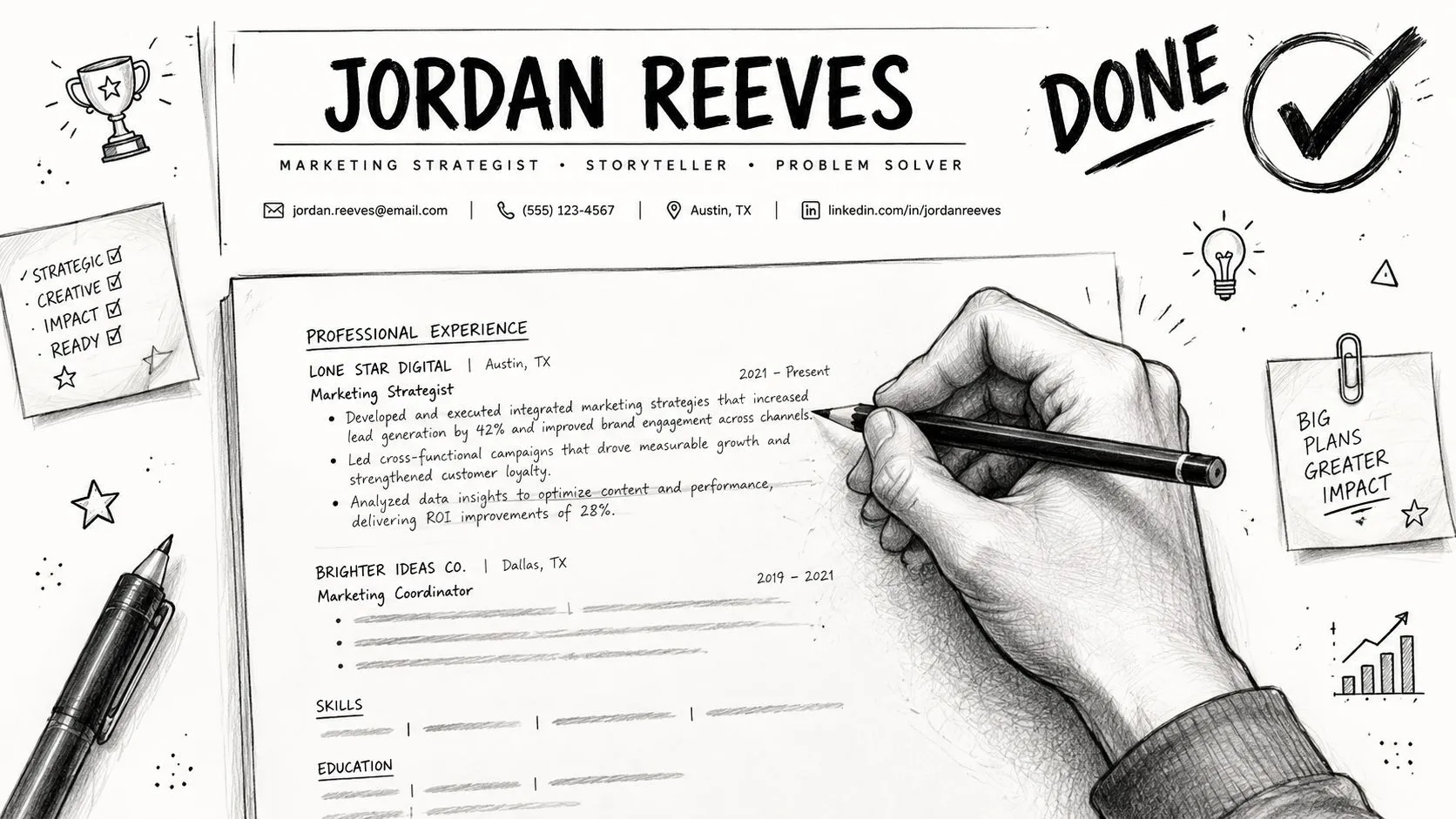
Recruiters spend only 7–9 seconds on a resume and often skip sections like the professional summary in favor of measurable outcomes, according to this discussion of recruiter scanning behavior. That's why a polished heading matters less than people want it to.
A beautiful top section on a weak resume still loses. A plain top section on a resume with sharp, specific bullets still gets attention.
Where your time should go now
Put the next hour into decisions that change the document:
- Cut weak bullets that only describe responsibilities
- Rewrite your first bullet under each role so it shows scope, ownership, or outcome
- Name the problem you solved, not just the task you performed
- Use proof where you have it, whether that's a credential, a tool, or a concrete result
If you need help getting unstuck there, start with this guide on career reflection before writing your resume. That work is harder than tweaking the contact line. It's also the part that changes whether someone calls you.
A clean resume heading makes you look organized. Strong bullets make you look hireable.
StoryCV is an online resume writer built for people who've done strong work but struggle to articulate it. It uses editorial judgment at software speed to turn messy experience into clear, credible resume language. If you're done wasting time on formatting and ready to write the part that gets interviews, StoryCV helps you do that.