“Put your best work in a reel” is incomplete advice. A polished montage can show the footage, music, and graphics without showing which decisions were yours.
A strong resume for video editor roles connects the page to the playback. The resume names your contribution. The reel gives the hiring team something they can inspect.
Why Most Video Editor Resumes Get Filtered Out
Premiere Pro. After Effects. DaVinci Resolve. Avid. Final Cut Pro.
That's a software inventory, not a reason to hire you. Another editor can list the same applications while making completely different decisions about pacing, structure, performance, and sound.
The problem isn't that technical skills don't matter. It's that software proficiency doesn't explain editorial judgment. A hiring manager still needs to know what you received, what you changed, and whether you could handle the work they need done.
Show the work behind the timeline
O*NET's film and video editor task profile gives organizing raw footage into a continuous whole an importance score of 92, while selecting shots into a logical story scores 90. Those responsibilities describe decisions, not buttons.
Build your experience around the evidence those decisions leave behind:
- Production scope: Documentary interviews, branded campaigns, episodic television, sports packages, or social cutdowns.
- Editorial ownership: Story assembly, performance selection, pacing, sound integration, or finishing.
- Delivery constraints: Incomplete coverage, changing briefs, competing versions, or a fixed transmission deadline.
- Outcomes: A clearer narrative, an approved delivery, fewer review problems, or documented audience results.
Hiring test: Could another editor paste your bullet into their resume without changing anything? If so, it needs more context.
Cut “creative professional with excellent attention to detail.” Replace it with evidence of a difficult choice you made well.
Don't claim every project changed the business. Some projects needed a clean, accurate delivery under pressure. That's useful evidence when you explain the pressure and your response. The resume should make your competence visible without asking the reader to infer it from a job title.
The Resume Structure That Actually Works
Use a predictable structure. Save the visual experimentation for the work you're applying to edit.
Keep the main sections in a clear reading order.
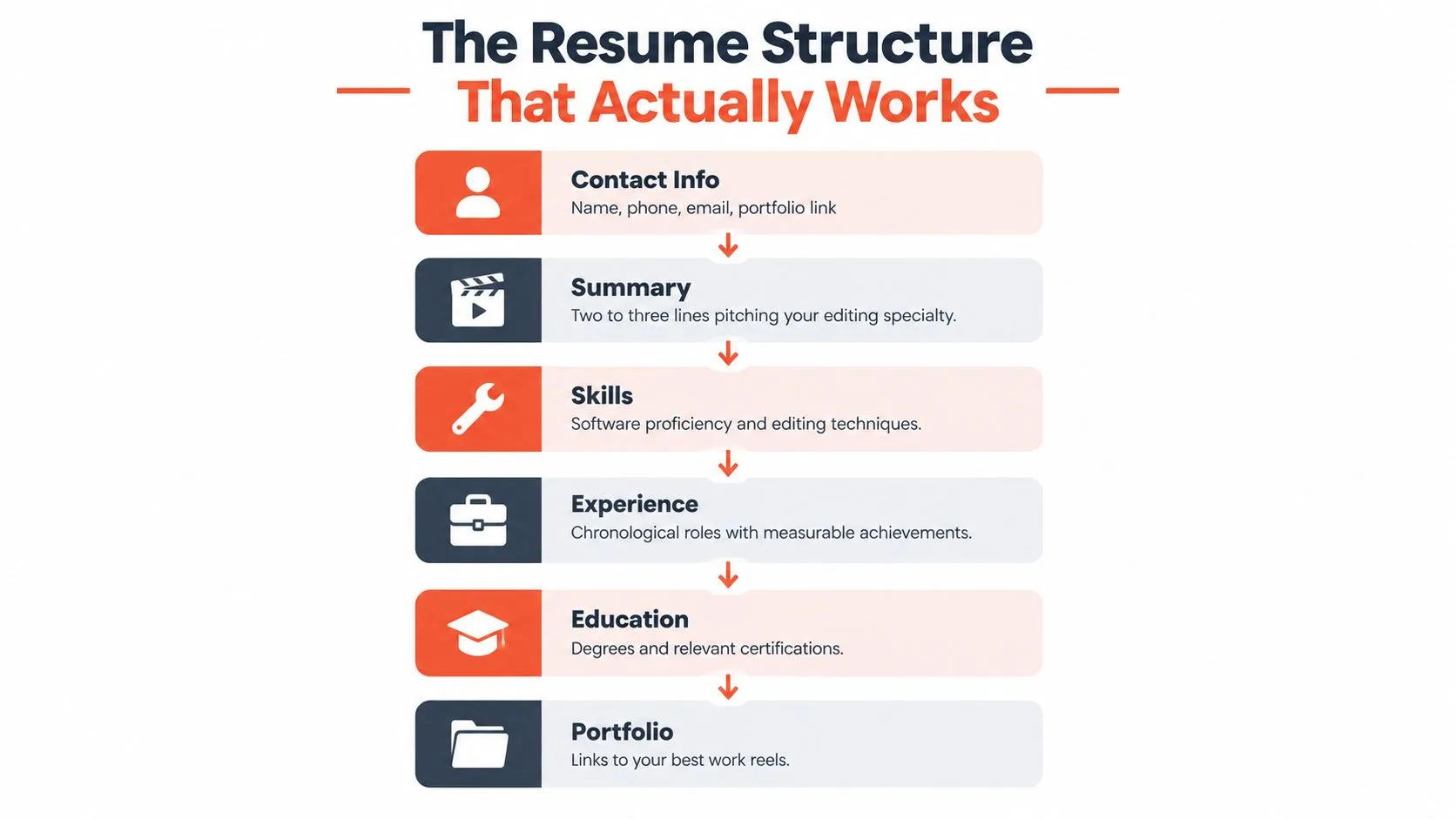
Harvard Extension's resume guidance recommends one to two pages focused on top accomplishments. Treat that as an editing constraint, not an invitation to shrink the font.
A practical video editor resume template
- Contact information: Name, phone, email, and a clearly labeled reel or portfolio link. Add a headline that identifies your editing specialty.
- Summary: A short account of the genres you cut, the platforms you deliver to, and the editorial problems you handle.
- Skills: Relevant applications and techniques. Keep this compact.
- Experience: Recent roles first, with employer or client context, dates, and achievement-led bullets.
- Education: Degrees and relevant certifications. Leave out training that no longer helps establish your fit.
- Selected projects or portfolio: Brief credits that explain work your employment history doesn't adequately represent.
A useful summary sounds like this, provided it reflects your actual experience:
Video editor specializing in interview-led documentaries and branded films. Shapes narrative assemblies, manages producer reviews, and prepares approved cuts for finishing. Experienced in adapting long-form stories for social distribution.
That tells me what you edit and where you take responsibility. “Passionate storyteller seeking an exciting opportunity” tells me neither.
Keep the reel accessible near the top, even if fuller project descriptions sit lower down. Don't make someone search through your employment history to find the work.
For a video walkthrough, use the embedded resource below.
Write the summary last. Once you've selected the strongest experience, describe the pattern it reveals. Don't write an ambitious introduction and then struggle to support it.
Writing Bullets That Show What You Decided
“Edited promotional videos” describes an assignment. It doesn't explain your contribution.
The useful sequence is responsibility → context → action → outcome. Start with the assignment, recover the constraint, identify your decision, then explain what happened. Compress that thinking into a sentence.
Harvard College's resume guidance recommends specific, active, fact-based language that quantifies and qualifies achievements. Qualifying matters when you don't have access to performance analytics. You can still establish the type of material, the delivery requirement, and the part you owned.
Weak vs Strong Video Editor Resume Bullets
These are illustrative wording examples, not claims about actual projects. Use them only when the underlying work matches your experience.
| Scenario | Weak Bullet | Strong Bullet |
|---|---|---|
| Documentary cut | Edited documentary footage. | Restructured interview-led documentary assemblies around the central conflict, combining testimony and archival material into a coherent narrative for director review. |
| High-volume social workflow | Made videos for social media. | Standardized campaign cutdowns and caption revisions across paid and organic versions, keeping approved messaging consistent through final delivery. |
| Broadcast or sports | Used Premiere Pro for sports editing. | Cut a deadline-driven sports package from game footage and commentary, resolving continuity gaps and synchronizing sound for the scheduled broadcast in Premiere Pro. |
The stronger versions name decisions. They don't depend on inflated adjectives or invented performance lifts.
Recover the details before rewriting
Ask yourself what made the project difficult. Was the strongest interview answer buried in another scene? Did the brief change after the assembly? Did you inherit inconsistent media or conflicting notes?
Then check what you can substantiate:
- Scope: Use production records to confirm footage volume, deliverables, or versions.
- Decision: Name what you selected, reordered, removed, rebuilt, or standardized.
- Result: Check approvals, delivery records, review history, or authorized analytics.
- Attribution: Separate your intervention from the producer's strategy or the wider campaign's performance.
Don't turn a team result into a personal victory. If completion rates improved, explain your contribution without pretending editing was the only variable.
Put tools after the editorial action when they add useful context. “Rebuilt the interview assembly” is a stronger opening than “Used Premiere Pro.” The application supports the claim. It isn't the claim.
Skills and Keywords Without the Stuffing
Your skills section should answer a practical question: can you work in this production environment?
Read the job description before editing the list. Identify the applications, finishing responsibilities, and workflow terms the employer names. Include the ones you can defend through shipped work.
Group skills by production function
| Category | Relevant examples |
|---|---|
| Core editing | Adobe Premiere Pro, Final Cut Pro, Avid Media Composer, DaVinci Resolve |
| Finishing and motion | After Effects, motion graphics, color grading, sound design |
| Production workflow | Frame rates, codecs, project management, asset management |
| Assignment-specific techniques | Multicam editing, conform, interview assembly, platform versioning |
This is a menu, not a checklist to copy. If you cut in Avid but haven't handled a conform, don't imply that you own the finishing pipeline.
Match the employer's language without borrowing experience. If the posting says “motion graphics” and you've created motion graphics, use that phrase. If you only inserted graphics supplied by a designer, describe graphics integration instead.
The same distinction applies to sound. Balancing dialogue and music isn't automatically the same as owning sound design or a final mix.
Cut skills you can't demonstrate
- Obscure plugins: Keep them only when they matter to the target production.
- Exhaustive codec lists: Show relevant workflow knowledge rather than every format you've encountered.
- Unshipped experimentation: Don't present a tutorial exercise or an unfamiliar AI application as professional proficiency.
- Unsupported soft skills: Replace “collaborative” with an experience bullet showing how you handled reviews or handoffs.
Use this approach to build a focused resume skills section, not a searchable pile of terminology.
A short, credible list gives you room to explain the work that required those skills. That's a better trade than filling the page with applications you'd need to relearn before the interview.
Pairing the Reel With the Resume
A reel without context is a montage. The viewer can assess the finished material, but they can't reliably separate your editing from the cinematographer's coverage, the producer's script, or the motion designer's work.
Treat the application as a connected evidence trail. Each selected resume project should point to identifiable work. Each reel segment should have an accessible credit explaining your contribution.
You don't need to cram every credit onto the resume. Put concise project notes beside the full work or in an accompanying portfolio index.
Give each project an attribution card
Use a repeatable format:
- Project context: Genre, intended audience, distribution platform, and a recognizable project label.
- Your role: Editor, assistant editor, additional editor, finishing editor, or another accurate credit.
- Scope and constraint: Source material, deliverables, turnaround, and the problem you inherited.
- Editorial decision: What you changed and why.
- Outcome and collaborators: What was delivered or measured, plus the work other people owned.
For example, an illustrative project description could read:
Role: Documentary editor. Rebuilt an interview-led sequence around conflicting accounts, using archival material to clarify chronology. Owned picture editing and temporary sound; a separate team completed grading and final mix.
That's more useful than “documentary project” beneath a thumbnail. It gives the reviewer a specific contribution to inspect.
Make the claim inspectable
Match the project labels across the resume and portfolio. If a bullet discusses a narrative reconstruction, point to the relevant sequence rather than an unrelated highlight montage.
Use approved excerpts or descriptions when confidentiality limits what you can share. Never publish restricted footage just to complete the application.
The same authorship problem appears in a resume for a photographer: impressive finished work still needs clear ownership. A recognizable client doesn't explain who made the important decisions.
Remove your name from the project note. If the reader can no longer identify your contribution, rewrite the credit.
Your reel should demonstrate taste. Your accompanying notes should demonstrate responsibility. Together, they let someone evaluate the work without guessing how much of it was yours.
ATS Rules That Actually Matter
Keep the application technically boring. A complicated layout isn't worth losing the text that explains your experience.
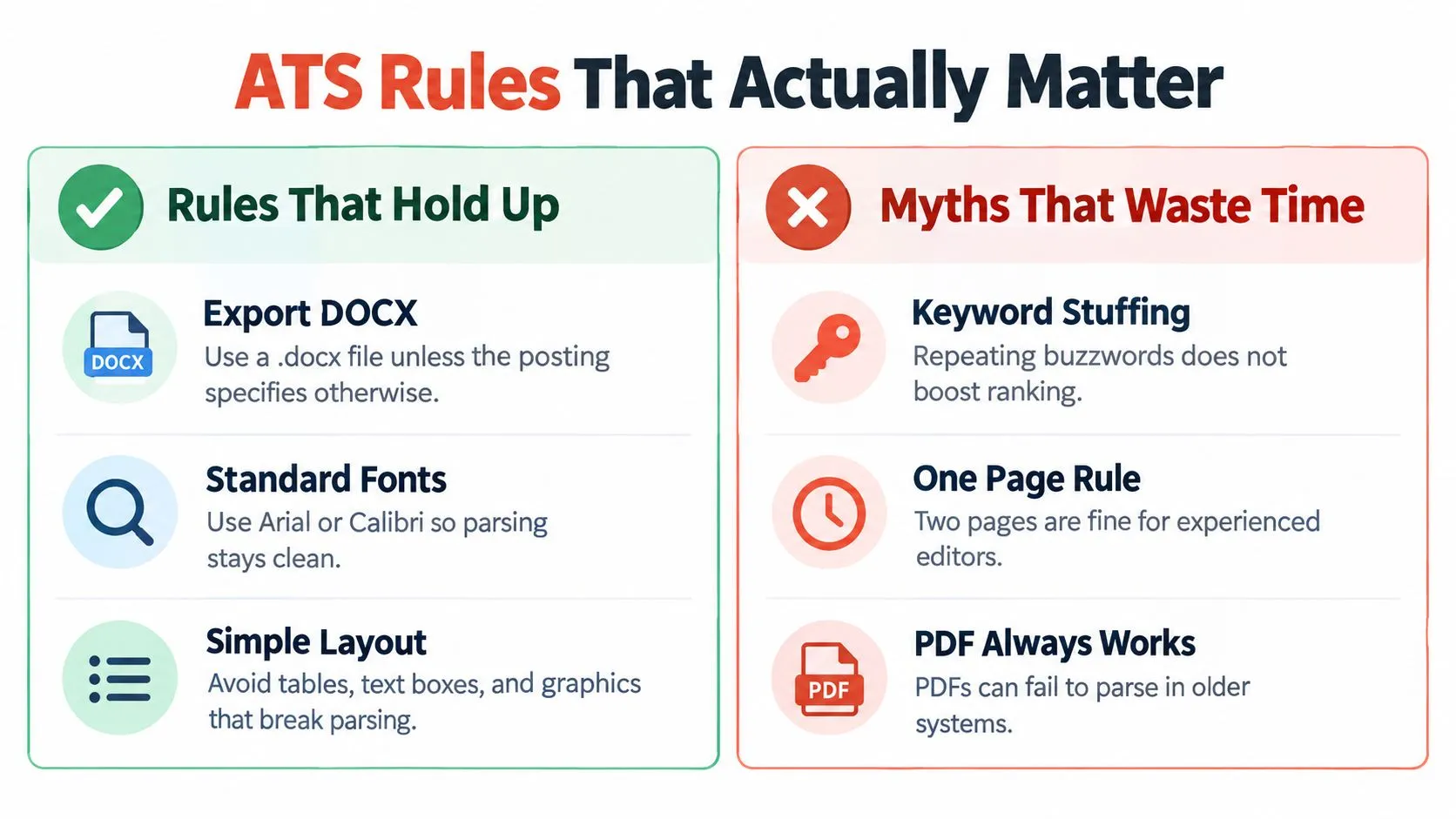
Use the visual checklist as a starting point, then verify the actual file.
Check the document, not a compatibility promise
A third-party compilation of resume parsing statistics reports directional differences between layouts and file formats, but the systems and methodology vary. Don't treat any format as a universal guarantee.
Run these checks instead:
- Follow the posting: Supply the requested format. When none is specified, use DOCX as your default.
- Use a single column: Keep essential text out of tables, graphics, text boxes, headers, and footers.
- Label sections conventionally: “Experience,” “Skills,” and “Education” are clearer than creative alternatives.
- Keep contact details in the document body: Put the reel link in the top contact block, not the word processor's header field.
- Test extraction: Copy the resume into plain text. Check that names, dates, bullets, and section order remain readable.
- Test access: Open the portfolio in an incognito browser and confirm that it doesn't require unexpected permissions.
A clean copy-and-paste test isn't proof that every system will parse the document perfectly. It's a useful way to catch obvious missing or jumbled content.
For a broader ATS resume optimization checklist, focus on readability and accurate terminology. Don't spend an afternoon chasing an opaque keyword score while your strongest project remains unexplained.
Tailoring the Resume to Your Career Stage
Experience level should change what you emphasize, not how loudly you describe yourself. “Senior” needs evidence of broader responsibility, not a longer adjective list.
The Bureau of Labor Statistics occupational profile identifies a bachelor's degree as typical entry-level education and describes collaboration with producers and directors as part of editing work. Formal preparation belongs on the page. Its prominence should depend on how much stronger professional evidence you have.
Early-career and mid-level editors
For an early-career application, relevant coursework, internships, freelance assignments, and selected projects can establish readiness. Explain your role in student or independent productions with the same care you'd use for commercial work.
Don't inflate the credit. Assistant work becomes credible through specifics about logging, synchronization, media organization, turnovers, or review support.
At mid-level, shift the emphasis toward increasing scope:
- Larger ownership: Show movement from individual cutdowns to complete projects or campaigns.
- Harder decisions: Include conflicting notes, complicated source material, or substantial story restructuring.
- Team responsibility: Describe assistant supervision, clearer handoffs, or coordination with sound and finishing teams.
Drop coursework when recent work makes the same point more convincingly. Keep education concise and give the space to decisions you've made in production.
Senior editors and career changers
Senior editors should compress early execution-heavy roles and expand the work that demonstrates leadership. Explain how you resolved creative disagreements, shaped editorial plans, supported on-set decisions, or changed a review process.
Use business outcomes only when you can substantiate them. Delivery speed, cost, retention, and production efficiency are useful evidence, not mandatory decorations.
Career changers should translate adjacent work without inventing an editing title. A production coordinator can describe asset handoffs and review cycles. A camera operator who also edited can distinguish footage capture from story assembly. A motion designer should separate animation ownership from picture editing.
Keep or cut: Does this line prove you can handle the target role? If not, remove it.
The remaining challenge is remembering your own material clearly enough to write it. Recover the scope, constraint, decision, and result before polishing the sentence. Then ship the resume and apply instead of endlessly adjusting the same bullet.
StoryCV is an Online Resume Writer that asks about your actual work and turns your answers into resume-ready writing. If you'd rather talk through an edit than draft it alone, visit StoryCV and describe a project's constraint, your decision, and the result to write your first strong role.