Most photographer resumes are like a list of gear and projects, not a record of business results. Hiring managers don't need your full lens inventory. They need proof that you can deliver clean work, handle clients, and keep projects moving.
That matters more now because photography is a measurable but competitive career path. A resume for photographer has to do real work in a market like that, because volume alone won't save you.
Why Most Photographer Resumes Read Like Gear Lists
A strong photographer resume is not a catalog. It's a proof document. If your bullets only say you shot weddings, edited images, or used Lightroom, you've told me what you did, not what changed because you did it.
The market wants reliability, not adjectives
This is a market where adaptability matters more than flash. A hiring manager or client wants to know if you can generate repeat work, manage a shoot without drama, and deliver on time across formats.
Practical rule: If a bullet doesn't prove trust, revenue, speed, or consistency, cut it.
That's where StoryCV's interview model fits better than a template. A template gives you boxes. An interview pulls out the useful story, then turns it into language that sounds like a person who knows their value. For a photographer, that means translating creative work into business outcomes, not hiding behind polished filler.
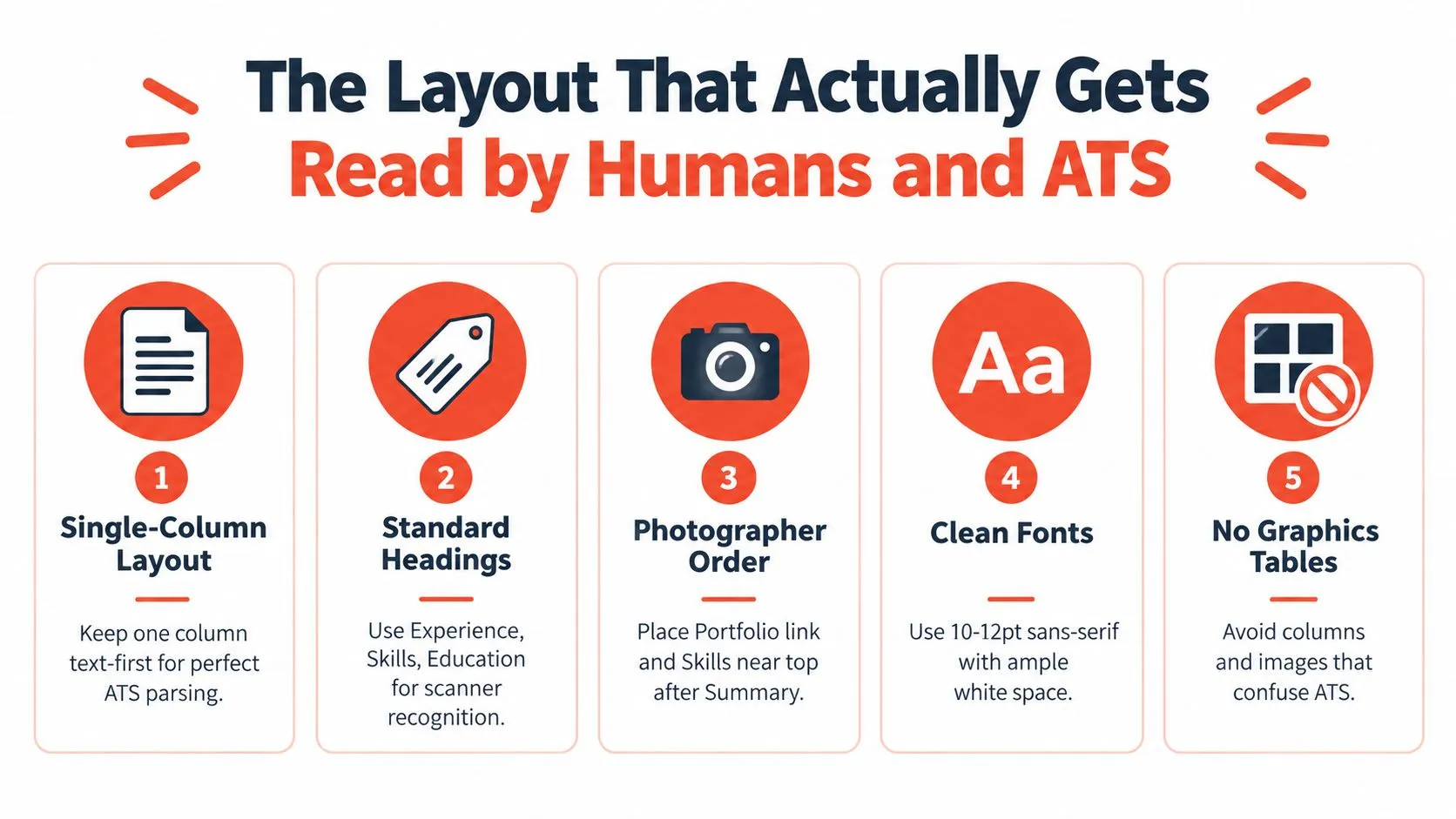
The Layout That Gets Read by Humans and ATS
Start with a single-column, text-first layout. That gives ATS the cleanest path and keeps the page readable for a person. Skip graphics, columns, icons, and decorative section labels. They look clever and often break parsing.
Use standard headings. Contact Information, Portfolio Link, Professional Summary, Work Experience, Skills, Equipment & Software, and Education is a sane order for a resume for photographer. ATS-focused guidance also treats portfolio placement as part of the structure, not a bonus, so put it near the top, right after contact details. ATS photographer resume section order For a full walkthrough of parser-safe formatting, see our guide on how to optimize a resume for ATS.
Keep the file and the page count boring
Boring wins here. Save the resume as a clean PDF unless the application asks for something else. Use a plain sans-serif font, normal spacing, and enough white space that the page does not feel crowded. The goal is to make the resume easy to skim in seconds.
Length should follow experience. General resume advice says one page is the default for students, recent graduates, and professionals with roughly under 10 years of experience, while two pages is the normal ceiling for most mid-career and senior candidates. Current guidance also translates that into editing targets, with a one-page resume typically around 400 to 600 words and a two-page resume around 600 to 900 words. Resume length guidance Resume word-count benchmark
Use this order, and keep it plain.
-
Contact details
-
Portfolio link
-
Professional summary
-
Work experience
-
Skills
-
Equipment & software
-
Education
If you are tempted to add graphics or a flashy header, skip it. ATS systems can miss important details when resumes use nonstandard layouts, and that is self-inflicted damage. ATS-safe layout advice for photographers
Write Each Section So It Proves Impact
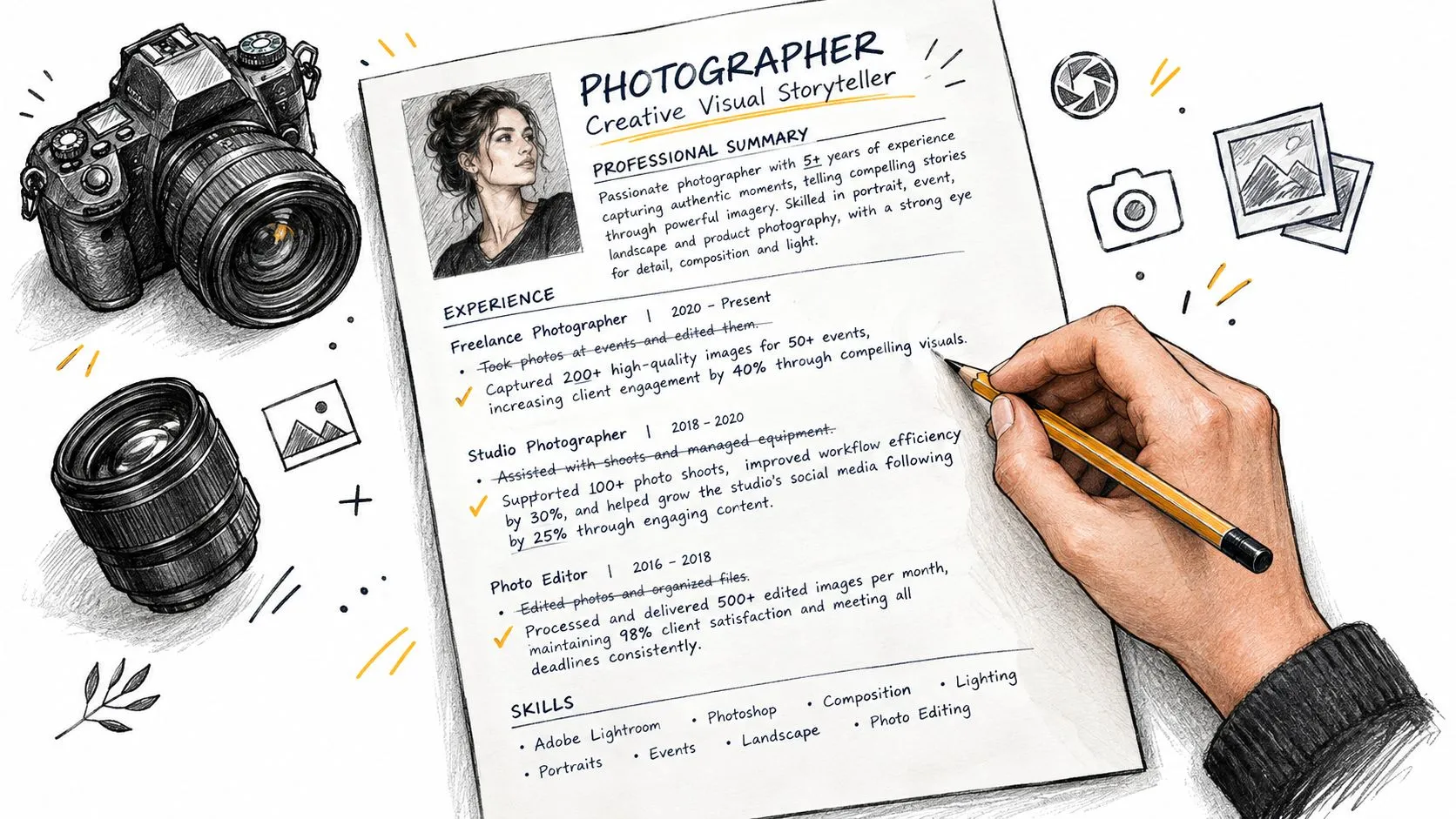
A photographer resume lives or dies in the summary and bullets. Not in the logo. Not in the paper texture. In the evidence. If your sentences don't show outcomes, they're just studio gossip.
Lead with a headline, then a summary that sounds human
Use the title the job post uses. If it says commercial photographer, say commercial photographer. If it says event photographer, mirror that language. ATS matching guidance says a 75%+ keyword match is a strong benchmark, and exact title alignment can increase interview likelihood, so don't freestyle your way out of relevance. ATS keyword matching guidance
Your summary should be 2 to 3 lines. Keep it grounded. Mention your niche, the kind of clients or productions you support, and the business result you consistently drive.
Example:
Commercial photographer with experience producing brand, campaign, and product imagery for clients who need fast turnaround and consistent visual standards. Known for organizing shoots cleanly, managing edits without chaos, and turning creative direction into usable assets.
That works because it reads like a person, not a form.
Features are what you use. Benefits are what the client gets. The same logic applies here. Don't say you use Capture One unless it matters. Say what the workflow improved.
Turn duties into proof
Your bullets need outcomes. Not chores. Not tasks. Outcomes. A strong resume for photographer usually uses 4 to 6 quantified bullets per role, but even without numbers you can still write with force. The point is to show impact in plain language.
Weak:
-
Shot weddings and edited images for clients.
-
Helped with studio work and equipment setup.
-
Used Lightroom and Photoshop daily.
Better:
-
Managed wedding shoots from prep to delivery, keeping client communication clear before and after each event.
-
Built a consistent editing workflow that kept image delivery organized across multiple projects.
-
Supported studio sessions with lighting setup, file handling, and on-site coordination so the lead photographer could stay focused on the shoot.
For freelance work, make the business result visible. If you know the outcome, name it. If you don't have a number, write the consequence.
-
Freelance photographer: Instead of saying you “took portraits,” say you handled portrait sessions for recurring clients, managed scheduling, and kept the workflow smooth enough that people came back.
-
Studio photographer: Instead of saying you “worked in a studio,” say you coordinated setup, maintained shot consistency, and delivered files in a format the client could use immediately.
-
Assistant photographer: Instead of saying you “assisted on shoots,” say you kept production moving, handled gear prep, and freed the lead photographer to stay with the client.
For more proof-based phrasing, use StoryCV's achievements guide. The logic is simple. Show what changed, not just what happened.
“If the bullet doesn't explain why the client kept hiring you, it's not finished.”
Skills Equipment Education and Portfolio Links Done Right
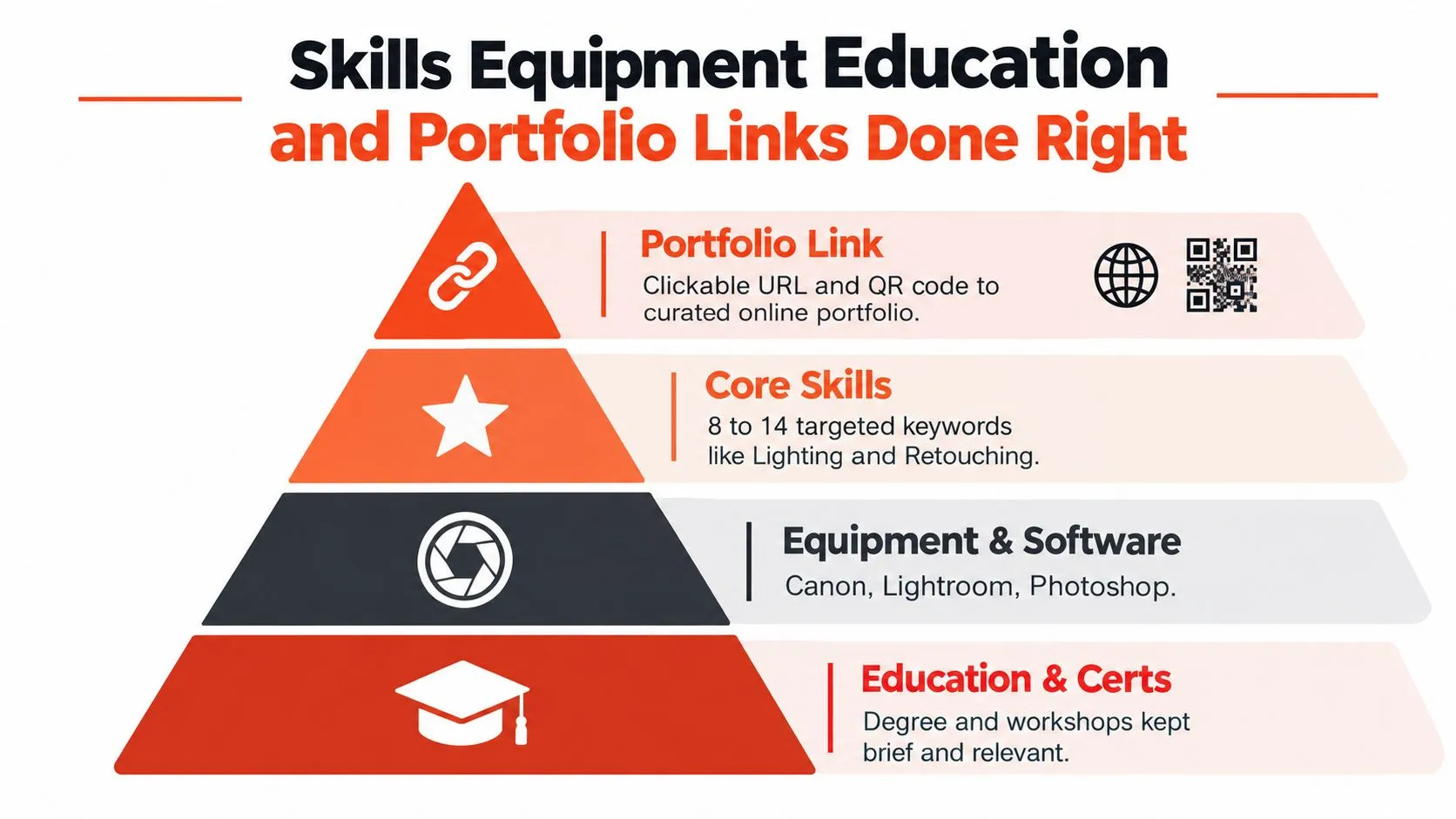
Most photographer resumes either bury the support sections or turn them into a junk drawer. Don't do that. These blocks should reinforce the story, not repeat it in a messy way.
Build a tight credibility stack
Your Skills section should be short and targeted, not a junk cloud of buzzwords. A focused range of 8 to 14 keywords is the right size when you want scanability and relevance. Pull terms from the posting, then use your actual strengths.
Use skills like:
-
Lighting
-
Retouching
-
Direction
-
File management
-
Client communication
-
Color correction
-
Studio workflow
-
On-location production
Then add Equipment & Software as a single line, not a shopping list. Mention only what supports your positioning. Canon, Nikon, Adobe Lightroom, Photoshop, Capture One, and similar tools are useful when they help the reader understand your workflow. Don't turn this into a catalog of everything in your bag.
Education should stay minimal unless it's doing real work. A degree, certificate, or relevant workshop can sit there cleanly. If it doesn't support the role, don't inflate it.
Put the portfolio where it belongs
The portfolio link is not optional decoration. It's a named structural requirement in photographer resume guidance, and it deserves top placement. Label it clearly, for example, Portfolio or Selected Work, and link only to a curated page that shows the type of work you want more of.
Use the portfolio to clarify your niche:
-
Commercial work for brand and campaign roles
-
Editorial work for publishing and media roles
-
Event work for live coverage roles
-
Retouching samples for post-production roles
The same section can also carry a QR code if the application format benefits from it, but only if the layout stays clean. The main thing is to make it easy for a recruiter to verify the quality of your work without hunting.
For a tighter skills block, StoryCV's resume skills guide is useful because it shows how to keep the section focused instead of bloated.
Tailor Your Resume for Commercial Editorial Wedding and Retouching Roles
One master resume is fine. One generic send is not. Different photo roles scan for different proof, and you should adjust the top third of the page to match.
| Role Type | Foreground These Outcomes | Mirror These Keywords |
|---|---|---|
| Commercial | Brand consistency, campaign delivery, client approvals, production coordination | commercial photography, brand assets, campaign, production, client-facing |
| Editorial | Storytelling, fast turnaround, newsroom or publication pace, coverage variety | editorial, assignment, coverage, publication, deadline |
| Wedding | Client calm, event flow, shoot volume, delivery consistency, repeat referrals | wedding, event, portraits, client communication, timeline |
| Retouching | Clean edits, color accuracy, file organization, post-production reliability | retouching, post-production, color correction, Adobe Photoshop |
Change the front, not the whole document
That table is the game. You don't need to rewrite your entire history. You need to foreground different evidence. For a commercial role, lead with campaign and client work. For editorial, emphasize speed and coverage. For weddings, show that you can handle client trust and event pressure. For retouching, make the post-production side obvious.
This is also where a keyword-match workflow pays off. Read the posting once. Pull the exact terms they use for the niche. Then adjust your headline, summary, and first two bullets so the resume sounds like it belongs in that stack of applications. If the role is “editorial photographer,” don't make the reader translate from “visual storyteller” into “can do the job.”
A strong habit here is to keep one master file, then save targeted versions by role. That keeps your history stable while your emphasis changes. It also stops you from bloating the page with every assignment you've ever touched.
Ship a Shorter Resume That Opens More Doors
The edit is simple. Cut everything that does not help you get hired. Keep the proof, drop the inventory. If a line does not show repeat bookings, client retention, licensing revenue, or reliable delivery, it is noise.
Most photographer resumes get bloated because they read like gear lists. Strip out old equipment notes, generic duties, and project history that does not support the role. Keep the portfolio link, the skills tied to the posting, and the bullets that show you can run a shoot, work with clients, and deliver work that gets used.
Shorter also reads better. As noted earlier, one page is the right target when your experience is focused, and two pages is the upper limit when the body of work is broad enough to justify it. Use that as an editing guardrail, then cut again.
Final tightening checklist
-
Keep standard headings: Skip clever section names that confuse scanners.
-
Match the posting language: Use the employer's specialty terms where they fit.
-
Show outcomes: Replace duties with proof of reliability, scale, repeat work, or licensing value.
-
Keep the portfolio visible: Do not bury it in the footer.
-
Stay readable: One column, plain text, clean spacing.
That is the point. Hiring is selective, and the resume has to sound calm, specific, and useful. A tight page signals judgment. A crowded page signals indecision.
StoryCV treats the resume like an interview, not a template. Build a resume for photographer around real impact, not filler, and send a version that earns the click. Visit StoryCV and turn one strong role into a resume that sounds like work.