Most career blogs tell you to keep "fast learner" and swap in a softer synonym. Quick learner. Adaptable. Eager to pick up new tools. That advice is wrong.
A resume fast learner line is a speed claim. It is not a skill, and a skills list is the wrong home for it. Keep it only when a named skill, a clock, and a result sit in the same bullet. If you can't put all three in one sentence, cut the phrase.
Hiring managers don't need a personality label. They need the tool, the weeks, and what moved.
When a Fast Learner Line Earns Its Place
"Fast learner" is a speed claim, not a skill. A skills list is the wrong home for it.
Keep the words only as a short clause under a skill the posting already names. The same sentence has to hold the tool or domain, the weeks, and what changed. Miss one of the three, and the phrase goes.
Employers in Cengage Group's 2025 Graduate Employability Report ranked job-specific technical abilities as their top priority, while educators placed those abilities last. 76% of employers said they were hiring the same or fewer entry-level workers, compared with 69% the prior year. A softer synonym doesn't fix a missing skill. Screeners still want the capability the posting names.
The keep or cut table
| Situation | Lead with | Learning line | Drop the phrase |
|---|---|---|---|
| You already do the posted skill | Scale, tool, and outcome | Only if the ramp was unusually short | Speed the result does not already show |
| Adjacent skill, short ramp | The target skill you now use | Weeks to proficiency plus the result | A personality label with no clock |
| Career change, return, or new domain | Proof you transferred into this work | First-time task, timeline, and outcome | I can learn anything |
| No tool, no time, no before-and-after | A real accomplishment you can verify | Do not write one | Always |
You already do the posted work. Lead with scale, the tool, and the outcome. Mention speed only when the ramp was unusually short. If the result already shows the skill, the speed clause is noise.
You crossed from an adjacent skill. Lead with the skill you use now, then the weeks and the result. No clock means no learning line.
You changed careers, returned, or entered a new domain. The learning line can carry the bullet only when it shows transfer, not enthusiasm. First-time task, timeline, outcome. "I can learn anything" gets deleted.
Nothing you can check. No tool, no time, no before-and-after. Don't write a learning line. Use an accomplishment you can verify.
Practical rule: Delete "fast learner." If the sentence still works, the phrase was never evidence.
People remember the project and forget the weeks. One pass through a single role, answering what was new and how long it took, shows whether the line survives. Start my role in StoryCV and pull that ramp from one job before you rewrite the page.
Resume Lines That Replace Fast Learner
Pick one role. Build one bullet in four beats. The adjective isn't the work.
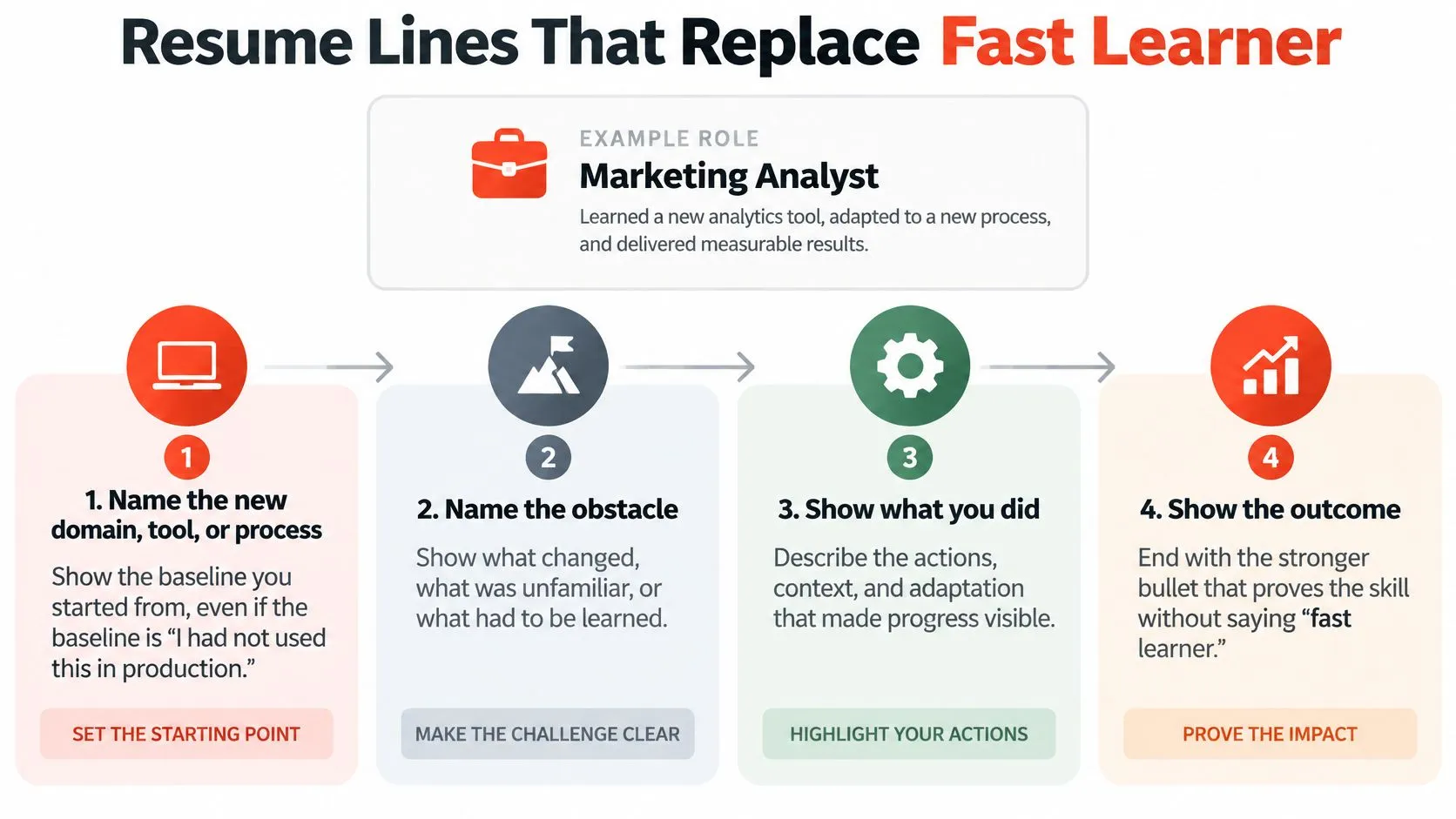
- Name the new domain, tool, or process. State the baseline, even when it's "I had not used this in production." A reader can't judge speed without a starting point.
- Name the learning action. A course, shadowing, the docs, or a prototype. Finishing a course proves attendance; the action is what you did with the material on real work.
- State the span. Three weeks or six weeks. "Quickly" is not a span. If you don't know the weeks, you don't have a speed claim.
- Quantify what changed. Time, errors, uptime, volume, or a decision someone else can verify. Tie the line to a requirement the posting lists.
Run one reporting role through the beats
You owned weekly revenue reporting and had never written SQL against a live dataset. That's the baseline. You worked through the warehouse docs and rebuilt the query: the action. Six weeks later it ran in production: the span. Preparation dropped from two days to three hours: the change.
Four beats, one sentence.
The finished line, the kind of behavioral bullet a University of Colorado Denver resume guide recommends in place of a trait label: "Learned SQL and automated weekly revenue reporting within six weeks, reducing preparation time from two days to three hours."
Read it as challenge, action, result. The challenge is the two-day manual prep. The action is learning SQL and automating the report. The result is the time cut. Each beat answers a requirement the posting can check, and none of them praises your personality.
Keep a receipt. Project feedback, an assessment, a certification, or a manager's note gives you the interview answer behind the sentence. Mirror a posting term only where the work supports it. If the req says "revenue reporting" and you did that, use those words. If it says "Snowflake" and you never touched it, don't borrow the term.
The World Economic Forum's Future of Jobs Report 2025 expects 39% of workers' core skills to change by 2030. That's why a finished ramp earns page space. The trait name earns nothing.
The same pattern holds when the system changes. "Learned Salesforce in three weeks and rebuilt the pipeline workflow, cutting weekly reporting time by 30%" puts a system, an action, a clock, and a measured change in one line. A recruiter can verify each part. "Picks up new systems fast" gives them nothing to check. The table runs that swap plus two more.
Weak lines and the proof that replaces them
| Weak line | Stronger line | What the weak line skips |
|---|---|---|
| Fast learner who adapts quickly | Learned SQL and automated weekly revenue reporting within six weeks, cutting prep from two days to three hours | Tool, clock, and result |
| Quick learner; picks up new systems fast | Learned Salesforce in three weeks and rebuilt the pipeline workflow, cutting weekly reporting time by 30% | System, action, and scale of the change |
| Adaptable professional eager to learn new tools | Moved from manual Excel reporting to Power BI in eight weeks, validated dashboards with finance, and reduced reporting errors | The target skill and who checked the work |
| Completed a Python course and is a fast learner | Completed Python upskilling on a live analytics project, automated a recurring workflow, and cut turnaround time by 60% | Application on real work, not course completion |
A certificate proves you finished something. A bullet proves you used it.
The hard part is remembering the baseline and the weeks, not finding a prettier adjective. Where soft skills belong on a resume is a separate decision from proving speed on one. StoryCV's interview pulls the baseline, the learning action, and the result out of a single role, then drafts the bullet from your answers. Find my words for that one role, not a full rewrite.
Where to Place the Proof
Put the proof under a real job, not in a trait cloud.
Experience is the default. One bullet, inside the role whose dates cover the ramp, with the target title and company already visible. A reader should see the job before the learning story.
A 2012 eye-tracking study of 30 professional recruiters found they spent about six seconds on an initial fit-or-no-fit decision. Nearly 80% of viewing time landed on six spots: name, current title and company, previous title and company, the dates for those two roles, and education. So the role header has to be obvious, and the learning bullet has to be short enough to catch on the next pass. Treat six seconds as a scan estimate, not a timer every recruiter uses. One bullet, one skill, one number.
Three homes, in this order
Experience. This is the home. If the ramp is older than your last two roles and the posting doesn't ask for that skill, leave it off. Old ramps don't earn the first screen.
Summary. A single clause, and only when that ramp is the reason you fit this opening. It still needs the tool and the result. A fair line reads, "Moved weekly revenue reporting to SQL in six weeks, cutting preparation from two days to three hours." One clause. No trait label.
Skills. List the tool you learned, such as SQL, Salesforce, or Power BI. Don't list fast learner, quick learner, or adaptability. Those aren't tools, and they don't parse as proof.
The skills block is a noun list. Speed is a story, and stories live under jobs.
For an applicant tracking system, repeat a posting's wording only where the work supports it. Spell the tool the way the posting spells it. Don't park the keyword in a hidden block or a skills dump. Clear resume categories beat a stuffed sidebar, because the first look hits the header and the dates, then the keywords that match the open role.
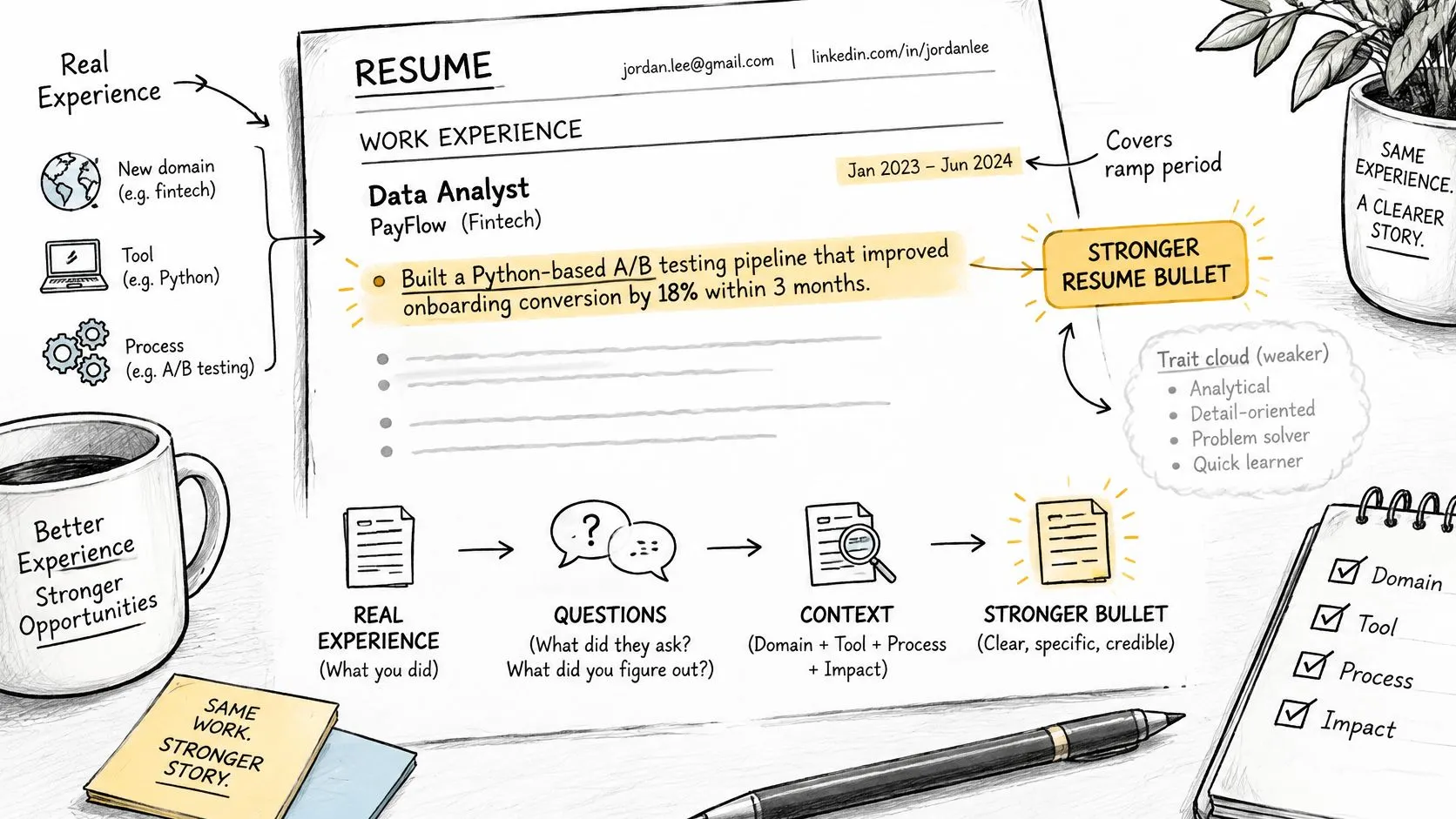
If the ramp isn't in the last two roles and the req doesn't name that skill, cut it. Space next to the job title is the constraint, not your pride in how fast you felt.
Mistakes That Make the Claim Collapse
The failure mode isn't a lie. It's a true story written so it can't be believed.
Recruiters in JobTarget's guide to quality hiring report that 62% consider most resumes they receive unqualified. Vague agility next to a specific requirement sounds like one of those resumes. The repair is transfer you can see: what was learned, how it was applied, and what changed.
| Mistake | Tell | Repair |
|---|---|---|
| Quick learner in the summary, no bullet | Claim with no role under it | Move the proof into the role or cut the line |
| Certificate treated as proficiency | Course named, no live task | Add the live task or drop the skill |
| Original problem skipped | Tool named, nothing that was broken | Restore what was slow, manual, or broken |
| Gain with no baseline | Improved efficiency, no numbers | Name the old number and the window: two days to three hours |
| Posting keywords you did not use | Terms that match nothing you did | Delete them; a precise miss beats a fake match |
A summary claim with no job under it is the most common empty line. Move the proof into the role, or cut the summary line.
A certificate treated as proficiency names the course and skips the live task. Add the task, or don't claim the skill.
A skipped original problem names the tool and never says what was slow, manual, or broken. Put that mess back. Without it, the result has nothing to beat.
A gain with no baseline says "improved efficiency" and stops. Name the old number and the window. Two days to three hours over the weekly close is a repair. "Improved a lot" isn't.
Posting keywords you didn't use should come out. A precise miss beats a fake match.
Before: "Fast learner, completed Python." After: "Completed Python upskilling while supporting a live analytics project, then automated a recurring workflow and cut turnaround time by 60%." Same ramp. The second line can be checked. When you get to the job interview stages explained, that sentence is what you'll defend, so it should already name the live work.
If a stranger can't tell what was new, how long it took, and what moved, the line isn't ready.
Put Your Own Ramp on the Page
Take one role. The last time something was new: a system, a domain, or a process you owned inside a quarter.
Answer four questions, in order.
- Day one gap. What you couldn't do when you started.
- Learning action. Course, shadowing, docs, or a prototype.
- Weeks to independence. How long until you ran it without help.
- The number that moved. Time, errors, volume, or a decision someone else signed.
If any answer is missing, the phrase stays off the resume. If all four are there, that sentence is the bullet, and "fast learner" doesn't need to appear.
Remembering is the hard part, not the formatting. A quantifiable achievement only lands if you can still recall the before and the after. StoryCV interviews you about the work you did, including first-time tasks, ramp time, feedback, and the before-and-after, then turns those answers into a resume-ready line. It isn't a template, and it isn't a keyword pad.
Tell my story for that one ramp. One role is enough to test the method. Stop there.
StoryCV asks about the work you did and writes the bullet from your answers, including the tool, the weeks, and the result. That's the direct way to turn one real ramp into a line a recruiter can check, without parking "fast learner" in a skills list. Visit StoryCV and talk through a single role before you keep the phrase.