
Memorizing polished STAR answers won't rescue a leadership story with no decision in it. Most lead candidates describe the project, then leave the interviewer to guess how they led.
Weak answer: I coordinated the CRM migration and kept everyone informed.
Stronger answer: Senior agents resisted the CRM migration because their saved workflows would disappear. I made preserving those workflows a launch condition, involved the agents in testing, and secured their support before the team switched.
Same project. Different evidence. The stronger answer shows a choice, a competing concern, and a change in how people worked.
Lead interviews test judgment, not vocabulary. Your job isn't to sound like a leader. It's to make your leadership visible.
The U.S. Office of Personnel Management's structured interview guide explains that greater interview structure improves validity, rater reliability, and agreement. Prepare accordingly: give interviewers specific behavior they can assess, not leadership adjectives they have to interpret.
These lead interview questions probe decisions about change, performance, priorities, failure, influence, development, autonomy, and conflict. The scenarios below demonstrate how to build an answer. Use their reasoning, not their details.
1. Tell me about a time you led a team through change
Announcing a change isn't leading it. The difficult part starts when someone has a reasonable objection and the rollout still needs to happen.
The decision behind the answer: What did you preserve, adapt, or refuse to compromise so people could adopt the change?
Say a support team is moving from scattered ticketing systems to Zendesk. Experienced agents resist because their macros contain hard-won knowledge that the migration plan ignores.
Before and after
Before: I helped the team adopt a new support platform.
After: I made rebuilding the agents' existing macros a prerequisite for the Zendesk rollout, turning the strongest critics into testers and helping the team adopt a shared support workflow.
A fuller answer would explain that you met with the agents, separated genuine workflow risks from preferences, and changed the rollout plan. Then you'd describe what happened after launch: whether agents used the shared queue, whether handoffs improved, and what support records showed.
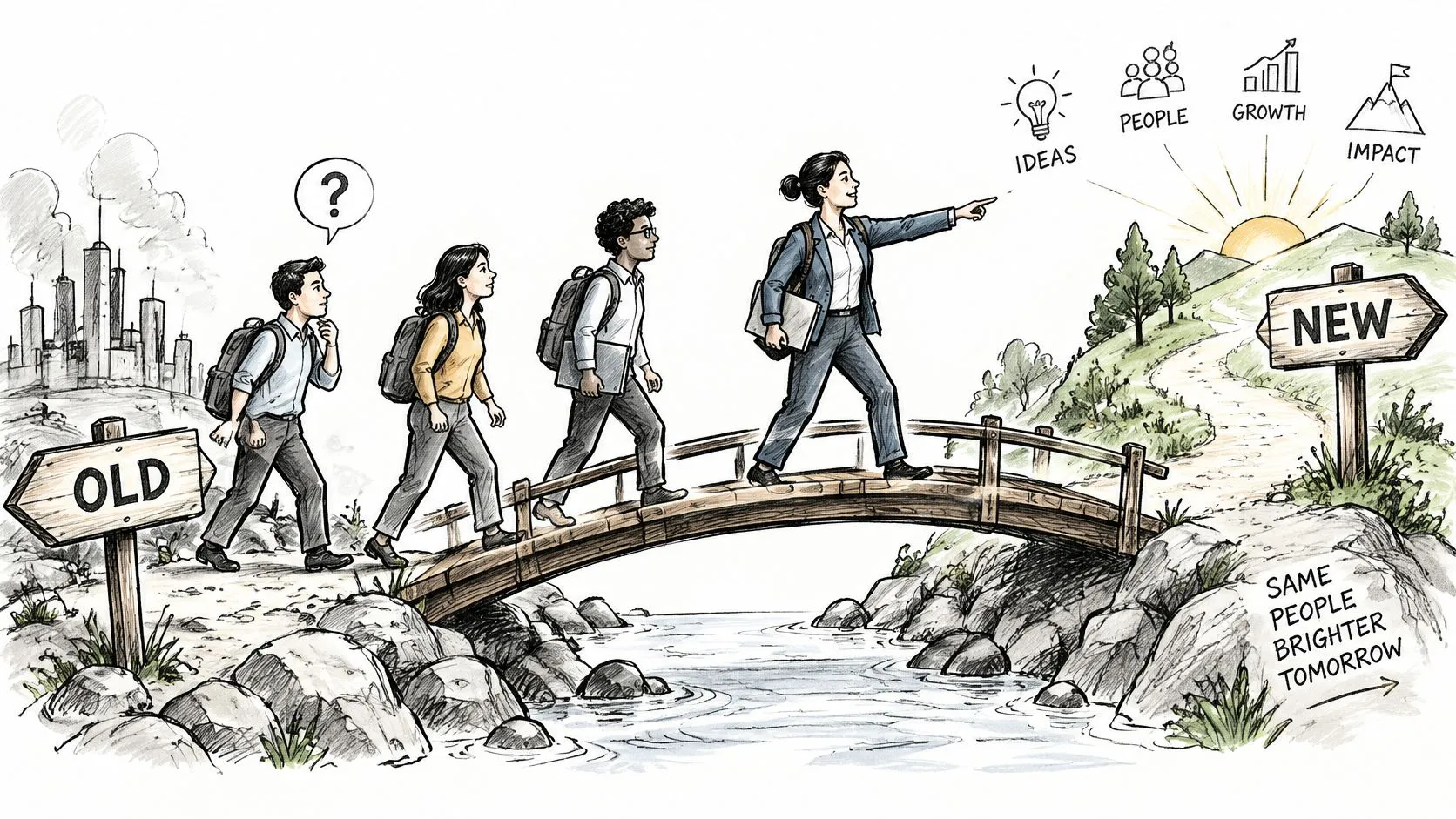
Build the answer around responsibility, context, action, and outcome. The reasoning behind writing impact statements applies here too: explain what changed because of your intervention.
- Choose resistance with substance. A legitimate operational concern reveals more judgment than a complaint about people disliking change.
- Name your intervention. Explain whether you changed training, sequencing, ownership, or the launch criteria.
- Verify adoption. A launch announcement isn't proof that anyone changed how they worked.
Use a person's role rather than their name. The interviewer needs to understand the objection, not identify the colleague.
2. How do you handle an underperforming team member?
Start with diagnosis, not discipline. Missed commitments can reflect a skill gap, unclear priorities, hidden workload, or an employee who isn't meeting an understood expectation.
The interviewer wants to know whether you can tell the difference. Being supportive without setting expectations is avoidance; setting expectations without understanding the work is careless.

The decision behind the answer: Did the situation require support, clearer expectations, a workload change, or formal escalation?
Consider a developer who repeatedly misses sprint commitments. A useful answer might explain that you reviewed their Jira work with them, discovered untracked production support, and agreed with the manager to redistribute that work.
Show fairness and follow-through
Before: I coached a developer who was struggling with delivery.
After: I uncovered untracked production support behind missed sprint commitments, helped rebalance the workload, and set explicit delivery expectations that the developer subsequently met.
Don't end the answer at the sympathetic conversation. Explain the agreed deliverable, review date, support available, and what you'd do if performance didn't improve.
- Describe observable work. Discuss missed handoffs, incomplete testing, or commitments that weren't met.
- Protect confidentiality. Leave out names and private personal circumstances.
- Respect your authority. If you weren't the manager, distinguish your coaching from the manager's formal performance decisions.
For interviewers, keep follow-up questions job-related. The EEOC's guidance on applicants and disability prohibits pre-offer questions about the existence, nature, or severity of a disability while allowing questions about performing specific job functions.
3. Describe a time you made an unpopular decision
An unpopular decision isn't automatically a brave decision. Sometimes people object because the decision is poor.
A strong answer shows that you considered the objection seriously and still had a defensible reason to proceed.
The decision behind the answer: Which cost did you accept, and why was it preferable to the alternative?
Explain what you chose not to do
Say an important customer requests a feature that would displace reliability work already committed for the release. Account managers want the feature; engineering wants to protect the existing scope.
Before: I pushed back on a customer request to protect the roadmap.
After: I deferred a customer-specific feature to protect committed reliability work, explained the trade-off to account managers, and arranged a temporary workflow that preserved the customer relationship.
The stronger sentence doesn't make the account managers villains. They had a legitimate commercial concern, and you addressed it rather than dismissing it.
A credible trade-off includes something you gave up. If your answer has no downside, you probably haven't explained the decision.
In the fuller story, describe the evidence you reviewed, who had final authority, and how you communicated the decision. If the temporary workaround created extra support work, acknowledge that cost.
Don't claim success solely because the release shipped. Explain whether the customer accepted the alternative and whether the people carrying the workaround had agreed to it.
The best ending isn't necessarily that everyone approved. It's that people understood the reasoning, knew their responsibilities, and could hold you accountable for the consequences.
4. Tell me about a time you failed as a leader
Choose a failure caused partly by your judgment. A supplier missing a deadline isn't your leadership failure unless your planning, escalation, or response contributed to the damage.
The decision behind the answer: What did you misunderstand, and what operating habit changed afterward?
A useful scenario is approving additional contractors without checking whether experienced staff could onboard them. The hiring decision looked sensible on paper, but the team lacked the capacity to make it work.

Before: I learned to communicate better after an onboarding challenge.
After: I approved contractor onboarding without protecting mentor capacity, disrupted delivery, and introduced a readiness review before subsequent staffing decisions.
That answer has a real mistake. It also names a correction someone could inspect.
Prove that the lesson changed your behavior
Explain what the readiness review now checks: access, documentation, a named onboarding owner, and time protected for support. Then describe a later staffing decision where you used it.
- Own your choice. Say you approved the plan, not that mistakes were made.
- Describe the consequence. Identify the work that slipped or the burden colleagues absorbed.
- Show a tested correction. A new intention isn't evidence of improvement.
Don't inflate your responsibility either. If several leaders approved the plan, explain your part and the decision you could have challenged.
A failure story doesn't need a triumphant ending. It needs honest accountability and a specific reason the same mistake is less likely to happen again.
5. Tell me about a time you influenced without authority
Start with what the other team needed. Your urgency alone doesn't give them a reason to change their priorities.
Say marketing needs a reporting fix, but finance won't prioritize it. Repeated escalation might win attention while damaging the relationship you need for future work.
The decision behind the answer: How did you make cooperation worthwhile without pretending you controlled the other team's workload?
Find the shared problem
A stronger approach is to understand the controller's process. If the same manual reconciliation step delays month-end close and marketing reports, you can propose a shared fix rather than competing requests.
Before: I persuaded finance to prioritize a reporting improvement.
After: I connected marketing's reporting delays to finance's manual reconciliation work and secured a jointly owned process change that supported both teams' deadlines.
The leadership isn't in presenting a clever argument. It's in finding a problem the other team genuinely wants to solve.
- Identify their constraint. Explain the workload, risk, or target that shaped their response.
- Offer a contribution. Bring analysis, testing capacity, documentation, or a narrower scope.
- Attribute the result fairly. Separate the case you built from the implementation others delivered.
You don't need direct reports to have credible leadership examples for your resume. Mentoring, incident coordination, and cross-functional process changes can all reveal leadership when you identify the decision you owned.
Avoid the lone-hero version. If finance redesigned the reconciliation process and you coordinated requirements, say that. Precise attribution makes your influence more believable, not less impressive.
6. How do you develop the people on your team?
Giving advice isn't the same as developing someone. The stronger evidence is work they can now do without your help.
The decision behind the answer: Which stretch assignment would build capability without exposing the person or the business to unmanaged risk?
Consider an analyst who produces strong analysis but avoids presenting recommendations. Handing over a high-stakes executive meeting without preparation isn't building confidence. It's an unnecessary gamble.

Show how your support changed
Before: I mentored an analyst and helped improve her confidence.
After: I gave an analyst ownership of a leadership review, rehearsed the recommendation with her, and reduced my involvement as she began handling stakeholder questions independently.
A convincing sample answer would explain how you agreed on the development goal, selected suitable work, and reviewed progress. It would also show that the analyst wanted the opportunity rather than having your preferred career path imposed on her.
Practical rule: Describe what you stopped doing once the other person became capable. That's evidence of development.
Use a repeatable method: agree on the skill, assign real work, provide feedback, then withdraw support deliberately. Explain what you'd change if the assignment proved too demanding.
Don't claim credit for someone's entire promotion. You can credibly describe the opportunity you created and the capability they demonstrated.
The trade-off matters. Coaching takes time, and a developing colleague may work more slowly than you would. Show how you protected delivery while still leaving room for them to learn.
7. How would you describe your leadership style?
Collaborative, supportive, and results-driven are labels. They don't tell an interviewer what working with you feels like.
Describe the behaviors your team would recognize, then explain where your default approach needs adjustment.
The decision behind the answer: When do you give autonomy, and when do you provide closer direction?
Replace adjectives with operating habits
Before: I'm a collaborative leader who empowers people.
After: I define the outcome and constraints, let experienced colleagues choose the approach, and use closer checkpoints when someone is learning unfamiliar work.
That becomes a stronger interview answer when you add a limitation. Perhaps you once waited too long to intervene because you mistook silence for confidence.
A useful continuation would explain that you now agree on visible checkpoints at the start. You still protect autonomy, but you no longer rely on someone volunteering that they're stuck.
- Name your defaults. Describe how you set direction, delegate, and review work.
- Explain your adjustment. Show what changes for unfamiliar tasks, urgent incidents, or new colleagues.
- Acknowledge the cost. More consultation can slow a decision; more direction can discourage ownership.
Learning to talk about your work means replacing broad self-descriptions with choices another person can picture. The same discipline makes leadership-style answers useful.
Don't promise that you adapt perfectly to everyone. Explain how you notice that your current approach isn't working and what you change in response.
A style without a trade-off sounds rehearsed. A style with an adjustment sounds usable.
8. Tell me about a time you resolved conflict on your team
Agreement isn't always the right outcome. A team may need a clear decision and a workable relationship, even when colleagues still prefer different approaches.
The decision behind the answer: Did the disagreement need more evidence, clearer ownership, or someone authorized to make the call?
Say senior designers disagree about a component library while frontend work stalls. Bringing everyone into another open-ended discussion won't help if nobody knows who decides.
Separate listening from deciding
Before: I brought the designers together and helped them compromise.
After: I clarified the designers' competing concerns, agreed on evaluation criteria with engineering, and established a decision owner so the component library could move forward.
A fuller answer would describe listening separately before the joint discussion, distinguishing product concerns from personal frustration, and setting a decision deadline. It would explain who made the final call and how the team reviewed the implementation afterward.
- Listen fairly. Represent each position accurately before judging it.
- Choose against criteria. Use accessibility, maintainability, delivery risk, or user needs rather than seniority.
- Check the relationship. Explain whether colleagues continued reviewing and supporting each other's work.
Don't force a hybrid solution just to make the story sound harmonious. Combining incompatible approaches can preserve the argument inside the implementation.
Use this video as a prompt for spoken practice, then check whether your answer makes the decision and your contribution clear.
How the eight lead interview questions differ
| Item | Core skill tested | Strongest fit | Story to prepare |
|---|---|---|---|
| Tell me about a time you led a team through change | Change management and stakeholder communication | Leaders who have driven a team or process change | A change you led, the resistance you addressed, and the measurable result |
| How do you handle an underperforming team member? | Fair diagnosis, accountability, and coaching | Managers who balance clear standards with support | A time you identified the cause, set expectations, and followed up |
| Describe a time you made an unpopular decision | Judgment, communication, and ownership | Leaders who can explain and stand behind difficult trade-offs | A contested decision, your reasoning, and how you handled the outcome |
| Tell me about a time you failed as a leader | Self-awareness and learning from mistakes | Leaders who take responsibility and change their behavior | A genuine leadership miss, your role in it, and what you changed afterward |
| Tell me about a time you influenced without authority | Persuasion and stakeholder alignment | Professionals leading across teams without direct reports | A time you learned others' priorities and built support for a shared goal |
| How do you develop the people on your team? | Coaching, delegation, and talent development | Managers who create stretch opportunities and track growth | A person you helped develop and the change in their skills or responsibilities |
| How would you describe your leadership style? | Self-awareness and adaptability | Leaders who adjust their approach to the team and situation | Your usual leadership behaviors, when you adapted them, and a trade-off |
| Tell me about a time you resolved conflict on your team | Conflict resolution and impartial facilitation | Leaders who address tension fairly and directly | A team disagreement, how you heard both sides, and how the team moved forward |
Turn Your Own Leadership Moments Into Answers
Before the interview, write down the decision, the resistance, and the result. That habit does more for your answers than memorizing leadership vocabulary.
Start with moments when someone needed to choose, priorities collided, or colleagues changed how they worked. A difficult handoff or a corrected mistake may reveal more judgment than your largest project.
Choose stories with different decisions
Pick a few stories that cover different kinds of leadership. Don't prepare a separate script for every possible question, and don't force the same success story into every answer.
- A change story. Choose work where you addressed resistance and helped people adopt a different approach.
- A people story. Choose coaching, development, or conflict where your intervention changed someone's work.
- A judgment story. Choose a trade-off or failure where you can explain your reasoning and its consequences.
For each story, record the situation, your authority, the choice you made, the alternative you rejected, and the outcome. Separate your contribution from the team's result.
Check the evidence before polishing the language. Review project notes, Jira tickets, release records, or performance feedback you're permitted to use, without copying confidential information into personal documents.
Keep the detail you can defend
If you can't verify a metric, don't invent precision. Describe an observable outcome: the team adopted the workflow, the employee met the agreed expectation, or stakeholders stopped reopening the same decision.
Practice answering aloud, then ask yourself what an interviewer would still need to clarify. If you can't explain who decided or what changed, shorten the project background and recover the missing decision.
For professionals moving toward governance roles, SeatSignal's board interview question bank offers a separate preparation resource. Keep operational leadership stories grounded in the authority you held in practice rather than presenting them as board-level oversight.
The hardest part is often remembering the choice buried inside the work. StoryCV is an Online Resume Writer that asks about your experience and turns your answers into resume-ready writing, helping you move from responsibilities to clear evidence of contribution.
You don't need a more impressive leadership persona. You need a more precise account of the work you've already done.
StoryCV asks guided questions about your work and turns the context, choices, and outcomes into resume-ready bullet points. Walk through a leadership moment with StoryCV and recover the details behind your contribution. Tell my story.