Most guides tell you to sound impressive. Don't. On a firefighter resume, impressive is cheap and screeners know it.
Your unit knows what you did. The page doesn't. The job trains you to say we responded and the crew executed, because that's how incidents really run. It's true. It's also useless to a hiring panel trying to work out what part was yours.
That gap is the whole problem. You don't lack material. You've rarely been asked to separate your assignment, your judgment call, and your hands-on work from the team's outcome. A strong firefighter resume example does that separation plainly, without stealing credit and without hero language.
Skip the drama. Name your role, the decision you made, and the result in the words an incident report would use. If you're also sorting out presentation basics, check the professional photo specifications for resumes before you submit anything with a photo attached.
Seven roles follow. Each shows the procedural line you'd say in the station, then the individual version that works on paper. All examples are hypothetical.
1. Firefighter Resume Example Entry-Level Recruit 0-2 Years
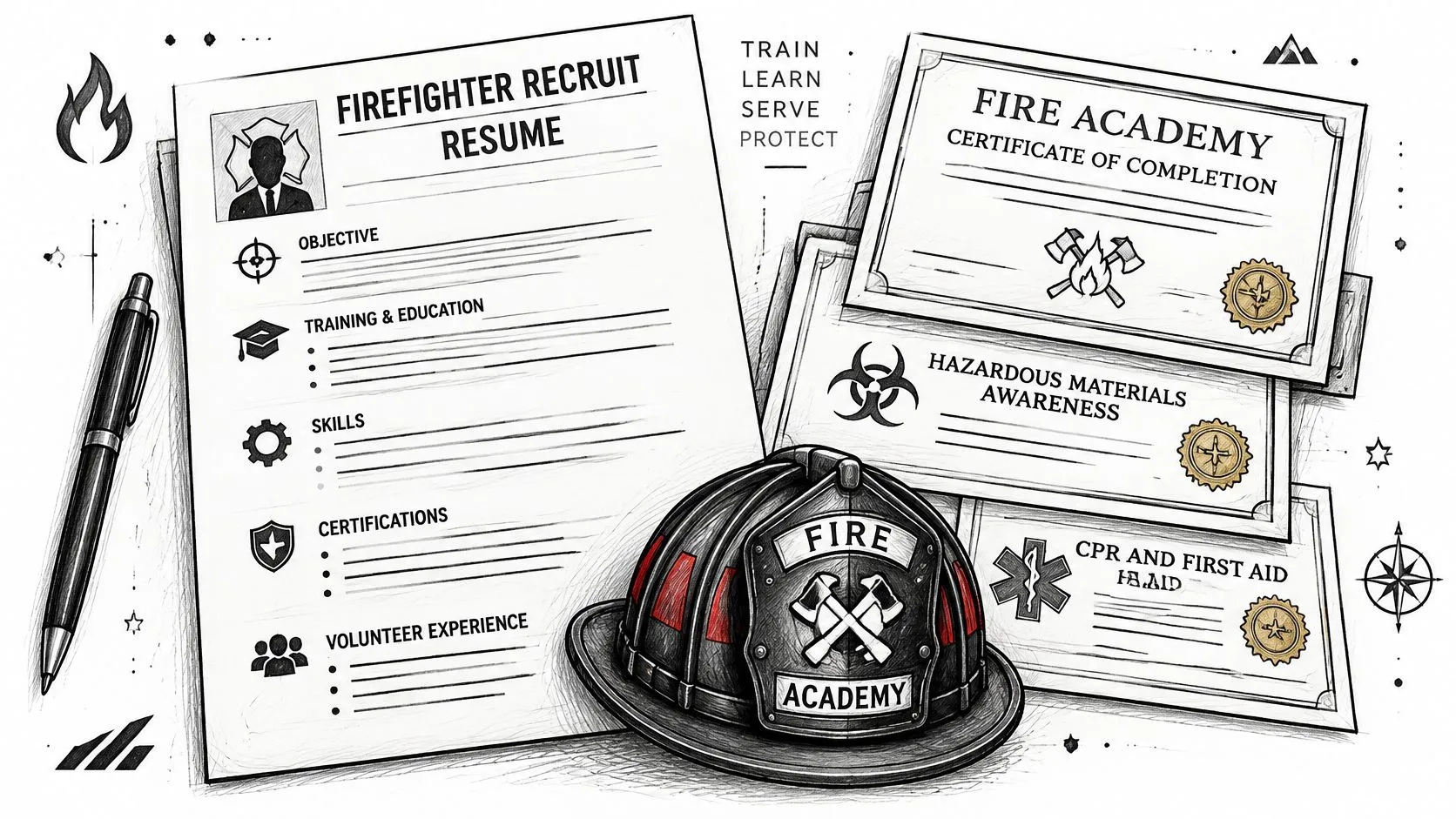
At entry level, academy work and clearly defined assignments carry more weight than inflated claims. You may have a short call history. Use the training and experience you do have, and state exactly what you handled.
Lead with certifications, academy performance, and real calls. Name the scope of your training and your role on each call. If you're building your first application with little work history, this guide to a resume with no job experience explains how to present training accurately without making it sound like job tenure.
Procedural vs. Individual
- Procedural: Completed Firefighter I and II academy. Participated in live-fire training.
- Individual (hypothetical): Completed 480-hour Firefighter I and II academy with top-five scores on live-fire and ventilation drills. Selected to lead a two-person hose line during the final burn evaluation.
- Procedural: Assisted on calls as a volunteer.
- Individual (hypothetical): Volunteer firefighter for 14 months. On a residential fire at night, served as the second person on the backup line and tracked air supply for the interior crew.
The National Fire Protection Association count of firefighters in the US notes that most US firefighters are volunteers. A volunteer start belongs on your resume. Record your assignment and contribution without implying you controlled the crew's outcome.
- Certifications first: List each certification with its issuing body and year. Make qualifications easy to find.
- One detail per call: Record one specific action you personally took, rather than relying on a general description of the incident.
- Use the exact word: Name your assignment, such as backup, nozzle, ventilation, or driver. Specific duties show where you fit in the operation.
Practical rule: Plain nouns and verbs carry more credibility at this level than any adjective you can add.
Keep the distinction clear: document the team's work as a team outcome, then name your own task. If details are hard to recall, Try StoryCV and use its guided questions to work through calls one at a time.
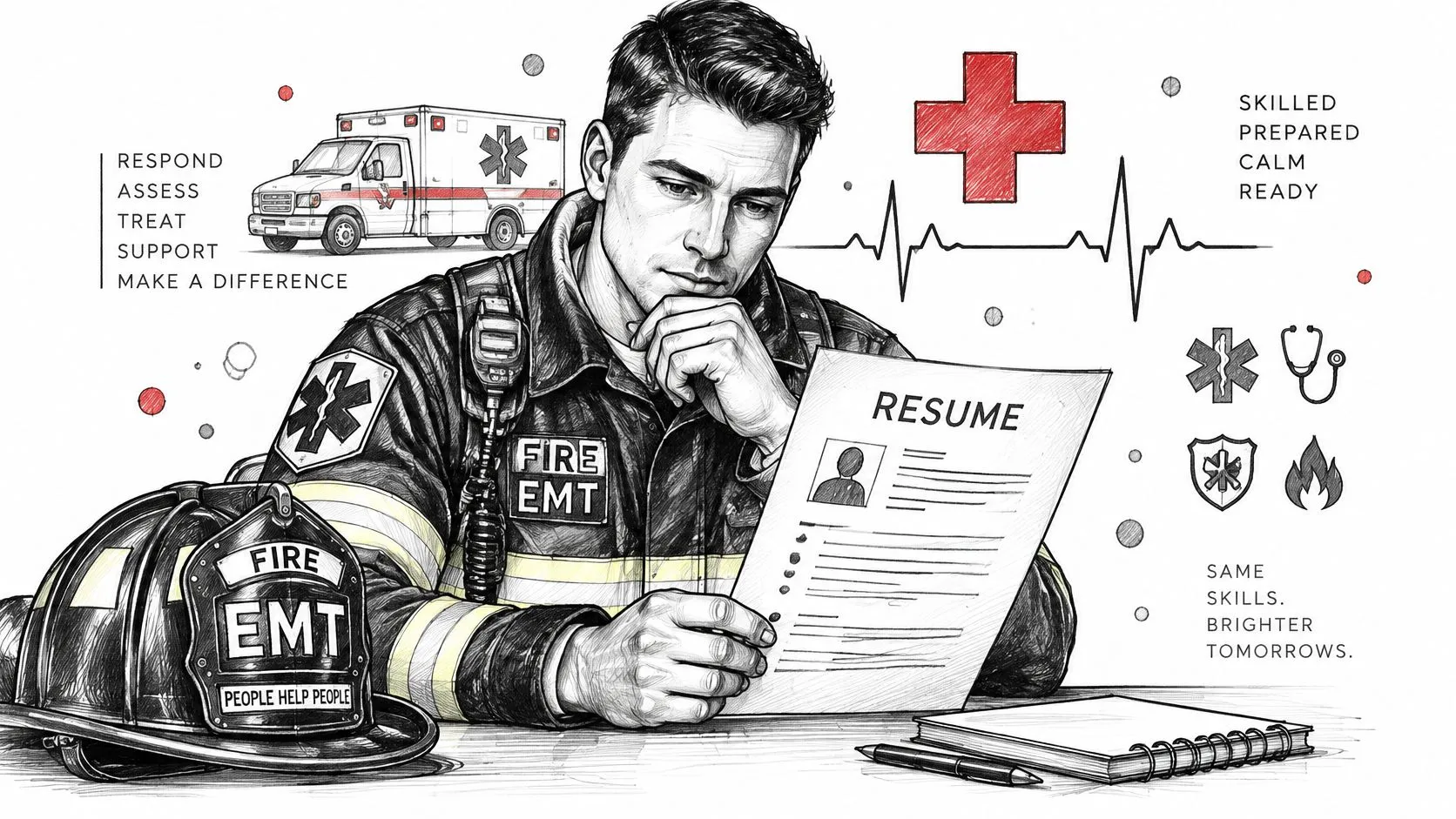
2. Firefighter Resume Example Firefighter EMT 3-5 Years
This is the front-line resume, and it fails in a predictable way. You write responded to emergency calls. So does every other applicant in the stack.
Your crew moves fast and nobody narrates. Fair. But on paper you have to slow one or two calls down and show where you stood, what you handled, and what your partner handled. That split is the evidence.
Procedural vs. Individual
- Procedural: Responded to medical calls and provided patient care per protocol.
- Individual (hypothetical): As EMT on a cardiac arrest call in a residential home, managed the airway and bag-valve ventilation while my partner established IV access. Crew achieved return of spontaneous circulation before transport.
- Procedural: Performed extrication on motor vehicle collisions.
- Individual (hypothetical): Led the extrication sequence on a two-vehicle collision with a trapped driver, deciding to stabilize the dash before cutting the door to limit further movement of the patient.
Notice what the second versions don't do. They don't claim the save alone. They name the situation, your responsibility, and the crew result in that order.
That's the honest frame for a high-consequence call. State what the situation required, what you were responsible for, and what you did. Then give the outcome in report language, including crew or team where it's true. Words like intense or heroic undercut you. Accuracy doesn't. The Bureau of Labor Statistics occupational profile for firefighters lists treating sick or injured people and preparing written incident reports as core duties, so write medical work as specific care plus documentation, not as a vague add-on.
- One line per call type: List what you handled regularly, then expand the two most instructive calls.
- Name it plainly: Trapped driver, dash stabilized before door cut says more than any adjective.
- Log it after shift: Five minutes now saves you a blank memory six months later.
When you've got the log, Write my first role in StoryCV and turn those notes into bullets.
3. Firefighter Resume Example Driver Operator 5-8 Years
When you do this job right, nobody notices. Water shows up, pressure holds, the apparatus starts. That invisibility is your resume problem.
So make the technical decisions visible. Which water source you chose and why. How you set up the pump. What you did when the supply failed. For driver operators, specificity isn't decoration. It's the entire argument. Operators in other trades face the same translation task, and this look at forklift operator resumes shows a similar pattern of turning routine operation into documented judgment.
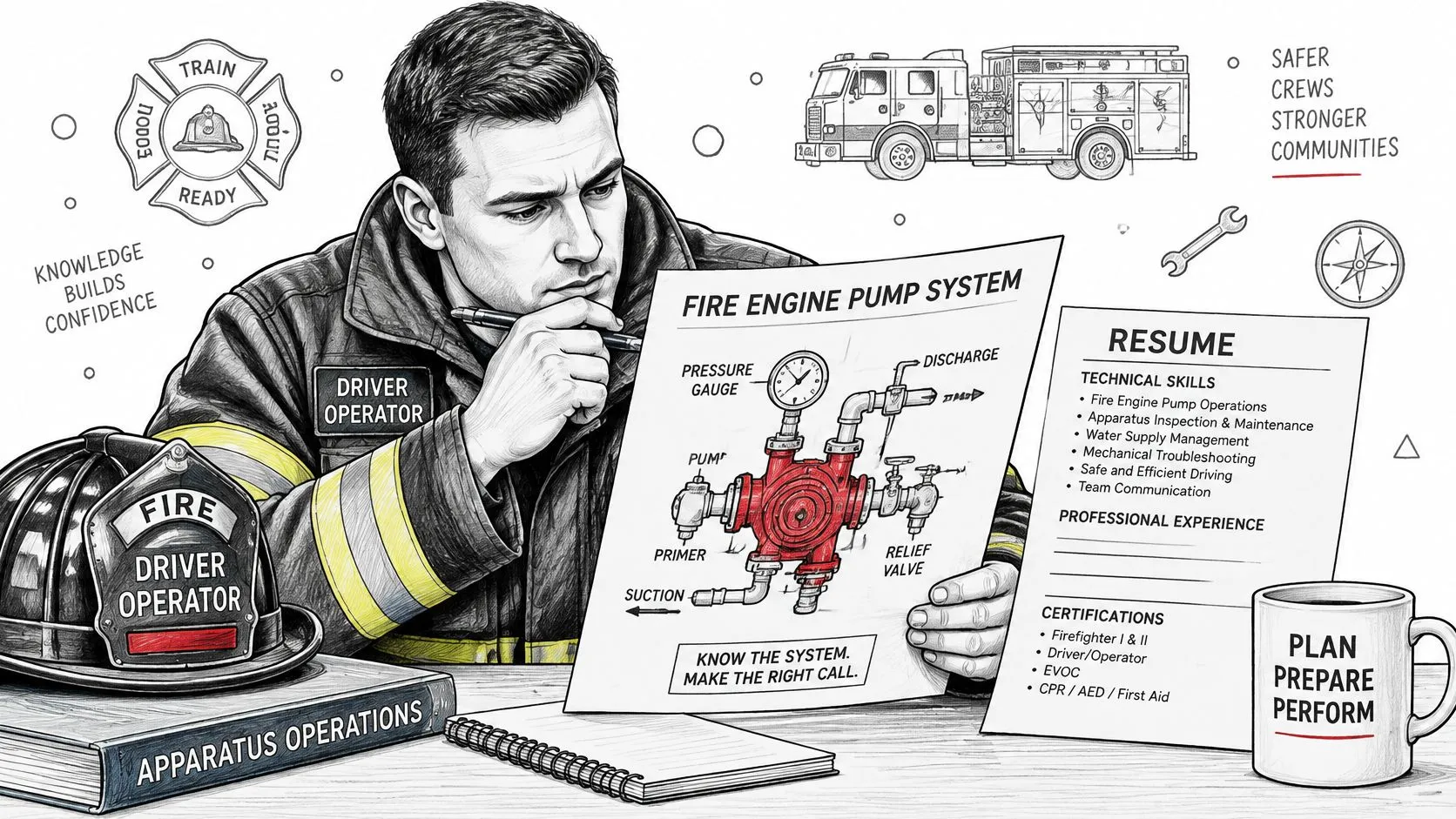
Procedural vs. Individual
- Procedural: Operated fire apparatus pump during structure fire responses.
- Individual (hypothetical): Supplied the attack engine at a commercial fire on a long hose lay after choosing a hydrant upstream of the first option, which had low flow. Maintained pressure on two attack lines through the incident.
- Procedural: Maintained apparatus and equipment.
- Individual (hypothetical): Ran weekly pump tests and daily checks on the engine. Caught a failing intake relief valve before a multi-alarm call and had it replaced the same shift.
The first rewrite works because it contains a rejected option. That's judgment on paper. Anyone can say they ran a pump. Fewer people can explain why they didn't use the closest hydrant.
The second rewrite turns maintenance into a finding. Federal postings back this approach. One USAJOBS firefighter announcement requiring specialized tool and equipment experience specifies equipment inspection and maintenance alongside search and rescue and hazardous-material release management, so readiness checks count as qualifying evidence when you write them concretely.
- Name the choice: Water source, positioning, supply switch. Choices show judgment.
- Write readiness as a finding: What you caught, what got fixed, and when.
- Admit the failure: When supply dropped or the line came up short, say so and say what you did next.
- Keep certs dated: Driving and pump credentials are quick screener checks. Don't make anyone hunt.
Solving a problem on scene reads well. Pretending there wasn't one reads as someone who wasn't paying attention.
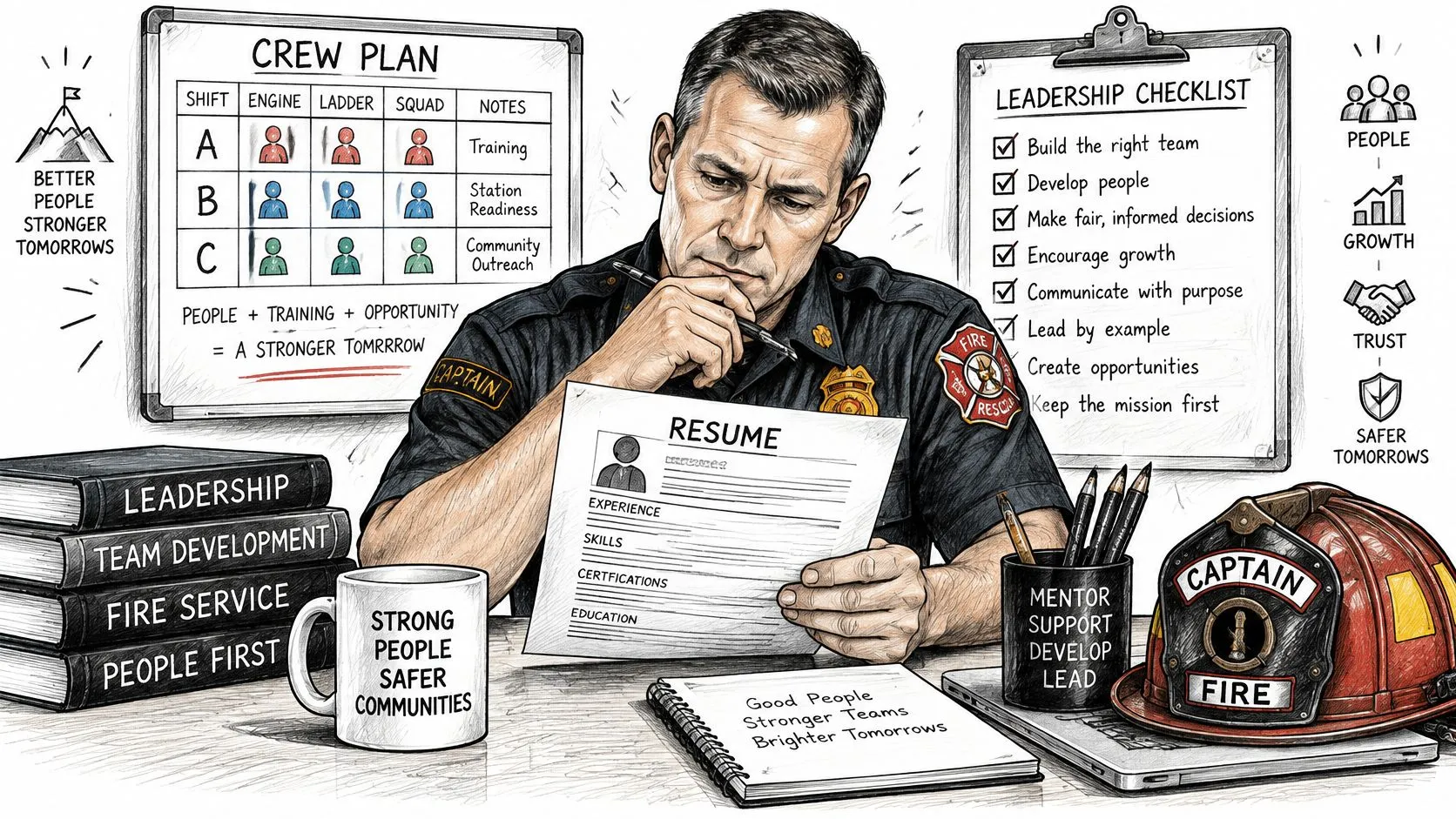
4. Firefighter Resume Example Fire Captain 8-12 Years
A captain's resume fails when it credits the officer with every action the crew performed. Your job is to show which decision was yours, what the crew did, and what you learned or changed. Keep the distinction clear, especially when describing high-consequence calls.
If you're applying for formal leadership roles, use this guide to write a resume for management positions alongside the fire service examples.
Procedural vs. Individual
- Procedural: Commanded an engine company during a structure fire.
- Individual (hypothetical): As company officer at a commercial fire, confirmed the roof was compromised and decided on a defensive strategy. The crew protected the exposures, limiting fire spread to the adjacent building.
- Procedural: Supervised crew training.
- Individual (hypothetical): Trained three probationary firefighters through their first live calls. Two completed probation on schedule. I also rewrote the ventilation drill sequence the crew used.
Write the decision as yours and the execution as the crew's. That gives credit accurately: you name the call you made, while the crew's work stays visible. A procedural duty alone says what your role required. The individual version gives the reader the decision, its context, and the team's response without claiming sole credit for a shared outcome.
- One defensible decision per incident: Choose a call you can explain to fellow officers. State what you knew, what you chose, and why.
- Show development with specifics: Name who you trained, what they went on to do, and what you changed in the process. Keep outcomes factual, and don't imply your coaching alone produced them.
- Describe risk without hero language: Identify the hazard and your decision. Don't claim that your call alone brought everyone home. A credible account separates your judgment from the crew's work and the limits of what you know.
Use the same discipline on training examples as on incidents. Claim the drill sequence you changed; report probation outcomes without taking sole credit. If you can't support an outcome, leave it out. A captain's resume should show responsibility without turning a team result into a personal victory.
5. Firefighter Resume Example Battalion Chief 12+ Years
A battalion chief resume should name decisions, not just command responsibilities. You manage span of control, weigh incomplete reports, and make calls that shape how several companies work. Show what you chose and what the team carried out, without claiming the whole outcome as your own.
The easy mistake is listing committees and initiatives without showing your role. Keep the systems you personally changed, then connect each one to a clear action. Your resume is not an inventory of meetings.
Procedural vs. Individual
- Procedural: Served as incident commander for multiple structure fires.
- Individual (hypothetical): Commanded a four-alarm apartment fire. Requested a second water supply branch early, maintained a defensive strategy after a partial collapse, and transferred command to the deputy chief with a written accountability report. Name your calls; credit the companies for the work they performed.
- Procedural: Managed district budget and staffing.
- Individual (hypothetical): Rebalanced overtime across three stations during a staffing gap. Reduced unfilled shifts over one year while maintaining required coverage, then documented the process in the district staffing procedure. Use this wording only if you can support the outcome and explain your own part.
The NFPA fire loss report for 2022 provides national context for the demands fire departments face. It does not prove what you achieved as a chief. Keep the resume focused on your command choices and verifiable contributions, not broad fire-loss figures that do not clarify your role.
- Limit the systems list: Keep the changes you personally drove. Move other committee work off the resume unless it supports the role.
- Show command transfer: State the incident, your decision, and how you passed command on. A clear handoff demonstrates disciplined leadership.
- Check every figure: Include measured results only when records support them and you can explain the method.
- Prepare one difficult account: If a panel asks about a call that went badly, describe what happened plainly and what you learned.
For chief roles: A record with no difficult calls can look incomplete. Include a candid example without dressing it up as a success.
District results belong to the district. State the decision you made within them, and give credit to the people who executed the work.
6. Firefighter Resume Example Wildland Crew 2-6 Years
Wildland work runs on its own language, and that language can lock out the person reading your application. Crews work long rotations on line construction, mop-up, and firing operations far from any station.
Your resume needs qualifications, hours, terrain, and the specific crew role you held. Squad boss and crew lead roles are where individual responsibility becomes visible fast, so don't bury them under generic crew duties.
Procedural vs. Individual
- Procedural: Worked on wildland fire crew doing line construction.
- Individual (hypothetical): Served as squad boss on a hand crew during a two-week assignment on mixed timber and grass. Assigned line segments by terrain and fuel, and held the line on a flank that shifted twice in one afternoon.
- Procedural: Performed mop-up operations.
- Individual (hypothetical): Led a mop-up sector, checking hot spots with a thermal imager and documenting each one for the division supervisor. No re-ignitions were reported in my sector after handoff.
The rewrites work through terrain, fuel, and assignment boundaries. Those details tell a reader what the job actually demanded. Long days and hard work tell them nothing, because every wildland applicant says both.
Federal applications reward this precision. A USAJOBS firefighter posting detailing required job information asks for relevant job titles, duties, accomplishments, employer names, dates, and sometimes hours per week. Wildland candidates who log assignments by role and duration can answer that without reconstructing a season from memory.
- Translate once: Add a plain equivalent like hand crew supervisor so non-fire readers follow your title.
- Write the ground: Terrain and fuel type communicate difficulty better than adjectives.
- Keep qualifications current: Agencies verify them. Dates and status need to be exact.
- Explain seasonal gaps in one line: A plain note that the season ended closes the question. Silence invites a worse guess.
7. Firefighter Resume Example Fire Inspector 4-10 Years
Inspectors and prevention specialists have the hardest translation job in the fire service. Your work is code, documentation, and persuasion. Nothing burns, and that's the point.
So don't write it like suppression. Show what you found, what you required, and what changed. A building that's safer now because of a specific finding is a complete story. A count of inspections with no findings is just activity.
Procedural vs. Individual
- Procedural: Conducted fire inspections in assigned district.
- Individual (hypothetical): Inspected a multi-unit apartment building and found a fire pump valve closed during a routine check. Issued a corrective notice, verified repair on a follow-up visit, and closed the case with the owner's signed testing report on file.
- Procedural: Reviewed fire protection plans.
- Individual (hypothetical): Reviewed sprinkler and fire alarm plans for a large warehouse. Flagged a missing fire department connection and a clear height conflict, and the design team corrected both before permit issuance.
That finding, requirement, fix structure does all the work. It shows judgment, authority, and a verified result without borrowing suppression language that doesn't fit your role.
It also lines up with how standards frame the job. NFPA 1001 and its minimum job performance requirements treats firefighter qualification as observable performance rather than personality traits. Prevention work proves itself the same way, through documented actions and outcomes a reviewer can check.
- Name the code by edition: It signals real expertise, especially to hiring managers outside the fire service.
- Close the loop: Verified repair and filed report beat issued notice on its own.
- Translate accurately: Fire code enforcement becomes regulatory compliance and risk reduction only if that's what you did.
Ready to put this in your own words? Tell my story through one inspection you're proud of, one question at a time, and see what comes out in plain resume language. Start with one role and decide from there.
Which Firefighter Resume Example Fits Your Rank and Path
| Item | Experience Level | Lead With | Common Trap |
|---|---|---|---|
| Firefighter Resume Example: Entry-Level Recruit, 0-2 Years | Entry-level, 0–2 years | Certifications, academy performance, and clearly labeled experience | Inflating volunteer duties or listing training without showing judgment |
| Firefighter Resume Example: Firefighter/EMT, 3-5 Years | 3–5 years | Specific calls, your role, and clinical or operational skills | Claiming team or patient outcomes as solely your own |
| Firefighter Resume Example: Driver Operator, 5-8 Years | 5–8 years | Pump decisions, water supply, and apparatus readiness | Describing tasks without showing decisions or results |
| Firefighter Resume Example: Fire Captain, 8-12 Years | 8–12 years | Incident decisions, crew accountability, and staff development | Taking sole credit for the crew's work |
| Firefighter Resume Example: Battalion Chief, 12+ Years | 12+ years | Command decisions, system changes, and measurable leadership | Listing programs and initiatives without showing impact |
| Firefighter Resume Example: Wildland Crew, 2-6 Years | 2–6 years | Qualifications, assignment conditions, and specific crew roles | Using unexplained jargon or obscuring individual contributions |
| Firefighter Resume Example: Fire Inspector, 4-10 Years | 4–10 years | Inspection findings, required corrections, and outcomes | Listing inspection counts without explaining results |
Pick One Call and Say What You Decided
Don't try to rewrite your whole career in one sitting. That's how resumes end up as duty lists again.
Pick one call. One where you made a real decision, where you can still explain the reasoning, and where you know exactly which part was yours and which part belonged to the crew. Write it in three moves. What the situation required. What you were responsible for. What happened, in report language.
Then check it for theft. If your partner, your officer, or your crew would read the bullet and say that wasn't just you, rewrite it until they'd nod. That test is stricter than any formatting rule, and it's the one that keeps you credible in an interview when someone asks you to walk through the incident.
Why This Is Harder Than It Looks
You're not bad at describing your work. You've been trained to describe it a different way. After-action talk is about protocol, sequence, and unit performance, because that's what improves the next response. Nobody in that room is asking what you personally decided at minute four.
A resume asks exactly that. So the skill isn't writing. It's remembering your own role separately, sometimes years later, and deciding which details prove judgment instead of just presence.
The plainer the description, the more credible the seriousness underneath it reads. Facts carry weight that adjectives can't.
That's also why copying a polished firefighter resume example line for line fails. The words fit someone else's call. Yours will sound borrowed because they are, and experienced officers spot borrowed language fast.
A Simple Way to Start
- Start with one role: Your most recent assignment, not your whole history.
- Answer out loud: What were you assigned, what did you decide, what did you do with your hands, what changed?
- Keep the crew in the crew's column: Name their execution as theirs. It makes your part more believable, not less.
- Cut every adjective you can't prove: Replace it with a role, a tool, a condition, or a result.
Do that for one call and the next one gets easier. The habit builds fast once you've seen your own work written the way a screener needs to read it.
If pulling those details out of memory is the hard part, that's the gap StoryCV is built to close. It asks you questions about work you really did and turns your answers into resume-ready writing. Start my role with one position, talk through one call candidly, and build from there.
You've already done work worth documenting, and StoryCV helps you say what your part in it was, one guided question at a time. Bring one call, one inspection, or one assignment and turn it into bullets you can defend in the room. Visit StoryCV and write your first role today.