A management resume isn't a longer job description. It's a record of decisions, scope, and outcomes. The popular advice says to squeeze everything onto one page. That's wrong for most experienced managers. Your resume needs enough room to show what you led, what changed, and why the result mattered.
For StoryCV, brevity is the brand. But brevity doesn't mean removing proof. It means removing noise. The right resume for management positions should pass an ATS cleanly, survive a fast human scan, and make your leadership judgment obvious.
Why Most Management Resumes Fail Before a Human Reads Them
A weak management resume describes activity. A strong one documents leadership proof.
“Managed a sales team.” “Oversaw operations.” “Responsible for project delivery.” These lines may be accurate, but they leave the important questions unanswered. How large was the team? What decisions did you own? What constraints did you handle? What improved because you were there?
Hiring managers often scan quickly. One industry survey found that 57% of hiring managers review a resume for only 1 to 3 minutes, while another set of resume statistics reports that many recruiters spend about 6 to 8 seconds on an initial pass (resume statistics from OneHour Digital). Your first page must make the candidate's management level visible without requiring detective work.

The two gates you need to pass
Most management candidates now face two readers.
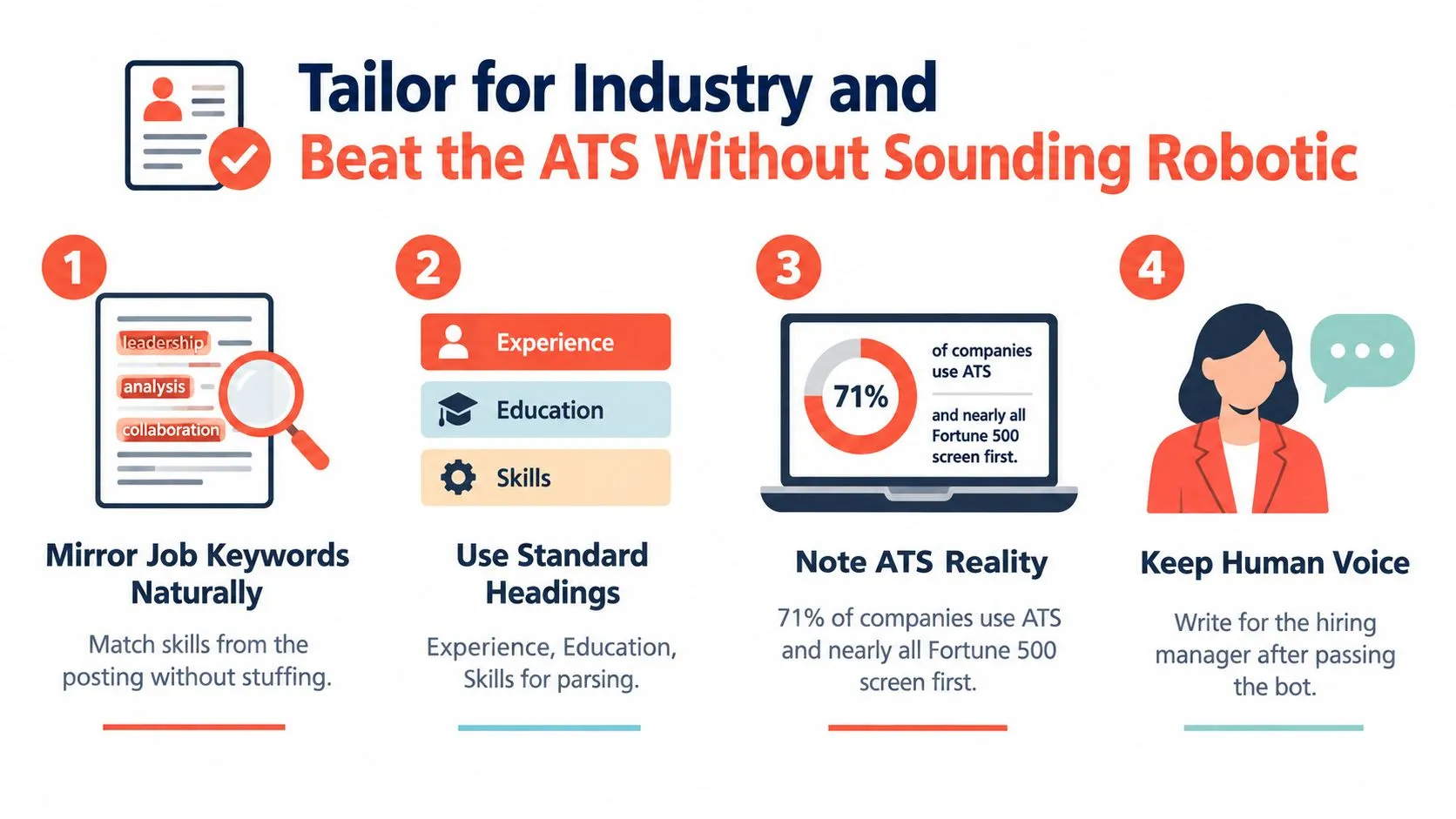
The first is software. Recent resume data reports that 71% of companies use an applicant tracking system, and 37% say candidates are screened out before an employer sees them (ATS resume statistics from Resume Genius). Another dataset reports that 85% of executive hires still go through an ATS at some stage, so seniority doesn't make parsing irrelevant.
The second reader is a person. That person wants evidence of judgment, not a pile of keywords. A machine may recognize “forecasting,” “cross-functional leadership,” or “project management,” but a hiring manager needs to see how you used those capabilities.
Practical rule: A keyword should support a proof point. Never let it replace one.
That's why templates often fail. They give you boxes for “responsibilities,” “skills,” and “objectives,” then encourage polished emptiness. Filling boxes is for machines. Talking is for humans. Your resume should answer the same questions a good interviewer would ask: What did you inherit? What did you change? Who depended on you? What did the business gain?
Treat every bullet as a management decision
A management bullet should usually contain three elements:
- Scope: State the team, function, geography, budget, product, or operating area involved.
- Decision: Explain the action you chose, not just the activity you performed.
- Outcome: Show the measurable or observable result, using only figures you can defend.
The result may be revenue, margin, delivery speed, retention, quality, risk reduction, or stronger team capability. If you don't have a precise number, describe the outcome plainly. “Restored weekly forecasting discipline across sales and finance” is stronger than “worked with stakeholders,” even without a percentage.
Define Your Target Role and Pick the Right Structure
Don't start by editing your old resume. Start by naming the job you want.
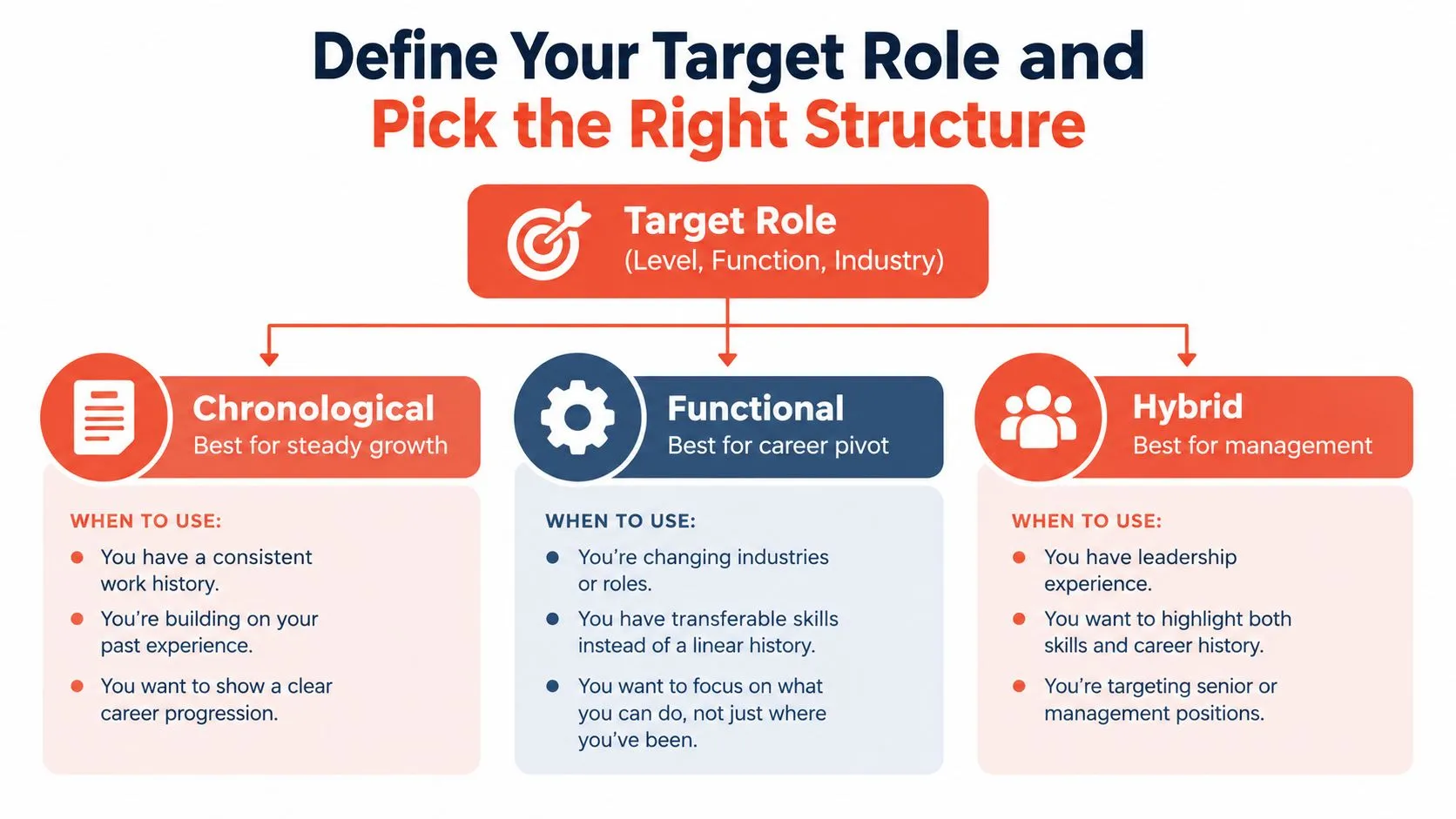
Write the target level, function, and industry in one line. For example: “Operations Director, multi-site logistics” is more useful than “senior business professional.” The first version tells you which achievements belong near the top. The second invites generic language.
Your target determines what the reader needs to understand first. A sales manager should foreground team performance, pipeline quality, forecasting, and coaching. An engineering manager should emphasize delivery, technical judgment, hiring, and reliability. A finance manager should lead with planning, controls, reporting, and decision support.
Choose a structure that matches the story
Use a chronological structure when your progression is clear and your recent roles closely match the target. It lets the reader follow increasing responsibility without interpretation.
A functional structure can help during a major career pivot, but it often creates suspicion when it hides dates or employers. Use it carefully. A manager changing industries still needs credible chronology.
For most management candidates, a hybrid structure works best. Lead with a focused summary and core capabilities, then use a chronological experience section to prove the claims.
Handle a non-linear career without apologizing
Career breaks, layoffs, lateral moves, and promotions without formal title changes don't need dramatic explanations. They need a clean narrative.
Keep company names and dates consistent. Add a short context line when it helps, then connect the experience to the target role. A lateral move from customer success to operations might become: “Moved into operations to lead service workflow redesign across support and implementation.” That sentence explains the direction and frames the move as capability building.
Promotions without title changes need visible progression. Use one employer heading with separate role lines, or show expanded scope in later bullets. Focus on what changed: larger team, broader region, new budget ownership, more complex stakeholders, or higher-risk decisions. Guidance on presenting that progression appears in how to show a promotion on a resume.
Use the space your experience requires
A one-page rule is too crude for management candidates. Analysis of 133,000 resumes found recruiters were 2.9x more likely to select a two-page resume for managerial roles than a one-page version (resume analysis from HR Future). Executive resume guidance generally treats one to two pages as appropriate, with three pages reserved for special cases such as CEOs with substantial board experience (Robert Half executive resume guidance).
Use two pages when the extra space adds leadership context. Don't use it to preserve every early-career task.
A clean order is:
- Name, contact details, and a target title.
- Leadership summary.
- Core capabilities.
- Professional experience.
- Education, certifications, and selected additional information.
Keep the page title concise. A resume title is commonly recommended at 50 to 60 characters to reduce truncation risk (character count guidance from SkyToolz).
Write a Leadership Summary and Bullets That Prove Impact
Your summary isn't a biography. It's a compact argument for your candidacy.
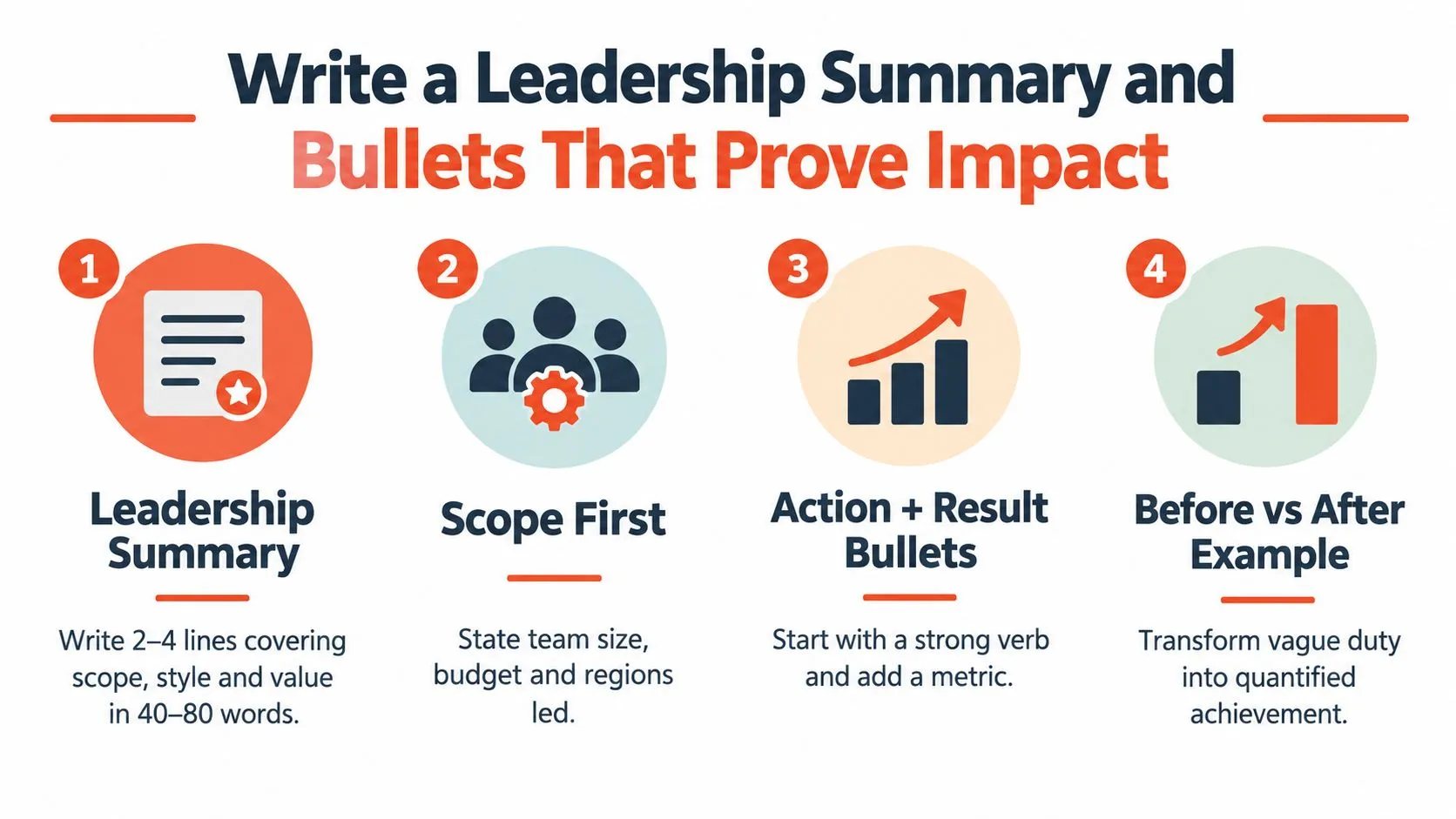
Keep it to 2 to 4 lines, or roughly 40 to 80 words, because longer summaries dilute the opening pitch (resume summary guidance from Qwyse). State your management scope, operating strength, and value. Don't write “results-oriented leader with excellent communication skills.” Almost anyone can claim that.
Try this pattern:
Management identity + scope + leadership style + business value
Example:
Operations manager leading distributed service teams through workflow redesign, capacity planning, and performance coaching. Known for turning unstable delivery processes into clear operating rhythms that improve customer experience and give senior leaders better visibility.
That example uses no invented metrics. It still communicates a management problem, a method, and a value proposition.
Put scope before decoration
Hiring managers need to understand the size and complexity of your remit. Put that information in the role heading or first bullet.
Useful scope markers include:
- Team size: Include direct and, where relevant, indirect reports.
- Budget ownership: State the budget or spend category when you can verify it.
- Geography: Mention regions, sites, or markets led.
- Operating scale: Name the product line, customer segment, portfolio, or workflow.
- Influence: Show the functions and senior stakeholders involved.
Don't add numbers because they look impressive. Use the figures in your records. If you managed a team of 12, say 12. If you don't remember the exact number, write “a multi-disciplinary team” rather than guessing.
Build bullets with action and consequence
Start with an ownership verb: restructured, launched, negotiated, consolidated, coached, redesigned, stabilized, improved, or led. Then explain the decision and result.
Weak:
- Managed quarterly planning and worked with multiple departments.
Stronger:
- Redesigned quarterly planning with finance, sales, and product leaders, creating a shared operating rhythm for resource decisions and delivery commitments.
The second bullet contains keywords naturally, but it reads like a real management action. Add a metric when you have one:
- Consolidated regional vendor operations, reducing invoice exceptions from [your verified baseline] to [your verified result].
Use placeholders while drafting, then replace them before sending. Never estimate a financial impact, percentage, team size, or time saving to make a bullet sound finished.
For more patterns that connect leadership behavior to measurable outcomes, use these leadership examples for a resume.
A resume for management positions should also show influence beyond direct authority. “Partnered with stakeholders” is weak because it says nothing about the work. Name the conflict, decision, or shared outcome: “Aligned product and support leaders on a triage model that clarified escalation ownership.”
The accompanying video offers another way to think about writing impact-focused resume content:
Before and After Management Role Entries That Actually Work
The fastest way to improve a management resume is to compare description with proof.
The examples below use illustrative wording. The metrics shown are placeholders, not facts to copy. Replace them with results from your own records.
Management Bullet Transformations Compared
| Weak Bullet | Strong Bullet | What Changed |
|---|---|---|
| Managed an operations team and handled daily workflow. | Led a multi-site operations team through workflow redesign, clarifying ownership across intake, fulfillment, and escalation processes. | The rewrite shows leadership scope and the operating problem. |
| Responsible for project delivery and stakeholder communication. | Directed a cross-functional implementation involving product, sales, and customer success, resolving priority conflicts and maintaining an agreed delivery plan. | The rewrite replaces responsibility with decisions and influence. |
| Improved customer satisfaction and supported service improvements. | Redesigned the service review process, using recurring customer issues to prioritize coaching and workflow changes that improved the verified satisfaction result from [baseline] to [result]. | The rewrite connects analysis, action, and evidence. |
| Supervised a team of analysts. | Hired, coached, and developed an analytics team supporting commercial planning, introducing review practices that improved decision confidence for business leaders. | The rewrite shows people leadership and organizational value. |
The pattern is simple. Name the situation, show your intervention, and end with the consequence. A task list tells the reader what occupied your calendar. A leadership entry shows how you used authority and judgment.
Make the role heading carry useful information
Don't bury scope inside every bullet. A role heading can establish context:
Operations Manager, Regional Service Delivery
Led multi-site workflows, vendor coordination, and customer escalation management.
That short line gives the bullets room to focus on decisions. It also helps an ATS recognize the function when the employer uses a different internal title.
Show the move from lead to director
A team lead applying for a director role must show expansion beyond personal execution. “Built dashboards” becomes “introduced reporting standards used by department leaders.” “Mentored colleagues” becomes “created a coaching rhythm that supported team capability and succession planning.”
The point isn't to inflate the title. It's to demonstrate director-level behaviors: setting direction, allocating resources, resolving tradeoffs, and building systems other people use.
Tailor for Industry and Beat the ATS Without Sounding Robotic
ATS optimization is not keyword stuffing. It's translation.
The system needs recognizable language. The hiring manager needs credible evidence. Use the terms from the job description when they accurately describe your work, then prove those terms in the experience section.
One 2026 industry report found that 97.8% of Fortune 500 companies had a detectable ATS, while a live-scan benchmark of 151,840 resumes reported an average ATS score of 60.3 out of 100, with 89% below a 70 readiness threshold (ATS research from Scout Apply). The lesson isn't to chase a score. It's to remove preventable parsing problems and close the gap between your experience and the employer's language.
Use simple formatting
Choose standard headings such as Experience, Education, Skills, and Certifications. Use a conventional font, readable spacing, and a clear date format. Avoid text inside headers, footers, graphics, charts, and decorative columns if it could interfere with parsing.
Tailor the top half first. Change the target title, summary, capabilities, and the first bullets under your most relevant roles. You don't need to rewrite every sentence for every application.
For an operations role, “capacity planning,” “continuous improvement,” and “vendor management” may matter. For a biotech leadership role, the vocabulary could include “clinical operations,” “quality systems,” “regulatory strategy,” or “research portfolio,” but only if those terms match your actual work. A curated resource on biotech executive leaders can help you recognize the language used around senior leadership in that sector.
Keep the human voice intact
Don't repeat a keyword in every section. Put it where it belongs, then show the decision behind it. “Led cross-functional teams” becomes useful when the next phrase explains which teams, what they had to resolve, and what changed.
Non-linear careers need the same discipline. Keep dates visible, use consistent headings, and add a short relevance bridge for a career break or transition. A parent returning to work might frame the current target around prior people leadership, operational planning, and stakeholder management. A veteran might translate command experience into workforce planning, risk management, and execution without relying on military shorthand.
The ATS resume optimization guide covers the mechanics. The editorial standard remains simple: write for the manager after the machine has parsed the document.
Final Checklist and Common Mistakes to Avoid
Give the finished resume one fast, unsentimental review. You're not looking for prettier language. You're checking whether a stranger can identify your management level and evidence within a quick scan.
The ten-minute quality check
- Target: Does the title name the management role you want?
- Opening: Does the summary state scope, leadership style, and value in 40 to 80 words?
- Proof: Does each major role include decisions and outcomes, not only duties?
- Scope: Can the reader see team, budget, geography, product, or operational complexity?
- Numbers: Can you defend every figure, date, and result?
- Progression: Do promotions, lateral moves, and expanded responsibility appear clearly?
- Formatting: Are headings, dates, bullets, and spacing consistent?
- Parsing: Can an ATS read the document without relying on graphics or text boxes?
- Tailoring: Does the resume use relevant language from this specific job description?
- Cutting: Have you removed early-career detail that doesn't support the target?
Common mistakes are predictable. Candidates claim to be strategic but show only execution. They write long summaries that bury the value proposition. They list every software platform they've touched. They use elegant design that makes the document harder for an ATS to interpret.
A resume for management positions should feel selective. Keep the evidence that proves leadership. Cut anything that only proves attendance.
StoryCV is an Online Resume Writer, not a template library. Its guided interview asks about your role, decisions, constraints, and outcomes, then turns those answers into resume language that balances ATS compatibility with a human narrative. Visit StoryCV to build one management role from real evidence, refine the draft, and send a resume that explains what you led.