Generic skills lists are popular because they're easy to write. They're also easy to ignore. A resume with transferable skills earns attention by showing what you did, how you did it, and why the same approach matters in a different role.
The distinction matters even more as job requirements shift. The World Economic Forum estimates that 39% of workers' core skills will be transformed or become outdated between 2025 and 2030. Employers also identify analytical thinking, resilience and agility, leadership and social influence, and creative thinking as important skills in its Future of Jobs Report. Naming those skills isn't proof. A strong resume shows how you applied them.
Transferable Skills Need Evidence
“Strong communicator” doesn't tell a hiring manager what you can do. Neither does “natural leader.” Those labels could describe almost anyone. A transferable skill is a behavior you've used in one setting that can help you solve a problem in another.
That doesn't mean every part of your old job transfers. A company's internal systems, industry regulations, credentials, and specialized technical knowledge may only apply in that field. The portable part might be how you analyze a problem, coordinate people, explain a decision, or adapt when priorities change. Name that mechanism so someone outside your industry can recognize it.
Consider the difference:
- Before: Managed customer requests.
- After: Organized incoming requests by urgency, coordinated responses across teams, and kept customers informed during service disruptions.
The second version gives the reader context, action, and the transferable mechanism: prioritization and coordination. It doesn't claim a result the writer can't prove. If you have a specific outcome, add it. If you don't, don't invent one.
The test: Could a hiring manager outside your industry explain what you contributed after one scan?
Polished language won't rescue a weak claim. Start with what changed because of your work, then make the behavior behind that change visible. Skills such as communication and leadership become credible when the resume shows who you worked with, what you did, and what happened next.
Build Your Transferable Skills Inventory
Start with the target job, not a list of skills you hope to sell. Read the vacancy and pull out the capabilities it requires. Separate functional skills, such as planning or analysis, from behavioral skills, such as adapting to change or working across teams. Then search your own experience for evidence.
The U.S. Bureau of Labor Statistics recommends building a skills inventory before changing careers and looking beyond formal job duties to school, hobbies, and volunteer work. That wider search matters. People often overlook skills they use every day because those skills feel ordinary.
Use the matrix to rank what you find:
| Target requirement | Portable mechanism | Evidence source | Proof strength | Skill gap |
|---|---|---|---|---|
| Project coordination | Prioritizing work and tracking handoffs | Operations role | Strong if tied to a completed project | Learn the target team's project process |
| Stakeholder communication | Explaining needs and confirming decisions | Client work or volunteering | Strong if the audience and action are clear | Build experience presenting recommendations |
| Data analysis | Checking information and drawing conclusions | Coursework or work project | Strong if the decision or finding is shown | Develop deeper technical knowledge if the role requires it |
Be precise about the last column. If a target role requires advanced technical knowledge and you have only introductory experience, don't label that expertise transferable. Show what you can already do and identify what still needs development.
Keep your inventory focused. Rank evidence by relevance to the vacancy, then by how clearly you can explain your contribution and outcome. A concise resume skills section can reinforce that story, but it can't replace the evidence in your experience bullets.
Turn Responsibilities Into Strong Bullets
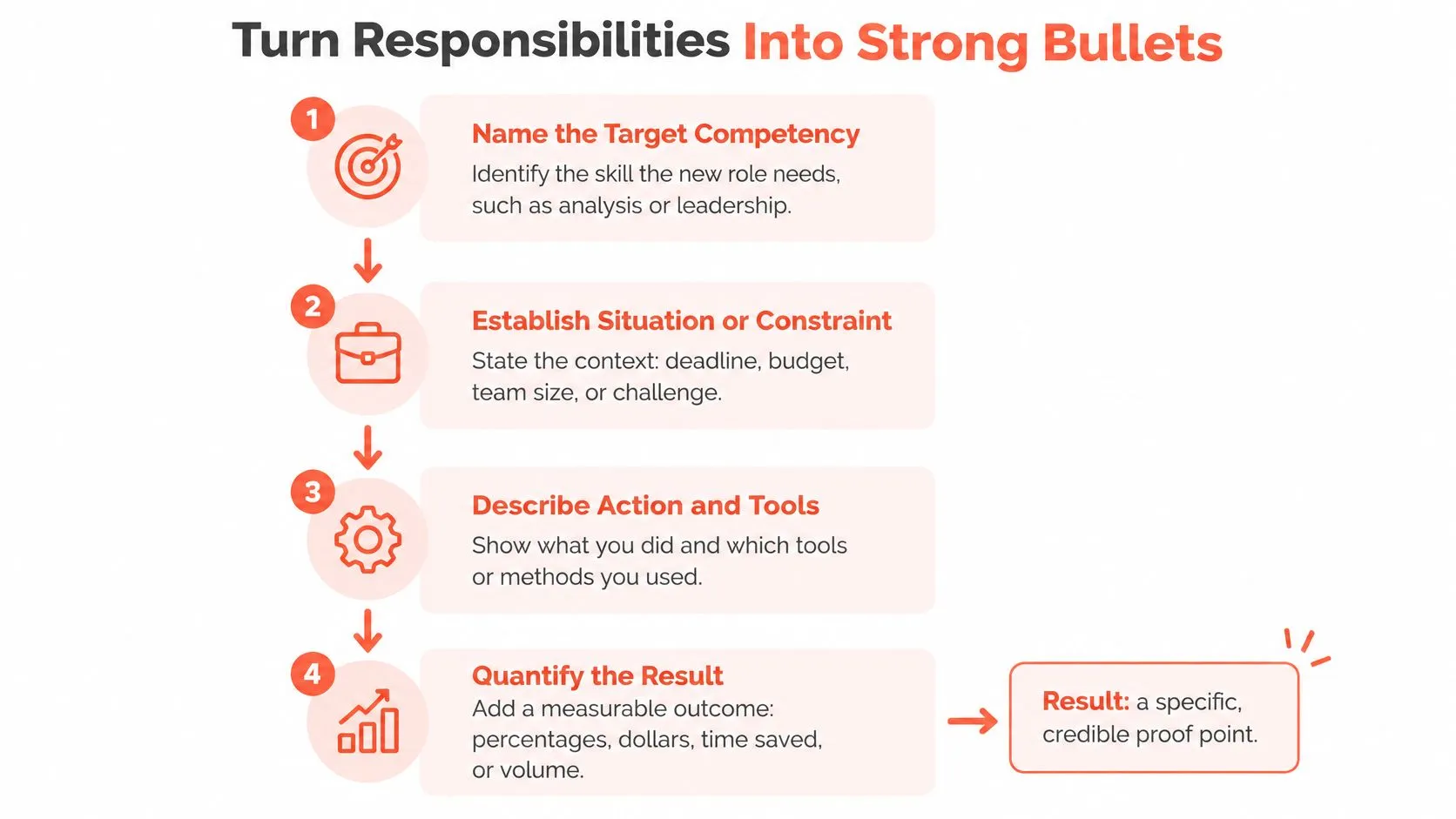
A responsibility tells the reader what sat on your desk. An accomplishment shows what you changed. Use this evidence chain to bridge the two:
- Name the target competency. Use the employer's wording when it accurately describes your experience.
- Set the context. Explain the challenge, audience, constraint, or scope.
- Show your action. Name what you did and the method or tools you used.
- State the result. Give a defensible outcome. Use a figure only if you can verify it.
Now apply the chain to real responsibilities. These examples show the structure; replace their general outcomes with the facts you can support.
- Project management: “Tracked project tasks” becomes “Coordinated handoffs across contributors, flagged schedule risks, and kept work moving toward the agreed deadline.”
- Stakeholder communication: “Answered client questions” becomes “Translated client requests into clear internal requirements, confirmed decisions, and kept delivery teams aligned.”
- Process improvement: “Updated the team's process” becomes “Mapped a recurring handoff problem, revised the workflow, and documented the steps so colleagues could follow them consistently.”
- Analysis: “Prepared reports” becomes “Reviewed operational data, identified patterns in incoming requests, and summarized findings to help the team set priorities.”
- Leadership: “Helped colleagues” becomes “Coordinated colleagues through a change in priorities, clarified ownership, and kept shared work on track.”
These bullets show method and contribution. Add a measurable result when you can verify it. If you can't, add honest scope instead, such as the teams involved, the volume handled, the deadline, or how widely a new process was adopted. Never patch a missing outcome with an invented percentage.
For more practice turning duties into evidence, use this guide to write achievements in a resume. Then scan each bullet once. The problem, your contribution, the transferable mechanism, and the result should be easy to find.
Adapt Your Proof for Every Reader
The evidence chain stays the same. The proof source and the context change. Nearly two-thirds of surveyed employers used skills-based hiring in 2025, with practices focused on screening and interviewing as well as other stages of hiring, according to NACE's report on skills-based hiring. Your resume should make your skills easy to recognize without pretending that every experience means the same thing.
Students and recent graduates should label the setting clearly. A course project isn't a professional role, but it can still show relevant analysis, coordination, or communication.
- Example: “Course project, business research: Compared customer feedback themes, summarized findings, and presented recommendations to a class team.”
That wording makes the source clear and shows what the student did. Add a result only if there's one worth stating, such as a recommendation adopted by the group.
Career changers should preserve their seniority while translating industry language. Don't disguise years of responsibility as entry-level experience. Explain the mechanism beneath the jargon, such as resource planning, process mapping, risk assessment, or stakeholder alignment.
- Example: “Reworked a production handoff to clarify ownership and reduce repeat follow-ups across teams.”
The hiring manager may not know your old operating model. They can still understand the coordination problem and the way you addressed it.
Veterans should keep enough service context to make the evidence credible. Explain the mission or operational constraint in plain language, then translate your contribution into terms the target employer can follow. Keep relevant rank and scope where they clarify responsibility; don't make the reader decode military abbreviations.
- Example: “Coordinated personnel and equipment during changing operational priorities, maintaining clear handoffs across the unit.”
The calibration rule is simple: prove potential early, preserve scope mid-career, and give veteran experience precise context. Tailor language to the role without overstating equivalence. This guide to tailoring a resume to a job description can help you choose which evidence belongs in the foreground.
Create a Sample Resume and Summary
A short sample makes the difference between a skills list and a coherent resume easier to see. Start by selecting the evidence that fits the role. Then carry the same language into the summary, experience bullets, and skills section.
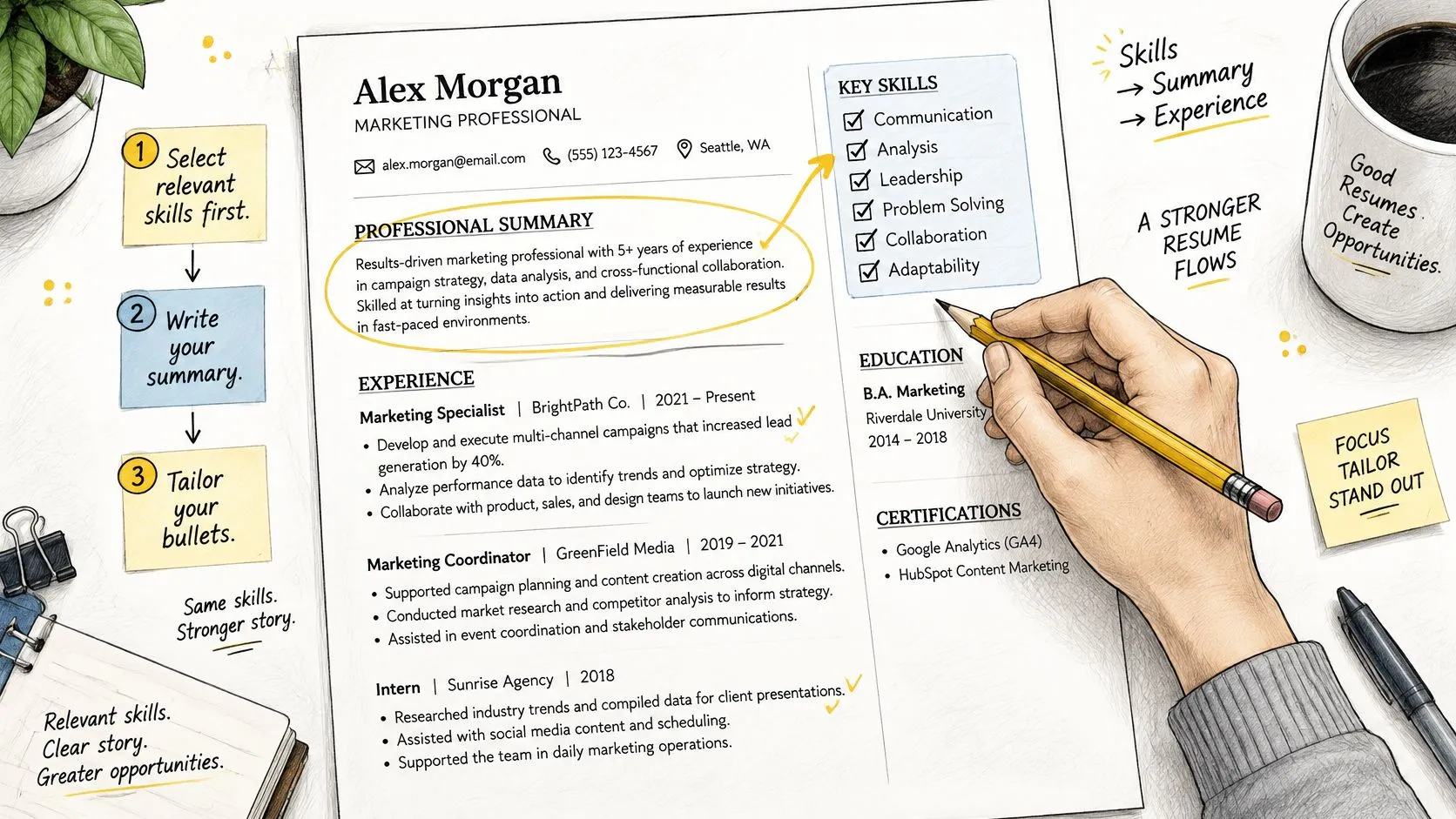
A concise sample structure
Professional Summary
Operations professional experienced in coordinating cross-functional work, clarifying handoffs, and improving team processes. Brings a practical approach to prioritization, stakeholder communication, and problem-solving.
Relevant Skills
Process improvement · Stakeholder communication · Project coordination · Data analysis
Experience
Operations Coordinator
- Before: Responsible for coordinating workflow.
- After: Mapped team handoffs, clarified ownership, and documented a consistent workflow for colleagues.
Career changer, before and after
- Before: Managed restaurant shifts and handled customer issues.
- After: Coordinated service teams during changing demand, prioritized customer issues, and aligned staff around immediate operating needs.
Student, before and after
- Before: Worked on a group assignment.
- After: Researched a course topic, organized findings with project teammates, and presented recommendations.
Veteran, before and after
- Before: Supervised unit operations.
- After: Coordinated personnel and resources through changing operational requirements, using clear briefings and handoffs to maintain team alignment.
These are models, not claims to copy as if they describe your own history. Replace each line with your setting, actions, and verifiable results. Keep specialized terms only when they establish useful credibility, and explain the underlying work in language a hiring manager can apply.
Prioritize skills based on the actual role. A job-posting analysis of transferable skills reported communication in 25.3% of postings, collaboration in 16.1%, and project management in 12.0%. Those figures show that popular skills aren't equally prominent in every posting. Follow the vacancy, not a universal checklist.
Every major skill you list should be demonstrated somewhere else on the page.
Format for ATS and Human Review
Make the resume easy to parse and easy to read. A 2025 analysis reported that 98.4% of the Fortune 500 companies studied used an ATS, while 76.4% of surveyed recruiters searched or ranked candidates by skills from the job description, according to Jobscan's ATS analysis. Use the employer's exact skill term when it accurately describes your experience, then support it with an accomplishment bullet.
Keep the structure conventional. Use standard headings such as “Experience,” “Education,” and “Skills.” Use consistent dates, a clear hierarchy, and bullets that still make sense if the document is read as plain text. Don't hide relevant experience under clever section names or bury it in a block of keywords.
A quick quality-control pass
- Scan the top third. Make sure your summary and first experience bullets point toward the target role.
- Compare terms with the vacancy. Add relevant wording only when your evidence supports it.
- Check every skill claim. Find the bullet or experience that proves it. Remove claims with no proof.
- Fix readability problems. Replace acronym-heavy bullets, unclear headings, and inconsistent tenses with direct language.
- Check seniority and outcomes. Don't inflate your title or hide the scale of your contribution. If a bullet has no outcome, add a verifiable result or clarify the scope.
A resume should remain understandable without color, columns, or decorative graphics. Formatting can organize evidence. It can't supply evidence that isn't there.
Run a Final Proof Audit
Check each major skill against its proof. Does a relevant bullet show what you did? Can a hiring manager identify your contribution and the result? Does the language fit the target role without disguising your experience level?
Cut unsupported keywords. Restore missing context instead of polishing a vague claim. If you can't name the situation, action, or outcome, the bullet still needs work.
The difficult part is often remembering what happened around a responsibility: who needed you, what went wrong, what you changed, and how the work turned out. StoryCV is an online resume writer that asks about your real work and turns your answers into resume-ready bullet points. Start with one role, talk through the evidence, and use the result to make your transferable skills credible.
Tell StoryCV about a role where your work changed a process, decision, or outcome. StoryCV helps turn that context into clear resume bullets, so your transferable skills come with proof.