Most resume skills sections fail for the same reason. They read like a storage closet.
Excel. Leadership. Communication. Jira. Strategic thinking. Team player.
That isn’t a pitch. It’s a pile.
A strong resume skills section should do one job well. It should tell a recruiter what kind of professional you are, what you’re equipped to do, and why the rest of your resume is worth reading. If it only exists to feed keywords into an ATS, you’ve already aimed too low.
The bot is not the buyer. The hiring manager is.
Your Skills Section Is Probably Broken
Often, the skills section is treated like admin work. Add a few tools. Sprinkle in some soft skills. Hope the system likes it.
That advice is outdated.
By 2025, 81% of employers had adopted skills-based hiring, up from 56% in 2022, which means employers are screening harder for demonstrated capability, not just credentials, according to Fuze HR’s overview of resume trends in a tech-driven job market. If your skills section is generic, you’re not neutral. You’re forgettable.
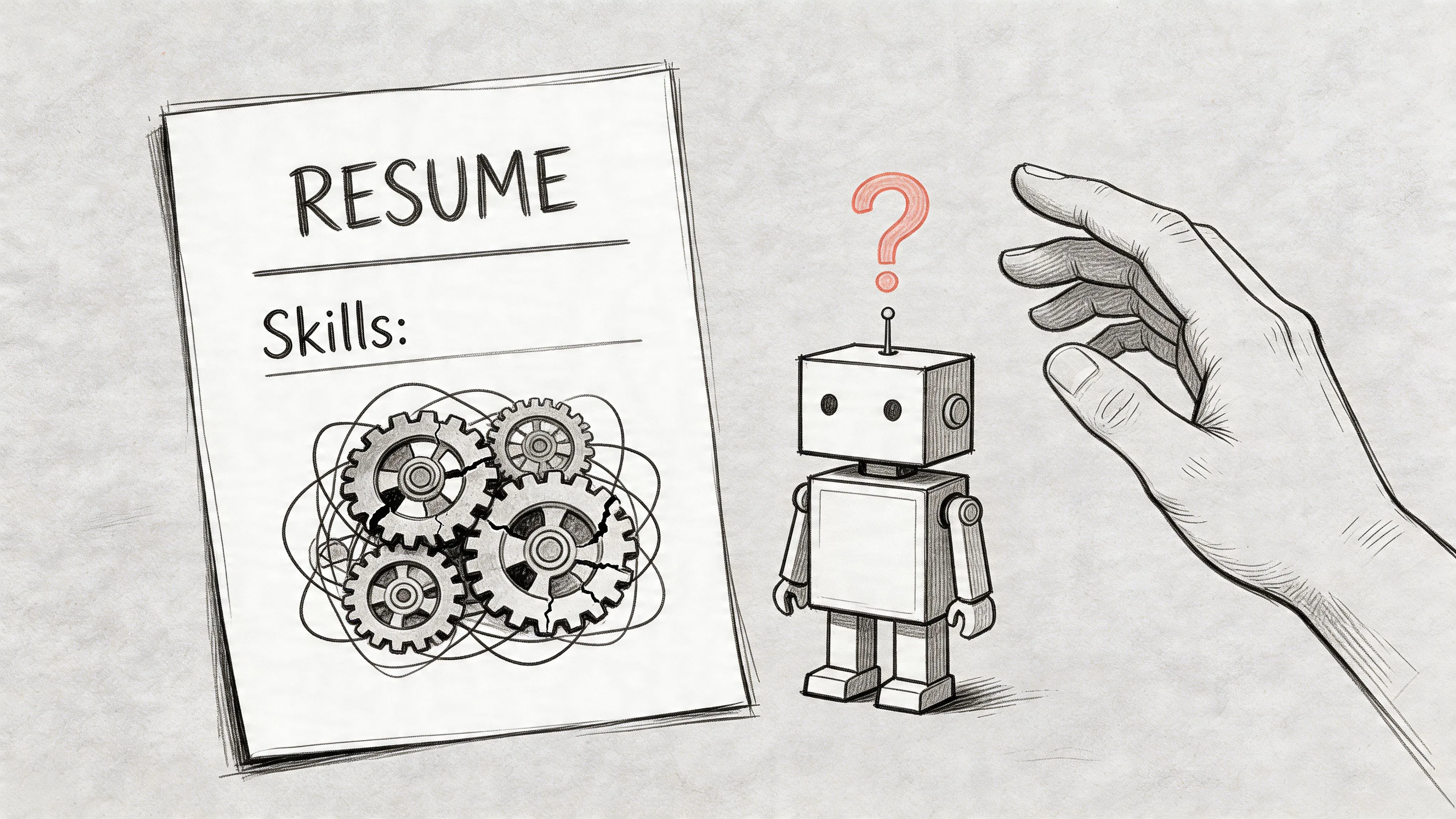
What broken looks like
A broken skills section usually has one or more of these problems:
- It’s too broad. You list everything you’ve touched, not what matters for the role.
- It’s too vague. Terms like “hardworking” and “team player” say nothing.
- It’s disconnected. The skills don’t show up anywhere in your work experience.
- It’s written for software only. It chases keywords and forgets clarity.
None of that gets interviews consistently.
Recruiters read fast. They make snap judgments. A sloppy skills section tells them you either don’t understand the role or you don’t know how to present your own value. Neither helps.
Your skills section should read like the summary of your professional edge, not the index of your past jobs.
What it should do instead
A good resume skills section acts like a thesis statement for the rest of the document. It answers three questions immediately:
| Question | What your skills section should signal |
|---|---|
| What lane are you in | Your function and level |
| What problems can you solve | Your practical capability |
| What kind of environment fits you | Your working style and operating range |
If you’re a product marketer, your skills should signal positioning, go-to-market execution, stakeholder alignment, and analysis. If you’re an operations manager, they should point to process improvement, cross-functional coordination, systems fluency, and execution discipline.
That’s the shift. Stop thinking “What can I list?” Start asking “What story does this set of skills tell about me?”
Stop Listing Skills and Start Curating Them
A long skills list does not make you look qualified. It makes you look unfocused.
The skills section works best when it behaves like a shortlist of your strongest selling points. Recruiters are not trying to admire your range. They are trying to answer one question fast. Does this person fit the role I need to fill?
That is why curation beats volume.
Use three buckets
Group your skills so the recruiter can scan them and understand your value in seconds. Three buckets usually do the job well:
-
Core skills
These are the capabilities you want to be known for. They define your lane and your level. Examples include stakeholder management, lifecycle marketing, financial modeling, vendor management, and user research. -
Technical skills
These are the tools, systems, and methods you can use on the job. Examples include SQL, Tableau, Salesforce, NetSuite, Python, and Kubernetes. -
Emerging skills
These signal relevance and direction. Include them only if they matter for the target role and you can prove them in your experience.
This structure does more than improve readability. It turns a random list into a clear professional profile.
Curate for the role you want
Your resume is not a record of everything you have ever done. It is a case for one specific hiring decision.
So build your skills section around the job you want next. If you are shifting from general marketing into product marketing, your list should center on messaging, competitive analysis, go-to-market planning, customer insight, and cross-functional launches. Do not waste prime space on event coordination just because it sat in your last title for years.
Cut good skills that support the wrong story.
That is the discipline strong candidates use. They do not ask, “What have I done?” They ask, “What should this employer remember about me?”
Show judgment, not inventory
A curated skills section signals seniority because it shows selection. It tells the reader you understand what matters, what is current, and what belongs together.
Include broad skills only when you sharpen them. “Communication” is flat. “Cross-functional communication” or “executive stakeholder communication” carries weight because it has context. The same rule applies across the board. Specific skills create a sharper narrative, and a sharper narrative gets interviews.
The Hard vs Soft Skills Balancing Act
The old advice says don’t list soft skills. That advice breaks down the second you look at how hiring works.
Employers screen for them. Recruiters look for them. Hiring managers care about them. Yet candidates are told to pretend they don’t belong in the resume skills section. That contradiction is the problem.
According to Resume Worded’s guidance on the skills section paradox, conventional resume advice creates a soft skills paradox by telling job seekers not to list them even as hiring managers increasingly screen for them. The issue isn’t the presence of soft skills. It’s the lazy way people write them.
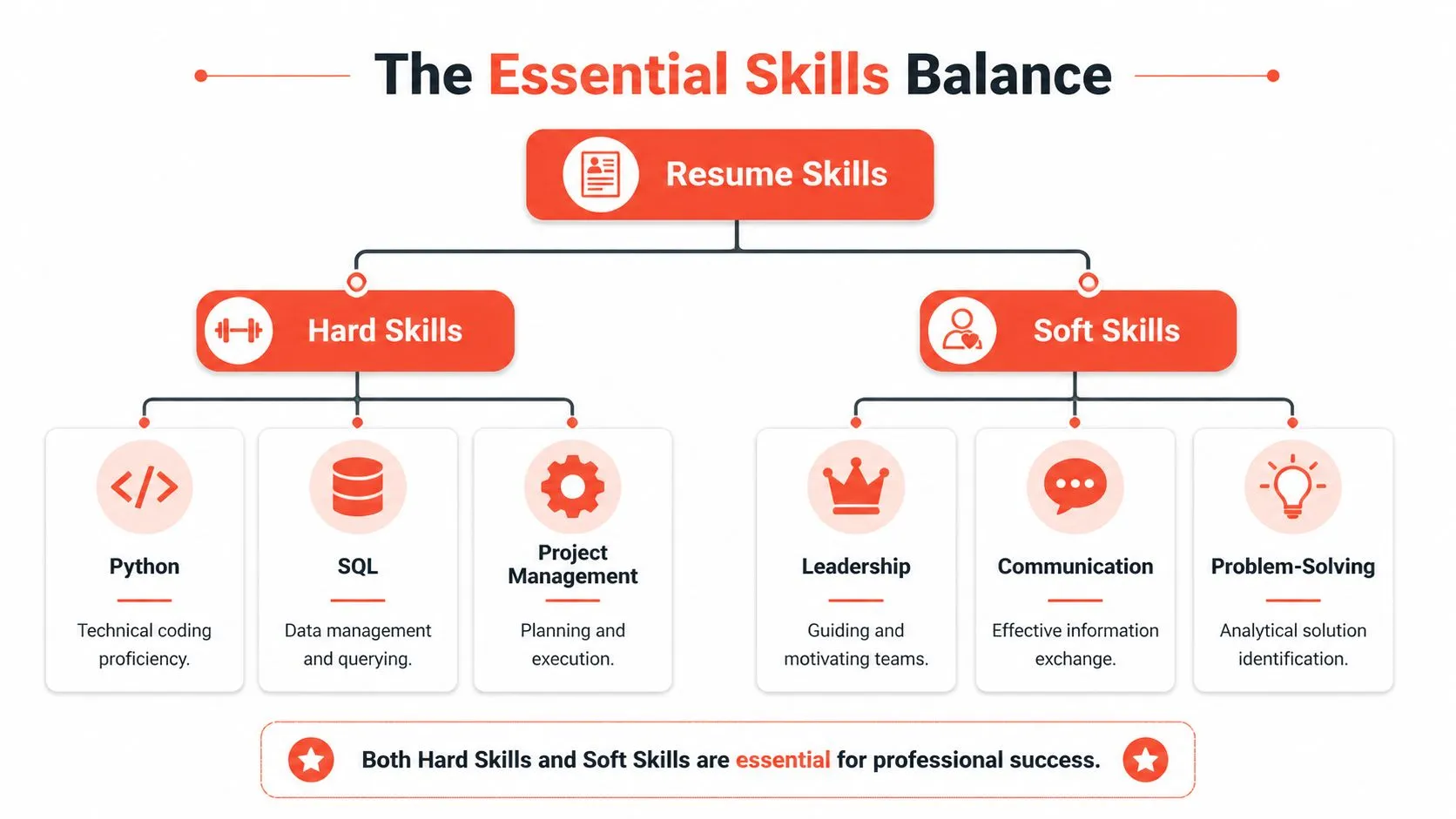
Generic soft skills are weak
These are weak:
- Strong communicator
- Team player
- Leadership
- Problem solver
Not because they’re false. Because they’re unshaped.
These are better:
- Cross-functional communication
- Team leadership in change environments
- Client-facing stakeholder management
- Analytical problem-solving
The second set gives context. Context makes a skill believable.
If you want a fuller breakdown of how to think about this split, StoryCV has a useful guide on soft skills vs hard skills.
Pick only the soft skills that change outcomes
You do not need a separate category full of personality words. You need a few soft skills that strengthen your hard skills.
Here’s a simple filter:
-
Pick the soft skills the role requires
A senior analyst may need stakeholder communication more than public speaking. An engineering manager may need coaching more than negotiation. -
Choose skills that appear in your work, not just your self-image
If you can’t point to a project, conflict, launch, turnaround, or decision where the skill mattered, leave it out. -
Use wording that sounds like work
“Adaptability” is generic. “Operating in ambiguous environments” sounds real.
Soft skills belong on your resume when they explain how you produce results, not when they read like a character reference.
Think in pairings
The strongest resumes pair one hard skill with one soft skill underneath the surface.
| Hard skill | Soft skill that amplifies it |
|---|---|
| SQL | Analytical problem-solving |
| Project management | Cross-functional coordination |
| Financial planning | Executive communication |
| Product analytics | Decision-making under ambiguity |
That’s how hiring managers read resumes anyway. Your job is to make the connection obvious.
Formatting Your Skills for Robots and Humans
Format is not decoration. Format is access.
If your skills are trapped inside a table, sidebar, graphic, or cute template, you’ve made your resume harder to parse and harder to scan. That’s self-sabotage.
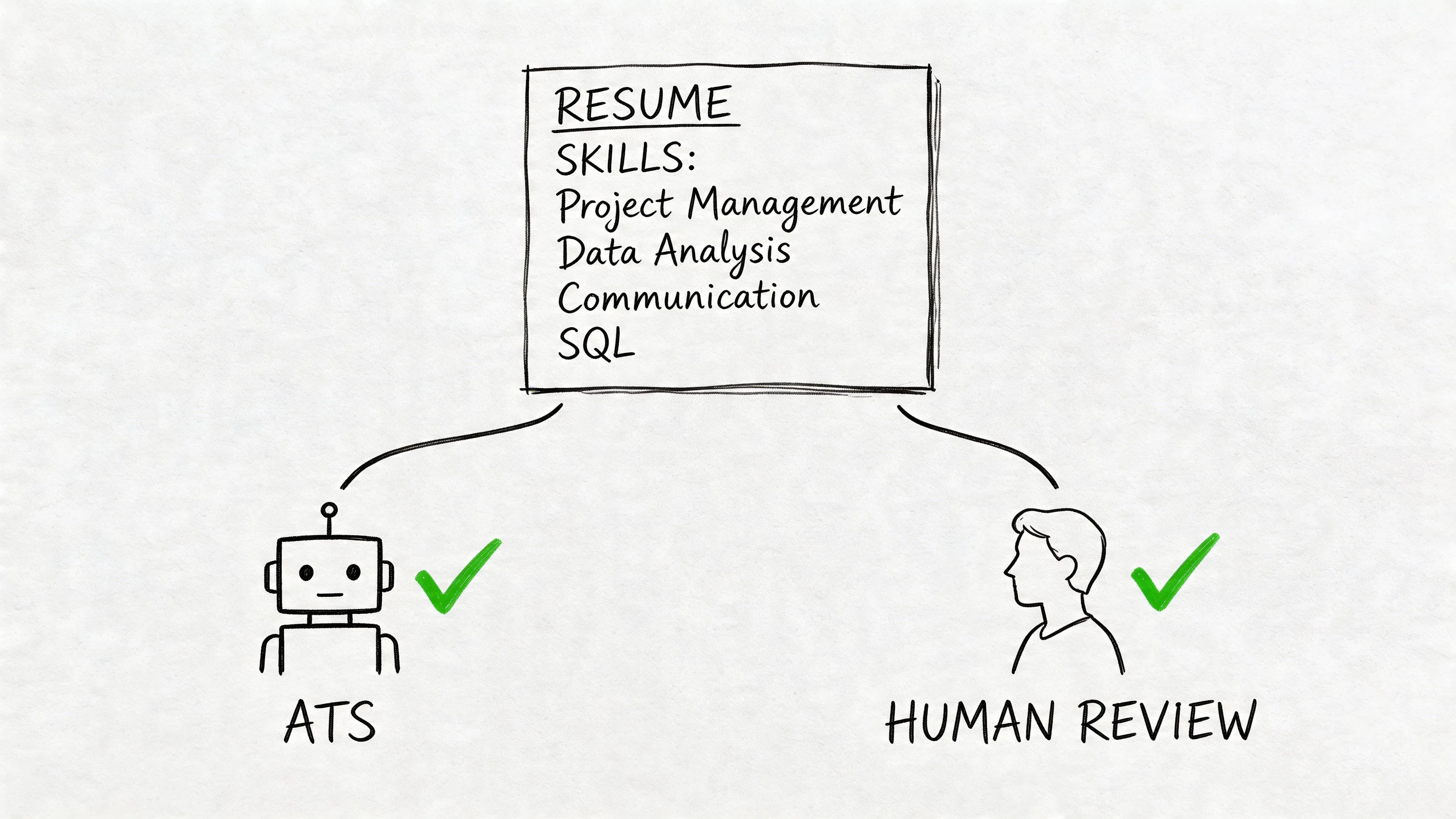
According to SGS Consulting’s guide to building an ATS-optimized resume, resumes using standard headers like “Skills” and simple, bulleted lists in a single column have a 75% higher pass-through rate in ATS, while complex formats like tables or graphics cause up to 65% of parsing failures.
That’s not a formatting preference. That’s a filtering problem.
The no-nonsense layout
Use this structure:
-
Header
Call it Skills. Not “My Toolkit.” Not “Core Competencies.” Not “What I Bring.” -
Single column
Keep it linear. Left to right. Top to bottom. -
Tight grouping
Group related skills in a way a human can read in seconds.
A clean example:
| Category | Example |
|---|---|
| Technical | SQL, Python, Tableau, Excel |
| Business | Forecasting, pricing analysis, stakeholder alignment |
| Operational | Process improvement, vendor management, workflow design |
That’s enough structure to help a recruiter. Not enough structure to confuse a parser.
Write for matching and reading
Use the language from the job description when it’s accurate. If the posting says “Agile methodology” and you’ve worked that way, use that phrasing. If it says “customer success” and your resume says only “account support,” you may be creating unnecessary distance.
For stronger bullets that support those skills, this guide to ATS resume bullet points is worth reading.
Here’s a practical benchmark for the section itself:
- Use standard terms recruiters recognize
- Keep categories simple
- Avoid icons, charts, logos, and design tricks
- Don’t rate yourself with bars or stars
- Don’t stuff keywords without proof elsewhere
A quick explainer helps if you’ve been fighting templates for too long:
Formatting rule: If your resume looks more designed than readable, simplify it.
The best resume skills section doesn’t try to impress through layout. It removes friction so the substance can win.
Weaving Skills into Your Work Experience
A skills section without proof is just a claim.
Recruiters notice the gap fast. If you list “stakeholder management,” “process optimization,” and “data analysis,” but your bullets only describe responsibilities, your resume feels inflated. Sharp readers won’t say that out loud. They’ll just move on.
Use the claim and proof model
Think of your resume in two layers.
Your skills section makes the claim.
Your work experience proves it.
That means every important skill in your list should echo somewhere in your bullets, your project descriptions, or your summary. Not mechanically. Naturally.
Here’s the difference.
| Weak | Strong |
|---|---|
| Managed projects | Led cross-functional projects across product, sales, and operations |
| Used SQL | Used SQL to analyze customer behavior and surface retention risks |
| Good communicator | Presented roadmap updates and tradeoffs to leadership and partner teams |
The stronger versions still name the skill, but they also show where it lived.
Rewrite bullets so skills do real work
If a skill matters enough to list, it matters enough to demonstrate.
Try this formula:
- Name the work
- Show the skill in action
- Add the outcome if you have it
Examples:
-
Agile project management
Led a cross-functional sprint cadence across engineering and design to ship roadmap priorities on schedule. -
Customer communication
Handled escalated client issues, translated technical constraints into plain language, and maintained trust during rollout changes. -
Process improvement
Redesigned intake and handoff workflows to reduce bottlenecks between sales and operations.
Notice what’s happening. The bullet doesn’t say “I have this skill.” It shows the skill doing something useful.
Your skills list should feel inevitable once someone reads your experience. Nothing on it should come as a surprise.
One mention of tools that help
If you struggle to translate your real work into this kind of language, use something that asks better questions instead of forcing you into a blank template. StoryCV is a digital resume writer that uses a guided interview to turn experience into achievement-driven drafts. That’s useful when your problem isn’t lack of experience. It’s lack of articulation.
The standard to aim for is simple. Every core skill you claim should have a trail of evidence.
Skills Section Examples for Different Roles
Examples matter because bad advice often sounds good in theory.
Below are compact before-and-after versions that show what a strategic resume skills section looks like. These aren’t templates. They’re positioning choices.
If you want more ideas for choosing the right mix, this guide on what skills to put on a resume is a useful companion.
Career changer moving into product management
Before
- Communication
- Leadership
- Marketing
- Research
- Strategy
- Teamwork
After
- Core User research, go-to-market strategy, stakeholder alignment, roadmap communication
- Technical Excel, SQL, Figma, analytics platforms
- Transferable Cross-functional campaign planning, customer insight synthesis, launch coordination
Why it works: it reframes prior marketing experience around product-adjacent value. It doesn’t pretend the person has done everything. It highlights overlap.
Mid-level software engineer aiming for stronger positioning
Before
- Python
- AWS
- SQL
- Docker
- Problem-solving
- Communication
- Coding
After
- Backend Python, Django, REST APIs, PostgreSQL
- Cloud and DevOps AWS, Docker, Kubernetes, CI/CD workflows
- Engineering strengths System design, debugging, cross-functional collaboration
Why it works: grouped skills signal maturity. “Coding” disappears because it says nothing. The structure also makes room for both technical depth and team effectiveness.
Operations manager targeting senior roles
Before
- Operations
- Management
- Excel
- Leadership
- Process improvement
- Communication
After
- Operations Process optimization, workflow design, SOP development, vendor management
- Analytics Excel, reporting, KPI tracking, forecast support
- Leadership Team supervision, cross-functional coordination, change communication
Why it works: it translates a broad operations background into clear business value. The leadership terms are specific enough to feel earned.
Recent graduate with projects and internships
Before
- Hardworking
- Fast learner
- Microsoft Office
- Web development
- Data analysis
After
- Development React, Node.js, HTML, CSS
- Analysis Python, Pandas, Excel, data visualization
- Project skills Documentation, presentation, team collaboration
Why it works: it cuts empty traits and replaces them with evidence-friendly skills tied to projects.
A quick test for your own section
Ask these three questions:
- Does this list make my target role obvious
- Can I prove each skill elsewhere on the page
- Does this sound like a focused professional, not a generalist by accident
If the answer is no, edit harder.
Your Skills Section Is Your Strategic Pitch
Your resume skills section is not an inventory. It’s your shortest strategic argument.
Done badly, it looks like filler. Done well, it tells a recruiter exactly where to place you, what problems you can handle, and why your experience deserves attention. That’s why the right approach is curation, not accumulation. Precision, not performance.
Use the section to define your lane. Back it up in your bullets. Format it so machines can parse it and humans can trust it.
Your resume also doesn’t exist alone. Once your narrative is clear, the same positioning should show up across the rest of your professional presence. If you’re also working on optimizing your LinkedIn profile to attract recruiters, keep the language aligned so your story feels consistent wherever someone finds you.
A good skills section makes the rest of the resume easier to believe. That's its primary purpose.
If you’ve done strong work but can’t get it onto the page clearly, StoryCV helps turn your experience into a sharp, ATS-friendly narrative without the usual template sludge.