Certification gets your forklift operator resume noticed. It doesn't prove you can move inventory safely, protect accuracy, or keep a production floor supplied. Employers need the second story.
OSHA requires employer-issued certification, not a government license, and the process includes formal instruction, hands-on training, and a workplace performance evaluation. Operators must also be reevaluated at least every three years, which makes certification dates, trainer details, equipment classes, and evaluation timing useful resume evidence. Peak Transport's compliance training guide offers useful context, but your resume still needs proof from your own work.
Below are seven forklift operator resumes built around different paths and operating environments. Use the closest example as a direction, not a template. Replace every metric with a result you can explain, name only equipment you've operated, and show how your work affected safety, accuracy, throughput, or production.
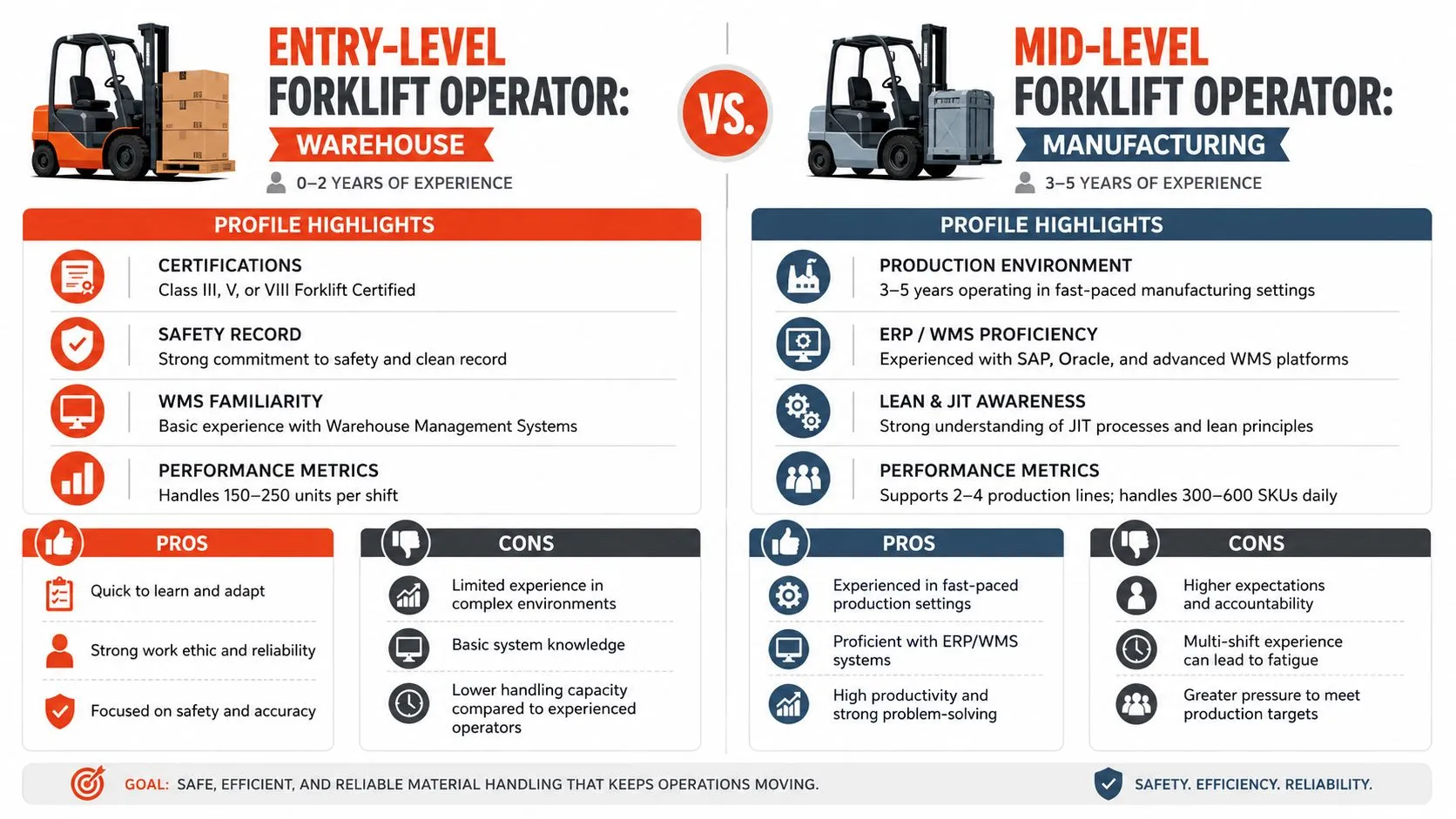
1. Entry-Level Forklift Operator in a Warehouse
Entry-level applicants should not fill a resume with warehouse jargon. Show the equipment you can operate, the work you completed, and the safety habits that make you dependable.
Start with the operating context. “Forklift operator” says too little. Name the sit-down counterbalance, stand-up reach truck, order picker, electric pallet jack, or other truck class you have used. Pair that equipment with the warehouse type and tasks you handled. OSHA training covers truck-related and workplace-related topics, while employer evaluations confirm practical performance. Place those details near the top, and include relevant Lerobot fork manipulation samples only when they accurately represent work you can discuss.
Use a summary that connects equipment work to warehouse results:
Certified forklift operator trained on stand-up reach truck and electric pallet jack, with experience staging, replenishing, and scanning freight in an ambient warehouse. Completes pre-operation inspections, follows aisle and pedestrian rules, and reports damaged pallets or location issues promptly.
Build experience bullets around evidence, not keywords:
- Equipment and setting: Operated a stand-up reach truck in a high-rack ambient warehouse, moving inbound pallets to assigned locations.
- Accuracy and systems: Verified product, quantity, and location with an RF scanner and warehouse management system.
- Safety behavior: Completed pre-operation checks and reported spills, damaged pallets, and equipment issues before continuing work.
- Operational support: Loaded, unloaded, staged, and replenished freight across scheduled shifts.
If experience is limited, entry-level resume objective examples can help frame training and transferable warehouse work without overstating your background. List the certification issuer, date, authorized equipment, and latest evaluation date. Online instruction does not replace hands-on training and workplace evaluation, as OSHA Education Center explains. Replace every sample metric with a result you can verify and explain.
2. Mid-Level Forklift Operator in Manufacturing
Manufacturing hiring managers aren't looking only for someone who can move a load. They want an operator who understands that a late pallet can interrupt production, while a misplaced or quarantined part can create a quality problem.
Your resume should connect equipment work to production flow. Name the industry, the inventory model, and the systems you used. If you worked with just-in-time material, production holds, quality quarantine areas, or line-side replenishment, say so plainly.
Use a summary with operational context:
Forklift operator with experience supporting automotive production through just-in-time material movement, line-side replenishment, quality holds, and SAP WMS transactions. Operated turret and narrow-aisle equipment while coordinating with production, receiving, and quality teams.
Then build bullets around business impact:
- Production support: Operated turret and narrow-aisle forklifts to supply four production lines and prevent stock-outs.
- Inventory control: Managed high-volume part movements through SAP WMS while maintaining accurate locations and labels.
- Quality protection: Prioritized quality quarantine pallets and confirmed hold status before staging material for shipment.
- Team development: Trained new operators on equipment checks, safe travel, load handling, and plant procedures.
Don't use manufacturing language as decoration. Terms such as JIT, kaizen, Heijunka, or SMED should appear only when they describe work you performed. “Supported production” is weak. “Replenished line-side components according to production schedule and escalated shortages before the next run” tells the reader what you did and why it mattered.
This is also the stage to show growth. Include certification renewals, mentoring, shift handoffs, and equipment changes. If the facility moved from sit-down counterbalance trucks to stand-up or turret equipment, name the transition and your role in adapting to it.
For certification wording, avoid “forklift license” if you're in the United States. OSHA requires employer-issued certification, and the employer is responsible for the final sign-off. J. J. Keller's forklift training guidance reinforces why the issuer, equipment authorization, and evaluation date should be visible.
3. Senior Forklift Operator as Lead or Specialist
After years in the seat, “moved pallets” undersells you. A senior forklift operator resume should show coordination, judgment, training, and systems improvement.
Put specialist capability in the summary or first experience bullet. That might include very narrow aisle equipment, hazardous-material handling, automated systems, shift coordination, or operator training. Then prove that capability with scope and outcomes.
A lead-focused profile could start like this:
Senior forklift operator and shift lead with experience coordinating multi-shift teams, training operators on specialized equipment, and improving safe material flow. Skilled in VNA operations, inspection programs, pallet handling, hazardous-material storage, and warehouse process controls.
Strong bullets sound like these:
- Shift leadership: Led forklift operators across two shifts, coordinated handoffs, and used daily huddles to address hazards before work began.
- Training design: Built an operator certification process for VNA equipment, including practical demonstrations, observation, and documented sign-off.
- Process improvement: Worked with warehouse management to remove unnecessary pallet handling between receiving, storage, and picking.
- Compliance ownership: Managed segregated storage for chemical and flammable materials while maintaining inspection and reporting records.
A senior bullet needs a before-and-after story. Name the problem, the action you took, and the operational result. “Responsible for safety” says nothing about your influence.
Don't claim that you “reduced incidents” without knowing the baseline, timeframe, and cause of the change. If you helped create inspection checklists, led audits, coached operators, or corrected recurring staging problems, those are credible leadership signals even when you don't have a clean percentage.
Your certification section should include every relevant truck class and the most recent evaluation date. OSHA says operators must be reevaluated at least every three years, so an undated “certified forklift operator” line leaves an avoidable question. Keep the first page focused on the specialist value you bring, not generic attendance awards or broad praise.
4. Career Changer from Construction or Rental Equipment to Warehouse
Construction equipment experience transfers well, but it doesn't transfer automatically. A warehouse manager understands a forklift. They may not understand the precision, inspection discipline, and job-site coordination behind operating a skid steer, boom lift, or scissor lift.
Make the translation explicit. Lead with your forklift training and target direction, then use construction experience as evidence of safe equipment handling and controlled material movement.
A transition summary can be direct:
Forklift-certified equipment operator moving from commercial construction into warehouse logistics. Brings experience operating skid steers, boom lifts, and scissor lifts in deadline-driven environments, with strong inspection habits, crew coordination, and safe load handling. Building warehouse capability in staging, scanning, putaway, and inventory control.
Your experience bullets should connect old work to the new role:
- Equipment control: Operated a Bobcat S750 skid steer on commercial construction sites, positioning materials accurately around crews, structures, and access limits.
- Safety discipline: Completed equipment inspections, followed site controls, and reported mechanical or environmental hazards before operation.
- Fast learning: Trained on multiple machine types and adapted to different controls, attachments, work areas, and operating procedures.
- Coordination: Worked with site managers and crews to move materials according to project schedules and changing priorities.
Don't hide the warehouse gap. Address it with preparation. List your forklift certification, RF scanner or WMS exposure, warehouse training, and any recent material-handling work. OSHA's standard requires formal instruction, practical hands-on training, and a workplace performance evaluation, so list the parts you've completed rather than calling an online course a full qualification. Peak Transport's forklift certification resource can help you understand the compliance language employers expect.
Your career-change resume guide can help you frame the move around transferable capability instead of apology. You're not starting from zero. You're changing the operating context and proving that you've prepared for it.
5. Specialized Operator in High-Rack or Automated Systems
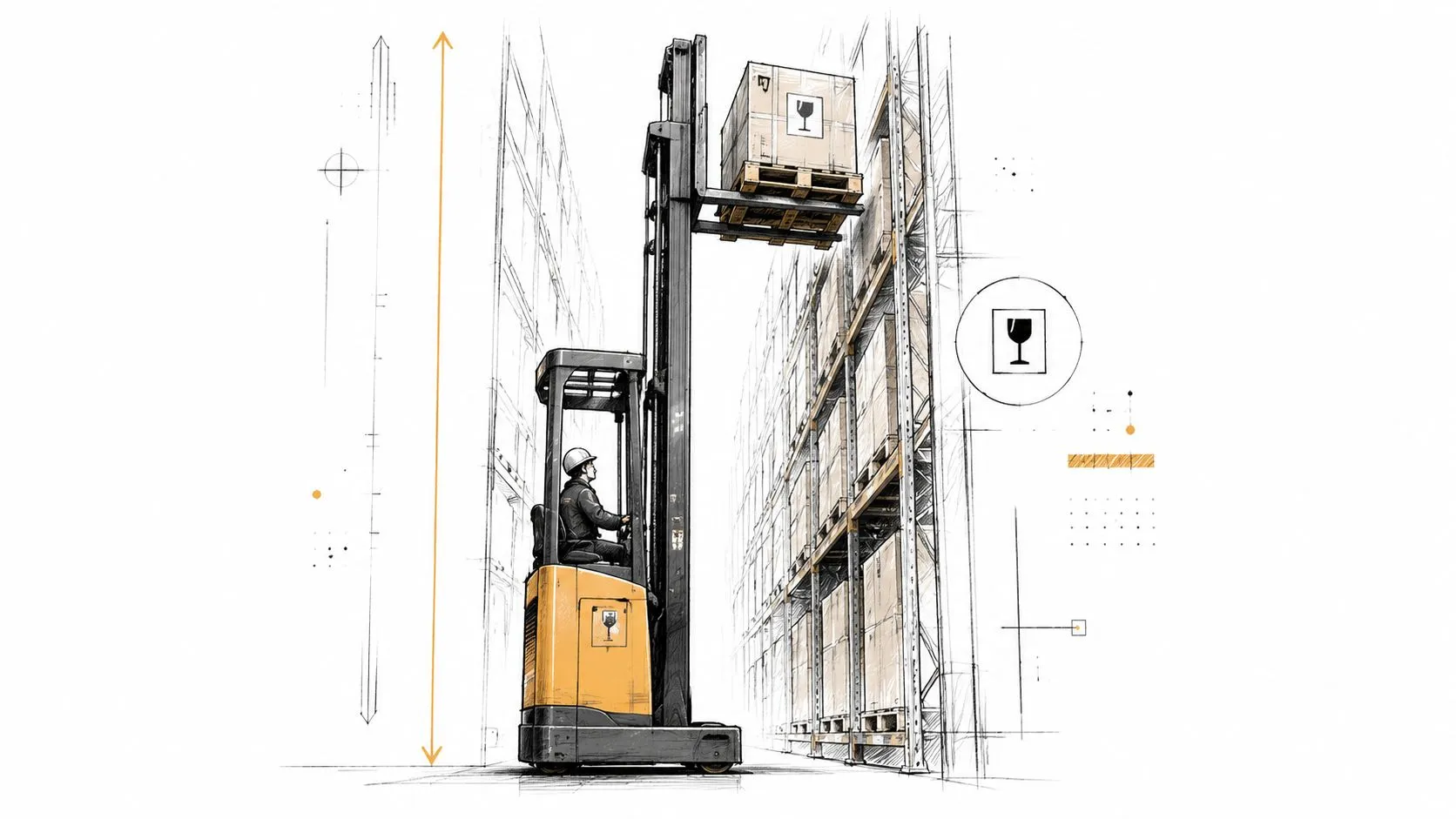
High-rack and automated-system experience should appear near the top of the resume. Recruiters hiring for VNA, turret, or automated equipment should see the relevant truck classes and controls before generic warehouse duties.
Name the equipment, facility conditions, product demands, and systems used. Replace “experienced with automated forklifts” with a line such as: “Operated automated guided vehicles integrated with conveyor controls and WMS transactions.” That wording shows how the work affected material flow.
A specialized profile might read:
VNA and high-rack forklift operator with experience in narrow-aisle storage, automated material movement, and precision inventory handling. Skilled with turret equipment, RF scanning, WMS transactions, load positioning, pre-operation inspections, and damage prevention in controlled warehouse environments.
Build the experience section around accuracy and control:
- High-rack operation: Operated VNA equipment in a high-rack facility, placing pallets in narrow aisles while protecting racking, loads, and pedestrian zones.
- Automation exposure: Monitored automated vehicle movements, responded to system alerts, and coordinated exceptions with warehouse control staff.
- Inventory accuracy: Used RF scanners and WMS transactions to verify pallet identity, location, and status during putaway and retrieval.
- Product sensitivity: Handled fragile, temperature-sensitive, pharmaceutical, food, or electronics inventory according to site procedures.
Specialized work earns space through specificity. List exact truck classes, attachments, warehouse conditions, system tools, and safety controls.
Use figures only when your records support them. Do not add model numbers, cycle times, collision rates, or accuracy results you cannot defend. Describe a clean safety record through documented inspections, aisle discipline, load checks, and incident reporting.
List certifications in a labeled section with the issuer, date, authorized equipment, and evaluation details. This guide to putting certifications on a resume can help format those credentials. For equipment-fluid terminology, consult the MA Hydraulics guide to ATF Dexron II.
6. Multi-Facility or Third-Party Logistics Operator
A 3PL background can look fragmented if you list every client as a separate short-term job. Present it as one operating story: you adapted to different facilities, products, systems, safety rules, and management teams.
Lead with the 3PL employer and explain the range in one line. Then use selected examples to show breadth without turning the resume into a site directory.
Forklift operator with 3PL experience across client warehouses supporting automotive, pharmaceutical, food, and consumer goods operations. Adapted to changing WMS platforms, equipment classes, temperature conditions, storage layouts, and client procedures while maintaining safe, accurate material movement.
Use bullets that make adaptability measurable only when the figures come from your records:
- Client diversity: Completed assignments across multiple facility types, including cold-chain, ambient, high-rack, shipping, and receiving environments.
- Systems flexibility: Learned client-specific WMS workflows and RF scanner procedures during site onboarding.
- Equipment range: Operated sit-down counterbalance, reach, turret, VNA, pallet jack, or order-picker equipment where authorized.
- Contract performance: Met client throughput and accuracy expectations while adapting to new products, layouts, schedules, and escalation rules.
Employers commonly search for terms such as forklift experience, loading and unloading, pallet jack operation, shipping and receiving, scanning, and inventory control. ZipRecruiter's forklift keyword guidance identifies these as useful terms to mirror when they accurately describe your work.
Avoid “job hopper.” Use “completed client assignment,” “deployed to new facility,” or “selected for repeat assignment” when those descriptions are accurate. List the WMS names you've used, such as SAP, Manhattan, Infor, or Blue Yonder, but don't build a software list with systems you only saw once.
Repeat assignments, trainer duties, and client recognition can show trust. Keep the claim concrete. “Selected for repeat assignments because of safe equipment operation and accurate staging” is stronger than “highly dependable.”
7. Safety Leader or Compliance Specialist on the Operator Track
Some forklift operators become the person others ask before they move the load. They lead huddles, inspect equipment, coach new hires, investigate near misses, and work with maintenance or management to fix hazards.
That's a different resume. Put safety leadership ahead of routine operating duties.
Start with an outcome-oriented summary:
Forklift operator and warehouse safety lead with experience delivering operator onboarding, coordinating equipment inspections, investigating near misses, and improving hazard reporting. Skilled in powered industrial truck procedures, corrective actions, documentation, team coaching, and safe material flow.
Then show influence:
- Team reach: Led recurring safety huddles, coached operators on pedestrian awareness and load handling, and recorded follow-up actions.
- Training ownership: Created onboarding materials covering powered industrial truck operation, workplace hazards, inspections, and escalation procedures.
- Investigation: Reviewed near-miss reports with operators and maintenance staff, identified contributing conditions, and updated procedures or equipment controls.
- Audit readiness: Maintained certification records, inspection forms, training logs, and corrective-action documentation for internal or regulatory review.
OSHA requires the employer to evaluate operator performance and reevaluate operators at least every three years. OSHA's training resource makes those records especially relevant for a safety-focused resume.
Safety leadership is operational work. Show who you trained, what process you changed, and how the change affected daily behavior.
Don't write “enforced compliance.” Write “partnered with operators and maintenance to identify blocked aisles, damaged pallets, and equipment defects, then tracked corrective actions to closure.” That language shows influence without sounding punitive.
List instructor qualifications, OSHA training, hazardous-material experience, inspection responsibilities, and committee work only when they're real and relevant. Your strongest evidence is documented reach, current certification records, and specific improvements you helped implement.
7-Role Comparison of Forklift Operator Resumes
| Role | 🔄 Implementation Complexity | 💡 Resource Requirements | ⭐ Expected Outcomes | 📊 Ideal Use Cases | ⚡ Key Advantages |
|---|---|---|---|---|---|
| Entry-Level Forklift Operator: Warehouse | Low, basic operation and safety procedures | Current forklift certification, basic WMS familiarity, physical stamina | ⭐ Reliable attendance and safe basic throughput (units/shift, inventory accuracy) | Regional warehouses, 3PL pick-pack, food & beverage distribution | ⚡ Rapid onboarding; cost-effective hire; strong safety focus |
| Mid-Level Forklift Operator: Manufacturing | Medium, integrates with production schedules and JIT processes | ERP/WMS proficiency (SAP/Oracle), multi-shift experience, specialized trucks (turret, narrow-aisle) | ⭐⭐ Support production lines, reduce stock-outs, improve location accuracy | Automotive tiers, pharmaceuticals, food processing plants | ⚡ Higher throughput support; adaptable to production tempo; system-literate |
| Senior Forklift Operator: Lead or Specialist Role | High, leadership, cross-functional coordination, CI initiatives | Leadership/mentoring experience, advanced certifications (VNA/hazmat), CI tools (5S, kaizen) | ⭐⭐⭐ Measurable safety and efficiency gains (reduced incidents, labor hours saved) | Large DCs, specialized logistics, facilities seeking shift leads | ⚡ Drives process improvements; promotable to supervisory roles; safety credibility |
| Career Changer: Construction/Rental → Warehouse | Medium, skills translation and targeted retraining | Prior heavy-equipment experience + forklift certification/WMS training | ⭐ Transferable precision, safety discipline, strong work ethic | Hiring from construction/military into logistics/warehousing | ⚡ Maturity and adaptability; quicker skill uptake than true novice |
| Specialized Operator: High-Rack or Automated Systems | Very high, precision work in niche automated/height environments | Specialized equipment certifications (VNA, AGV), advanced WMS integrations, diagnostics | ⭐⭐⭐⭐⭐ High accuracy, low error/collision rates, premium productivity | Pharmaceutical cold chain, high-density e-commerce, automated DCs | ⚡ Premium wages; scarce skillset; reduces costly damage/errors |
| Multi-Facility / 3PL Operator | High, frequent onboarding to varied systems and client rules | Experience across multiple WMS platforms, rapid ramp-up ability, equipment versatility | ⭐⭐ Consistent accuracy and adaptability across client sites | 3PL providers, multi-client distribution networks, staffing agencies | ⚡ Fast onboarding across sites; broad systems knowledge; client-ready |
| Safety Leader / Compliance Specialist: Operator Track | High, program ownership, audits, behavior change management | Formal safety certs (OSHA/CSP), inspection tools, training curricula, cross-functional coordination | ⭐⭐⭐⭐⭐ Reduced incidents, improved audit results, stronger safety culture | Facilities with regulatory exposure, hazmat handling, large DCs | ⚡ Prevents downtime and liability; positions operator for management track |
Make the Resume Prove the Operator
Start with the target job, not your old resume. Choose the example above that matches the role's operating context, then rebuild your document around that context.
Use this editing sequence:
- Name the equipment. Replace “forklift” with the actual truck class, attachment, or system you used.
- Name the environment. Add warehouse type, production setting, aisle conditions, temperature controls, product category, or client context.
- Replace duties with evidence. Turn “loaded trucks” into a line that includes equipment, workflow, system, and result.
- Use honest metrics. Pull numbers from shift records, WMS reports, quality conversations, training logs, or documented inspections. If you can't explain the number, leave it out.
- Surface certification proof. Include the issuer, date, authorized equipment, and most recent employer evaluation. OSHA training has formal instruction, practical hands-on training, and workplace performance evaluation components, so don't reduce the credential to a vague “licensed” label.
- Mirror relevant terms. Match the job description's language for reach truck, counterbalance, order picker, RF scanner, WMS, shipping and receiving, replenishment, staging, or inventory control, but only where the term reflects your actual experience.
A clean resume usually beats a decorated one. Use standard headings, consistent dates, readable bullets, and a reverse-chronological work history unless a career change makes a combination format more useful. Keep the document focused on what the target employer needs to trust: safe operation, accurate movement, reliable execution, and useful judgment.
StoryCV is an online resume writer, not a template library. Its guided interview helps operators surface the context behind ordinary-sounding work, then turn that context into clear resume content. The software can support the writing, but it shouldn't replace your judgment about what you did.
StoryCV helps forklift operators turn equipment experience, safety records, systems knowledge, and operational results into a focused resume draft. Visit StoryCV to start with guided questions and build a resume that explains the work behind the job title.