Replacing your military title with a civilian title isn't enough. A supply specialist who controlled property, trained staff, and coordinated deliveries needs more than a new label.
A military skills translator for resume writing should help you identify relevant work, recover the evidence, and explain it without military shorthand. The standard isn't whether the bullet sounds impressive. It's whether someone who never served can understand what you did.
Map Your Military Code to Civilian Job Families
You're not necessarily under-qualified. You may be under-translated. One job title is the wrong unit of translation because your occupational code doesn't capture every responsibility you carried.
The U.S. Department of Labor's 2014 pilot study compared a crosswalk connecting 68 military occupations to 100 civilian occupations, an average of 1.5 options each, with an enhanced crosswalk reaching 962 civilian occupations, averaging 14 each. That's a reason to explore several job families, not permission to claim every suggested occupation.
Start by selecting two or three families to test. Compare their actual work with yours before choosing a title.
Example military codes and the civilian job families to test
These are starting hypotheses, not confirmed qualifications. Confirm every match in O*NET's Military Crosswalk before writing a bullet, then inspect the occupation's tasks, skills, and knowledge requirements.
| Code | Military role | Civilian job families to test | Evidence to pull |
|---|---|---|---|
| 11B | Army infantryman | Team leadership, operations supervision, security | Team size, training cycles, safety record |
| 92Y | Army unit supply specialist | Inventory control, supply chain, procurement | Dollar value of property managed, audit results |
| 68W | Army combat medic specialist | Healthcare support, patient care, emergency response | Patients treated, certifications held |
| 3D0X2 | Air Force cyber systems operations | Network operations, systems administration, cybersecurity | Systems maintained, outage response times |
| HM | Navy hospital corpsman | Clinical support, healthcare operations, medical training | Patients seen, training delivered |
A supply background might support inventory control directly while supporting procurement through related skills. Those aren't identical claims. Ordering supplies doesn't automatically establish contract negotiation experience, just as military medical training doesn't establish a civilian license.
Practical rule: Treat the code as a menu of possibilities. Your actual duties determine what you can order.
Use StoryCV's guide to transferable skills for career changers to separate a capability from the setting where you developed it. If you're also planning a midcareer move in Australia, TP Training's practical career change roadmap Australia provides a separate planning resource beyond the resume.
Choose the family before polishing the wording. An operations resume should foreground scheduling, resources, and delivery. A technical resume should foreground systems, troubleshooting, and reliability. The family sets the vocabulary, while the evidence keeps that vocabulary honest.
Gather the Facts Your Translator Needs
Start with the record, not memory. Pull evaluations, training records, qualification documents, award narratives, and work records you're authorized to use.
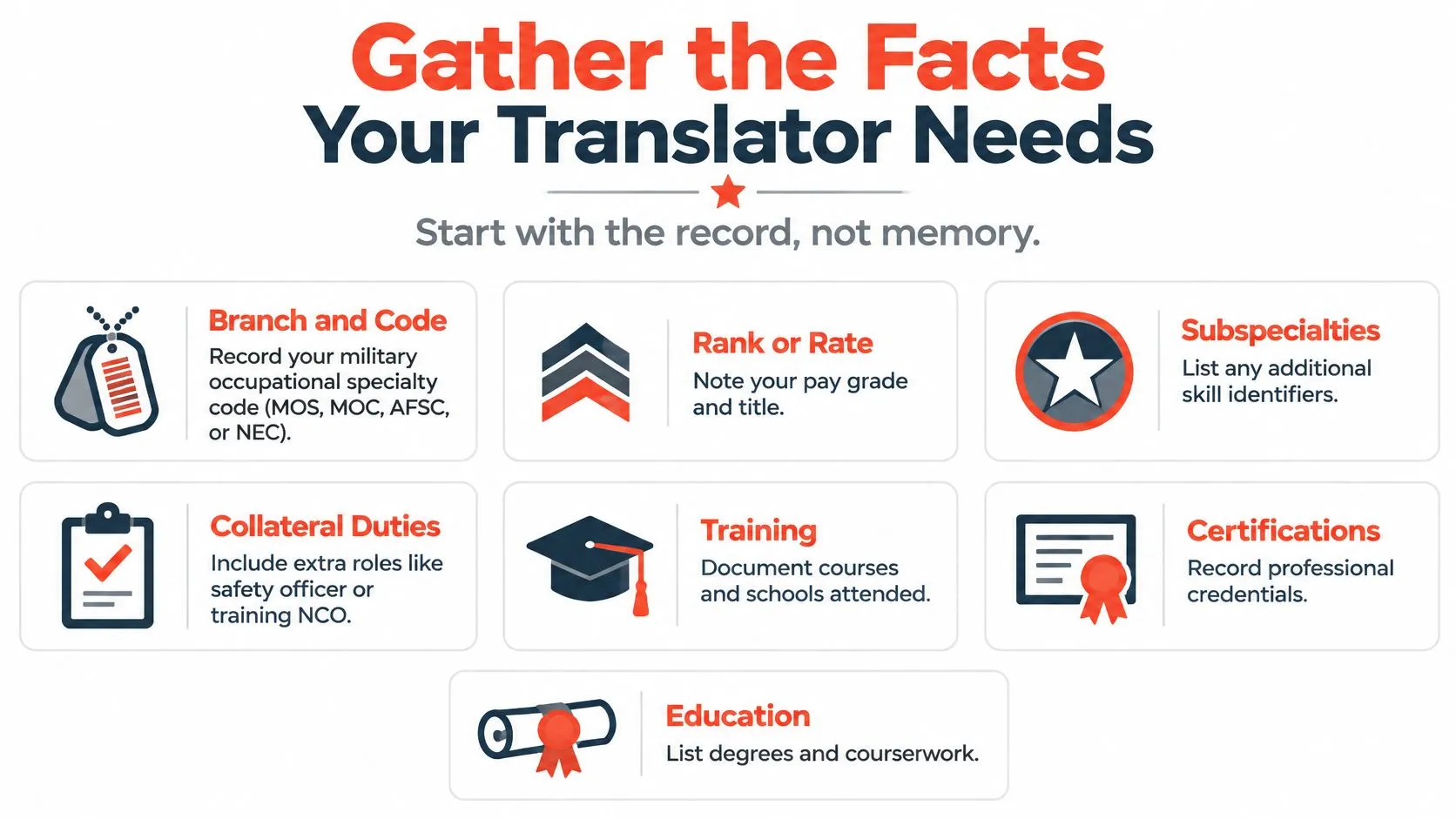
Build an intake checklist before asking a tool to rewrite anything:
- Branch and code: Record your military occupational specialty (MOS), military occupational classification (MOC), Air Force Specialty Code (AFSC), or Navy Enlisted Classification (NEC).
- Rank or rate: Include your title, pay grade, and dates in the role.
- Subspecialties: List additional skill identifiers and specialist assignments.
- Collateral duties: Capture safety, training, inspection, and other responsibilities outside your primary job.
- Training: Identify courses and schools relevant to your target work.
- Certifications: Record credentials, their status, and expiration dates where applicable.
- Education: Include degrees and relevant coursework.
The former VA for Vets Career Center's translator documentation describes accepting an occupation code alongside rank or rate, subspecialties, collateral duties, training, and education. That's the right intake model: the code establishes a starting point, but the surrounding facts establish scope.
Ask questions that recover evidence
Answer these in complete, plain sentences. Fragments such as equipment accountability or training oversight leave the important work unexplained.
- People: How many people did you lead, train, or supervise at the peak?
- Resources: What equipment, budget, or inventory were you responsible for, and what was it worth?
- Coverage: Where did the work happen, across how many sites or time zones?
- Change: What broke, recovered, or improved while you ran it?
- Consequences: What would have gone wrong without your intervention?
Keep a working note beside each answer identifying where you found it. That makes later verification easier and exposes numbers you're remembering rather than confirming.
For senior candidates, distinguish leading teams from leading other leaders. Record whether you assigned work directly, supervised supervisors, or owned an entire program. Likewise, distinguish a budget you could allocate from spending you only tracked.
Those differences matter more than a broad claim of senior leadership. They tell an employer what decisions you were trusted to make.
At StoryCV, we ask targeted questions about your industry, role, and accomplishments to understand your experience and rewrite the resume. You can also use these resume questions to ask yourself to prepare your account of the work.
If you can't answer a question yet, leave it blank rather than guessing. Missing evidence is a follow-up task, not an invitation to invent a plausible figure.
How to Replace Jargon With Plain Language
Expanding an acronym doesn't automatically make a sentence clear. A civilian reviewer may understand every word and still have no idea what responsibility you held.
VA careers guidance recommends explaining responsibilities, work scope, and results, tailoring the content to the announcement, and spelling out unfamiliar military acronyms. Use that as the foundation for a deliberate editing process.
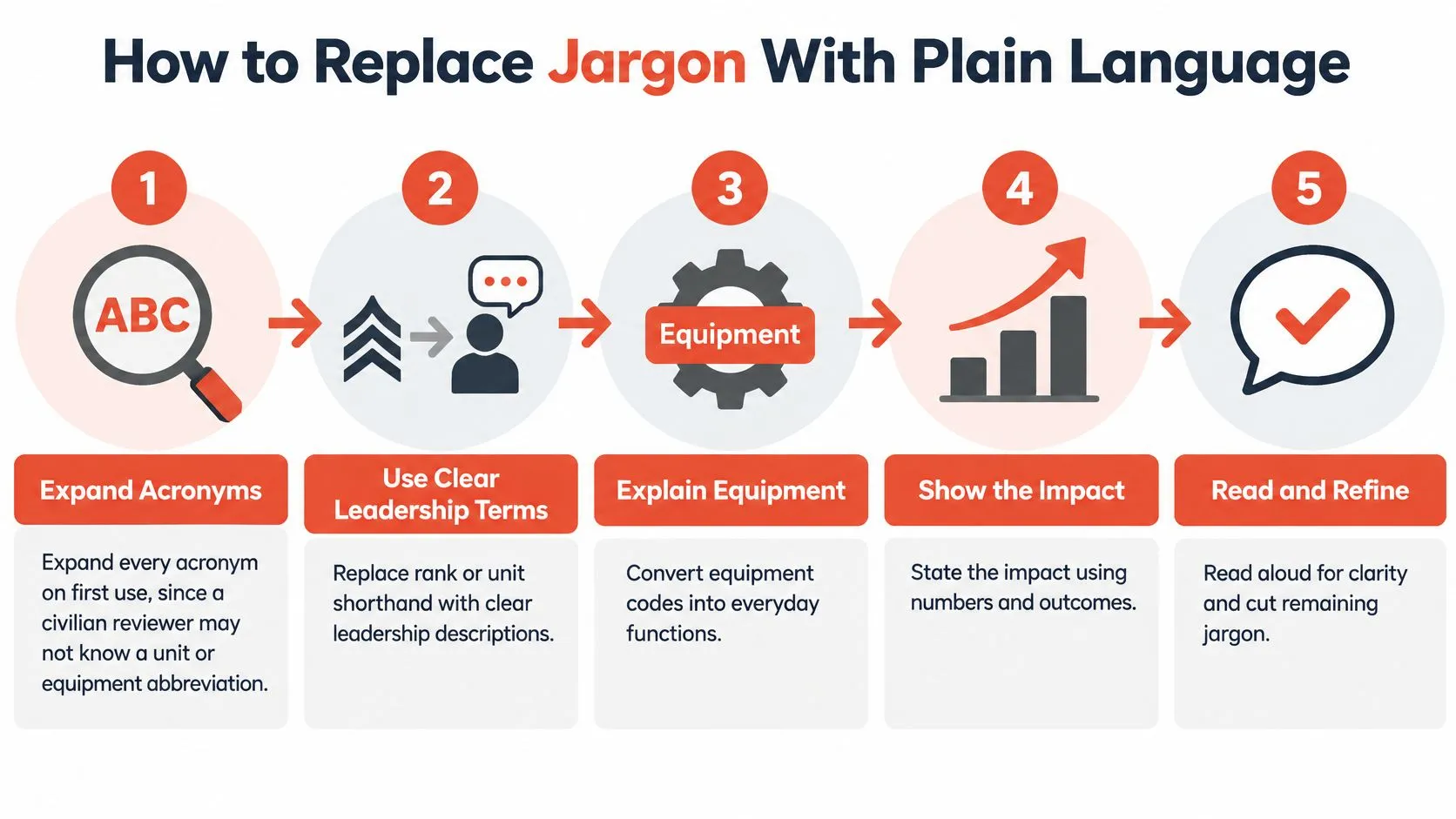
Run the wording through five passes
- Expand every acronym on first use. If the expanded phrase still needs explanation, describe its function instead. An internal organization name rarely deserves space unless the employer needs it.
- Replace rank or unit shorthand with a role description. Say whether you supervised people, scheduled equipment, coordinated maintenance, or approved work. Keep your official title in the employment record, but explain the work beneath it.
- Quantify the scale. Add verified team size, equipment value, coverage, throughput, availability, safety, cost, or time. Choose a measure that helps the reader understand responsibility.
- Connect the task to a civilian competency. Show scheduling through the schedules you managed, or incident response through the failures you resolved. Don't bolt a list of skill labels onto an otherwise vague bullet.
- Remove sensitive and irrelevant details. Exclude operationally sensitive information and details that don't help establish your fit. Don't paste restricted records into a public writing tool.
Consider this illustrative scenario, with invented figures that you must replace with your own.
Before → After: Ran the motor pool → Coordinated dispatch and maintenance for 22 vehicles supporting three units, sustaining 95% fleet availability.
The second pass produces the plain description: dispatched and maintained vehicles. The third adds 22 vehicles, three units, and 95% availability. The fourth clarifies the coordination responsibility rather than implying you personally performed every repair.
The final pass asks whether any identifying details should disappear. A civilian employer may need to understand fleet scale without knowing locations, deployment schedules, or equipment vulnerabilities.
Don't stretch the result while simplifying the wording. Availability isn't the same as on-time delivery. Tracking repairs isn't the same as repairing vehicles. Plain language should make your contribution more precise, not larger.
Give the finished bullet to someone who has never served and ask them to explain what you did.
Don't coach them through the answer. If they can't describe your work, its scale, and its purpose, the wording failed. Return to the role-description pass and rewrite it.
Write Bullets That Prove Each Claim
Use action, scope, constraint, result. Start with a strong verb, name what you handled, explain the difficult condition when it matters, and finish with what changed.
Aim for one strong verb, one meaningful number, and one outcome in each bullet. That's an editing target, not a reason to manufacture metrics or squeeze unrelated achievements into a sentence.
VA resume-writing guidance recommends quantifying achievements and using numerals, such as 100, rather than spelling out one hundred. Keep the military experience as evidence, but describe it in language a general employer can understand.
Before and after military draft versus translated bullet
All figures below are illustrative. Replace them with your own verified numbers and outcomes. Don't borrow the scale because the sentence sounds better.
| Vague draft | Translated bullet | What changed |
|---|---|---|
| Responsible for system improvements | Rebuilt the image deployment process for 60 workstations, cutting setup time from two days to one | Named the scope and the result |
| Collaborated across teams | Coordinated 18 staff across three sites to complete an equipment rollout before a six-week deadline | Added headcount, sites and the deadline |
| Led squad operations in the field | Supervised a nine-person team on 14 field missions with zero safety incidents | Added team size, mission count and safety result |
| Managed unit supply | Reconciled $2 million in property across four sites, achieving 100% inventory accuracy in the annual audit | Added dollar value, sites and audit accuracy |
Notice what the stronger versions don't say: excellent communicator, natural leader, or highly detail-oriented. The reader can evaluate those qualities from the work.
Leadership needs a decision, not just a headcount. If you reassigned people during a staffing shortage, explain what you protected: coverage, training completion, a deadline, or safe operation. Include that constraint when it makes your judgment visible.
Preserve evidence during the rewrite
A writing tool can improve structure while overstating responsibility. Check verbs carefully. Supported, coordinated, approved, and owned describe different levels of authority.
Give a mentor or writing tool this prompt:
Rewrite this in plain civilian English. Keep every number I give you. Do not add results I did not state. Flag any acronym you cannot explain.
Then compare the output with your original notes. Reject any claim you couldn't explain under interview questioning, including a calculated improvement whose starting point you can't verify.
StoryCV's guide to writing impact statements can help separate an activity from its consequence. That distinction matters when your first draft lists everything you touched but nothing you changed.
Don't force a percentage where a concrete outcome would be more honest. Restored service, completed an inspection, or qualified staff can establish a result when you have the supporting context.
A bullet with no number and no result is a job description, not a proof point. Find the missing evidence before adding more adjectives.
Role-Specific Phrasing for Three Career Targets
Build one resume per target job family, not one universal resume that asks employers to work out your direction. Pick two promising families and develop a separate version for each.
The VA's military-to-civilian career guidance recommends mapping military experience through ONET, examining civilian task and skill alignment, and creating series-specific resumes. The useful sequence is match the posting's verbs, keep the proof, cut the code* from achievement statements where it adds nothing.
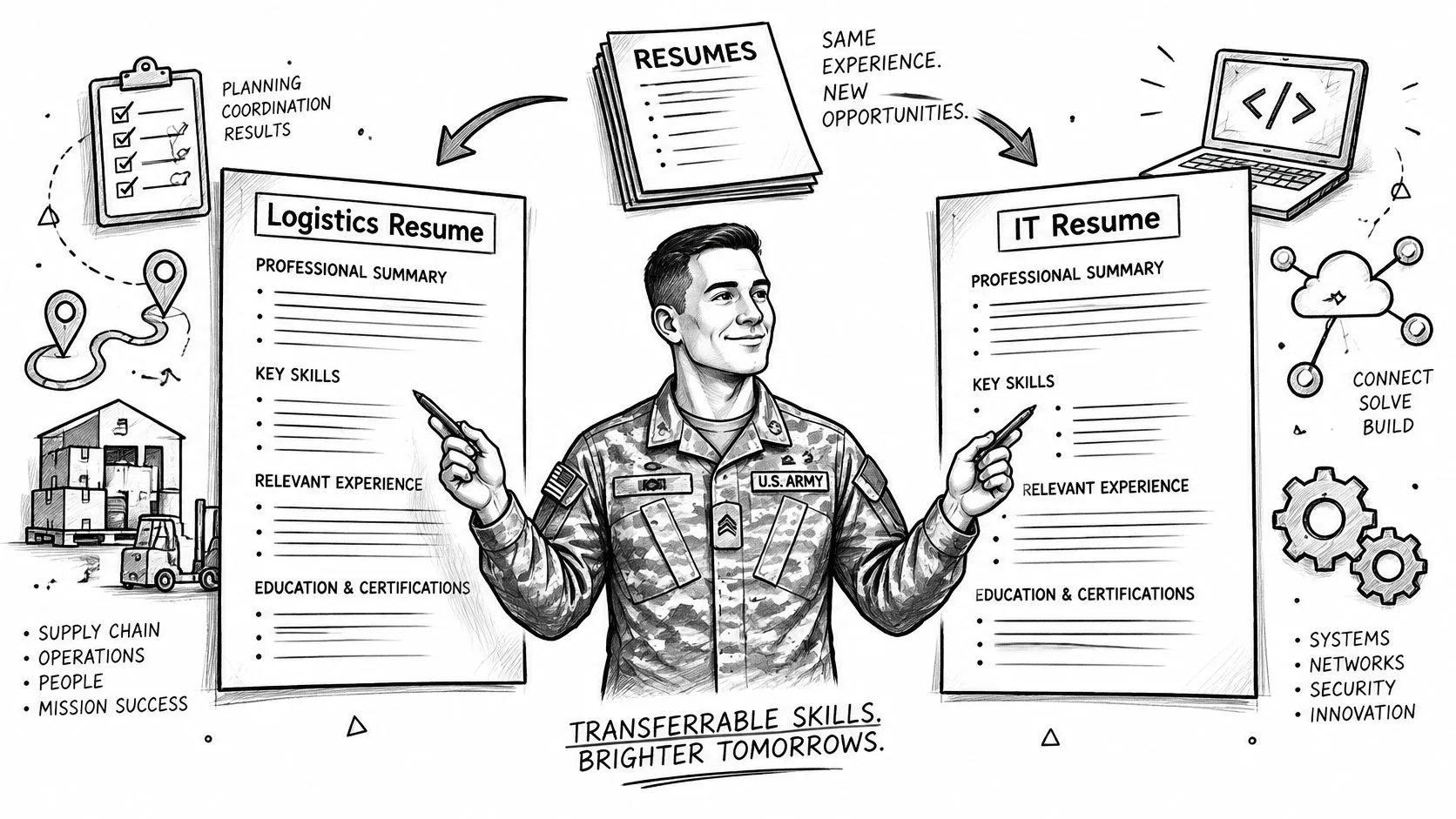
Phrasing and proof by career target
Use these phrases only when they describe work you performed.
| Career target | Phrases that land | Terms to drop | Proof to attach |
|---|---|---|---|
| IT and cybersecurity | Network administration, endpoint support, incident response, system uptime | Unit designators, equipment nomenclature | Tickets resolved per month, uptime percentage, users supported |
| Operations and logistics | Inventory control, fleet management, procurement, throughput | Rank-only titles, unit abbreviations | Dollar value managed, on-time delivery rate, audit results |
| People and project management | Hiring, onboarding, performance reviews, budget ownership | Rank titles used alone, program acronyms | Headcount led, budget size, retention or training results |
For IT and cybersecurity, distinguish maintaining infrastructure from defending it. Administering accounts and installing updates can support a systems administration application. They don't automatically establish threat investigation experience. Name relevant systems and technical credentials when the posting calls for them.
For operations and logistics, explain the movement and control of resources. Inventory accuracy, equipment scheduling, and delivery performance are different outcomes. Choose the one you influenced rather than using supply chain management as a catch-all label.
For people and project management, be especially careful with civilian authority terms. Assigning personnel isn't necessarily hiring. Tracking expenditure isn't budget ownership. Training new arrivals may support onboarding language, but only if you explain what you delivered.
Change the emphasis, not the history
The same equipment rollout could support different applications. A technical version might emphasize configuration and service continuity. A project version might emphasize dependencies, stakeholder coordination, and completion against a deadline.
The underlying facts must stay consistent. You're selecting relevant evidence, not creating separate versions of what happened.
Some transitions also require profession-specific presentation. If aviation is your target, DuBois Aviation's guidance to craft a recruiter-ready pilot resume offers a focused resource alongside the broader translation process.
Before submitting, compare the resume with the vacancy's duties and qualifications. Keep relevant technical terms; remove military language that requires insider knowledge. If a phrase only makes sense on a base, replace it with the civilian equivalent before it reaches the page.
Build and Test Your Translated Resume This Week
Finish one role before trying to rewrite your entire career. A small set of defensible bullets is more useful than a polished document full of assumptions.
- Choose a direction. Pick one past role and one civilian job family.
- Recover the facts. Answer the intake questions, then draft five bullets using action, scope, constraint, and result.
- Edit deliberately. Run every bullet through the five passes, starting with acronyms and ending with sensitive or irrelevant detail.
- Compare requirements. Test the draft against two postings in your target family. Adopt their verbs only where the meaning holds.
- Check comprehension. Read the bullets to someone who never served and ask what you did. Their answer decides whether the wording is ready.
Budget one to two hours per role as a working allowance, not a guaranteed completion time. Finding records and resolving unclear ownership may take longer than writing. The finish line is a result you can defend in an interview.
StoryCV is free to start, with two finished bullet points included. Full formatted resume export is planned; for now, copy the bullets into your own resume template.
Then move to the next role. You don't need to disguise your service. You need to make the relevant work understandable.
StoryCV interviews you about your work, asks follow-up questions, and turns your answers into clear resume bullets. Bring one military role and a target civilian job to StoryCV, and start translating the responsibilities your occupational code leaves out.