The most repeated advice about social worker cover letter samples is to open with why you care. It's wrong, and it's the reason most of these letters get skimmed in four seconds.
A panel reading forty applications is deciding one thing. Not whether you're warm. Whether you can hold a caseload here without supervision becoming the problem. A line about wanting to help people answers nothing, because everyone wrote it. A caseload of twelve answers something. So does a safety decision you made under time pressure, or a discharge that should have taken three days and took one.
So every sample below gets judged the same way. What decision does the panel make after reading this paragraph? Which proof is doing the work? Which sentence is burning a line for nothing? And what exact line can you swap into your own letter before the end of the day.
The eight cover entry-level, child welfare, hospital discharge, clinical, career changer, veteran, returner, and director roles, all in the same format so you can compare them quickly. Read the one that matches your situation twice. Skim the rest.
1. Entry-Level Social Worker Cover Letter Sample for New Grads
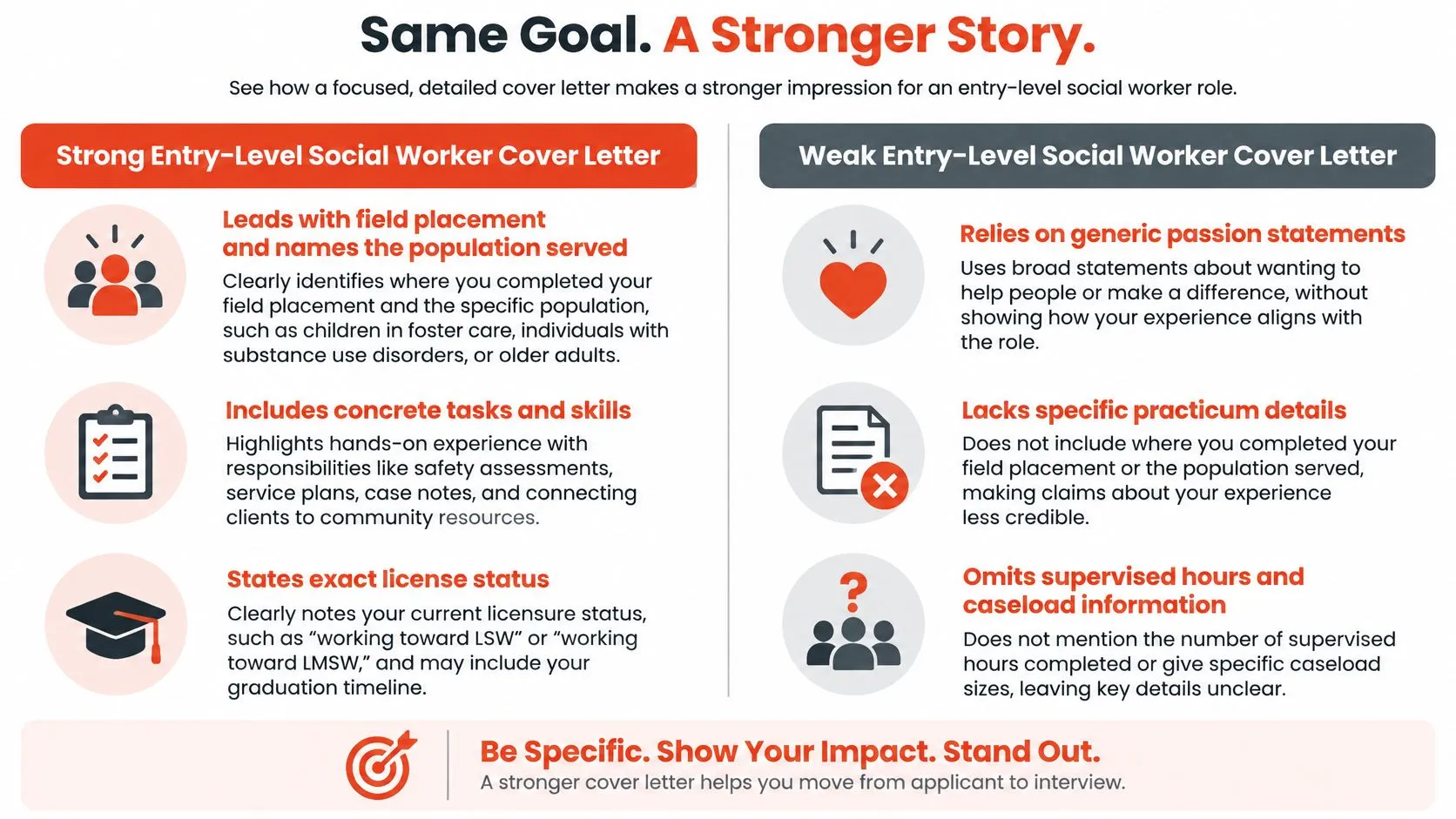
A field placement can prove readiness more clearly than a paragraph about passion. The Bureau of Labor Statistics projected 7.8% employment growth across community and social-service occupations from 2022 to 2032, but that figure does not show what you can do. Your placement details do.
During my field placement at [Agency], I carried a caseload of twelve clients in a family preservation program. I completed safety assessments, drafted service plans with families, and documented contacts in the state system within 48 hours. By my second semester, my supervisor noted that my court reports needed few revisions.
What the panel decides after this paragraph
“Ready for a caseload with weekly review.” That judgment rests on evidence, not enthusiasm.
The caseload size helps a supervisor picture the work you can take on. The documentation deadline shows you understand timeliness. The supervisor's feedback gives the panel a concrete signal about your writing.
The court-report feedback does the most work. “I love helping families” does none. Most letters contain a passion statement, and it costs a line without changing the hiring decision.
Swap in: “I documented contacts within 48 hours, and my court reports needed few revisions by my second semester.”
What to keep
- One caseload number. “Twelve clients” gives a clearer picture than “a diverse caseload.”
- One task in plain words. “Completed safety assessments” is clearer than “utilized assessment frameworks.”
- Exact license status. Write “MSW, LMSW application submitted in March” or “BSW, exam booked for April.” “License pending” leaves the panel guessing.
- One page. Keep the letter focused on the evidence that supports your readiness.
2. Child Welfare Caseworker Cover Letter Sample With Examples
Child welfare panels read for one thing past the resume. Would your documentation survive a court file, and would your decisions survive a review. That's hard to claim and easy to prove, if you know which details are allowed to leave the building.
The University of Texas cover letter writing guide names the gap most samples never solve. They tell you to show results and never explain how, when the outcomes are qualitative, shared across a multidisciplinary team, or protected by privacy rules. Its answer is a STAR structure plus privacy-safe substitutes: caseload volume, service settings, referral completion, attendance, benefits secured, crisis-response time, documentation quality. When the result wasn't yours alone, you write "contributed to."
In my three years as a child protective services investigator with [County], I completed [number] initial assessments and wrote family service plans for [number] families. I made safety decisions under time pressure and testified in dependency hearings on [number] occasions. My documentation stayed within state timelines across [number] compliance reviews.
The decision this paragraph forces
"Safe pair of hands under pressure." You get there with three moves: the decision you made, the reason behind it, and the record that shows you documented it properly.
The reasoning is the part people skip. "I removed a child from the home" describes an action. "I recommended removal because the safety threat couldn't be managed with a present caregiver, and the plan named the specific conditions for return" describes judgment. Panels hire judgment.
What wastes space: "I am a compassionate caseworker who understands the importance of child safety." Understanding is assumed. Show the call.
Practical rule: Name the population in general terms, never the case. "A family with two school-age children" is fine. A school district and a date is not.
Then use the language of the posting. If it says safety planning or permanency, those words go in your sentence about your own work. If you want a wider vocabulary for that section, this breakdown of case management skills covers what supervisors scan for.

3. Hospital Discharge Social Worker Cover Letter Sample
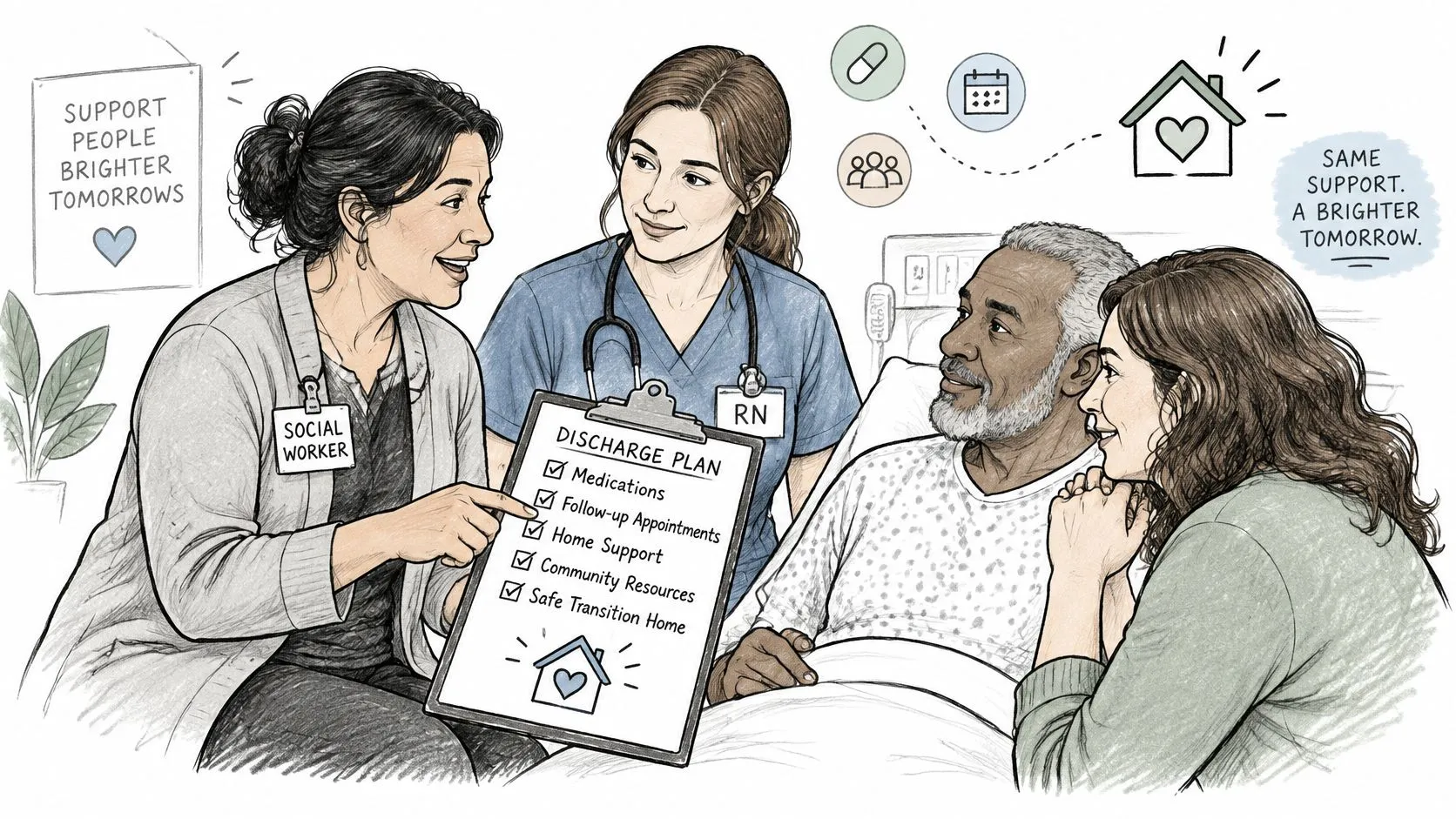
Discharge planning is a coordination job with a bed-turnover clock attached. The letter has to show you move complex cases to safe outcomes fast, and that the people around you keep working with you afterward.
Boston University's Social Work Career Guide makes the structural point cleanly. Don't list jobs or reproduce resume information word for word. The middle of the letter should explain why you want this position, identify the populations served, connect your experience to the agency's systems and issues, and name specific results. That middle section is where one applicant separates from another.
As a discharge planner at [Hospital], I coordinated safe discharges for patients moving to skilled nursing, home health, or community services, working with physicians, nurses, and families on same-day plans. I built a referral checklist the unit still uses to track post-discharge follow-up.
What the panel decides after this paragraph
"She understands that discharge is a team sport, and she leaves systems better than she found them." The checklist does that. It's small, it's specific, and it's still in use. A process someone else adopted is stronger evidence than any adjective about teamwork.
The waste line here is usually the payer paragraph. One sentence naming your comfort with insurance and payer requirements is plenty. Three sentences explaining Medicare rules tells a hiring manager you'd rather describe the system than work in it.
What to keep
- One process you changed, however small, with who still uses it.
- The settings you placed patients into, because it proves breadth.
- Payer fluency in one line. No more.
- The hospital's own department names, copied from the posting.
If you're unsure where the social work role ends and case management begins inside a hospital, this explanation of what hospital case managers can and cannot do is worth ten minutes before you write.
4. Clinical LCSW Cover Letter Sample for Mental Health Roles
Clinical letters get screened on credentials before a human reads a sentence. That's the whole reason the license belongs in paragraph one, stated precisely.
Hiring guidance collected by Jobscan notes that employers may screen for license status early and recommends saying plainly whether a credential is current or actively being pursued. Most templates stop there, which leaves MSW graduates, provisionally licensed applicants, and internationally trained social workers guessing. Separate five things instead: completed education, supervised hours, exam status, duties you're permitted to perform, and expected credential dates.
Social work is a profession built on formal gatekeeping. The University of Michigan's history of social work traces it: seventeen schools of social work were affiliated with the predecessor of today's CSWE by 1919, CSWE was founded in January 1952, and the National Association of Social Workers was established in October 1955 through a merger of seven organizations. A panel reading your letter is reading it against that standard.
I hold my LCSW and have spent six years providing individual and group therapy in an outpatient clinic serving adults with depression, anxiety, and co-occurring substance use. I use cognitive behavioral approaches and motivational interviewing, and I manage a caseload of [number] clients while meeting documentation and billing requirements.
What the panel decides after this paragraph
"Credentialed, focused, and billable." The population is named in the first sentence. The modalities are specific and defensible. The billing line tells a clinic director you won't create revenue problems.
What wastes space: "I am trained in a wide variety of therapeutic modalities suited to each client's unique needs." That's a claim with no content. List two or three you can discuss for ten minutes in an interview. If you can't, they don't go in the letter.
If you're weighing which license fits the role you want, this comparison of the therapy approaches of LPCs and LCSWs is a useful check before you name a credential that doesn't match the posting.
5. Career Changer Into Social Work Cover Letter Sample
Selection tutors have been telling people this for years, and the answer is not what most career changers expect. It isn't the years. A UK study of social-work education providers, published through the University of Stirling repository, found applicant statements were assessed on academic ability, relevant work or personal experience, and understanding of and commitment to social-work values. Providers cared what applicants learned from experience rather than counting months, and 78% of respondents ranked personal qualities and values as the most important selection criterion.
So don't apologise for the switch. Convert it.
Before social work, I spent nine years as a high school teacher. I managed classrooms of thirty students, wrote individualized plans for students with learning needs, and worked with families on attendance and behavior. I'm applying to [Agency] because I want that same work with a clinical lens and a wider role in family stability.
What the panel decides after this paragraph
"He's done hard work with families and he knows why he's here." Two transferable skills, each with one example, plus one sentence on the reason for the move. That's the whole job.
What wastes space: the apology paragraph. "Although my background is in education, I believe my skills are transferable." Saying it invites doubt. Showing it removes it.
One rule for the switch: explain it once, in one sentence, and never return to it. The rest of the letter is evidence, not justification.
Skip the full duty list. Pick the two duties that map onto the posting. If you're writing the rest of the application package too, this guide to a cover letter for career changers covers how the letter and resume should carry the same translation.
6. Veteran to Social Worker Cover Letter Sample for VA Roles
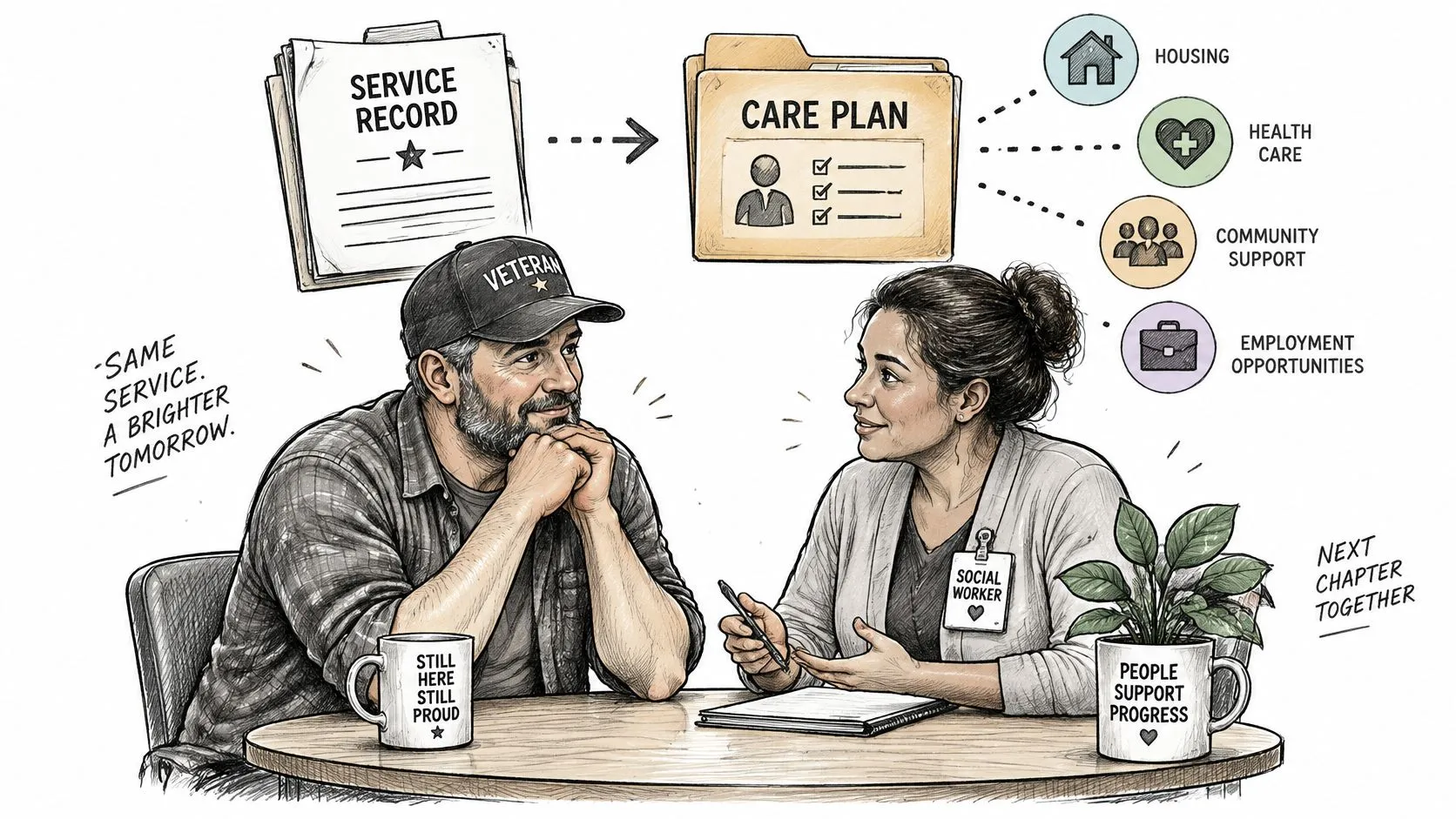
Veteran applicants lose interviews on vocabulary, not experience. A medic who supported soldiers through crisis has done crisis intervention. The letter has to say so in civilian words, and it has to match the qualification language the agency itself uses.
Federal postings spell that out. A current USAJOBS social worker posting requires one year of specialized experience that includes conducting biopsychosocial evaluations of children and adolescents, providing individual or group counseling, and developing patient treatment plans. A Veterans Health Administration posting specifies state licensure or certification for independent social-work practice at the master's level. If your MSW isn't finished, don't write around it. Write it exactly.
I served eight years as an Army medic, including two deployments. I supported soldiers through crisis, coordinated care with behavioral health teams, and handled sensitive records under strict confidentiality rules. I'm completing my MSW and want to bring that understanding of military life to veteran clients at [VA Facility].
What the panel decides after this paragraph
"Lived credibility plus a real qualification timeline." The care work is named in plain terms. The MSW status is clear. Nobody has to guess whether you're licensed, because you didn't imply you were.
What wastes space: acronyms and rank with no translation. "Served as NCOIC of a behavioral health detachment" creates a puzzle for the reader and gains you nothing. Replace each acronym with what you did for people.
What to keep
- Plain descriptions of care, not military shorthand.
- Combat details brief. Outcomes over narrative.
- Credential status in one clear line, including expected dates.
- Any familiarity with VA systems, stated without overclaiming.
If the rest of your application still reads in service language, these military to civilian resume examples show the same translation at bullet level.
7. Returner Social Worker Cover Letter Sample After a Break
A gap is one sentence. The rest of the letter follows current practice. That split is the entire craft of a returner's letter, and many people get it backwards, spending three paragraphs on the reason they left.
Australian recruitment research published in Advances in Social Work and Welfare Education found agencies assessing new social-work graduates looked for reflective practice, understanding and enactment of the role, interpersonal communication, and organizational practice. Recruiters also favoured applicants who contacted the agency for information before interview, and applications that were informed, succinct, well structured, independently reasoned, and supported by evidence from placements or referees. Nothing there is about recency. All of it is about evidence.
After stepping away from full-time work for [number] years to care for my family, I kept my license current through continuing education and volunteered as a crisis line advocate. Previously, as a family services case manager, I managed a caseload of [number] families. I'm ready to return with current practice knowledge and a clear focus on family stability.
What the panel decides after this paragraph
"The license is live and she's been in the work recently." Those are the two fears, and both are answered in the first sentence.
What wastes space: "I took time away to focus on my family, which taught me resilience and empathy." Nobody doubts the empathy. Name the continuing education hours, name the volunteer role, name the dates, and move.
What to keep
- The break in one sentence, no apology attached.
- Continuing education or certifications by name, because they're checkable.
- Recent volunteer work as proof of current practice.
- License status confirmed before you send anything.
Recent volunteer work only helps if it's written like a job. These notes on writing strong volunteer bullet points apply to the letter as much as the resume.
8. Nonprofit Director of Social Services Cover Letter Sample
At director level the letter changes hands. A program director reads it for operational proof, then an executive director reads it for whether you'll be a liability in a funder meeting. Both questions get answered in the first four lines or not at all.
As director of programs at [Organization], I oversee a budget of [amount], a team of [number] staff, and contracts with three county agencies. I rebuilt our intake process, which shortened the wait time for families from [number] weeks to [number] weeks. I want to bring that operational discipline and clinical judgment to [Organization].
What the panel decides after this paragraph
"She runs the business side." Budget, headcount, contracts, and a before-and-after number on a process you owned. That's the whole case, and it's made before anyone asks about your clinical philosophy.
What wastes space: a mission paragraph longer than the results paragraph. At this level, values show up in what you chose to fix and who benefited. Say the values once, briefly, and let the intake wait time carry the rest.
What to keep
- Real budget, team, and contract figures. Rounded is fine. Invented is fatal.
- One process change with a measurable effect, stated as before and after.
- One line of clinical grounding, so you don't read as pure administration.
- The funder and population language the organization itself uses.
Which Social Worker Cover Letter Sample Fits Your Situation
| Item | Best For | Experience Level | License Status | Strongest Proof |
|---|---|---|---|---|
| Entry-Level Social Worker Cover Letter Sample for New Grads | New graduates applying for a first social work role | Entry-level; field placement experience | State current pathway, such as working toward LSW or LMSW | Specific placement, population served, caseload, and supervised tasks |
| Child Welfare Caseworker Cover Letter Sample With Examples | Child protective services, foster care, or family preservation roles | Experienced or transitioning into child welfare | Not specified; confirm role requirements | Safety decisions, risk assessments, court work, and timely documentation |
| Hospital Discharge Social Worker Cover Letter Sample | Hospital, health system, or skilled care discharge planning roles | Medical social work experience | Not specified; confirm role requirements | Coordinated discharge plans and a practical workflow improvement |
| Clinical LCSW Cover Letter Sample for Mental Health Roles | Outpatient, community mental health, or private practice roles | Licensed clinical practitioner | LCSW; state and status should be stated accurately | Clinical license, relevant modalities, population served, and caseload |
| Career Changer Into Social Work Cover Letter Sample | Professionals transitioning from another field into social work | Career changer with transferable experience | Not specified; include relevant credentials or coursework | Prior work examples tied to assessment, advocacy, or coordination |
| Veteran to Social Worker Cover Letter Sample for VA Roles | Veterans pursuing VA or veteran-serving social work roles | Veteran with relevant service or care experience | MSW in progress in the example; state actual status | Civilian-language examples of crisis response, care coordination, and confidentiality |
| Returner Social Worker Cover Letter Sample After a Break | Social workers returning after caregiving, health, or other breaks | Returning professional | Emphasize current license status and continuing education | Current training or volunteer work plus relevant prior practice |
| Nonprofit Director of Social Services Cover Letter Sample | Senior social work professionals seeking program leadership | Senior leadership | Not specified; confirm role requirements | Verifiable budget, team, contract, and service-improvement results |
Pick One Sample and Rewrite It Today
Pick the letter that matches the job you're applying to this week, not the career you want in five years. Copy the structure, not the content. The structure is four moves: your proof paragraph, your decision paragraph, your translation paragraph, and one line on why this agency. Everything else in a cover letter is optional.
Then cut. Anything a panel could skip goes, starting with the mission statement, the adjectives, the sentence about your dedication to social justice, and the closing paragraph that thanks them for reviewing your application. If a line doesn't change what a hiring manager believes about your capacity, it's costing you attention you can't get back.
Then replace every general claim with something countable or checkable. "Managed a caseload" becomes "carried a caseload of twelve." "Worked with families" becomes "completed safety assessments and wrote service plans for the families on my caseload." "Improved processes" becomes "rebuilt intake and cut the wait from [number] weeks to [number] weeks." If you can't attach a number without breaking confidentiality, attach a scope instead: the setting, the population, the frequency, the timeframe.
State your credential in the exact terms the posting uses, with a date attached. "LMSW, application submitted," "MSW expected May," "LCSW, active in [State] through [year]." Ambiguity here reads as either evasiveness or inattention, and screeners are scanning for the difference.
One page. No exceptions below director level, and rarely above it. A tight letter signals that you can prioritise under pressure, which is the job.
If your problem is that you have the work but not the words, that's a description problem, not a qualification problem. StoryCV interviews you about your caseload, your decisions, and what changed, then writes plain sentences you can lift straight into a letter. The free start includes two finished bullet points, and a resume takes hours, not days.
You've done the work. The letter fails because the work is described in the wrong language, and that's a fixable problem. StoryCV is a resume writer, not a builder: it interviews you the way a good editor would, asking about the problem you walked into, what you owned, the scale, and who benefited, then turns your answers into bullet points you can use in a cover letter or a resume. Start with StoryCV for free and you'll have two finished bullet points before you decide whether to go further.