A career change cover letter is not a mini memoir. If your opening starts with your old job, you're already losing. Hiring managers don't need your life story, they need a fast, credible reason to believe you can do the new job.
The strongest letters are short, focused, and easy to scan. A concise 250 to 400 word one-page letter with three to four compact paragraphs helps you explain the pivot without burying the proof of fit, which lines up with SEEK's guidance on career-change letters SEEK's career change cover letter advice. That's the standard to aim for because recruiters scan quickly, and because a career changer has to do two jobs at once, explain the transition and prove competence.
If you want a useful pairing for your prep, the same mindset applies to interview prep. A good set of top interview questions for managers helps you anticipate how your pivot will be tested later.
Introduction
The usual advice is wrong. Don't start with why you're leaving your old field. Start with why you fit the new one.
A cover letter for career changers works when it gets to the point fast. The letter has to name the transition, map old experience to the target role, and show that you're already acting like someone in that field. That's why a one-page, 250 to 400 word format matters, with three to four compact paragraphs that keep the story tight and the best evidence visible SEEK's career change cover letter guidance.
The best version doesn't ramble. It opens with the role, moves into transferable skills, then ends with a clear ask for an interview. That structure also makes it easier to sound specific instead of defensive, which is exactly where most career changers go wrong.
If you want to pair the letter with the right resume framing, StoryCV's guide on how to write a resume for a career change is the cleanest companion piece. Keep the cover letter focused on narrative, proof, and fit. Save the full biography for your own head.
Position Your Pivot Clearly
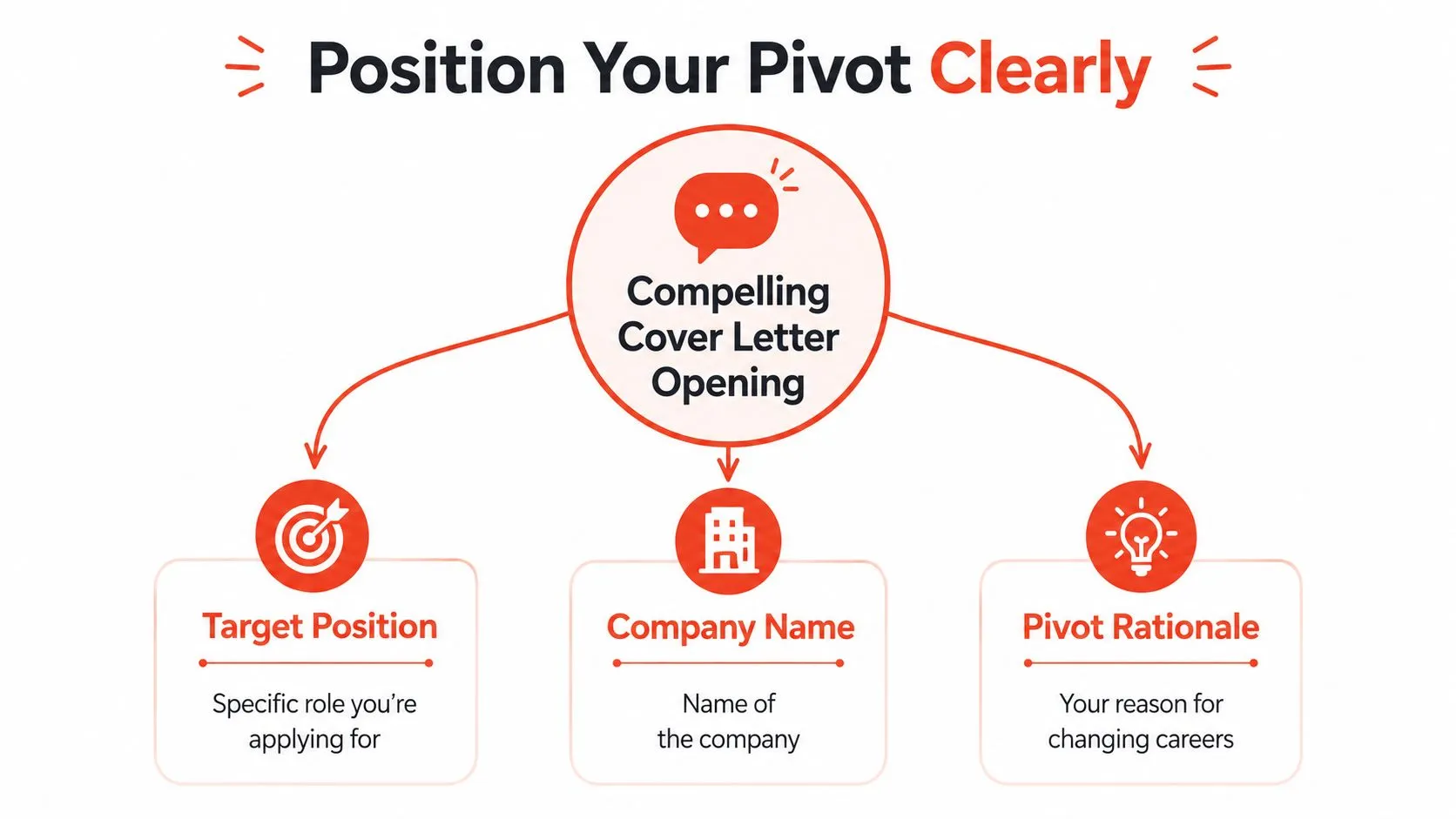
Your first sentence should do real work. Name the role, name the company, and state the pivot in plain language. That's the opening mechanic that keeps the reader from wondering what you want Candor's career change cover letter guide.
The opening should sound like a pitch
Skip the soft intro. Say who you are, what you're pursuing, and what you bring. Candor frames this as an elevator pitch in one or two sentences, and that's exactly right. If the first sentence can't stand alone, it's too weak.
A strong opener looks like this:
I'm applying for the Operations Manager role at Northbridge. I'm moving from logistics into operations because my background in process control and team coordination maps directly to the work this role requires.
That sentence works because it does three things at once. It identifies the target job, signals intent, and gives a reason that sounds deliberate, not impulsive.
Name the pivot without apologizing
Don't lead with what you lack. Lead with what you're bringing forward. Upwork's advice on customizing for each role is useful here, because a generic opener reads like a mass email, while a specific one tells the hiring manager you chose this job on purpose. The same logic shows up in a stronger personal-branding approach too, which is why resources like resources from Flexwork Podcast Studios can be useful when you're tightening how you present your story.
Practical rule: If the reader can't tell the role and the company by the end of sentence one, rewrite it.
If you need a model for how your resume should support this opening, StoryCV's sample cover letter for job application shows how clean positioning carries through the rest of the application. The point is simple. Name the move early, then make the pivot feel intentional.
Map Your Transferable Skills to Your Target Role
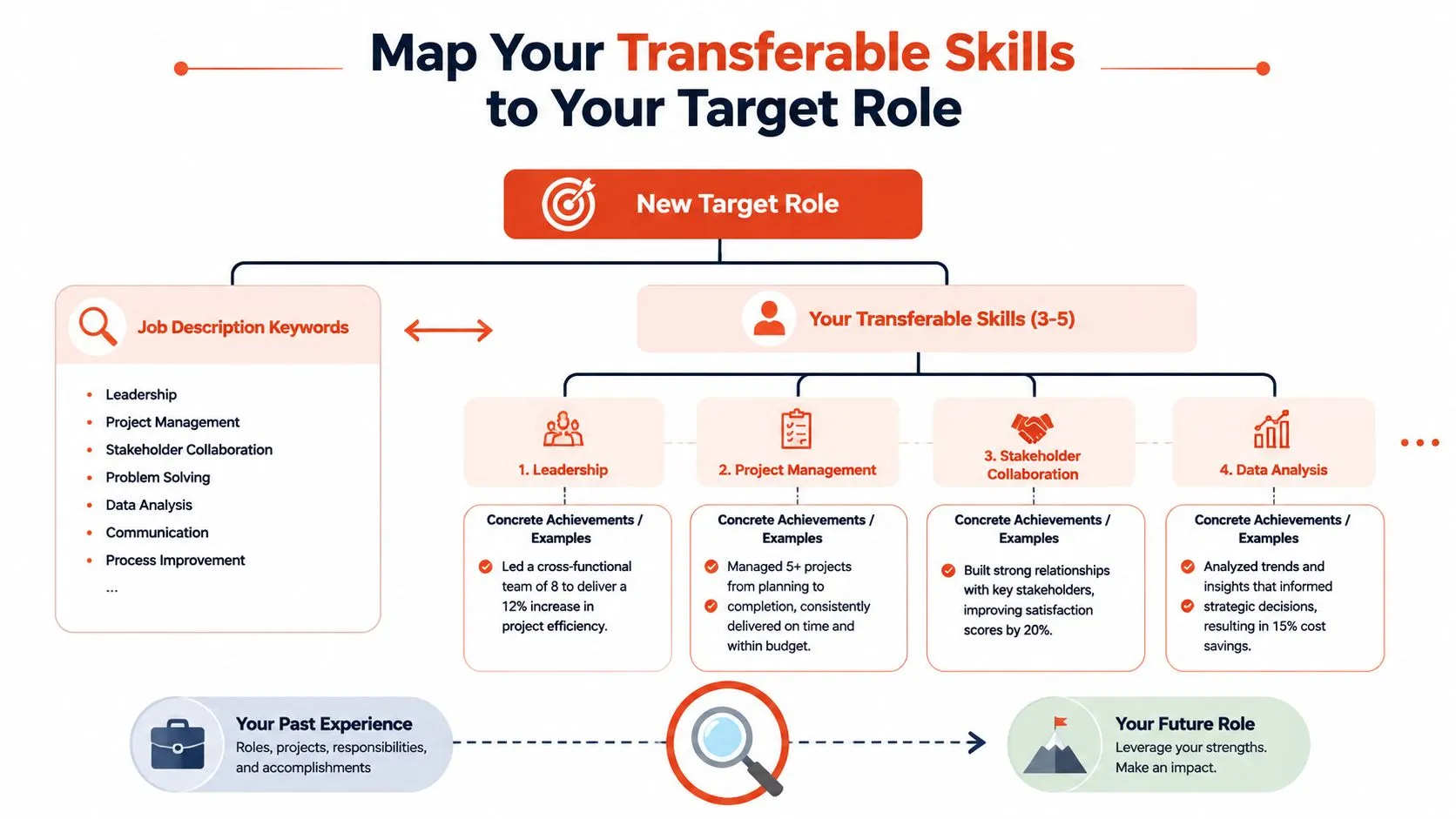
You don't need to prove you've done the job before. You need to prove that your transferable skills already solve the problems in the job description. That means picking a small set of high-signal strengths, then attaching evidence to each one Indeed's career change cover letter guidance.
Match the job, not your ego
Read the posting and pull out the language that matters. Then choose 3 to 5 skills or achievements from your background that line up. StoryCV's article on transferable skills for career changers is useful if you're stuck on what counts, but the rule stays the same. If it doesn't help the target role, leave it out.
The strongest letters use 2 to 3 paragraphs of direct skill matching, and each skill needs a measurable outcome when possible Indeed's career change cover letter guidance. That could be revenue growth, time saved, or team size managed. If you don't have a number, use a specific result or context. Don't pad.
Here's the logic in plain English:
- Pick the requirement: Find the exact phrase the employer uses.
- Pick the proof: Choose a past result that shows you can do it.
- Translate the language: Rewrite the proof in the vocabulary of the target role.
Practical rule: One skill, one proof, one link to the new job. Anything more is clutter.
Use evidence, not labels
Words like “strong communicator” or “team player” don't carry much weight by themselves. A hiring manager wants the action and the result. A better line sounds like, “I led cross-functional planning meetings that kept three departments aligned on launch deadlines.” That's concrete enough to trust.
The goal isn't to sound impressive. It's to sound transferable. If the letter makes your past work feel like preparation instead of detour, you're doing it right.
Structure Your Cover Letter for Impact
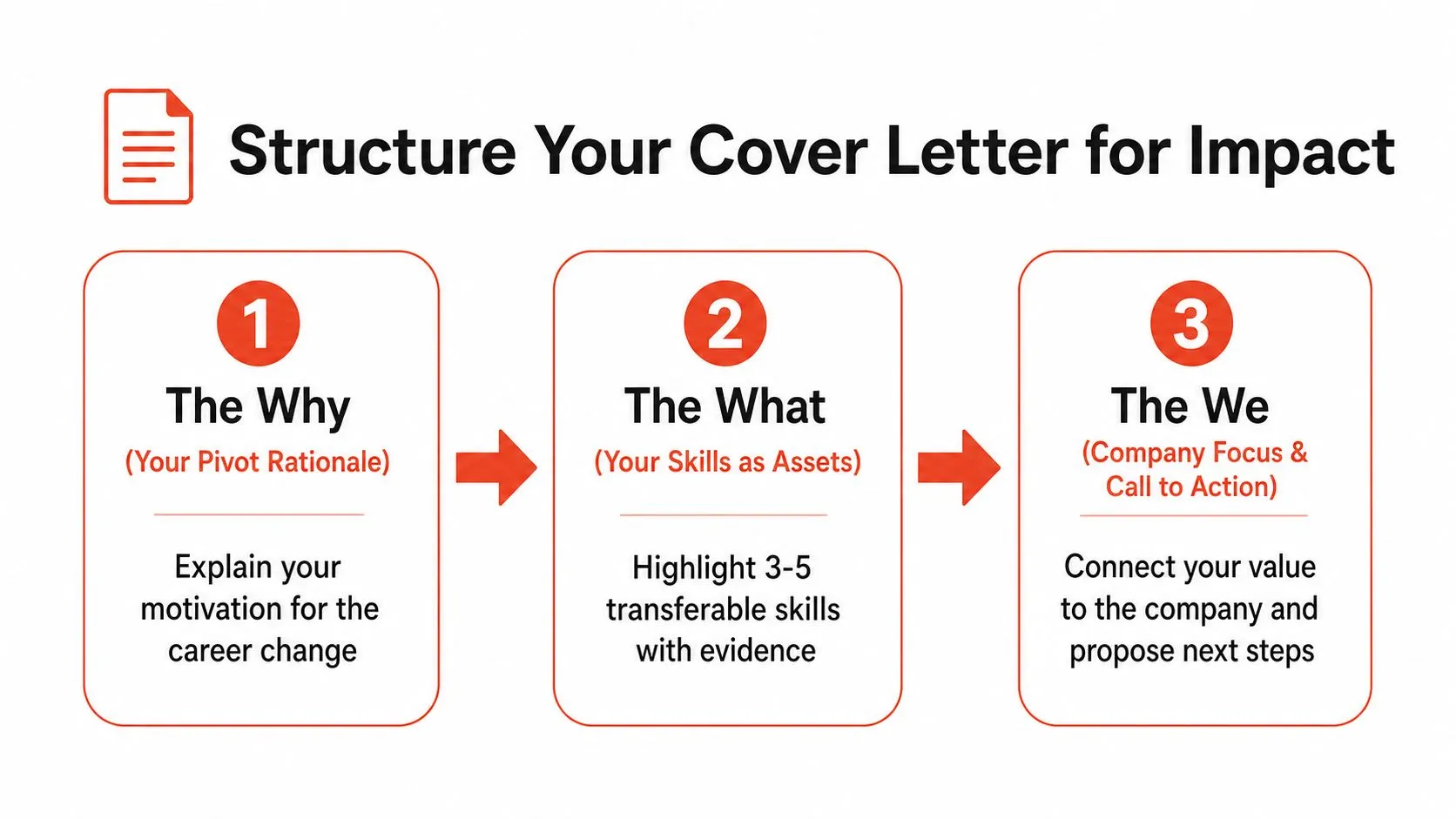
A career change letter gets messy when it tries to tell the whole story. A cleaner structure keeps the argument moving. BetterUp's advice to keep it to a few curated paragraphs fits well with ECLA's three-block approach, The Why, The What, and The We BetterUp's cover letter for career change guide.
The Why, The What, The We
The Why is your pivot rationale. Keep it to one or two sentences. Say what pulled you toward the new field without turning it into a dramatic origin story.
The What is your skills case. Here, you connect the past to the new role with evidence. Use the facts that matter, not a job-by-job recap of your career.
The We is company fit and the close. Show you understand the employer, then end with a direct invitation to talk. That final move matters because it turns interest into action.
A simple flow works better than clever writing:
- State the move.
- Prove the fit.
- Ask for the conversation.
If you want help sharpening the wording of the close, boost conversions with language is a useful reference for making the final ask feel more confident. And if you want to see how a similar structure works in another application format, StoryCV's sample cover letter for job application is worth comparing against your draft.
Practical rule: If a paragraph doesn't advance the case for the new role, cut it.
A strong structure beats a long explanation
Most career changers overdo it; they spend too long on the switch and too little on the evidence. Don't. The letter should read like a concise argument, not a personal essay.
Use the structure to keep your reader moving. By the time they finish the third block, they should know exactly why you're changing fields, what you already know how to do, and why they should call you.
Sample Paragraphs for Common Career Pivots
Examples help because they show the shape of a good letter without turning it into generic filler. These are short, adaptable paragraphs, not scripts to copy. The key is the balance, quick pivot rationale, clear skill translation, and a closing that sounds ready for the role.
Tech to product management
I'm applying for the Product Manager role at Orion. After five years in software implementation, I've spent most of my time translating customer needs into decisions the engineering team can ship, which is why product management is the right next step. In my current role, I've led launch coordination across sales, support, and engineering, kept stakeholders aligned through shifting deadlines, and turned client feedback into feature priorities that improved adoption across new accounts. I'm ready to bring that mix of customer judgment and cross-functional execution into a product team.
Education to corporate training
I'm applying for the Corporate Trainer position at Northstar Learning. My background is in secondary education, and I'm moving into L&D because I want to build learning experiences for adult professionals instead of students. I've designed lesson sequences, facilitated group sessions, and adjusted delivery for different learning styles, which translates directly to training programs that need structure and engagement. Over the past year, I've also completed recent professional development in instructional design and adult learning, which gives me current, relevant preparation for this move.
Finance to operations
I'm writing to apply for the Operations Analyst role at Meridian. My work in finance taught me how to spot process breakdowns, work with clean data, and make decisions that hold up under pressure. That background has made me effective at improving workflows, tracking performance, and supporting teams that need clear reporting, not noise. I'm now looking to apply those strengths in operations, where the focus is execution, consistency, and measurable improvement.
A few things make these paragraphs work. They open with the role, they name the pivot directly, and they avoid overexplaining the old career. They also use language that fits the target job instead of recycling the vocabulary of the previous one.
If you're building from scratch, StoryCV's editorial approach can help you turn your own experience into something this focused, because the right draft doesn't feel assembled from blocks. It feels chosen.
Tailor Your Letter and Avoid Common Mistakes
Tailoring is not swapping in a company name and calling it done. You need proof that you've already started moving toward the new field, and you need to avoid the mistakes that make pivot letters sound weak Scale.jobs on career change cover letters.
What counts as proof of commitment
Recent projects, certifications, and volunteer work all help because they show action, not just interest. The question is how much is enough. The answer is simple, enough to show that your move is deliberate, but not so much that the letter turns into a training log. One strong proof point is better than five loose ones.
The three mistakes that sink most letters
| Mistake | Better move |
|---|---|
| Generic greeting and opening | Name the role and company early, then connect your background to the job |
| No measurable evidence | Add specific outcomes, context, or recent preparation |
| Oversharing about the old job | Keep the focus on what you're moving toward |
The third mistake is the most common. People explain why they're bored, burned out, or done with their old field. That story may be true, but it doesn't help you get hired. Employers want to know whether you can do the new work, not whether your last job annoyed you.
Tailor to the job description, not your mood
Mirror the language of the posting when it's relevant. If the employer says stakeholder management, use that phrase only if your experience supports it. If the company emphasizes process improvement or customer insight, fold those ideas into your proof. The point is alignment, not keyword stuffing.
Practical rule: If your draft could be sent to three other companies with no edits, it's not tailored enough.
This is also where a tool can help you keep the story tight. StoryCV is one option for turning a work history into a role-specific draft, but the ultimate test is whether the letter sounds like you've read the posting carefully and already done the preparation.
Final Editing Checklist
The last draft should be shorter, sharper, and easier to trust than the first one. Read it once for structure, once for evidence, and once for tone. If any sentence feels like filler, cut it.
Check these before you send
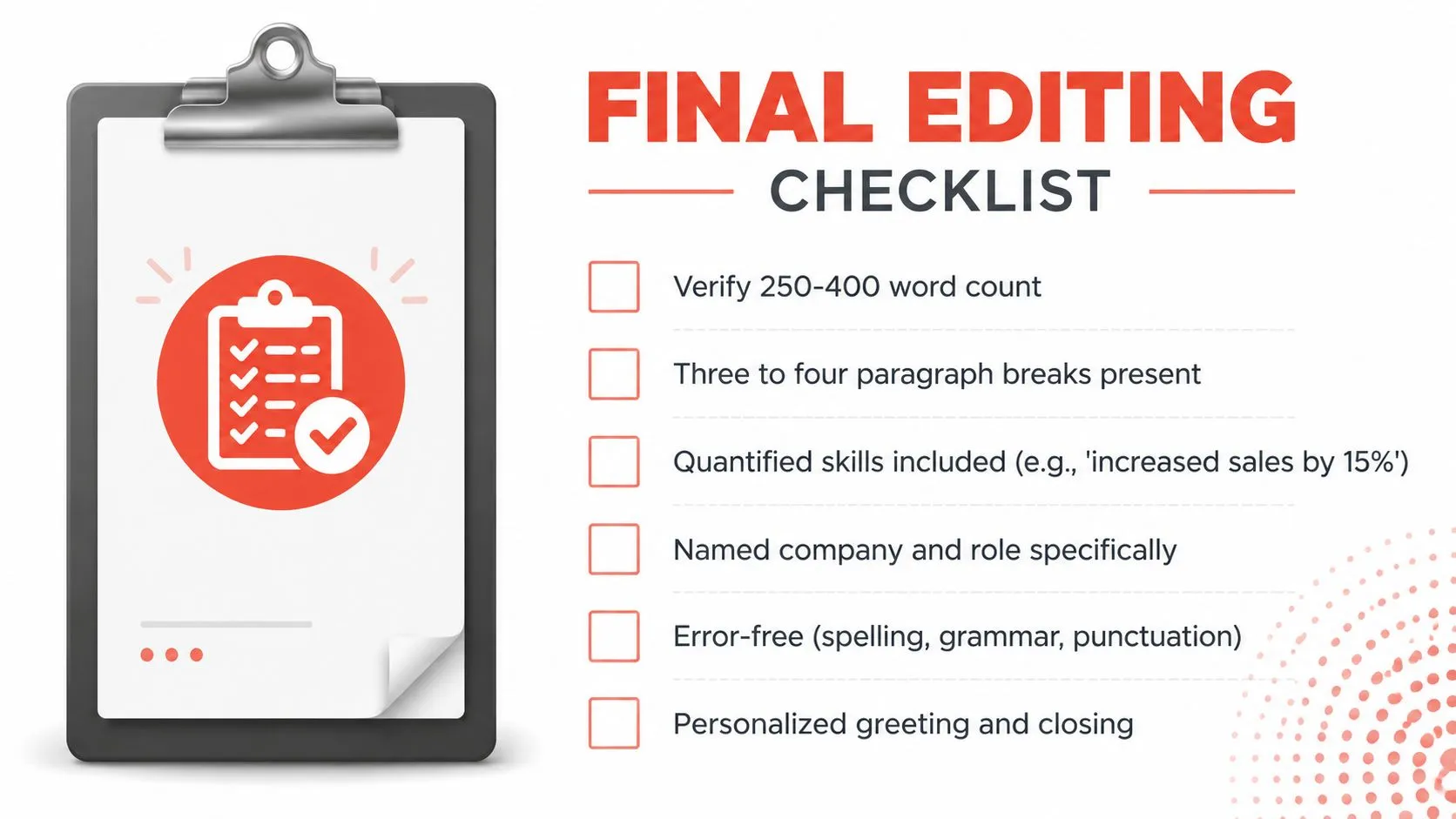
- Verify the length: Keep it to 250 to 400 words and one page.
- Confirm the structure: Make sure you have three to four paragraphs, not a wall of text.
- Check the evidence: Each transferable skill should have a clear result, context, or measurable outcome.
- Name the role and company: Don't make the reader guess.
- Remove weak lines: Delete apologies, vague enthusiasm, and old-role complaints.
- Proofread carefully: Spelling, grammar, punctuation, and dates all need to be clean.
- Save it cleanly: Use a simple filename and a format that preserves layout.
The final version should feel deliberate. No hedging. No clutter. No autobiography. Just a short, specific argument that says you understand the job, you've done the work to prepare, and you're ready for the interview.
If you want a sharper draft without fighting templates, start with StoryCV. It turns your experience into a focused career-change cover letter that's brief, customized, and ready to send.