Leading with a list of games is weak advice for a camp counselor resume. Archery, swimming, and crafts matter, but they don't tell a camp director whether you'll notice a missing camper, follow an emergency procedure, or communicate clearly with a worried parent.
A strong resume for camp counselor leads with safety and supervision evidence. Activities support that case. They don't replace it.
What Camp Hiring Managers Scan for First
An activity list doesn't sell a camp counselor. Give the person reading your application these facts before asking them to infer that you're trustworthy:
- Safety credentials: What you're currently qualified to do.
- Supervision scope: The number and age range of children you've supported.
- Season and availability: How long you worked and when you can start.
- Rehire or promotion: Whether an employer chose to bring you back or expand your responsibility.
This is professional experience, not filler. The American Camp Association's staff research reported that U.S. camps hired an average of 239,085 seasonal staff annually, based on its 2016 industry research, and that a typical camp had about 60% returning staff in 2017.
Returning matters because the camp chose to retain you. For students, even an initial season can demonstrate responsibility and judgment rather than account for summer free time. Before drafting, collect those facts from your past work.
Resume Layout and Section Order
Camp counselor resume section order
| Section | What goes in it | Camp-specific example |
|---|---|---|
| Header | Name, city, phone, email and availability | Available for the full June to August season |
| Safety and certifications | CPR, First Aid, AED or lifeguard with issuer and expiry date | CPR/AED, issuing organization, expiration month and year |
| Camp and youth experience | Roles, dates, age ranges and group sizes | Cabin counselor, ages 8-10, group of 12 |
| Skills and activities | Named activities you can lead | Swim instruction, archery, arts and crafts |
| Education and training | Degrees, courses and training in progress | Wilderness first aid, in progress |
| References | Two or three contacts with their role | Former camp director |
The examples show formatting, not qualifications to copy. The header should make your season availability explicit, including any school or travel commitments that affect your start or finish date.
Put the safety block near the top, where a reader can find it without searching. Experience follows because a certificate and a record of supervising children answer different questions. List roles in reverse chronological order, including relevant unpaid work, and distinguish your individual responsibility from the team's responsibility.
Keep the page easy to inspect
I'd use a single column, a standard readable font, and month-and-year dates. Skip the photo and objective statement. A sentence about wanting a rewarding summer contributes less than a clear account of the work you can perform.
- Length: Aim for one page. Consider two only with 15 or more years of relevant work and enough substance to justify the space.
- Skills: Name activities you can lead, not everything you've tried recreationally.
- Education: Include relevant courses and label unfinished training accurately.
- References: Have contacts ready with permission. If the application doesn't request their details, keep them on a separate sheet available on request.
Include outdoor readiness and relevant physical capabilities in a concise availability or qualifications line, rather than hiding them in an unrelated job description. Draft the header and certification block first. They establish what you can offer before the experience bullets explain how you work.
Safety Credentials to Put First
Completed credentials and planned training aren't interchangeable. Put current certifications in the main safety list; put unfinished courses under training, and describe willingness to enroll separately.
For each completed credential, include its exact name, issuer, and expiration date. For training underway, use in progress with an expected completion date, not wording that implies you've passed. This guide to putting certifications on a resume helps you separate those statuses cleanly.
The camp counselor posting hosted by NAAEE illustrates why credential accuracy matters: youth-facing camp requirements can include safety training, screening, and direct experience supervising children.
Informal work can show safeguarding judgment
Babysitting, youth coaching, tutoring, classroom support, volunteering, and family caregiving can all supply relevant evidence. Describe the actual action: checking children's locations, following a family's allergy instructions, documenting an incident, practicing emergency steps, or updating a parent.
Practical rule: Describe the procedure you followed, not authority you didn't have.
Don't turn following a medication protocol into independently managing medication. Don't claim sole disciplinary authority if you escalated concerns to a teacher or director.
For outdoor roles, resources such as Florida camp planning with PADL can help you think through the activity setting before identifying relevant experience. Planning familiarity isn't a substitute for required credentials.
Check the posting's background-screening, minimum-age, mandatory-training, outdoor-work, and lifting requirements. Address applicable requirements without adding sensitive screening documents to your resume. Pull your certificates, confirm their dates, and finish this list before writing experience bullets.
Writing Bullets That Prove Supervision
A useful bullet follows action, context, result, with a concrete supervision detail. Don't force a dramatic outcome when the accomplishment was consistently carrying out a necessary procedure.
- Name the action. Start with supervised, led, taught, coordinated, or another verb that describes your contribution.
- Add context. Include group size, ages, setting, and duration where you can verify them.
- State the result. Use an outcome you can explain, or an observable operational measure.
- Show the supervision method. Identify attendance checks, handovers, equipment checks, or another relevant action.
Hypothetical example: Supervised 12 campers ages 9-12 during daily outdoor activities, ran attendance checks at every transition, and adapted games for mixed abilities.
That statement identifies both scale and method. It doesn't invent improved behavior or satisfaction.
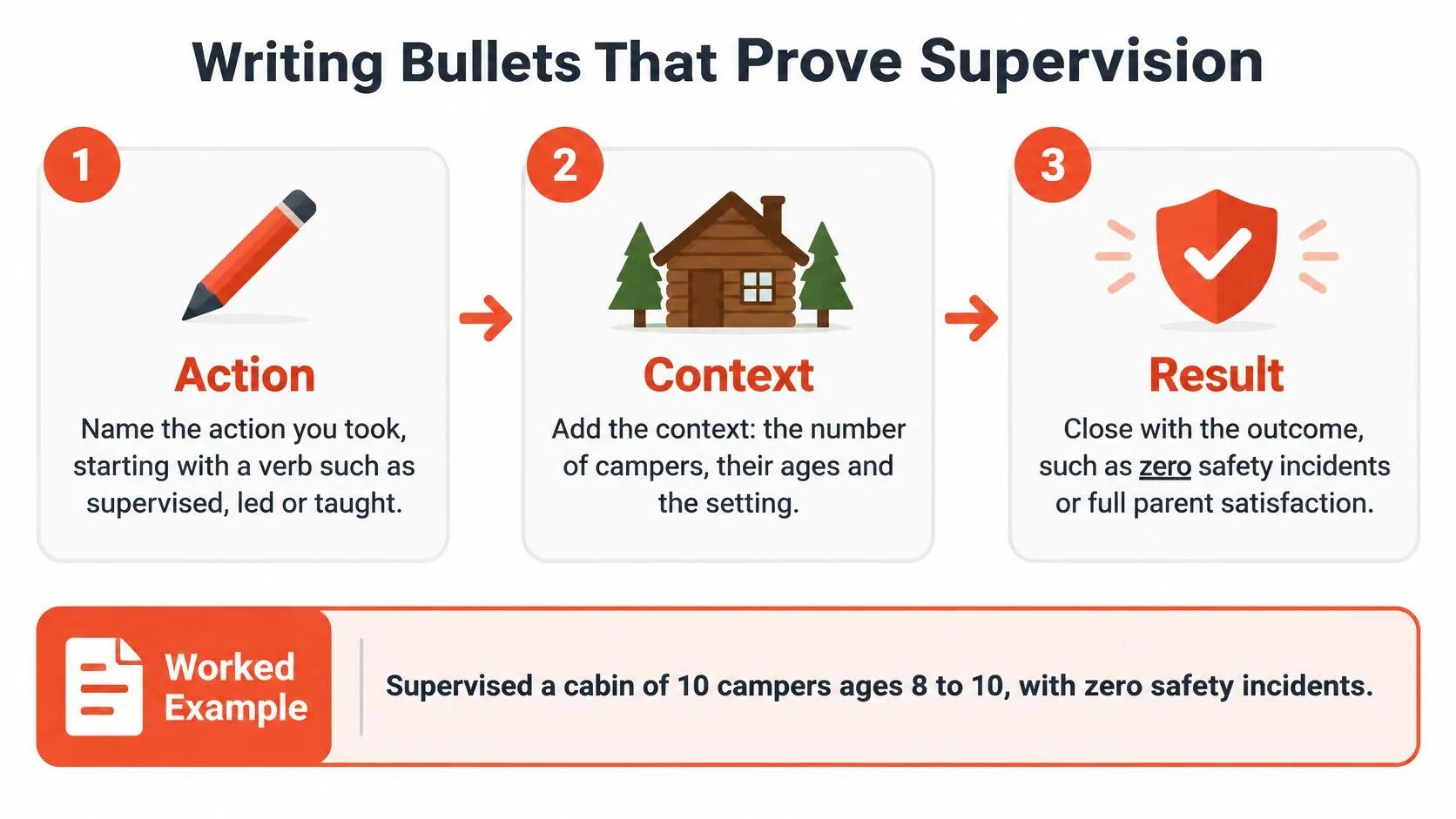
Treat outcome language in the infographic as conditional. Claims about zero incidents or parent satisfaction need records and appropriate scope, not just a good memory.
Put group size in staffing context
The American Camp Association's camp safety guidance gives these typical supervision ratios:
Typical camp supervision ratios by age group
| Age group | Overnight camp (staff:campers) | Day camp (staff:campers) |
|---|---|---|
| Ages 4-5 | 1:5 | 1:6 |
| Ages 6-8 | 1:6 | 1:8 |
| Ages 9-14 | 1:8 | 1:10 |
| Ages 15-17 | 1:10 | 1:12 |
These are scale references, not proof of your former camp's staffing arrangement. In a hypothetical day-camp group of 12 campers ages 9-14 using the table's ratio, staffing would require two people. If you co-supervised, say so rather than implying you worked alone.
The ACA staff guide on camper accountability calls for attendance checks when groups enter or leave buildings and at the beginning and end of activity periods. That makes transition management substantive resume evidence when it reflects your work.
Use these leadership examples for a resume to identify other decisions worth describing. Then draft three bullets using the process above.
Proof When You Have No Numbers
Competency to proof matrix
| Competency | Proof point | Scale indicator | Operational measure |
|---|---|---|---|
| Safety and compliance | Current CPR, First Aid or AED card | Number of certificates held | Attendance accuracy at every headcount |
| Group leadership | Ran a group during a season or program | Campers per group | Shift length and sessions led |
| Activity instruction | Taught a named activity | Sessions per week | Activity frequency across the term |
| Inclusion | Adapted activities for mixed abilities or languages | Age range or group mix | Number of participants accommodated |
| Communication | Sent updates to parents or guardians | Families contacted | Frequency of updates per week |
| Reliability | Attended every scheduled shift | Shifts per week | Attendance rate or shift length |
| Physical readiness | Outdoor work, lifting or swimming | Hours outdoors per day | Consecutive days worked |
Read across each row before composing a sentence. Find a real action, establish its scope, and identify either an outcome or an observable measure. The Discovery Center's counselor job description emphasizes responsibilities such as group supervision, headcounts, emergency procedures, and working with diverse populations.
The cells are prompts, not automatic connections. A CPR card proves training status; it doesn't prove accurate attendance checks. Each claim needs its own supporting experience.
A babysitting example without a headline outcome
Say you cared for three children, five evenings a week, for a year. You don't have a performance improvement to report, but you can describe the routine:
Cared for three children during five weekly evening shifts, followed family meal and bedtime routines, and confirmed each child's whereabouts at every caregiver handover.
That hypothetical statement shows scope and accountability without claiming you improved safety by an invented percentage. Replace its details with your own and remove anything you didn't do.
Don't use consecutive days worked to imply that exhaustion is a qualification. Name the relevant outdoor conditions or duties instead. Drop any matrix row where you can't identify genuine proof.
Sample Statements by Background
These are hypothetical models, not ready-made achievements. Replace every number with your own, change the responsibility to match your role, and delete any clause you can't defend.
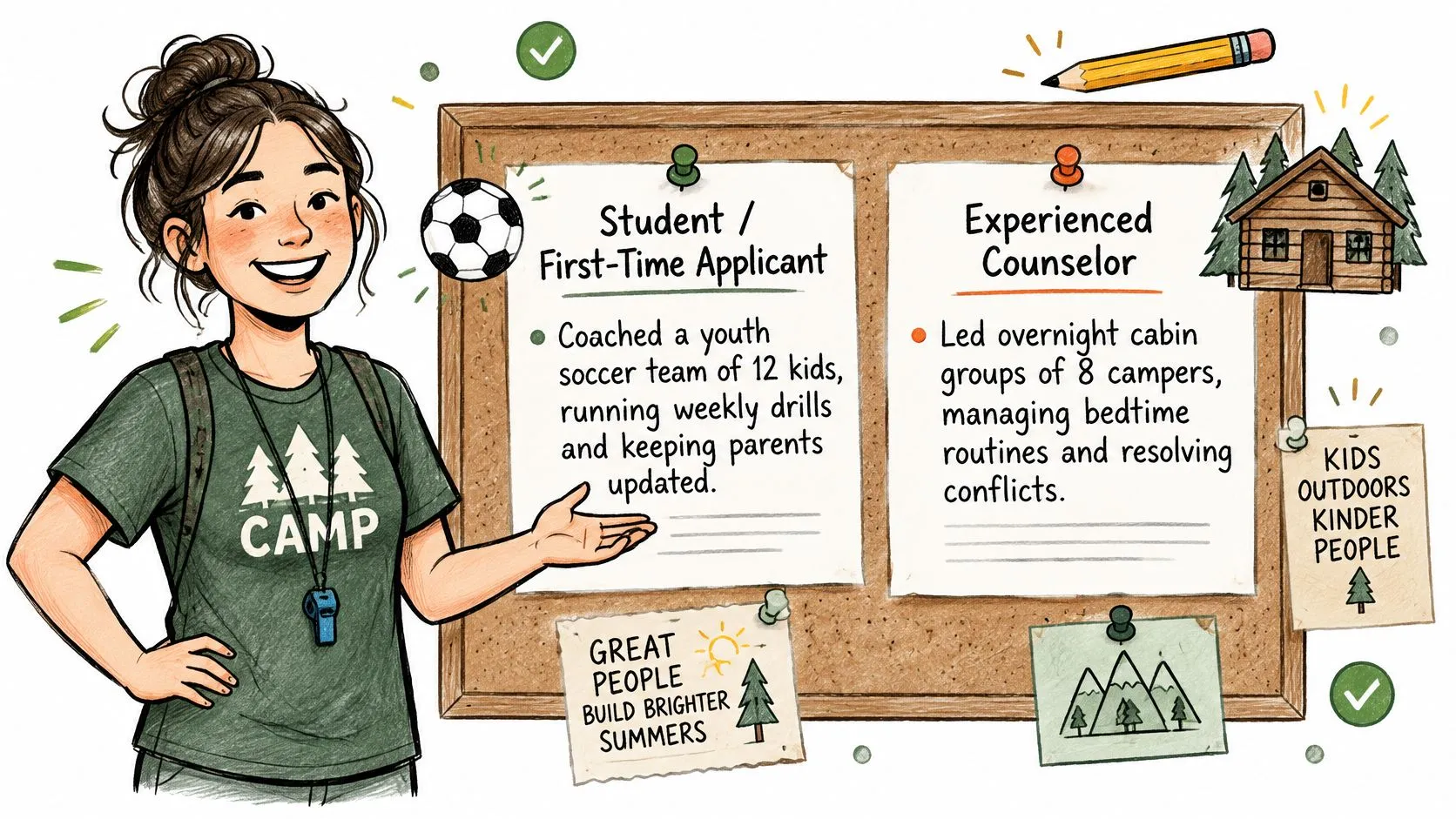
Students and first-time applicants
Coached a youth soccer team of 14 players ages 8-10 across a 12-week season, ran safety-checked drills, and tracked attendance at every session.
This works because coaching becomes evidence of instruction and supervision. The reader can identify whom you supported, for how long, and how you maintained accountability.
If you assisted the coach, write assisted rather than coached independently. If your experience was babysitting, use the same underlying structure but describe caregiving routines instead of drills. You don't need a camp job title to show relevant responsibility.
Returning camp staff
Returned for a second season as archery lead, supervising two range staff and sessions of 16 campers, and trained three new counselors on range safety rules.
This statement distinguishes progression from repeating a summer job. It identifies staff oversight, activity scope, and training responsibility.
Keep the title your camp used. If you demonstrated procedures but didn't supervise staff, describe the demonstration. A more senior-sounding title isn't worth an awkward reference check.
Career changers
Taught daily classroom groups of 28 students, managed behavior with clear routines, and wrote weekly progress updates for families.
The teaching example translates without jargon. A camp manager can recognize group management, consistency, and family communication immediately.
Nursing or retail experience needs different boundaries. Describe the procedures you were authorized to perform, or how you handled complaints and explained rules. Don't imply that adult customer service automatically equals experience supervising children.
Choose responsibilities that fit the opening
The Society for Human Resource Management's camp counselor description includes these responsibilities:
- Programming: Planning and leading arts, crafts, sports, games, camping, and hobby activities.
- Rules and facilities: Enforcing camp rules and maintaining safe recreational spaces.
- Instruction: Demonstrating equipment and teaching activity-specific safety.
- Camper support: Welcoming new campers, explaining facility rules, and handling complaints.
- First aid: Providing care according to prescribed procedures.
Choose the responsibilities you can substantiate. A focused account of actual work is stronger than a complete-looking list borrowed from a job description.
Matching Keywords from the Job Posting
Use the employer's wording when it accurately names your experience. You're making qualifications easier for a person to locate, not trying to satisfy an imagined scoring formula.
Sort relevant terms by where they belong:
- Certifications such as CPR, First Aid, AED, and lifeguarding go in the safety block. Match the credential's actual name rather than overstating its coverage.
- Supervision terms such as headcounts, attendance checks, and group supervision belong in experience bullets where you can show the task.
- Activities such as swim instruction, archery, arts and crafts, and outdoor education belong in the skills list when you can lead them.
- Conduct and inclusion terms such as behavior management, diverse populations, and inclusion support need examples of what you did.
- Logistics such as full-season availability, overnight stays, and relevant lifting capabilities belong in the header's availability or qualifications line.
A municipal camp counselor job description from Exeter illustrates how supervision, parent communication, training, and physical requirements can appear together. Treat the actual opening you're applying for as the deciding document.
If a sentence exists only to contain a keyword, rewrite it around an action or remove it.
For a practical method of tailoring your resume to a job description, copy the posting and highlight nouns that name skills, credentials, or responsibilities. Check each against your draft. Use accurate terms in their proper place rather than repeating them throughout the page.
Run the Quick Edit Checklist Before You Send
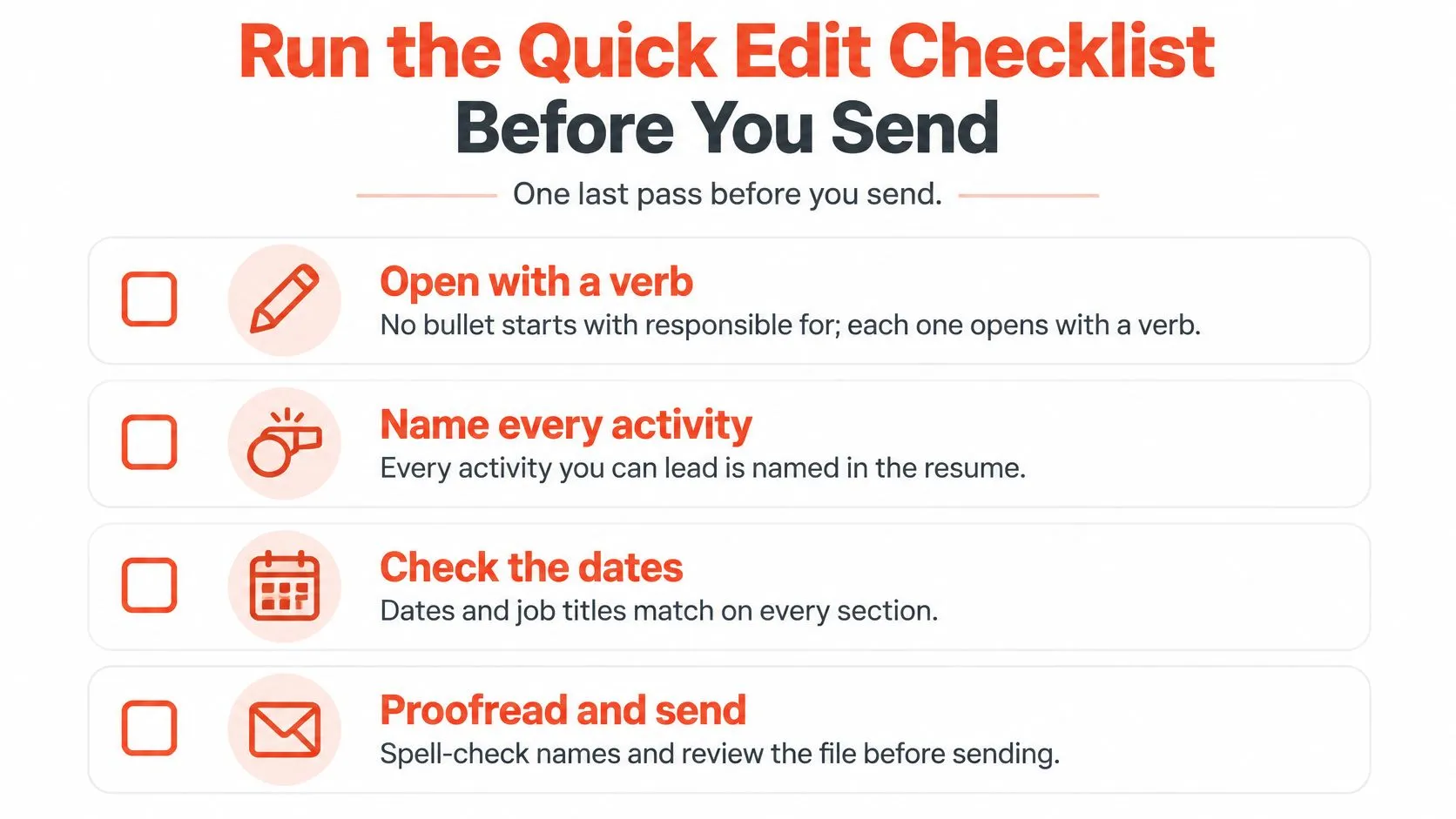
Run these checks before submitting:
- Open with a verb. Replace responsible for with the action you performed.
- Name your activities. Make sure the skills block identifies what you can lead.
- Confirm availability and format. Put your dates in the header and save the file in the format the camp requests.
- Defend every number. Be ready to explain its source and your individual contribution.
Use the visual checklist for the final proofreading pass, including names, dates, and job titles.
If describing the work is the sticking point, we ask what you owned, what you changed, and what happened next, then turn your answers into bullets. A full resume takes 1 to 1.5 hours to complete. Apply the same checks to the draft before using it.
Start with your most recent camp or youth role at StoryCV, where we interview you about the work and turn your answers into clear resume bullet points. It's free to start, including two finished bullet points, so you can check the wording against your actual supervision responsibilities before going further.