A strong resume usually doesn't have an achievement problem. It has a remembering problem.
Experienced professionals have solved expensive problems, made difficult decisions, protected customers, fixed broken processes, and learned skills they never expected to use. But by the time they write a resume, the context has gone missing. They remember the task, not the pressure around it. They remember the outcome, not who benefited. They remember the team win, but not their exact contribution.
That's why the usual advice, “just list your accomplishments,” fails. You need a reliable way to retrieve the story first. Then you can turn it into a defensible bullet without inflating your credit or hiding behind jargon.
These resume questions to ask yourself move from impact to evidence, then from evidence to clear language. They're designed for professionals with real experience who need a sharper way to explain it. If reflection helps you recover useful detail, these reflection exercises from Acheloa Wellness can give you another starting point.
StoryCV takes a similar approach as an online resume writer, not a template library. It uses a guided interview to uncover the narrative before drafting. Start with the first question.
1. What problem did I actually solve?
A resume that starts with duties hides the value of your work. “Managed projects” describes an activity. It does not explain the problem that made the project worth doing.
Start with what was broken before you arrived. Ask which friction kept repeating, which risk needed removing, or which decision lacked reliable information. A customer onboarding manager might have “managed the onboarding process,” while the actual problem was that new customers abandoned setup during the first week. Rebuilding the onboarding flow to reduce early churn gives the work a clear purpose.
Write this sentence before drafting a bullet:
Before I did X, the situation was...
Finish it in plain language. Engineers may have wasted time searching for outdated specifications. Sales leaders may have worked from inconsistent reports. Customers may have waited too long for answers because three teams owned different parts of the process.
Replace duties with decisions and outcomes
Use these questions to recover the story:
- Find the friction: What bottleneck, gap, failure, or recurring complaint did I address?
- Test your absence: If I had not acted, what would have continued or worsened?
- Separate task from problem: What did I do, and what changed because I did it?
- Notice repetition: Did the same issue return often enough to require judgment or ownership?
“Improved documentation” leaves the reader guessing about the cost of poor documentation. “Built a maintained documentation system that reduced time spent searching for specifications” connects the action to its purpose.
Look for a clear before and after, without manufacturing drama. The guide to writing impact statements can help you turn activity into consequence.
Include problems you solved outside your formal job description. They often show judgment more clearly than assigned responsibilities, because you recognized the gap and acted before someone handed you ownership.
2. Can I prove this with a number?
A number belongs on your resume only when you can explain its source, scope, and connection to your work. Start with the result, then find the evidence that supports it.
Use measures tied to time, money, speed, quality, accuracy, volume, or scale. “Improved team efficiency” leaves the value unclear. “Automated pipeline reviews, reducing weekly meeting time from eight hours to one and a half across a twelve-person sales team” shows the change and its reach.
Test every figure before you publish it
Search old dashboards, project notes, performance reviews, invoices, customer feedback, and status updates. Ask yourself:
- Find the measure: How did my manager define success?
- Name the scale: How many customers, users, teams, regions, systems, or projects were affected?
- Show movement: Did the work reduce time, errors, cost, delays, or rework?
- Clarify ownership: Is the number mine, or does it describe the team's result?
A shared result can still strengthen a resume. Use “contributed to” or “coordinated” when those verbs accurately describe your role. Claiming the entire outcome makes a strong achievement harder to defend.
Then rehearse the explanation. Could you tell a recruiter how the number was measured, which period it covered, and what part of the improvement came from your work? If the answer is unclear, keep investigating or replace the figure with a precise qualitative description. This metrics in a resume guide can help you select evidence that belongs in the bullet.
Choose the number that clarifies value, not the one that merely looks impressive. A smaller, defensible measure gives the reader more confidence than a larger figure you cannot explain.
3. Who benefited from what I did?
The strongest resume bullets identify the person whose work became easier, safer, faster, or more reliable because of yours.
Start with the beneficiary, then connect that person to your action and its effect. “Implemented a new CRM” records an assignment. “Implemented a CRM that gave the sales team cleaner pipeline visibility” shows who used the result and why the work mattered. A hiring manager can then assess whether you could create similar value for their organization.
Name the customer, colleague, executive, user, supplier, or wider company that gained from the change. If several groups benefited, choose the one closest to the outcome you can defend.
Write for the person who felt the difference
Ask yourself:
- Who struggled before the change? Identify the frustrated group.
- Who used or depended on the result? Name the recipient.
- What changed for them? Describe faster work, fewer surprises, lower effort, clearer decisions, or greater reliability.
- What did their improvement affect? Connect it to delivery, quality, retention, revenue, or capacity only when you can support the connection.
“Built an analytics dashboard” leaves the user and purpose unclear. “Built an analytics dashboard for the product team, helping them identify high-value user journeys” gives both details.
The beneficiary also gives you a stronger interview story. Explain the result from that person's perspective. Customers may have spent less effort. Finance teams may have faced fewer surprises. Engineering teams may have delivered faster. Those perspectives turn a task into a contribution.
Avoid vague praise such as “Built a tool customers loved.” Describe adoption, feedback, reduced effort, or a specific customer outcome you can verify.
Ask more than “What did I do?” Ask, “Who felt the difference?” Then write the bullet around that person.
4. Am I claiming credit I didn't earn?
A strong resume claim should survive a skeptical follow-up.
Write “led a product launch” only if you can explain the decisions you owned, the decisions handled by marketing or sales, and how you resolved disagreements. If you supported the launch, state that role plainly. Accurate scope protects your credibility and gives the interviewer a clearer story to explore.
Shared results still belong on your resume. Other people's involvement does not erase your contribution. It defines the boundaries you need to describe.
Name the work you owned
Choose your verb from the responsibility you carried:
- Use “led” when you owned direction, decisions, or accountability.
- Use “drove” when you pushed progress across people or functions without owning every decision.
- Use “coordinated” when you connected contributors and kept the work moving.
- Use “contributed to” when the outcome was shared and your role was one part of it.
“Grew the company's revenue” claims more than one person usually controls. “Built the reporting process used by the sales team to identify renewal risks” is credible when that was your work.
Apply the same standard to team growth. If recruiting, operations, and leadership shaped the outcome, describe the pipeline, onboarding system, or hiring process you owned. Do not present yourself as the sole architect.
Before keeping a bullet, test every sentence. Could you name the decisions, constraints, collaborators, and trade-offs behind it? Could you explain what changed because of your work? If not, narrow the claim until the evidence matches.
Honesty gives your resume sharper specificity. It also turns the document into a useful career interview, one that distinguishes your actual judgment from work you merely observed.
5. Can I point to someone who'd vouch for this?
A resume claim should survive a follow-up question. Identify the person who saw the work closely enough to confirm what you did and what changed.
That person could be a manager, product partner, customer, senior executive, or colleague who relied on your output. You will not list their name on the resume, but their perspective can expose vague wording and recover details you have forgotten.
Start with the evidence, not a template. Review performance feedback, project messages, customer notes, and one-to-ones. Look for the behavior someone recognized, the work they reused, or the result they connected to your contribution.
“Improved team morale” says very little. If a manager observed that structured retrospectives changed how the team discussed problems, write about the retrospectives and the change in discussion. The witness helps you replace an impression with an observable action and outcome.
A witness cannot rescue an unsupported claim. You still need to explain your role and the result.
For example, replace “Mentored junior developers” with a clearer account: coached a junior developer through a project that they later owned and shipped. Their progress gives the mentoring claim a visible outcome and shows what your coaching involved.
Use these questions to test the story:
- Who directly saw me do the work?
- What did that person notice or repeat afterward?
- What changed for them, their team, or their customer?
- Could I explain the contribution without borrowing credit?
Keep names private and off the resume unless an employer explicitly requests references. Their role is to anchor your memory, sharpen your wording, and prepare you for an interview conversation.
You can also review LinkedIn recommendation samples to see how people describe genuine contributions with specific language. Do not copy the praise. Extract the concrete behavior beneath it, then connect that behavior to your own evidence.
6. What skill did I use that surprised me?
Your strongest resume skill may have appeared outside your job description. Find the moment when the work demanded more than your title suggested, then show what you did with that demand.
A sales operations analyst may have taught a reluctant team to adopt a new system. An engineer may have interviewed customers and turned confusing feedback into a product decision. An HR coordinator may have spotted patterns in employee data that others missed. These examples reveal adaptability, but the true value lies in the behavior and result.
Start with the incident, not the skill label. A technical professional pursuing management might find stronger leadership evidence in incident reviews than in formal supervision. An operations professional moving toward strategy might show strategic judgment by removing a recurring process instead of improving it.
Write the story in one line:
Problem: What forced you beyond your usual responsibilities?
Action: Did you teach, negotiate, analyze, persuade, simplify, or mediate?
Result: What changed because you used that ability?
“Communication” is not a useful answer. Specify the work: translated technical constraints for a nontechnical customer, persuaded a vendor to change terms, or wrote documentation that let another team work independently.
Then ask what the example changes about your career story. If you are applying for management roles, teaching and conflict resolution may matter more than another technical task. If you are targeting strategy, the decision to stop an inefficient process may carry more weight than process improvement alone.
The unexpected skill should connect to evidence you already earned. It is not a new identity or a decorative keyword. It is proof that your experience reaches beyond your title, and that you can recognize and apply useful abilities when the obvious solution fails.
7. What would I do differently if I could go back?
Your answer belongs in the interview preparation behind the resume. It shows whether you can examine a decision after the result, not merely describe a polished success.
Review one achievement without protecting your image. Identify the choice you made, the constraint you faced, and the consequence you accepted. Then decide whether you would change the approach, repeat it, or change only the timing.
For a customer feedback program, you might have collected useful insights while involving the product team too late. The resume should state the program and its output. In an interview, explain that you would involve product earlier to prevent duplicated work. That answer demonstrates judgment because it connects a specific lesson to a real operating decision.
Use this short review:
- Decision: What did you choose, and what did you own?
- Trade-off: What became harder because of that choice?
- Lesson: What would you change next time, and why?
- Context: Which constraint made the original decision reasonable?
Reflection should sharpen the evidence, not turn into self-blame. Explain the process, the judgment behind it, and the part you would repeat. If the original approach was measured, collaborative, and effective, say why you would use it again.
Hiring managers do not need a flawless highlight reel. They need a professional who can defend results, acknowledge limitations, and make better choices with clearer information. Your answer should make the achievement more credible, because it shows ownership beyond the final outcome.
8. What's the simplest way to say what I did?
A resume bullet should sound like an explanation from a capable colleague, not a service brochure. Start with the work, the change it produced, and the people or process affected.
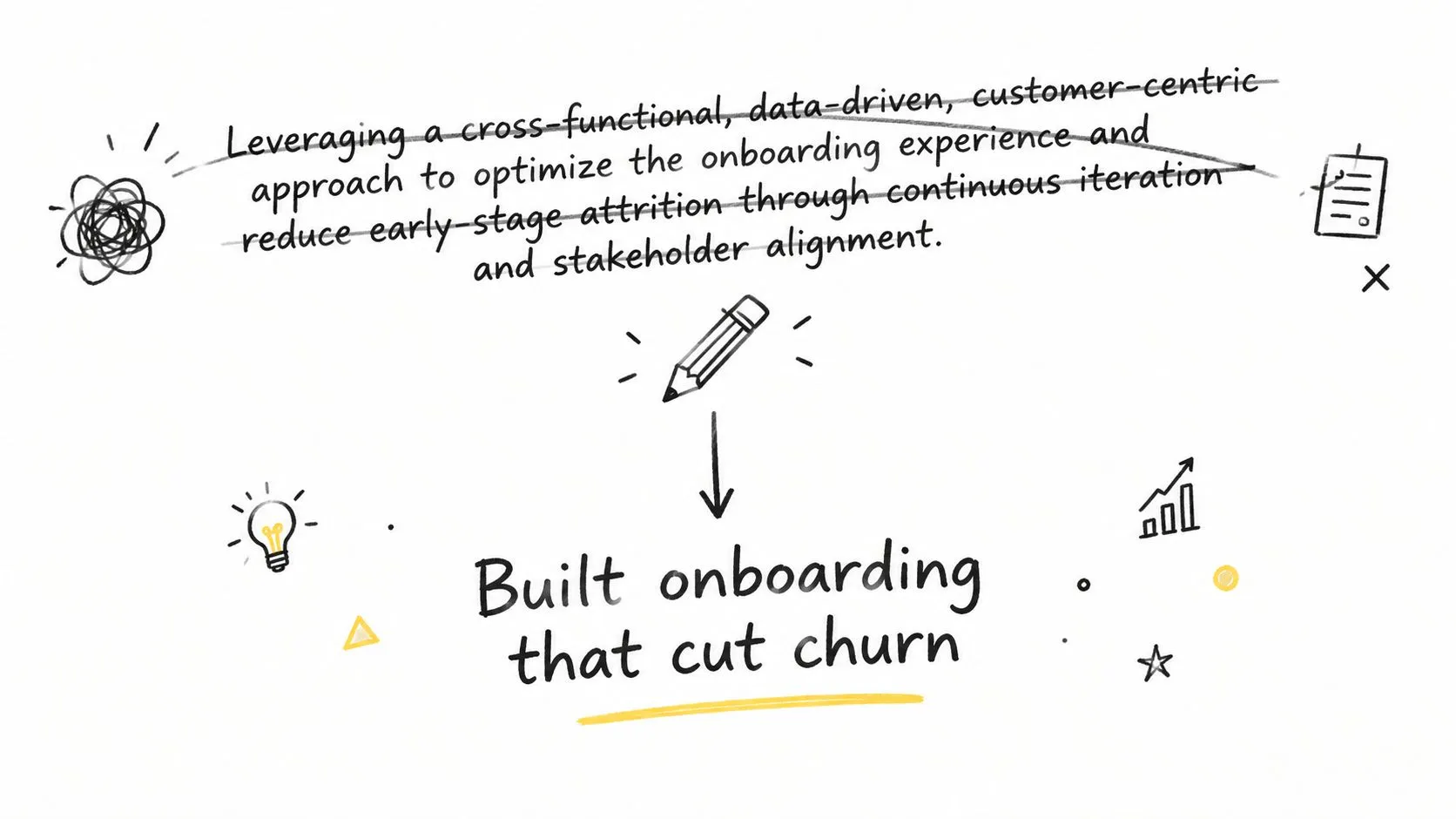
“Facilitated agile transformation initiatives to drive operational excellence” hides the useful information. Say, “Moved the team from waterfall planning to two-week sprints and reduced project delays.” The second version gives the reader a clear achievement to understand and discuss.
Plain language signals control. If you understand the work, you can explain it without making the reader decode jargon.
Read each bullet aloud. Then ask:
- Can a nontechnical person explain it? Remove terminology that does not clarify the work.
- Does the verb show action? Replace vague verbs like “leveraged” and “supported” with the specific action you took.
- Does the result appear quickly? Put the consequence near the start instead of burying it under qualifications.
- Is the industry term necessary? Keep terms that help searchability, but do not let them replace meaning.
“Architected scalable infrastructure to enhance system resilience” can become, “Rebuilt infrastructure to handle higher traffic and reduce service outages.” “Synthesized cross-departmental insights to catalyze process optimization outcomes” can become, “Compared reporting across three departments, removed duplicated work, and saved the team time each week.”
Use the words colleagues used when describing the work. If a sentence sounds like a vendor presentation, rewrite it until the action and outcome are obvious.
ATS compatibility and human readability can work together. Include standard role terms and skills so systems can classify your experience, then explain the judgment behind those skills in ordinary language. Keywords may help your resume get noticed. Clear evidence helps a hiring manager trust it.
9. What career direction am I building toward?
A resume should point toward your next role, not preserve every task from your last one. Decide the direction first, then test each experience against it.
Write that direction in one sentence: operations leadership, technical management, deeper engineering ownership, product strategy, or a move into another function. This turns resume writing into a career interview. You are asking what problem you want to solve next, what proof shows you can solve it, and who benefited from your past decisions.
A mid-career operations professional should give space to process redesign, cross-functional ownership, operational scale, and decisions that improved how the business worked. Administrative duties belong only when they support that story. A technical professional pursuing people management should show mentoring, hiring, prioritisation, delivery, and team health alongside technical judgment.
Review your experience with three questions:
- Which pattern appears repeatedly in my strongest work?
- What evidence proves I can contribute at the next level?
- Which stories would make a hiring manager trust that direction?
You may find leadership in crisis decisions, strategic ownership in difficult trade-offs, technical depth in systems or risks you handled, and transferable value in skills that survive a title change. Group examples by the capability they demonstrate, then keep the examples with clear ownership and outcomes.
Do not reshape your identity to match a job advert. If your intended direction is unsupported, address the experience gap. If the pattern exists but remains hidden, edit the resume instead of exaggerating it.
A focused resume will leave out valid tasks. That is necessary. Give the reader evidence for the next move, using these employability and work skills subjects to identify capabilities your target role requires. Your direction decides which stories earn attention.
9-Point Resume Self-Assessment
| Item | Complexity 🔄 | Resource requirements ⚡ | Expected outcomes 📊 | Ideal use cases 💡 | Key advantages ⭐ |
|---|---|---|---|---|---|
| What problem did I actually solve? | Medium 🔄 (analysis & context) | Low ⚡ (time for reflection) | Concrete impact statements; problem→result | Rewriting bullets to show impact | Distinguishes outcomes from tasks ⭐⭐⭐ |
| Can I prove this with a number? | Medium–High 🔄 (data collection/validation) | Medium ⚡ (access to metrics) | Quantified, defensible claims | Roles with measurable KPIs; data-driven resumes | Makes achievements memorable and verifiable ⭐⭐⭐⭐ |
| Who benefited from what I did? | Low–Medium 🔄 (identify stakeholders) | Low ⚡ | Stakeholder-centered outcomes | Customer-facing, cross‑functional stories | Connects work to real beneficiaries ⭐⭐⭐ |
| Am I claiming credit I didn't earn? | Low–Medium 🔄 (scope clarification) | Low ⚡ | Honest, defensible wording | Avoiding resume inflation; reference checks | Builds credibility and interview resilience ⭐⭐⭐ |
| Can I point to someone who'd vouch for this? | Low 🔄 (identify witnesses) | Low–Medium ⚡ (locate feedback) | Referenceable achievements; documented proof | Senior roles; high‑impact claims | Anchors claims in social proof ⭐⭐⭐ |
| What skill did I use that surprised me? | Low 🔄 (self-audit) | Low ⚡ | Distinctive, memorable stories | Differentiation; career pivots | Highlights transferable, unexpected strengths ⭐⭐⭐⭐ |
| What would I do differently if I could go back? | Medium 🔄 (reflective analysis) | Low ⚡ | Nuanced narratives and learnings | Interview prep; demonstrating growth | Shows maturity and honest self‑assessment ⭐⭐⭐ |
| What's the simplest way to say what I did? | Low 🔄 (language editing) | Low ⚡ | Clear, concise bullets; better skimability | Any resume; ATS + human readers | Improves clarity and recall ⭐⭐⭐⭐ |
| What career direction am I building toward? | Medium–High 🔄 (strategic selection) | Medium ⚡ | Focused resume narrative aligned to goals | Mid/senior transitions; targeted searches | Creates coherent positioning for next role ⭐⭐⭐ |
Turn Answers Into a Resume That Sounds Like You
Start with rough answers. Don't try to sound professional yet. Write the messy version: what was broken, who needed help, what you changed, what happened, and what you'd do differently.
Then collect proof. Look through reviews, project documents, dashboards, customer messages, planning notes, and feedback. Separate the team result from your contribution. If the outcome belonged to several people, say what you owned. If the evidence is qualitative, use clear language instead of inventing a number.
Next, choose the stories that support the role you want. A resume for people leadership needs different evidence from a resume for technical specialization. A career changer needs to make transferable skills visible. A returning professional needs to explain continuity, learning, and direction without sounding defensive.
Finally, rewrite each story in plain language. Start with a strong verb, name the problem or decision, identify who benefited, and include defensible proof when you have it. Remove tasks that don't show judgment, change, scale, or value.
Your resume is the edited result, not the full reflection. The reflection helps you retrieve the material. The resume keeps only the parts that support your next move.
The machine still matters. Large employers commonly use applicant-tracking systems, and ATS research reports note that filters can rely on keywords, skills, and education signals. Use standard headings, recognizable job titles, and relevant language. But don't mistake formatting for substance. A perfectly parsed resume with weak evidence is still weak.
The screening environment also rewards clarity. A long-running eye-tracking benchmark popularized by TheLadders found that hiring managers spent about 7.4 seconds on an initial resume scan, while later summaries continue to describe first-pass reviews as taking under 10 seconds. The practical lesson is simple: the first third of the page must make your fit, impact, and scope easy to find. Resume screening statistics provide the background for that benchmark.
Customization matters too. One 2026 application dataset cited by TalentTuner reported interview rates of 4.23% for customized resumes versus 2.07% for generic resumes. Treat that as a reason to align your evidence with the role, not as permission to stuff keywords into every line. TalentTuner's research also highlights the larger issue: content-to-job mismatch often matters more than cosmetic polish.
Your career may not be linear. You may have a caregiving break, a layoff, contract work, military experience, or a move across functions. Employer guidance from SEEK recommends addressing the reason for leaving, what you learned during a break, and how you decided what to do next. SEEK's guidance on resume gaps supports a direct approach. Explain continuity and relevance. Don't hide a gap behind confusing dates.
Length should follow evidence. Indeed says one page is ideal for students, new graduates, and professionals with 1 to 10 years of experience, while many hiring managers accept two pages for applicants with several relevant years, often more than 5 to 10 years. Indeed's resume length guidance gives the practical baseline. A separate summary of ResumeGo findings reports recruiters were 2.3 times more likely to prefer a two-page resume, with 1 page for 0 to 5 years, 1 to 2 pages for 5 to 10 years, 2 pages for 10 to 15 years, and 2 to 3 pages for 15 or more years. The Wobo summary reinforces the same principle: use the space your relevant evidence needs.
When you need editorial judgment, a guided interview approach such as StoryCV can help turn nuanced answers into clear, ATS-compatible narratives. Review every claim yourself before sending it. The final resume should sound like you, because you'll be the one defending it in the interview.
You can continue the reflection with practical conversion optimization social posts if you want prompts that sharpen the way you communicate value. Keep the useful parts. Ignore anything that asks you to sound like a brochure.
StoryCV is an AI-powered online resume writer that interviews you about your problems solved, ownership, evidence, and career direction. Visit StoryCV to turn those answers into clear resume drafts that balance ATS compatibility with a human narrative.