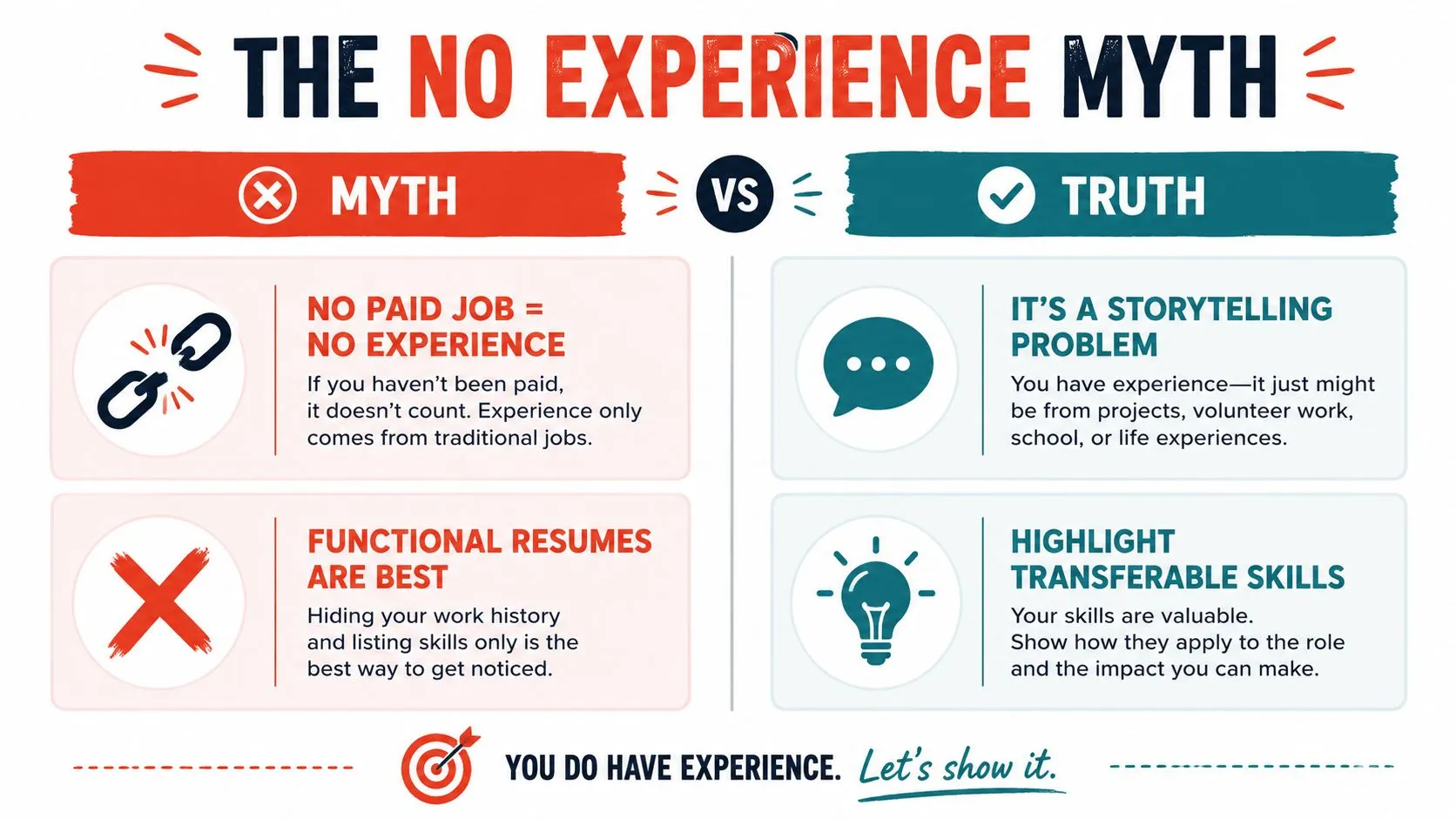
Most advice about a resume for no job experience is wrong. The biggest lie is that you should hide your lack of paid work behind a functional resume.
That advice gets people rejected.
You do not have an experience problem. You have a framing problem. School projects, volunteer work, leadership roles, certifications, freelance gigs, community work, and personal projects all count. The job is to present them in a format recruiters and ATS can read.
The No Experience Myth and Why Your Resume Fails
The phrase “no experience” does a lot of damage. It makes smart people leave half their story off the page.
The primary issue is usually structure. A lot of guides still push a functional resume, which groups skills and avoids a timeline. That sounds safe. It isn't. 85% of modern recruiters and ATS systems now explicitly reject functional resumes as non-standard or difficult to parse, and a 2025 industry survey says functional resumes decrease interview chances by 32% compared to chronological resumes with relevant experience sections (Coursera on resumes with no experience).
What recruiters actually want
Recruiters want to answer three questions fast:
- What did you do
- Where did you do it
- When did you do it
A functional resume often dodges all three. It forces the reader to guess where your skills came from. That's not persuasive. It's annoying.
Stop trying to disguise your lack of paid work. Replace it with evidence.
The myth versus the useful truth
| Bad advice | Better move |
|---|---|
| Use a skills-only format | Use a chronological format with a strong Relevant Experience section |
| Leave off unpaid work | Include projects, volunteer work, clubs, research, and community leadership |
| List soft skills only | Show where those skills were used and what came out of it |
Another common mistake is sending the same generic resume everywhere. That fails even harder when you don't have job titles doing the heavy lifting.
If your previous resume for no job experience wasn't getting traction, there's a good chance the problem wasn't you. It was the format. The fix is simple. Keep the timeline. Make your non-paid experience look like real experience, because it is.
Build a Relevant Experience Section That Works
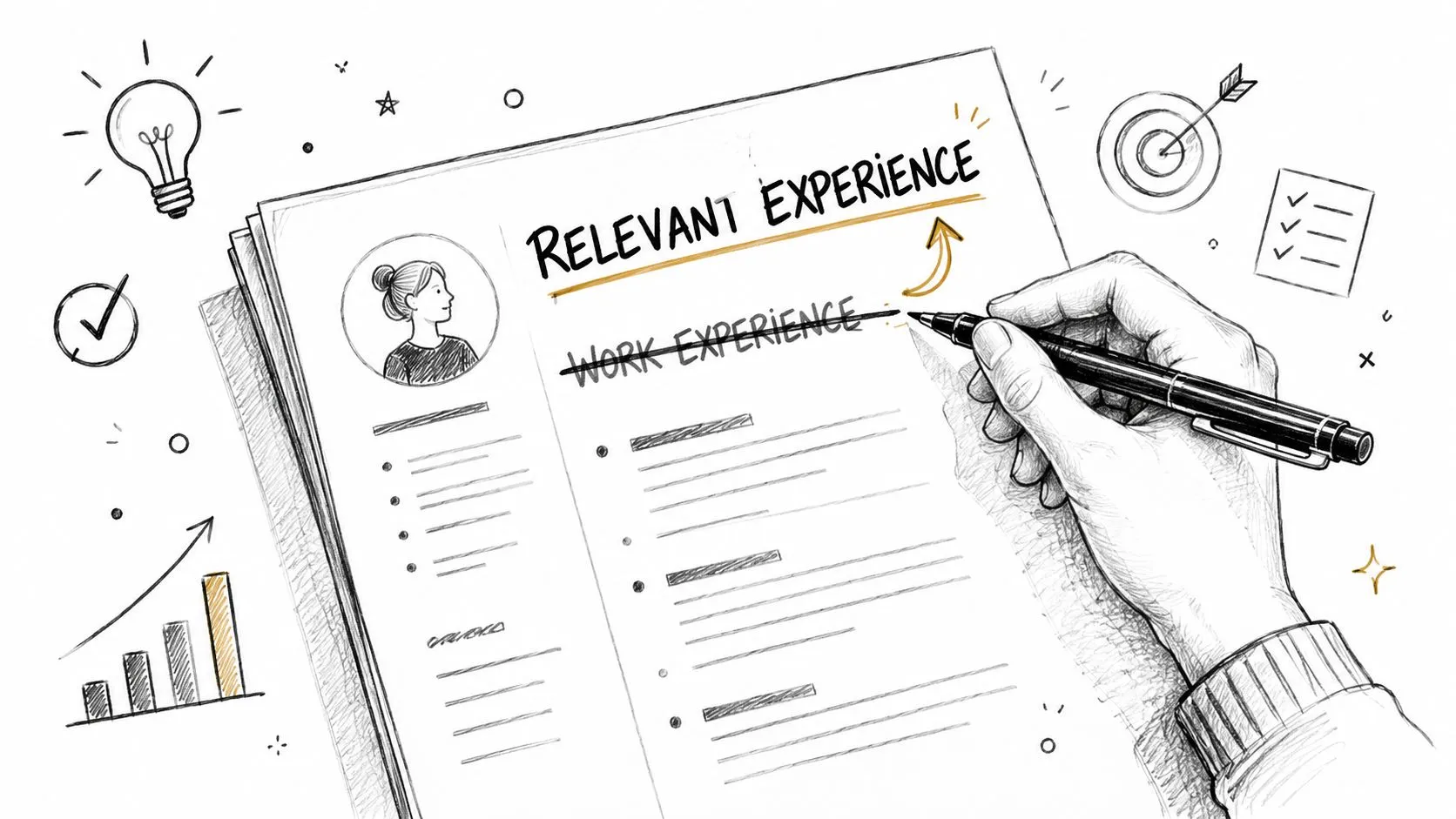
Rename the section. That alone fixes a lot.
If “Work Experience” makes your resume look empty, use Relevant Experience or Projects and Leadership. Both are honest. Both are readable. Both let you keep a normal structure.
What belongs in this section
A relevant experience entry should look like a real role. Include a title, organization, dates, and bullets.
Good candidates for this section:
- Academic projects that match the target job
- Volunteer roles with real responsibilities
- Student leadership such as club officer or event lead
- Personal projects like a portfolio site, app, research blog, or design work
- Internships or micro-internships, if you have them
- Freelance or informal client work, even if it was small
Use reverse chronological order
List your most recent item first. Then go backward. That format is familiar to recruiters and easier for ATS to parse.
A lot of candidates skip tailoring. That's a mistake. 54% of candidates fail to tailor their resume to match the specific job description (Skillademia resume statistics). If you have no paid work history, tailoring matters even more because your project titles won't automatically signal relevance.
Here's the practical version:
- Match the language from the job ad when it's true
- Pick the right projects instead of dumping everything in
- Reorder bullets so the most relevant evidence comes first
Practical rule: If the job asks for research, coordination, Excel, writing, or customer support, those words should appear naturally in your experience bullets when they reflect what you actually did.
A simple example
Instead of this:
- Member, University Business Club
Write this:
Events Coordinator
University Business Club | 2024 to 2025
- Planned speaker sessions and coordinated communication with students and guest presenters
- Managed event logistics and promoted attendance through email and campus outreach
- Worked with club leadership to keep events organized and on schedule
That reads like experience because it is experience. A recruiter can follow it. An ATS can parse it. That's the point.
Turn Your Education into Proof of Skill
Your education section shouldn't just confirm that you went to school. It should prove you can do the work.
Most weak resumes list a degree, a school name, and a date. That's dead space. A stronger resume uses education to show competence, focus, and momentum.
What to include
For a resume with little or no paid work, your education section can carry real weight. Include:
- Degree and institution
- Graduation date or expected date
- GPA if it is 3.0 or higher
- Academic honors or scholarships
- Capstone project
- Relevant coursework, ideally 3 to 5 classes
That guidance lines up with Indeed's advice on writing a resume with no experience, which recommends including the degree earned, institution name, graduation date, GPA if it is 3.0 or higher, honors, scholarships, and capstone work with a brief explanation of the result and your contribution.
Don't list classes like a transcript
Coursework only helps when it supports the job you want.
Bad:
- Intro to Marketing
- Business Writing
- Statistics
- Economics
Better:
- Business Writing for formal reports and persuasive communication
- Statistics for data analysis and spreadsheet-based decision making
- Digital Marketing with campaign planning and audience research
- Consumer Behavior for market insight and presentation work
Make one school project do real work
If you completed a capstone, thesis, final presentation, design build, or research project, give it a line or two. Name the project. State the outcome. Clarify your role.
Example:
Capstone Project, Customer Retention Analysis
Built a retention recommendation deck using survey results and spreadsheet analysis. Presented findings to faculty panel and proposed changes to improve student engagement.
That's not filler. That's proof.
If you're building job-ready skills outside a degree path, targeted training can also strengthen this section. For readers exploring practical programs, these Industry Horror job training resources are useful because they focus on training routes that can turn into credible resume material.
Write Bullet Points That Prove Your Value
Many resumes fail at this stage. The entry exists, but the bullet points say nothing.
“Helped with project.”
“Participated in event.”
“Responsible for research.”
That language wastes space.
Use contextual metrics
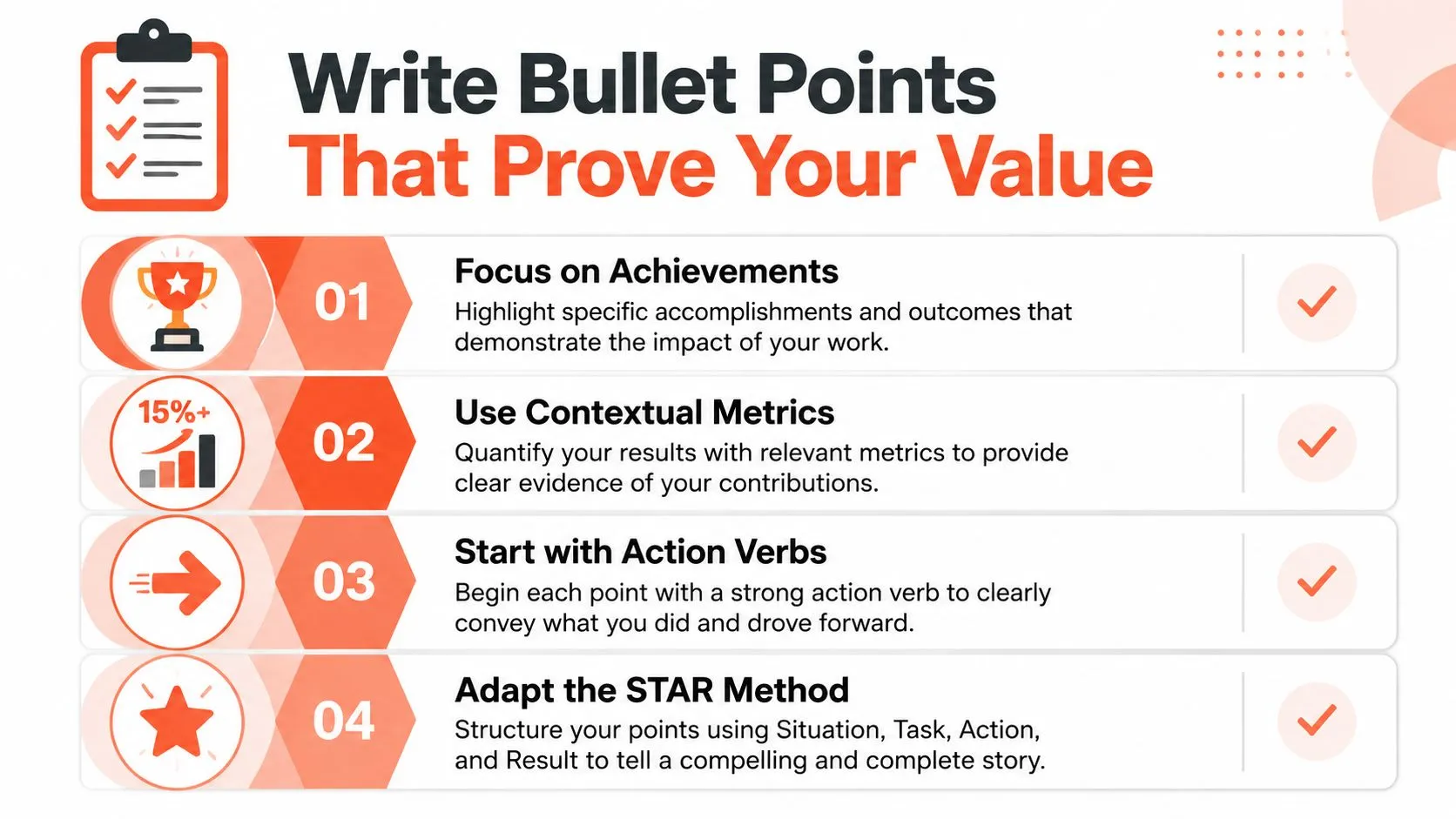
You do not need sales quotas or budget ownership to quantify impact. Use contextual metrics. That means counting the scale, speed, scope, participation, output, or result of what you did.
Resumes with 3+ contextual metrics receive 41% more attention from recruiters than those with only generic bullet points (Reddit discussion citing 2025 hiring data).
That matters because people writing a resume for no job experience often assume they have nothing measurable. They do. They just don't call it that.
A simple formula:
Action verb + task + context + result
For more help shaping bullets, this guide on how to write achievements in a resume is worth keeping open while you edit.
Before and after examples
“Write bullets like a witness, not a participant.”
Class project
Before:
- Worked on a group presentation for a marketing class
After:
- Researched competitor messaging and presented recommendations in a group marketing project, helping shape the final presentation for the class panel
Volunteer role
Before:
- Helped at community events
After:
- Coordinated check-in and volunteer communication for a community event, supporting a team of volunteers and keeping event setup on schedule
Personal project
Before:
- Built a website
After:
- Designed and launched a personal portfolio website to showcase writing samples and project work, organizing content for easier navigation and clearer presentation
Here's a useful walkthrough if you want to hear the logic out loud:
What to measure when you have no job metrics
Use what you can honestly count:
- Team size you worked with
- Number of events, presentations, or deliverables
- Time saved through a better process
- Participation or attendance
- Project duration
- Tools used, such as Microsoft Excel, Google Workspace, Canva, Figma, Python, or WordPress
If you can count it, compare it, or point to an outcome, it belongs in a bullet.
Nail the Summary and Skills Sections
The top third of the page decides whether the rest gets read.
A weak summary says you're “motivated,” “hardworking,” and “seeking an opportunity.” That tells nobody anything. Cut it.
A summary formula that works
Use three lines:
- Who you are
- What you work with
- What kind of role you're targeting
Example:
Recent Business Administration graduate with experience in student leadership, event coordination, and research-based projects. Strong with Microsoft Excel, Google Workspace, and written communication. Seeking an entry-level operations or administrative role where organized execution matters.
That's enough. No life story. No vague ambition.
How to handle the skills section
You'll see some advice telling you to put a categorized skills section first on a functional resume. That recommendation appears in guides like ResuFit's resume with no work experience examples. I wouldn't use that structure for the reasons covered earlier. But the underlying point is still useful. Your skills need to be easy to scan.
Build a short skills section that mixes hard and soft skills relevant to the role.
For example:
- Software and tools Microsoft Excel, Google Docs, PowerPoint, Canva
- Technical skills data entry, research, presentation design, scheduling
- Working skills time management, teamwork, written communication, attention to detail
If you need help choosing which skills belong, this guide to resume skills with examples is a decent starting point. Then tighten your list using this StoryCV article on the resume skills section.
Use the job description as a filter. If a skill doesn't help you win this role, it doesn't need to be there.
The Final Polish and Your Next Step
Keep it to one page. Save it as a PDF. Use a clean filename like FirstName-LastName-Resume.pdf. Then proofread it three times.
That last part matters more than people think. A typo on a resume with limited experience doesn't look minor. It looks careless.
What to check before sending
- Section names should be clear and standard
- Dates should be consistent
- Bullet points should start with strong verbs
- Formatting should look even from top to bottom
- Claims should be true and defensible

The harder part isn't formatting. It's pulling your own story out of your head and turning it into sharp language. If you need structure for that, StoryCV works as an online resume writer that guides you through questions to uncover achievements, context, and clearer phrasing instead of making you fill in boxes. If you're still figuring out how to approach applications more broadly, this guide on how to apply for a job without experience is a useful next read.
And if you're in a field where first-role positioning is especially tricky, role-specific resources help. For example, this piece on securing your first nurse job is a solid example of matching early experience to a real hiring path.
Your resume does not need fake authority. It needs readable proof.
If you want help turning school projects, volunteer work, and uneven early experience into a resume that reads like real professional value, try StoryCV. It helps you pull out the details that usually get missed, then turns them into a cleaner, stronger draft without the usual template sludge.