Most advice about an automobile mechanic resume is wrong. It tells you to list tasks, tools, and duties, like a service manual exploded onto a page. Hiring managers don't need a catalog. They need proof you can diagnose, fix, and improve a shop.
If your resume says you "performed repairs" and "used diagnostic tools," you've said almost nothing. A parts-swapper can write that. A real diagnostician writes the result of the diagnosis, the speed of the repair, the reduction in comebacks, and the reason customers trusted the recommendation.
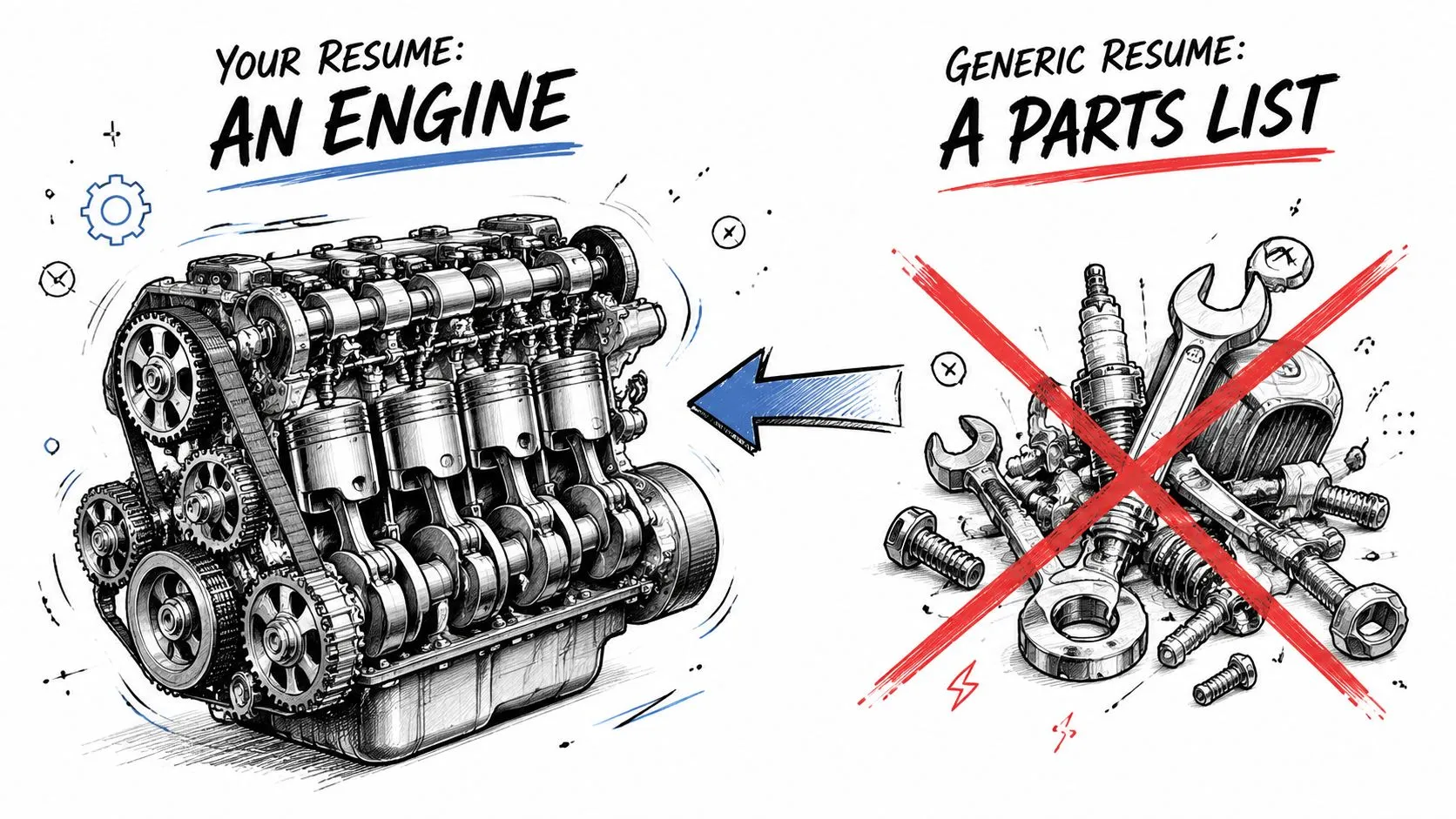
Your Resume Is an Engine Not a Parts List
A mechanic resume should show force, flow, and output. I want to see how your work kept cars moving, bays productive, and customers saying yes to the right repairs.
Task lists don't do that. "Changed oil," "repaired brakes," and "diagnosed issues" read like a repair order after the useful details got stripped out. Any lube tech or parts changer can claim the same things. A strong resume proves judgment. It shows that you found the root cause, fixed it right, documented it well, and helped the shop make money without sacrificing quality.
That business angle is what separates a senior technician from another applicant with a toolbox. Your resume needs to translate physical work into shop results. Faster turnaround. Fewer comebacks. Clearer recommendations. Better approval rates. If you also want to attract opportunities via LinkedIn, your resume and profile should tell the same story.
What hiring managers look for
I scan for three signals right away:
- Diagnostic judgment. You solved faults, confirmed causes, and avoided wasted parts and labor.
- Shop contribution. Your work improved cycle time, reduced rework, supported advisors, or raised billed hours.
- Communication. You wrote findings clearly enough that service advisors could sell the repair and customers could trust it.
One line should answer one question. Why did your work matter to the business?
If your bullets can't do that, rebuild them. A good place to start is reviewing professional summary examples for resume so you can hear the difference between generic wording and language that sells value.
Parts list versus engine
The difference is simple.
| Weak bullet | Strong bullet |
|---|---|
| Performed diagnostics on vehicles | Diagnosed drivability and electrical faults with scan data and test results, cutting wasted teardown and helping the shop keep bays moving |
| Repaired brake systems | Completed brake inspections and repairs with clear documentation, giving advisors the evidence to explain safety concerns and win faster approvals |
| Helped customers understand repairs | Turned technical findings into plain language, improving trust and reducing pushback on recommended work |
A real resume has pressure behind every line. If a bullet shows only the task, it's dead weight. Keep the bullets that prove output, judgment, and business impact. Cut the rest.
The Headline and Summary That Gets You Called
Hiring managers make a decision fast. The top of your resume either tells me what bay I can trust you with, or it wastes my time.
Your headline and summary are not a career objective. They are a positioning statement. Their job is to tell the shop owner, service manager, or fixed ops director three things right away. What you specialize in. How you work. Why your work makes the business run better.
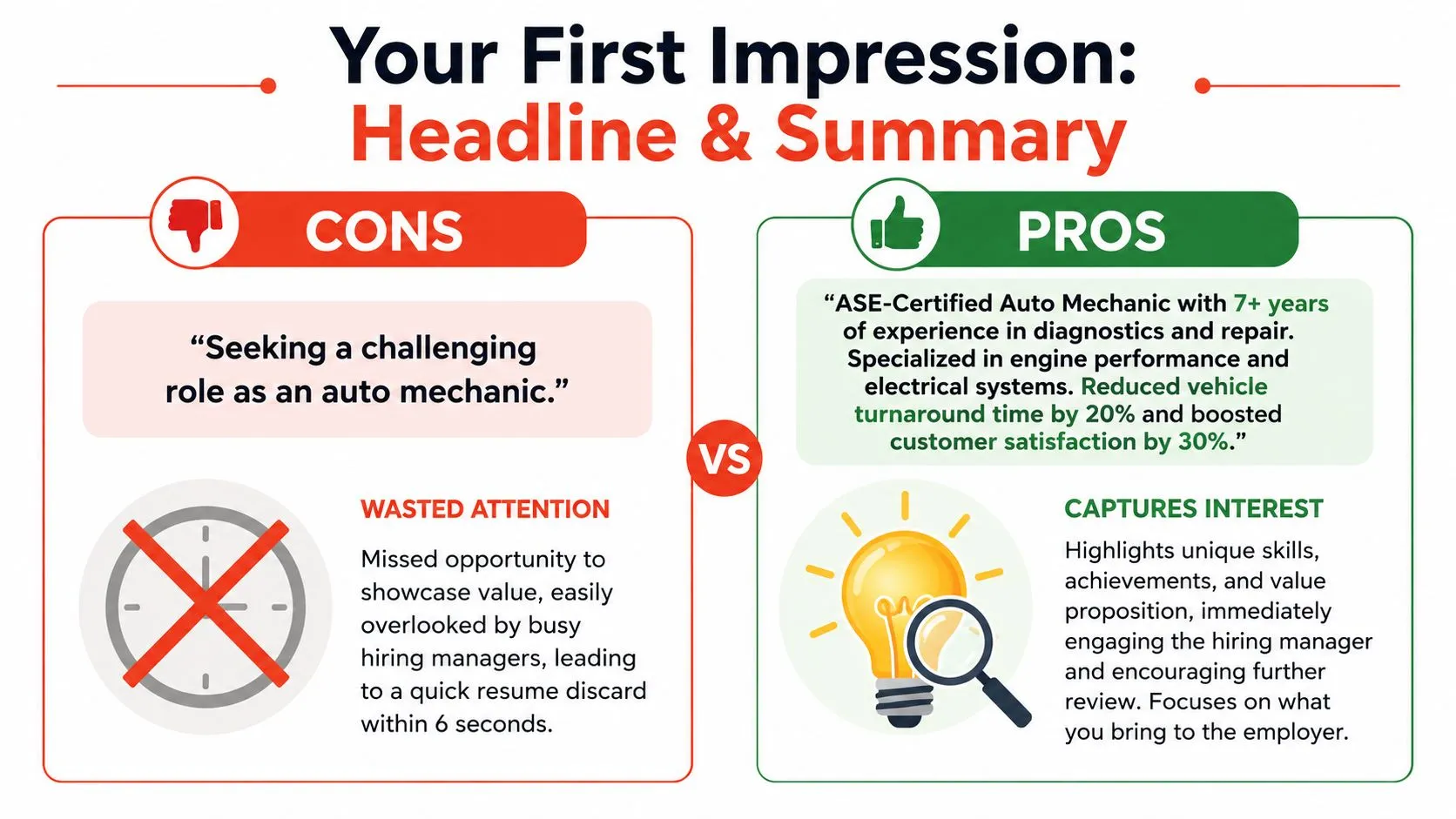
Your headline should name your lane
Be specific. "Automobile Mechanic" is too broad. It says you turn wrenches. It does not say whether you can diagnose an intermittent electrical fault, handle heavy line work, or keep work flowing without tying up a bay.
Use a headline that tells the shop where you create value:
- Automotive Technician | Electrical Diagnostics and Driveability
- ASE-Certified Mechanic | Brake, Suspension, and Front-End Specialist
- Senior Auto Technician | Domestic, Import, and Shop Workflow Support
A good headline helps the reader sort you fast. More important, it frames your experience in business terms. The best technicians do not just fix cars. They protect billed hours, reduce wasted parts, support advisor sales, and keep customers from coming back angry.
Your summary should sell outcomes, not effort
A weak summary sounds like an applicant. A strong one sounds like a producer.
Weak
Seeking a challenging role as an auto mechanic where I can use my skills and grow with the company.
Better
Automotive technician with experience in diagnostics, brake systems, and engine repair. Known for methodical troubleshooting, clear repair documentation, and steady turnaround in a busy shop.
Stronger
Automotive technician specializing in diagnostics, brake systems, and electrical troubleshooting. Known for finding root causes fast, documenting repairs clearly, and giving advisors information they can turn into approved work. Brings shop value through accurate diagnosis, fewer stalled jobs, and repair recommendations customers understand.
That last version works because it translates hands-on work into business impact. That is what gets a senior mechanic a better job, not just another job.
Keep it tight and loaded
Aim for 2 to 4 sentences. Every sentence should earn its space.
Use this formula:
- Your role and specialization
- Your strongest technical edge
- Your business impact
For example:
Senior automotive technician with deep experience in electrical diagnostics, drivability, and complex repair verification. Known for isolating faults without parts swapping, writing clear notes that help advisors close work, and keeping comeback risk low through disciplined testing. Contributes to shop efficiency, customer trust, and stronger revenue per repair order.
That summary tells me more than your effort level. It tells me how you make the shop money.
Two rules that keep this section sharp
- Write like a proven tech, not a hopeful applicant. Drop phrases like "seeking opportunity" and "looking to grow." Shops hire people who solve problems.
- Match the summary to the rest of the page. If you claim diagnostic strength, your bullets need to show tested faults, verified fixes, and work that improved throughput or customer confidence.
If you're also tightening your online presence, it helps to attract opportunities via LinkedIn with the same headline and positioning. Keep your resume and profile aligned.
If you want more phrasing patterns, review these professional summary examples for resume and steal the structure, not the fluff.
Writing Bullets That Prove Your Worth
Hiring managers skim duties and stop on proof. Your bullets need to show what changed because you touched the car, the workflow, or the customer conversation.
A weak bullet reads like a repair order. A strong bullet reads like a result. "Performed diagnostics" says you were assigned a problem. It does not say you found the fault fast, prevented wasted parts, helped the advisor sell the right work, or kept the vehicle from coming back.
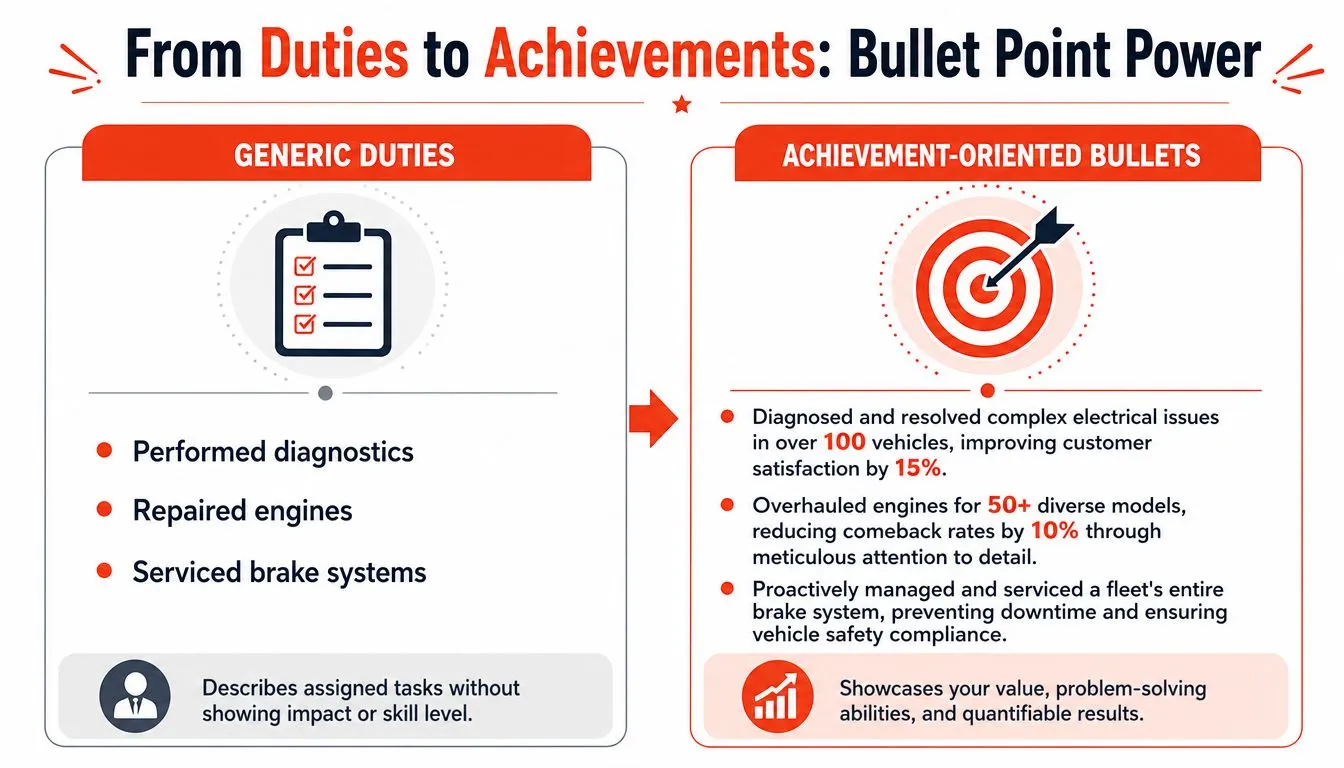
Good bullets connect three things in one line:
The fault or job. The method you used. The business result.
Analysts at Enhancv's automotive technician resume guidance consistently push measurable results such as low comeback rates, fast diagnostic turnaround, and strong first-time fix performance because those are the signals employers care about. Shops do not pay senior tech money for effort. They pay for correct diagnosis, efficient throughput, sold work, and fewer headaches at the front counter.
Use a simple structure that forces proof
Write bullets this way:
Solved X by doing Y, which led to Z.
That keeps you out of vague, duty-only writing and forces you to translate wrench time into business impact.
| Duty bullet | Worth-proving bullet |
|---|---|
| Performed diagnostics | Diagnosed intermittent electrical and drivability faults with scan data, wiring diagrams, and voltage-drop testing, cutting wasted parts replacement and improving first-time fix consistency |
| Repaired engines | Completed engine repair jobs with clear teardown findings and repair notes that sped up approvals, improved parts coordination, and reduced return visits |
| Serviced brake systems | Performed brake inspections and repairs with documented measurements and clear safety notes, helping advisors explain urgency and win customer approval |
Use numbers that shops already track
Techs say they do not have metrics. Usually they just have not pulled them out of the day-to-day mess yet.
Use numbers like these if you can verify them:
- Comeback rate
- Average diagnostic turnaround
- First-time fix rate
- Weekly repair volume
- Flagged hours or bay productivity
- Approval rate on recommended work
- Customer feedback tied to your inspections or explanations
If you cannot prove a number, do not fake one. Use a concrete qualitative result instead. "Reduced unnecessary parts replacement" is better than a made-up percentage that falls apart in the interview.
Practical rule: If a bullet could describe both a C tech doing basic service and a senior diagnostician handling electrical nightmares, it is too weak.
A quick walkthrough helps. This video covers bullet writing in a practical way:
Before and after examples
Before
- Performed diagnostics on domestic and import vehicles
- Repaired engine and electrical issues
- Communicated with customers about repairs
After
- Diagnosed drivability and electrical faults using scan data, wiring diagrams, and step-by-step testing, reducing unnecessary parts swapping and supporting accurate first-time repair
- Resolved complex engine and electrical concerns with verification procedures that lowered comeback risk and kept work moving through the bay without avoidable delays
- Explained inspection findings in plain language that helped advisors gain approval for needed repairs and improved customer confidence in the work performed
The best bullets prove you are not just good with tools. They prove you protect gross profit, keep bays moving, and give customers a reason to trust the shop. That is how a resume gets a better offer instead of just another interview.
If you want more examples of bullet structure that holds up under scrutiny, read this guide on how to write resume bullet points.
The Right Skills and Certifications to Highlight
Your skills section should answer one question fast. Can this tech make the shop more money without creating headaches?
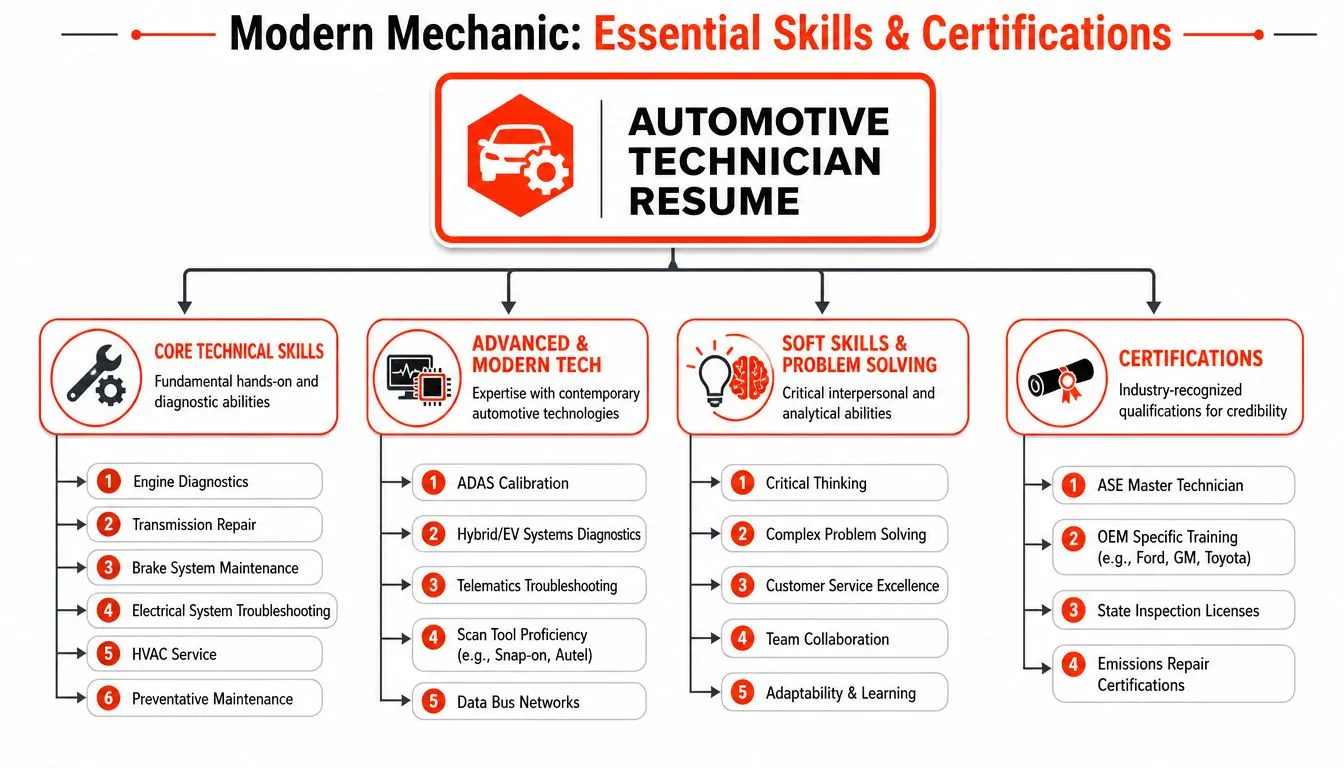
A lot of mechanic resumes fail here because they read like a tool truck invoice. Brakes. Electrical. Scan tools. Teamwork. That tells me what you've seen, not what you can handle under pressure. Hiring managers want skill categories that show level, range, and business value.
Start with the skills that drive shop performance
Lead with the work that keeps bays productive and comebacks low:
- Diagnostics and testing. OBD-II, electrical troubleshooting, parasitic draw testing, drivability, no-start diagnosis
- Repair systems. Engine repair, brakes, suspension, steering, HVAC, transmission service
- Workflow and documentation. Digital inspections, repair orders, inspection notes, parts coordination, preventive maintenance
Be selective. If you cannot explain your process, your common failure points, and how you verify the fix, leave it off.
Show you can work in a modern shop
Senior techs are not judged on wrench time alone. They are judged on how well they use information.
If you've used Mitchell 1, Alldata, Autel, Snap-on, OEM service information, shop management systems, or digital inspection platforms, list them. Those tools connect directly to speed, accuracy, and customer approval. A technician who can pull service data fast, test correctly, and document cleanly helps the whole shop bill more hours with less confusion.
If you need help grouping those tools cleanly, StoryCV's guide to examples of technical skills in resume is useful.
Put people skills inside the technical work
"Communication" should almost never sit alone in a skills block. It has no weight there.
What matters is whether you can explain a failed coil driver, a voltage drop, or a brake safety issue in plain language that an advisor can sell and a customer can trust. That is not soft. That is revenue protection.
Write it like this:
- Explained scan data, test results, and repair priorities in clear language, helping advisors gain approval for needed work and reducing confusion at the counter
That line does two jobs. It shows technical understanding and shows you help the shop close work.
Certifications should be easy to spot
Certifications are proof of standards, not decoration. Put them in a dedicated section where they can be found in seconds.
A clean format works:
- Certifications
- ASE certifications
- OEM training
- State inspection or emissions license
- EPA Section 609 certification for A/C work
List current credentials first. If one is expired, either renew it or move it out. Nothing dates a resume faster than stale certs and vague skill claims.
The goal is simple. Show that you do more than replace parts. Show that you diagnose accurately, document clearly, support sales, and keep cars from coming back. That is the difference between a mechanic who fills a bay and a technician who raises the value of the whole shop.
Tailoring Your Resume Without Losing Your Mind
Sending the same resume to every shop is lazy. It also costs interviews.
That doesn't mean rewriting the whole thing every time. If you've got less than 10 years of experience, a one-page resume is typically sufficient according to Monster's auto mechanic resume guidance. One page forces discipline. Tailoring is mostly about choosing the right proof, not adding more text.
Read the job ad like a repair order
Job descriptions tell you the shop's pain points if you stop reading them like a keyword dump.
If the post leans on high-volume service, they care about throughput, organization, and steady quality. If it talks about diagnostics, electrical issues, or difficult repairs, they need somebody who can think, test, and verify. If it emphasizes customer communication, they want a technician who doesn't create friction at the front counter.
A simple three-step system
-
Mark the underlying problem
Circle phrases that hint at pressure points. "Fast-paced." "Complex diagnostics." "Customer-facing." "Team environment." That's the shop telling you where it hurts. -
Swap in matching evidence
Pull bullets that answer that problem directly. For a diagnostic-heavy role, lead with electrical troubleshooting, root-cause analysis, and verification. For a production shop, lead with consistency, workflow, and clean handoff. -
Retune the summary
Change your headline and summary to match the role. Not dramatically. Just enough to show alignment.
If the shop needs a diagnostician and your top bullet is about oil changes, you've buried the lead.
What tailoring looks like in practice
| Shop type | What to emphasize |
|---|---|
| Dealership service department | OEM procedures, clean documentation, customer communication |
| Independent diagnostic shop | Electrical testing, complex troubleshooting, first-time fix habits |
| High-volume chain | Speed, consistency, inspection quality, workflow discipline |
Tailoring should take minutes once the base resume is solid. Think socket set, not fabrication shop. Use the right tool. Don't remake the whole car.
Final Checks for a Flawless Finish
You wouldn't send a car out with loose lug nuts. Don't send a resume with sloppy finishing.
Your last-pass checklist
- Read it out loud. Clunky phrasing shows up fast when you hear it.
- Check bullet tension. Every bullet should earn space. If it reads like a job description, cut it.
- Use PDF format. This is not optional. PDF keeps your layout from shifting when someone opens it on a different machine.
- Name the file like a pro. Use something like JohnDoe-Mechanic-Resume.pdf. Not resume_final_v2.pdf.
- Get another set of eyes. A non-mechanic can still spot confusing wording, grammar problems, and lines that don't make sense.
Small details that change the read
Keep dates aligned. Keep section titles clean. Make sure your contact info works. If your summary says you're a diagnostic specialist, your bullets had better back that up.
A hiring manager notices care long before they notice polish. Clean formatting helps. Clear thinking gets the callback.
StoryCV is an Online Resume Writer built for people who've done real work and need help saying it clearly. It uses editorial judgment at software speed, so you get a resume that sounds like a professional, not a template. If your current automobile mechanic resume reads like a parts list, StoryCV helps turn it into a case for why you should be hired.