
The most popular advice about projects for a resume is wrong: you don't need more projects. You need better proof. A project belongs on your resume only when it shows judgment, ownership, and a measurable change.
The strongest evidence often comes from normal work. You don't need a side hustle, hackathon, or polished portfolio piece if you rebuilt a process, rescued a launch, retained customers, developed people, or found a revenue opportunity inside your actual job.
Use five questions to test every entry: What problem existed? What decision did you make? What did you do? What changed? What was the scope? A task says you “managed reporting.” A project says you rebuilt the reporting process, removed manual work, and gave finance faster information. That distinction matters in high-volume hiring, where an average U.S. job opening attracts 250 resumes, and about 60% of hiring managers pay attention to whether a resume was customized to the role, according to career guidance on tailoring project entries.
The eight project narratives below create different kinds of proof: efficiency, execution, growth, retention, scale, risk control, talent development, and revenue. Choose the proof your target role needs, then write it with real numbers and honest attribution.
1. Built Data Pipeline That Cut Report Time 60%
Efficiency projects prove you can remove friction from work that people have accepted for too long. They're especially valuable for analysts, operations professionals, engineers, and program managers because the result is easy to understand: less manual effort, faster decisions, and a process that can run without constant intervention.
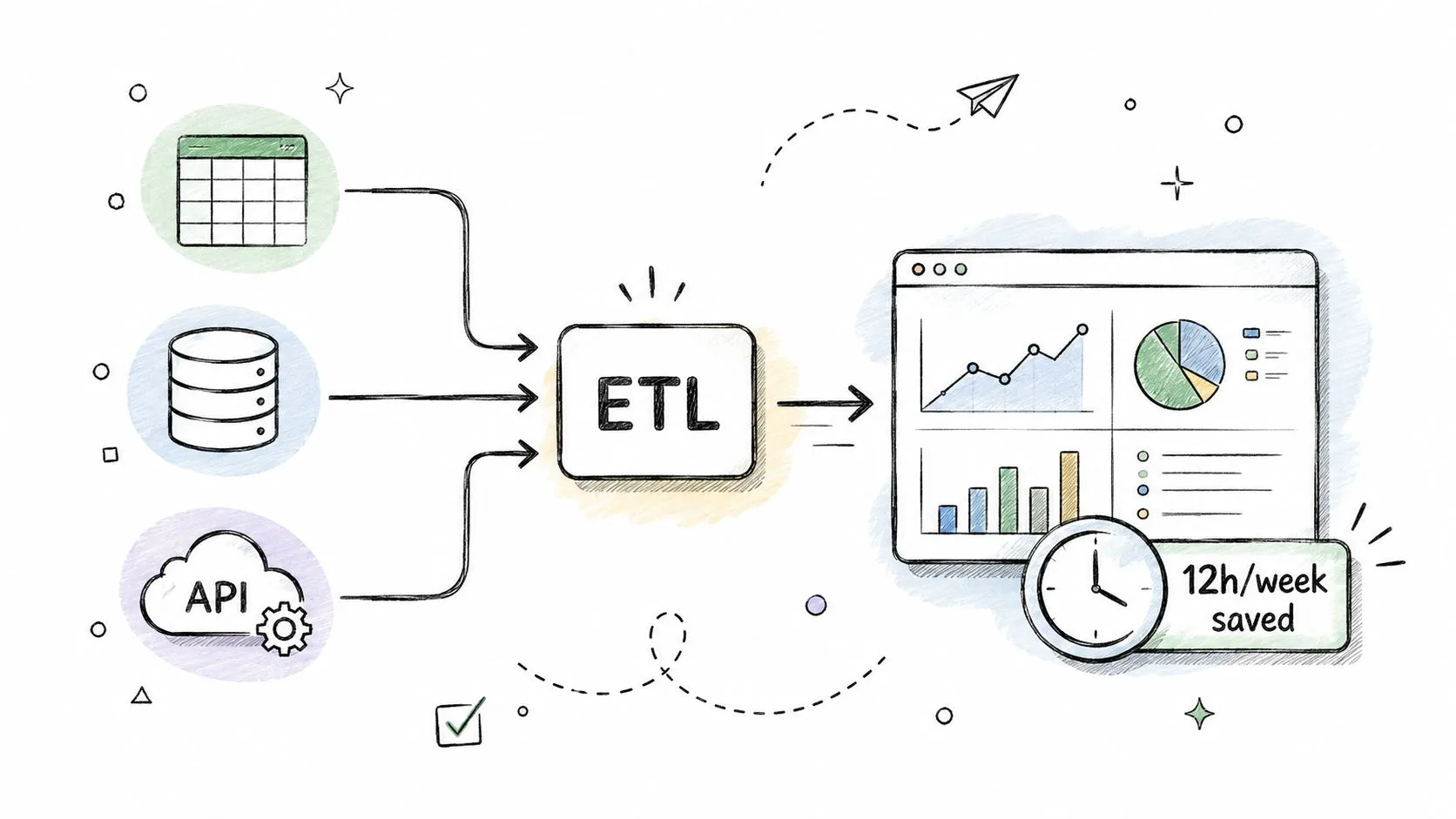
A strong project might begin with weekly reporting that consumed 20 hours per week. The analyst designed a Python-based ETL pipeline that pulled data from three sources, added validation checks, and delivered unattended dashboards to finance. Within six weeks, reports that had taken two days ran in four hours. The story isn't “used Python.” The story is that the analyst reclaimed time for a team and made reporting dependable.
Write the result before the tool
Lead with time saved. Tools change. The outcome stays useful.
- Analytics example: “Automated weekly cohort analysis in SQL, reducing manual spreadsheet work from 12 hours to 2 hours, freeing the team to focus on strategy.”
- Operations example: “Built inventory reconciliation script with Python and Pandas, cutting month-end audit time from three days to six hours.”
- Scope detail: Name the beneficiary, such as finance, customer support, or a regional operations team.
If you don't have exact hours, estimate from real memory and label it accurately. “Roughly halved the time spent on weekly reporting” is stronger than an invented precise figure.
A compact project-based resume usually works best when it centers each entry on the deliverable, dates, and outcome. Current guidance commonly recommends 2 to 4 projects, with 2 to 4 bullet points per project, and advises leading with numbers, scope, or impact in this overview of project-based resumes. For a deeper treatment of evidence, use this guide to show metrics on a resume.
2. Led Cross-Functional Launch That Shipped on Budget
Execution projects show that you can turn an ambiguous plan into a delivered result. They're more persuasive than a list of meetings because they reveal how you handled constraints, dependencies, risk, and trade-offs.
Consider a product manager coordinating engineering, design, QA, and customer success for an onboarding feature across web and mobile. The launch had an eight-week timeline, a five-person team, and a fixed budget. The manager ran weekly planning, tracked milestones, raised risks early, and cut a lower-value feature when the schedule tightened. The result was an on-time launch that finished 15% under budget and reached 42% first-month adoption.
A bullet can carry that entire narrative:
“Led cross-functional launch of customer onboarding redesign across web and mobile in eight weeks with five people, shipping on schedule and 15% under budget while reaching 42% first-month adoption.”
Show the decision, not just the coordination
“Managed stakeholders” says almost nothing. Explain what you protected and what you sacrificed.
- Name the constraint: Timeline, budget, team capacity, regulatory deadline, or scope.
- Name the hard choice: Cut a feature, reallocated engineering time, changed launch sequencing, or delayed a noncritical integration.
- Use one execution signal: On-time delivery, budget control, adoption, cycle time, or defect reduction.
- Avoid title inflation: If you weren't the formal manager, use “led,” “coordinated,” or “owned the rollout.”
An operations professional could write: “Coordinated vendor transition across four internal teams, shipping a new contract framework on time and reducing procurement cycle by 30%.” A product manager can find more role-specific framing in this guide to writing a product manager resume.
The project matters because it proves judgment under pressure. That's what senior hiring managers need to see.
3. Grew User Base 200% by Repositioning Product Messaging
Growth projects prove that you can diagnose a market problem, make a strategic choice, and connect messaging to commercial results. Don't present repositioning as a copywriting exercise. Present it as a research-led change in audience, promise, and buying behavior.
A marketing manager started with 15 customer interviews and found that operations teams at mid-market B2B companies were the strongest buyer. The product had been described as “workflow software.” The manager repositioned it as “the ops playbook for scaling teams,” then rewrote the website and supporting messaging. Qualified lead volume doubled, while trial-to-customer conversion rose from 8% to 13% within six months.
That's a credible project because the method is visible. The reader can see the diagnosis, the intervention, and the result.
Be precise about what drove growth
Growth metrics need clean attribution. If paid acquisition, sales outreach, product changes, and messaging all contributed, don't claim the entire result as your own.
A strong bullet might read:
“Repositioned SaaS product from horizontal workflow tool to operations platform for scaling B2B teams, leading 15 customer interviews, rewriting website messaging, doubling qualified lead volume, and lifting trial-to-customer conversion from 8% to 13% in six months.”
A product marketer could write: “Shifted developer tool positioning from API framework to shipping speed for small teams, leading research, updating homepage and documentation, and increasing signups 150% over six months.”
Attribution rule: Claim the decision and work you owned. Credit adjacent contributions when they materially affected the outcome.
Use the research method in the bullet. Interviews, surveys, usage analysis, and win-loss reviews make the strategy believable. Guidance for recruiters recommends selecting roughly 3 to 5 substantial projects, particularly those that are recent, role-aligned, and quantified, as explained in this advice on developer projects and GitHub work.
4. Reduced Customer Churn 25% with Retention Framework
Retention projects create proof through diagnosis and repeatability. They show that you didn't just resolve individual customer complaints. You found a pattern, built an intervention, and changed how the organization worked.
A customer success leader used cohort analysis to identify a warning signal: customers who didn't use Feature X in month two rarely renewed. The leader introduced earlier feature training, structured check-ins, and usage-based intervention triggers. Across 120 accounts, churn fell from 18% to 13.5% within nine months, a 25% relative reduction.
The project bullet should preserve both the diagnosis and the system:
“Reduced customer churn from 18% to 13.5% by conducting cohort analysis, identifying month-two Feature X adoption as a renewal signal, and deploying a training and intervention playbook across 120 accounts.”
Separate percentage points from relative change
The move from 18% to 13.5% is a 4.5 percentage-point decline. Calling it a 25% reduction is accurate only when you define it as relative. Precision protects your credibility.
You can also frame retention work in operations terms: “Launched onboarding checklist for new vendor partnerships, reducing early-stage dropout from 22% to 16% and retaining an estimated $180K in annual value.” Only use that framing if the value estimate is documented and tied to the work.
The best entry answers four questions quickly:
- What pattern did you find? Name the behavior that predicted risk.
- What system changed? Explain the playbook, trigger, cadence, or workflow.
- Who was affected? State accounts, customers, partners, or segments.
- What improved? Include the before-and-after measure.
For more guidance on converting work into defensible results, see how to write quantifiable achievements. Skills-based hiring also makes this type of evidence useful because employers are increasingly evaluating demonstrated capability rather than credentials alone, a direction discussed in the U.S. Chamber Foundation skills-based hiring project report.
5. Rebuilt System Architecture to Support 10x Scale
Scale projects prove that you can solve a future problem before it becomes an operational failure. They're ideal for engineers, infrastructure leaders, technical product managers, and architects, but the underlying narrative works in any function: demand changed, the old system couldn't support it, and you redesigned the foundation.
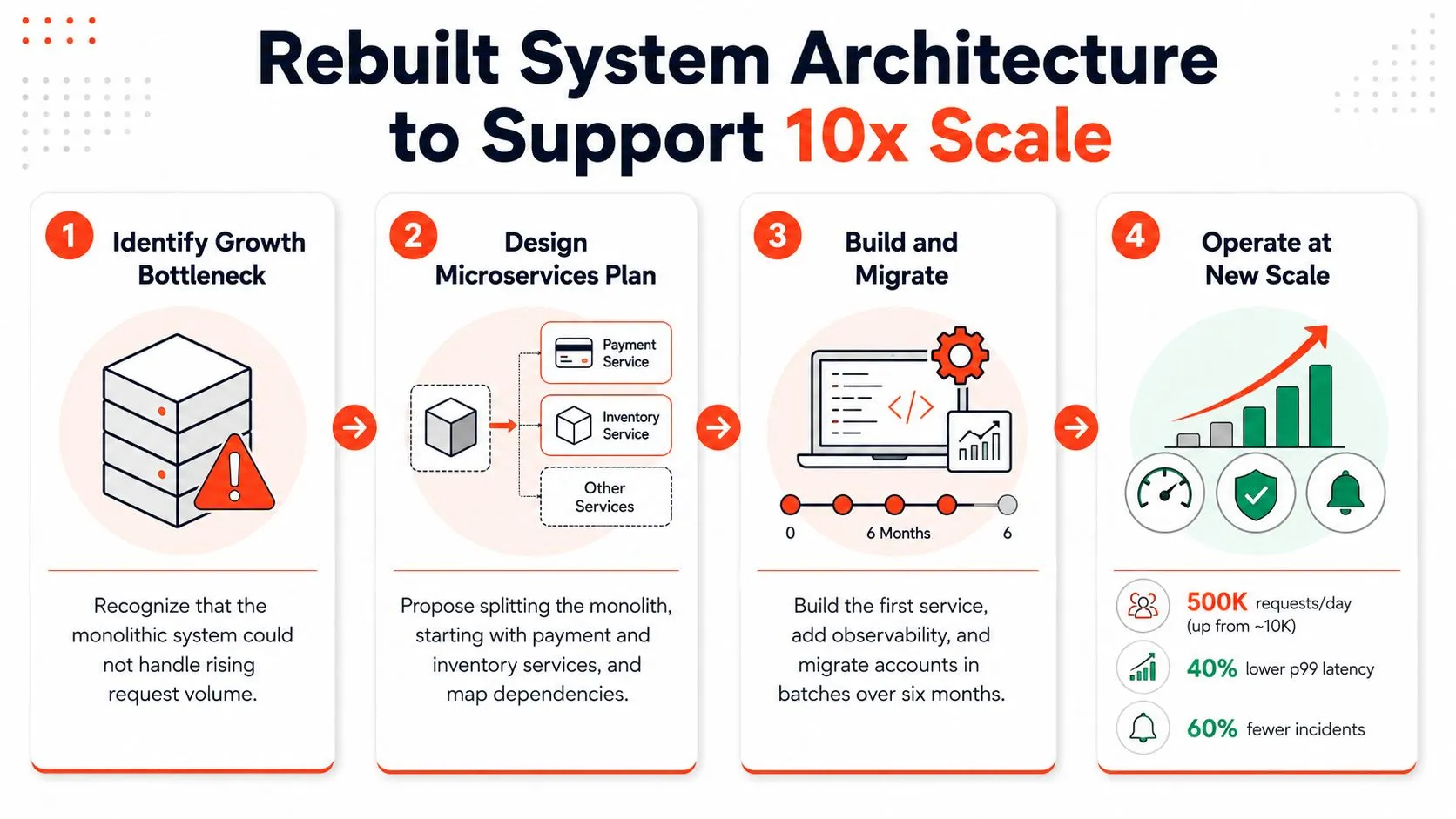
A backend engineer refactored a monolithic codebase by proposing microservices for payment and inventory. They mapped dependencies, built the first service, added observability, and migrated accounts in batches. Over six months, the system grew from roughly 10,000 to 500,000 requests per day, while latency and incidents decreased.
The engineer's scope matters. “Rebuilt the platform” is too broad if the person owned only payment migration. “Owned payment service migration while leading the broader architecture redesign” is both stronger and more honest.
Make technical complexity readable
A resume doesn't need every implementation detail. It needs enough detail to prove you built or changed the system.
- Growth challenge: State the movement from roughly 10K to 500K requests per day.
- Technical decision: Name microservices, database sharding, read replicas, observability, or phased migration when relevant.
- Owned component: Identify the service, dependency map, migration plan, or reliability layer you led.
- Operational proof: Use latency, incidents, uptime, or zero-downtime migration only when documented.
A sample bullet:
“Redesigned monolithic architecture into microservices to support growth from roughly 10K to 500K requests per day, leading payment service migration, adding observability, and moving accounts through phased releases.”
The bullet demonstrates architecture, execution, and risk management without pretending one person delivered every part.
A short technical project walkthrough can help interviewers understand the trade-offs behind the result.
6. Cut Compliance Audit Time 70% with Documentation Overhaul
Risk-control projects are often undervalued because the best outcome is something that didn't happen. That's a mistake. A clean audit process proves operational discipline, cross-functional coordination, and the ability to turn scattered obligations into a system people can follow.
A compliance officer built a controls documentation system that mapped regulations to technical controls, created runbooks for evidence collection, and automated checks. The next audit took four days instead of three weeks. The achievement isn't “maintained compliance documentation.” It's that the officer made compliance repeatable and reduced disruption for finance, legal, engineering, and auditors.
Try this bullet:
“Cut annual audit cycle from three weeks to four days by building a controls documentation system, mapping regulations to technical controls, and automating evidence collection.”
Replace activity language with system language
Avoid “supported audits,” “prepared documentation,” and “worked with legal.” Those phrases describe participation. They don't show ownership.
Instead, name what replaced the old process:
- Old process: Searching email threads, requesting evidence manually, and rebuilding control maps each cycle.
- New system: A documented control library, evidence runbooks, automated checks, and clear owners.
- Business result: A shorter audit cycle with less interruption and more consistent evidence.
You can also frame a similar operations project as: “Implemented an internal audit checklist and workflow, reducing month-end close time from five days to two days by automating reconciliation checks.” Use the measure only if you can support it.
ATS-friendly project entries should include a clear project label, relevant tools or methods, the user or business problem, and a measurable output when possible. They should also use truthful keywords that match the role, such as controls mapping, evidence collection, risk management, audit readiness, or process automation, following the principles in this ATS guide to resume project sections.
7. Launched Mentorship Program That Increased Internal Mobility 3x
Talent development projects prove that you can improve an organization through an intervention, not just administer a program. They're valuable for HR, people operations, learning and development, and senior managers because they connect design choices to leadership continuity and retention.
An HR business partner designed a six-month mentorship program for 12 high-potential individual contributors, pairing them with manager mentors. The program mapped skill gaps, created development plans, and tracked progression. Internal manager promotions increased from 2 to 6 annually, while promoted employees reached 95% two-year retention.
The project entry should show both the program mechanics and the business reason:
“Designed six-month mentorship program pairing 12 high-potential individual contributors with manager mentors, increasing internal manager promotions from 2 to 6 annually and achieving 95% two-year retention among promoted employees.”
Show the intervention, not the event
“Created a mentorship program” is a task. The evidence is in the choices:
- Audience: Who entered the program, and why were they selected?
- Structure: How long did it run, and who mentored whom?
- Development method: What skill gaps, plans, or progression criteria did you use?
- Business problem: Did the program address retention, leadership continuity, or promotion readiness?
A people operations professional might instead write: “Built an internal career framework and visibility dashboard, reducing regrettable attrition by 40% by helping employees see growth paths within the company.” Again, use that metric only when it's yours and can be explained.
Good talent projects make organizational work concrete. They show that you designed a mechanism, got people to use it, and measured whether it improved the pipeline.
Project-management guidance recommends capturing scope through users, stakeholders, timelines, budgets, quality, satisfaction, and cost or revenue impact where relevant. Those dimensions can turn an internal program into evidence rather than a soft description, as outlined in this guide to quantifiable project-management achievements.
8. Identified Market Opportunity Worth $2M in New Revenue
Revenue projects create the clearest commercial proof, but they still need a credible chain from insight to implementation. Don't write “generated revenue” when you only made a recommendation. State whether you identified the opportunity, influenced the decision, or worked with product and sales to launch it.
A strategy consultant analyzed a customer segment with 3x higher lifetime value, conducted 20 customer interviews, reviewed usage data, and surveyed buyers. The research uncovered an underserved persona. The company launched a Pro tier for that segment, which grew from 5% to 28% of customers and added $2M in annual recurring revenue.
A precise bullet might read:
“Analyzed a segment with 3x higher lifetime value, conducted 20 customer interviews and usage analysis, and recommended a Pro tier for an underserved buyer persona that grew from 5% to 28% of customers and added $2M in annual recurring revenue.”
Keep the ownership line clean
If the product team implemented the tier, say so:
“Identified an underserved buyer persona through interviews, survey analysis, and usage data, then worked with product to launch a customized tier that expanded the segment from 5% to 28% of customers and added $2M in annual recurring revenue.”
This version gives the consultant credit for the insight and partnership, without claiming sole ownership of implementation.
For strategy and product roles, research method is a credibility signal. Mention interviews, surveys, cohort analysis, pricing research, or usage data. Then connect the finding to a decision and the decision to a commercial result. Strong projects should show the problem, technical or analytical approach, and measurable outcome, particularly for entry-level candidates and career changers who need applied evidence, as noted in guidance on project-based developer resumes.
8 Resume Projects: Impact & Metrics
| Project | Implementation 🔄 | Resource requirements ⚡ | Expected outcomes 📊 | Ideal use cases 💡 | Key advantages ⭐ |
|---|---|---|---|---|---|
| Built Data Pipeline That Cut Report Time 60% | 🔄 Moderate, Python ETL, validation, orchestration | ⚡ Mid-level dev time (≈6 weeks), access to 3 data sources, scheduling infra | 📊 60% time saved (20h→4h/week); repeatable weekly reporting | 💡 Automating manual reporting for finance/analytics | ⭐ Concrete, verifiable time savings; full lifecycle ownership |
| Led Cross-Functional Launch That Shipped on Budget | 🔄 Moderate, coordination, milestone tracking, scope trade-offs | ⚡ Multi-team effort (eng, design, QA, CS), project management time | 📊 Launched on schedule, 15% under budget; adoption targets met | 💡 Time- and budget-constrained product/features launches | ⭐ Demonstrates leadership, risk management, execution |
| Grew User Base 200% by Repositioning Product Messaging | 🔄 Moderate, customer research and copy/asset changes | ⚡ Marketing + research time (15 interviews), content updates | 📊 Qualified leads +200%; conversion 8%→13% in 6 months | 💡 Repositioning for clearer buyer fit (B2B SaaS messaging) | ⭐ Strategy-driven growth with research-backed proof |
| Reduced Customer Churn 25% with Retention Framework | 🔄 Moderate, cohort analysis, playbook, automation triggers | ⚡ Data analysis, CS program design, rollout across accounts | 📊 Churn 18%→13.5% (25% relative reduction) in 9 months | 💡 Subscription/SaaS retention and onboarding optimization | ⭐ Systematic, repeatable retention program with measurable ROI |
| Rebuilt System Architecture to Support 10x Scale | 🔄 High, design microservices, phased migration, observability | ⚡ Senior engineering time, infra changes, migration effort (6 months) | 📊 Traffic 10K→500K req/day; p99 latency ↓40%, incidents ↓60% | 💡 Scaling backend for large traffic/throughput growth | ⭐ Architectural thinking with clear performance/reliability gains |
| Cut Compliance Audit Time 70% with Documentation Overhaul | 🔄 Moderate–High, controls mapping, runbooks, automated checks | ⚡ Cross-functional coordination (auditors, legal, engineering), tooling | 📊 Audit time 3 weeks→4 days (~85% faster); repeatable process | 💡 Regulated environments needing audit efficiency (finance, health) | ⭐ Reduces disruption, creates sustainable compliance processes |
| Launched Mentorship Program That Increased Internal Mobility 3x | 🔄 Moderate, program design, pairing, development plans | ⚡ HR facilitation, manager time, tracking over 18 months | 📊 Internal manager promotions 2→6/year; 95% retention at 2 years | 💡 Building internal leadership pipeline and reducing attrition | ⭐ Strengthens promotion pipeline and long-term retention |
| Identified Market Opportunity Worth $2M in New Revenue | 🔄 Moderate, interviews, usage analysis, survey, segmentation | ⚡ Research effort (20 interviews), product/GT M coordination | 📊 New cohort 5%→28%; +$2M ARR after Pro-tier launch | 💡 Discovering high-LTV segments and pricing opportunities | ⭐ Research-to-revenue story with clear ARR impact |
Choose the Proof Your Target Role Needs
Don't put all eight projects on your resume. Mid-to-senior professionals usually have enough material. The problem is selection. Choose one or two projects that match the target role and prove the capability the job description needs.
A project-based resume organizes career evidence around discrete deliverables, dates, titles, and outcomes instead of relying only on job titles. That structure works best when each entry earns its space. A recent guide on which projects to include on a resume emphasizes relevance and recency, with projects from the last 2 to 3 years often carrying more weight than older work. Treat that as a trimming rule, not a requirement. An older project still belongs if it proves a capability your recent work doesn't.
Place projects under Experience when they were part of paid employment. Use a dedicated Projects section for independent, academic, volunteer, freelance, research, or side work. Don't hide substantial professional work under a generic projects heading just because it had a project name. Context affects how the reader values the evidence.
Use a compact project format
A strong entry needs only the details that help the reader judge your contribution:
- Specific name: “Customer Onboarding Redesign,” not “Product Project.”
- Role or context: Product manager, analyst, consultant, volunteer lead, or independent builder.
- Relevant tools: Include SQL, Python, Pandas, Jira, Salesforce, or other methods only when they support the target role.
- Dates or scope: Add timing, team size, customer count, business unit, or rollout scope when useful.
- Result-led bullets: Use one or two bullets that move from problem to decision to outcome.
Yale's career guidance recommends grouping related work into projects or activities, starting with an action verb, and emphasizing the result, including percentages or increases when they're available. Emory career guidance similarly recommends answering what you did, how you did it, why you did it, and what impact it produced, using a STAR-style structure with action and result emphasized. You can review those principles in Yale's guide to impactful resume bullets and Emory-related resume project guidance.
Apply the honesty test
Before publishing a project, ask:
- Did I own the decision, the execution, or both?
- Can I explain the metric in an interview?
- Is the result tied to my work, or did several teams contribute?
- Does this project match the role I'm targeting?
- Does it replace a weaker bullet?
Cut projects that are generic, stale, unfinished without a meaningful result, unrelated to the target role, or impossible to verify. Coursework and side projects can work, but only when they show applied skill, a real constraint, or a meaningful deliverable. A project isn't valuable because it exists. It's valuable because it changes the reader's view of what you can do.
Write every bullet as Action + Project + Result. “Improved reporting” is weak. “Automated weekly reporting pipeline, adding validation checks and reducing finance reporting time from two days to four hours” gives the reader a decision, a deliverable, and an outcome.
If your project memory is detailed but disorganized, StoryCV can help turn it into a clear resume narrative through guided questions about context, decisions, scope, and results. It's an online resume writer, not a template library, so the useful output comes from clarifying the work before drafting the bullet.
StoryCV helps you turn real project work into clear, impact-focused resume bullets through a guided interview about what you owned and what changed. Visit StoryCV and start with one project you know made a difference.