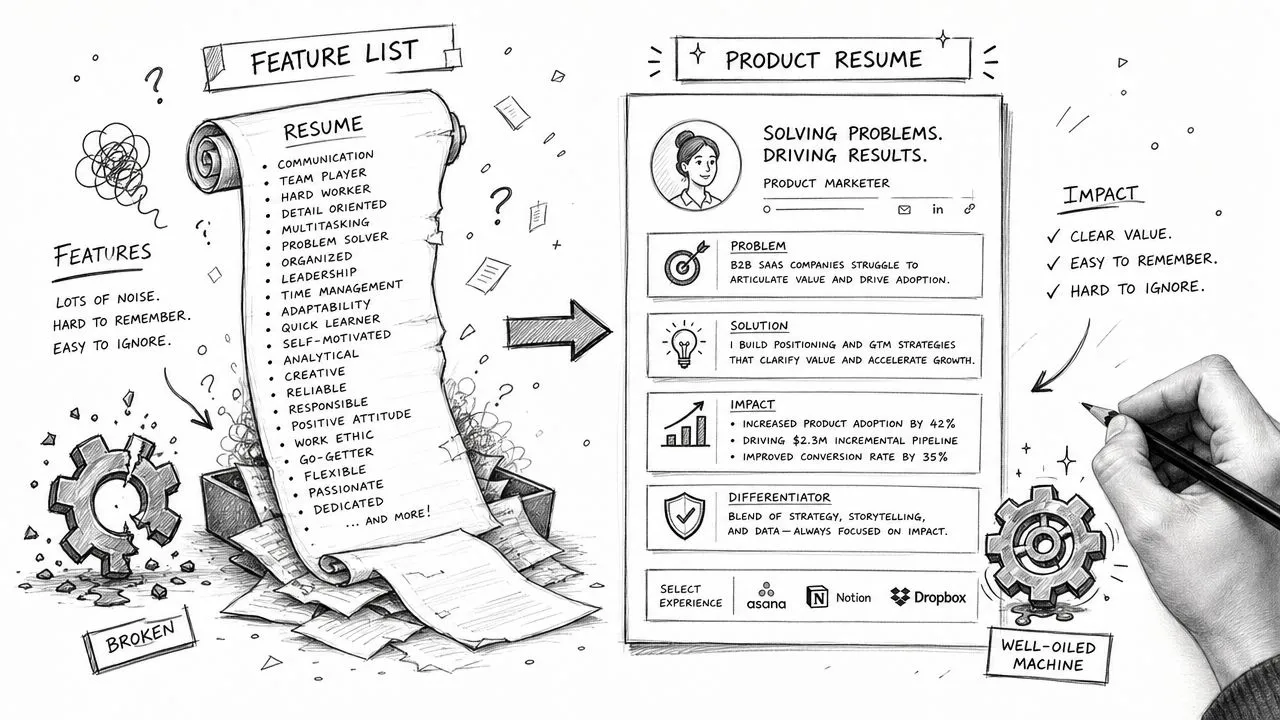
Most product manager resumes are bad for one simple reason. They read like a Jira export.
Feature launched. Standup run. Roadmap owned. Stakeholders aligned. None of that tells me whether you made good decisions, handled ugly trade-offs, or changed the business in a way that mattered.
A product manager resume is not a history log. It's an argument. It should prove that when the work was messy, the priorities conflicted, and the clock was ugly, you knew what to do.
Your Resume Is a Product Not a Feature List
PMs get bad resume advice because hiring advice is usually written for generic roles. Product work is not generic. If your resume reads like a duty log, you flatten the hardest parts of the job into a list anyone could claim.
Your resume is a positioning document. It should show how you handled ambiguity, conflict, and trade-offs when the answer was not obvious. Feature names do not do that. Meeting cadence does not do that. Vague ownership language definitely does not do that.
Start with the question that exposes your leverage
Open a blank doc and ask a harsher question than any template will.
Where did my judgment change the outcome, and what would have gone wrong if nobody made that call well?
That gets you to the substance fast. PM work lives in messy context. Two teams want different things. Engineering pushes for stability. Sales wants the launch now. Leadership wants a metric moved this quarter. Conflict, trade-offs, and resolved bottlenecks are the story that matters.
Good raw material usually falls into a few buckets:
- Revenue risk you reduced by fixing a broken flow or bad pricing logic
- Execution risk you contained by forcing scope decisions before a launch slipped
- Customer risk you addressed by choosing the right problem instead of shipping more surface area
- Operational risk you cleaned up by creating prioritization discipline where chaos was winning
Those are resume inputs. Responsibilities are not.
Write for a hiring manager scanning under pressure
A strong PM resume follows the same structure as strong product writing. Lead with the point. Then support it. mastering inverted pyramid writing is a useful model because it forces you to put the signal first instead of burying it under process.
Build bullets in this order:
1. What tension or problem existed
2. What call you made
3. What changed after that call
That structure makes influence visible. It also separates PMs from project coordinators, because it shows decision quality, not just activity volume.
If you want a sharper sense of how this reads in practice, these narrative resume examples show how context and causality beat generic formatting every time.
A weak PM resume says you participated. A strong one shows where you broke deadlock, chose a direction, and got a result that mattered.
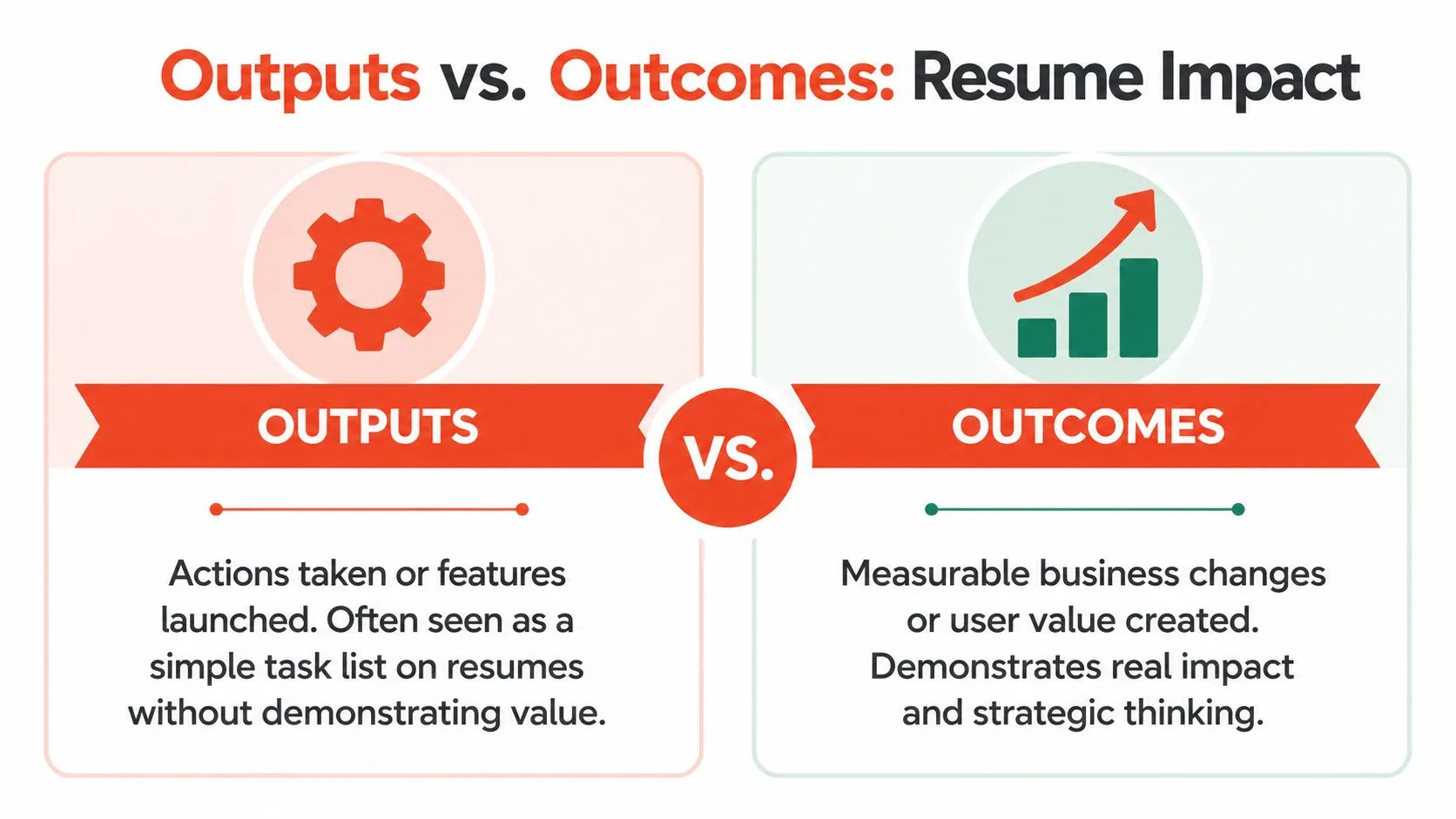
Frame Outcomes Not Outputs
Most PM bullets stop too early.
They describe the output. They never reach the outcome.
“Led launch of onboarding redesign” is an output. “Redesigned onboarding after activation friction surfaced in early-user behavior, then changed the path and improved activation” is getting closer. The second version has causality. It sounds like a PM, not a project coordinator.
The rewrite that matters
Here's the pattern I'd use on nearly every product manager resume.
| Weak bullet | Better bullet |
|---|---|
| Led the cross-functional development and launch of a new subscription checkout flow to improve the overall conversion rate. | Killed a legacy 5-step checkout sequence that was dropping 30% of mobile traffic; designed a 1-click alternative with a 2-engineer team in a single sprint, lifting checkout conversion by 14%. |
| Managed product roadmap for onboarding improvements. | Reworked onboarding after early-user drop-off exposed friction in account setup; narrowed scope to the highest-friction steps and tied the release to activation, not feature count. |
| Conducted customer research and gathered feedback. | Ran customer interviews, identified repeated points of confusion, and used that evidence to cut lower-value roadmap work in favor of fixes users were already asking for. |
That first “after” example works because it does three things at once. It names the problem. It shows a decision. It lands on business impact.
A great bullet point is a decision, not a description.
Use this formula for every major bullet
Many recruiters spend less than 10 seconds scanning a resume, and one expert guide cites research that resumes with quantified achievements are 38% more likely to be shortlisted, according to Flavored Resume's PM resume guide.
So stop burying your best material.
Use this order:
-
Problem first
What was failing, blocked, confusing, delayed, or underperforming? -
Decision second
What did you cut, simplify, reframe, sequence, test, or push through? -
Constraint third
Small team, limited time, inherited system, political tension, fixed launch date. PM credibility thrives in these conditions. -
Result last
Use a number if you have one. If you don't, describe the change plainly.
If your current bullets don't have that shape, rewrite them. If you need help tightening those statements, this guide on how to write impact statements is useful.
A later section of this video breaks down the same idea in practical resume terms:
Show scale, not just activity
The strongest PM resume examples don't just show wins. They show operating scope.
Enhancv's product manager resume examples highlight bullets tied to 40% product revenue growth in three months, 200% user activation improvement, 60% premium conversion growth, and 500+ customer interviews tied to 99.6% customer satisfaction. The same examples recommend showing scale with markers like 8 cross-functional initiatives, 12-person teams, and a $2M annual product development budget, as shown in Enhancv's product manager resume examples.
That doesn't mean you should force fake metrics into every line. It means you should stop writing bullets that hide the size and difficulty of the work.
Kill the Corporate Hedging
“Collaborated with stakeholders” should be deleted on sight.
That phrase says nothing because collaboration is the minimum bar for the role. It's like a designer saying they “used Figma” or an engineer saying they “wrote code.” Fine. And?
The bigger problem is that PM work is often hard to quantify cleanly. A lot of your real value sits in influence, prioritization, and conflict resolution. That gap shows up in public resume advice too. Existing guidance often struggles to show how PMs should explain work rooted in influence, prioritization, and cross-functional alignment rather than clean feature metrics, as noted in Project Manager Template's guide to impactful PM resumes.
Replace vague teamwork language with operational truth
Don't write about who you talked to. Write about what was in tension.
Use contrasts like these:
-
Weak
Collaborated closely with Engineering, Design, and Marketing stakeholders to ensure feature alignment. -
Strong
Aligned engineering capacity with a shifting marketing deadline by dropping 3 non-critical backend requirements, ensuring a tier-1 product launch went live on time. -
Weak
Worked cross-functionally to prioritize roadmap initiatives. -
Strong
Broke a deadlock between support requests and sales asks by redefining roadmap priority around churn risk instead of loudest internal voice. -
Weak
Partnered with leadership on product strategy. -
Strong
Reframed roadmap discussion from feature requests to retention risk, which changed executive approval on what shipped first.
“Collaborated” is filler. Conflict, trade-offs, and resolved bottlenecks are the real story.
Keyword stuffing is lazy writing
PMs get trapped here all the time. They stuff in agile, scrum, PRDs, backlog management, user stories, stakeholder management, and think they're being strategic.
They're not. They're hiding.
Keywords matter only when attached to evidence. “Ran A/B tests” is weak. A stronger signal is the method itself: define KPIs, run A/B tests or cohort analysis, and connect the result to a business outcome. It also helps to name actual tools like Amplitude, Mixpanel, Tableau, or SQL instead of vague labels, as recommended in Aakash Gupta's PM resume keyword guidance.
A cleaner skills line:
- Better signal
SQL, Amplitude, Mixpanel, Tableau, KPI design, A/B testing, cohort analysis
A weaker one:
- Noise
Data analysis, communication, collaboration, agile mindset, strategic thinker
One tells me how you work. The other tells me you've read too many resume blogs.
Tailor for PM Subdomains
A generic product manager resume is usually a weak one.
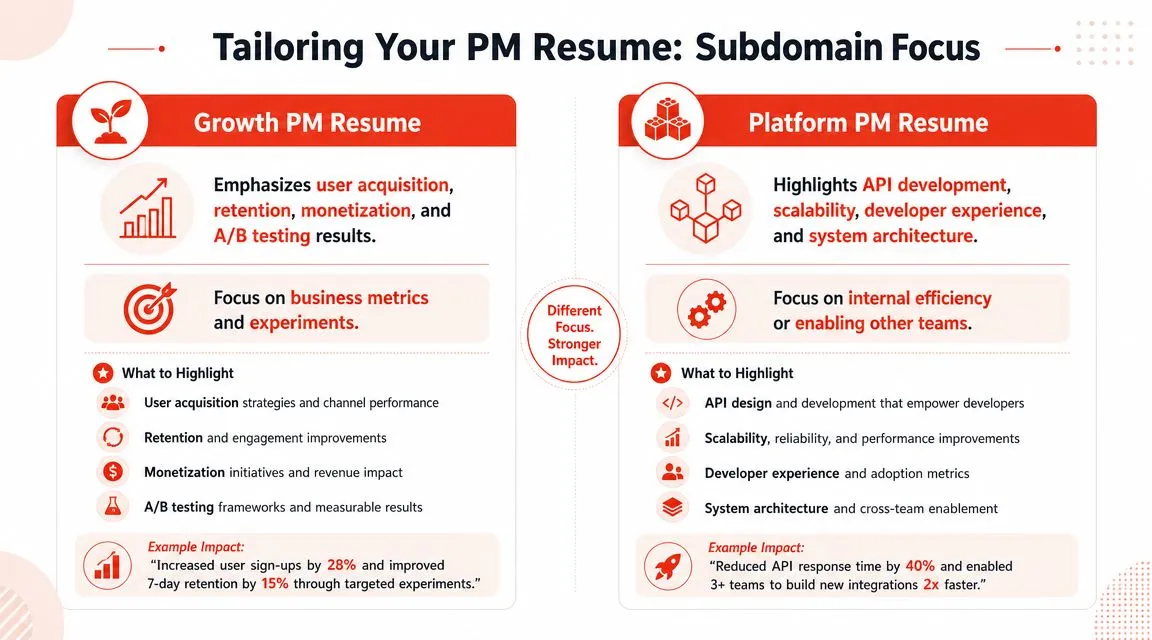
Growth PM, platform PM, and AI-adjacent PM roles do not hire for the same evidence. Yet most resumes flatten everything into one bland profile. That's a mistake, especially now that PM hiring is more specialized. Public guidance still treats PM resumes too generically, even though specialization has shifted toward AI/ML, platform, and technical PM roles, as discussed in this YouTube discussion on PM resume specialization.
Growth PMs should sound commercial
If you're a Growth PM, your resume should feel close to a funnel review. Not in tone. In evidence.
Good signals:
- Experiment logic tied to acquisition, activation, retention, or monetization
- Behavior change instead of feature shipping
- Instrumentation and analytics tools named directly
Example bullets:
- Prioritized onboarding changes around activation friction instead of feature parity, then used event data to decide what shipped next.
- Simplified a paid conversion path after repeated drop-off in the purchase journey, turning a design request into a monetization fix.
- Used Amplitude and cohort analysis to separate curiosity clicks from retained behavior, which changed where the team invested.
Platform PMs should sound enabling
Platform PMs often undersell themselves because their users are internal, technical, or indirect. That doesn't make the work less important. It changes how you frame impact.
Good signals:
- Developer velocity
- System reliability
- API adoption
- Reduced operational pain for other teams
Example bullets:
- Reworked API onboarding after internal teams kept escalating integration issues, reducing friction for teams building on top of the platform.
- Cut low-value platform requests from the roadmap and focused on reusable infrastructure that unblocked multiple product squads.
- Defined success in terms of enablement, not feature count, then used adoption signals from internal teams to guide prioritization.
If you're still fuzzy on adjacent product titles, this breakdown of key differences between product roles helps clarify how expectations shift.
AI and technical PMs should not bluff
Candidates often overreach here.
Don't imply you built the model if you shaped the product around it. Don't pretend architecture depth you don't have. The right move is narrower and more credible.
Use language like:
- Defined the user-facing workflow around model output quality and escalation paths
- Scoped requirements for a technical system with engineering, then translated trade-offs for non-technical partners
- Added a technology snapshot to show the systems, tools, or data environment you worked with
For targeting, the fastest fix is often tailoring your evidence, not rewriting your entire identity. This article on tailoring your resume to a job description is useful if you need a cleaner way to do that.
The One-Page Impact Document
Hiring managers do not need your life story. They need fast proof that you can make hard calls, align people who disagree, and produce better outcomes.
That is why the page count matters. Early-career PMs should keep the resume to one page. More experienced PMs can use two, but only if both pages earn their space. If older roles are thin on relevance, compress them hard. Your recent work should carry the weight because that is where your judgment is easiest to evaluate.
The structure that actually works
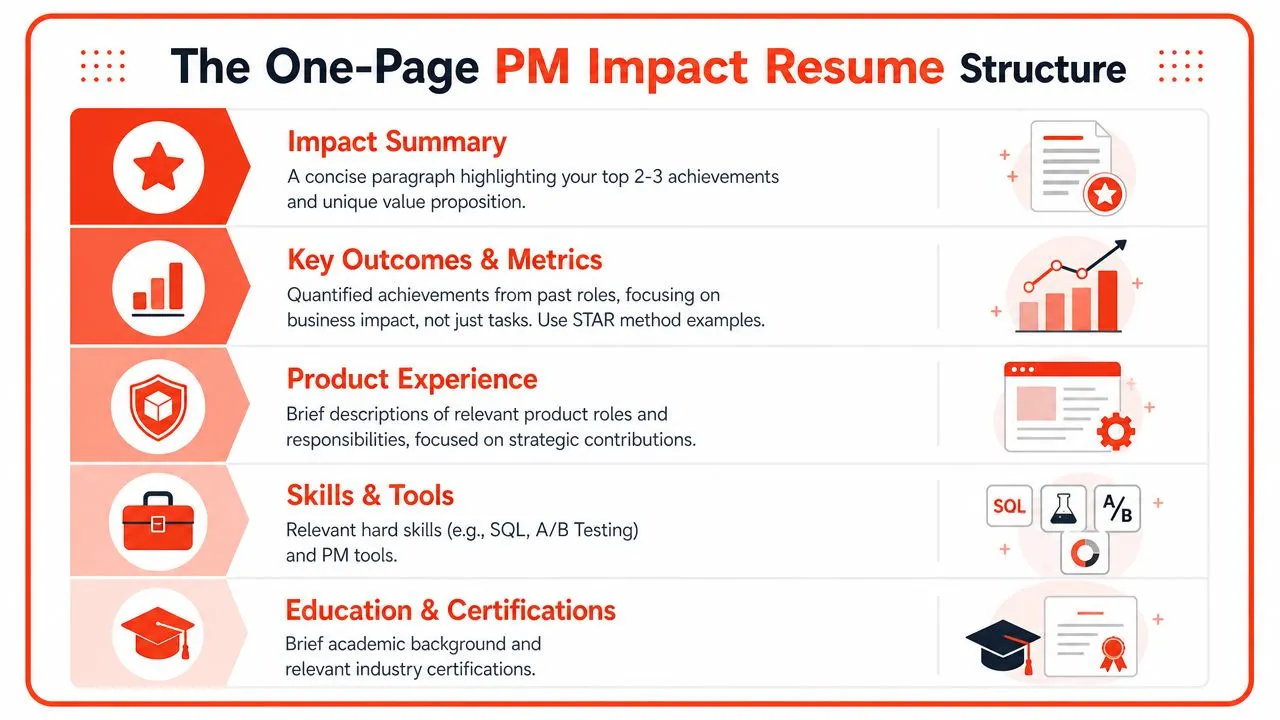
Use a simple layout that puts impact first.
| Section | What belongs there |
|---|---|
| Summary | A short product thesis. Your domain, your scope, and the kind of problems you solve well. |
| Experience | Bullets about decisions, trade-offs, influence, and outcomes. Put the strongest evidence first. |
| Skills | Tools and methods you actually used. SQL, Amplitude, Mixpanel, Tableau, A/B testing, KPI design, cohort analysis. |
| Selected projects or portfolio | Include this only when it sharpens your fit for the role. |
| Education | Keep it brief. Degree, school, relevant signal if it matters. |
The mistake is treating experience like a shipping log. PM work is messy, political, and full of partial wins. Your resume has to turn that mess into evidence. Show what was stuck, who disagreed, what trade-off you made, and what changed because of it.
A sample experience block
Senior Product Manager
B2B SaaS Company
- Took over a checkout flow with sharp mobile drop-off, cut steps that added friction, and worked with a lean engineering team to improve conversion.
- Resolved a roadmap fight between sales requests and support pain by prioritizing churn-linked issues first, changing what shipped that quarter.
- Set success metrics with SQL and Amplitude before launch, then adjusted scope based on adoption data instead of stakeholder opinion.
- Cut lower-value requirements when engineering capacity shrank, protecting the launch date without stuffing the release with weak work.
That works because it shows judgment. You can see prioritization, conflict resolution, scope control, and outcome ownership on the page.
Your resume is proof that your decisions changed the work, even when you were not the person writing code or closing deals.
If writing bullets like that feels harder than the job itself, StoryCV is a Digital Resume Writer that uses a guided interview to pull out context, trade-offs, and impact before turning them into resume bullets. That is useful for PMs because formatting is rarely the problem. The hard part is translating high-context work into clear, credible evidence.
Your product manager resume should read like a record of smart calls under pressure. If that story is missing, the problem is not your background. The problem is the document.