Most advice on how to write a skills section of a CV is bad. It tells you to cram in keywords, sprinkle in “leadership” and “communication,” and hope the scanner smiles on you.
That's lazy advice. A good skills section isn't a keyword landfill. It's a tight summary of what your career amounts to, with proof waiting in your experience section.
Why Your CV Skills Section Fails
Yes, you need one. A dedicated skills section is no longer optional. 85% of hiring managers explicitly require a dedicated skills section on a resume for candidate visibility in 2026, according to Forbes reporting on hiring manager expectations.
Now the uncomfortable part. Most skills sections are still terrible.
The junk drawer problem
I see the same mess over and over:
- Buzzword stacking like “leadership, teamwork, strategic thinking, results-driven”
- Tool dumping with every platform you touched once
- Random mixing of traits, software, methods, and industries in one line
- Zero proof anywhere else on the CV
That kind of list doesn't help a recruiter decide. It just tells them you know how to copy from a job ad.
Your skills section should help someone understand your value in seconds. If it creates more sorting work, it failed.
What a recruiter reads instead
A hiring manager doesn't look at your skills section and think, “Great, this person wrote ten nouns.”
They're asking three things:
| What they want to know | What weak CVs do | What strong CVs do |
|---|---|---|
| Can you do this job? | List generic terms | Name relevant tools and methods |
| Is this claim believable? | Make unsupported claims | Back skills up in experience bullets |
| Are you aligned to this role? | Reuse the same list everywhere | Curate skills for this job |
The real job of this section
Your skills section is a filter and a summary.
It should tell both the ATS and the human reader, fast, “This person fits the shape of this role.” Not every skill you have. Not your whole personality. Just the capabilities that matter for this decision.
If you're trying to figure out how to write skills section of a CV properly, start here: cut anything that doesn't earn its place.
Stop Listing Soft Skills
If your skills section says “Leadership,” “Communication,” and “Team Player,” you're not making a case. You're making unsupported allegations.
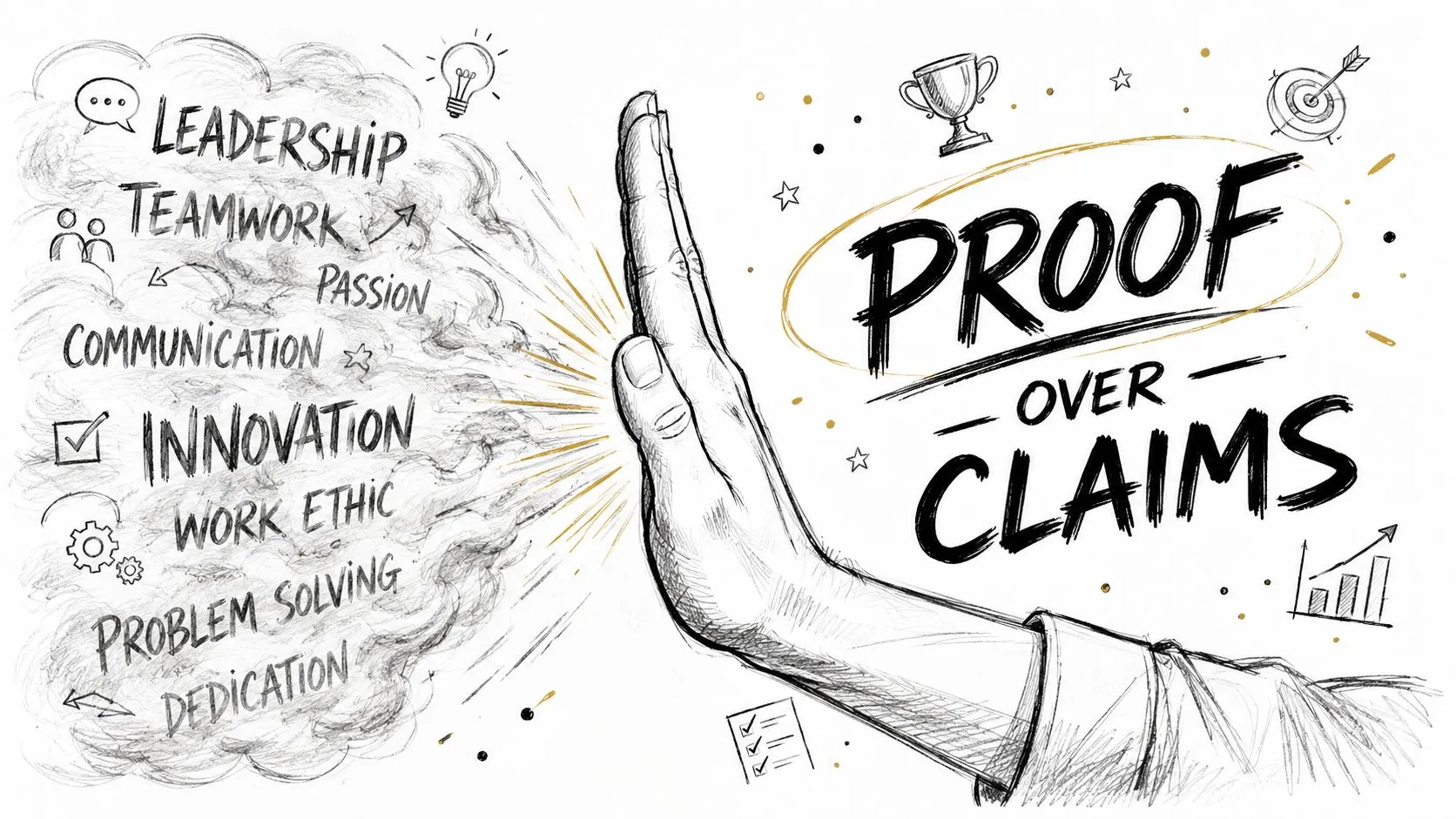
Soft skills are weak when listed alone
There's a simple rule here. When addressing soft skills like “leadership,” never list them as standalone attributes; instead, describe a specific accomplishment where you coached a group or led a project, backing every claim with hard numbers and metrics, as advised by Resume Worded's guidance on skills sections.
That means “leadership” doesn't belong as a naked bullet in your skills list.
It belongs in your experience section, where you can prove it:
- Led a cross-functional product launch
- Coached managers through a systems rollout
- Resolved an ugly stakeholder conflict that was blocking delivery
If you want a cleaner way to think about the difference, StoryCV's breakdown of soft skills vs hard skills is useful. Hard skills are usually listed. Soft skills are usually demonstrated.
What to list instead
Your dedicated skills section should lean toward things a reviewer can verify quickly:
- Technical tools like SQL, Python, Salesforce, Jira, Tableau, SAP, AWS
- Methods like Agile, forecasting, financial modeling, A/B testing, incident response
- Domain capabilities like vendor negotiation, compliance reporting, pipeline operations, release management
Those are easier to scan and easier to trust.
A better split
Here's the clean distinction:
| Put in the skills section | Prove in the experience section |
|---|---|
| Python | How you used Python to automate or analyze |
| Salesforce | What process or reporting you built in it |
| Budgeting | Where you owned planning or reforecasting |
| Stakeholder management | Which groups you aligned and what changed |
| Leadership | Who you led, coached, or influenced |
Practical rule: If a skill sounds like a personality compliment, don't list it. Show it.
“Good communicator” means nothing. A concise bullet about steering a difficult launch meeting means something.
How to Choose the Right Skills for Your CV
Good selection beats long selection. You do not need to list everything you've learned since your first job.
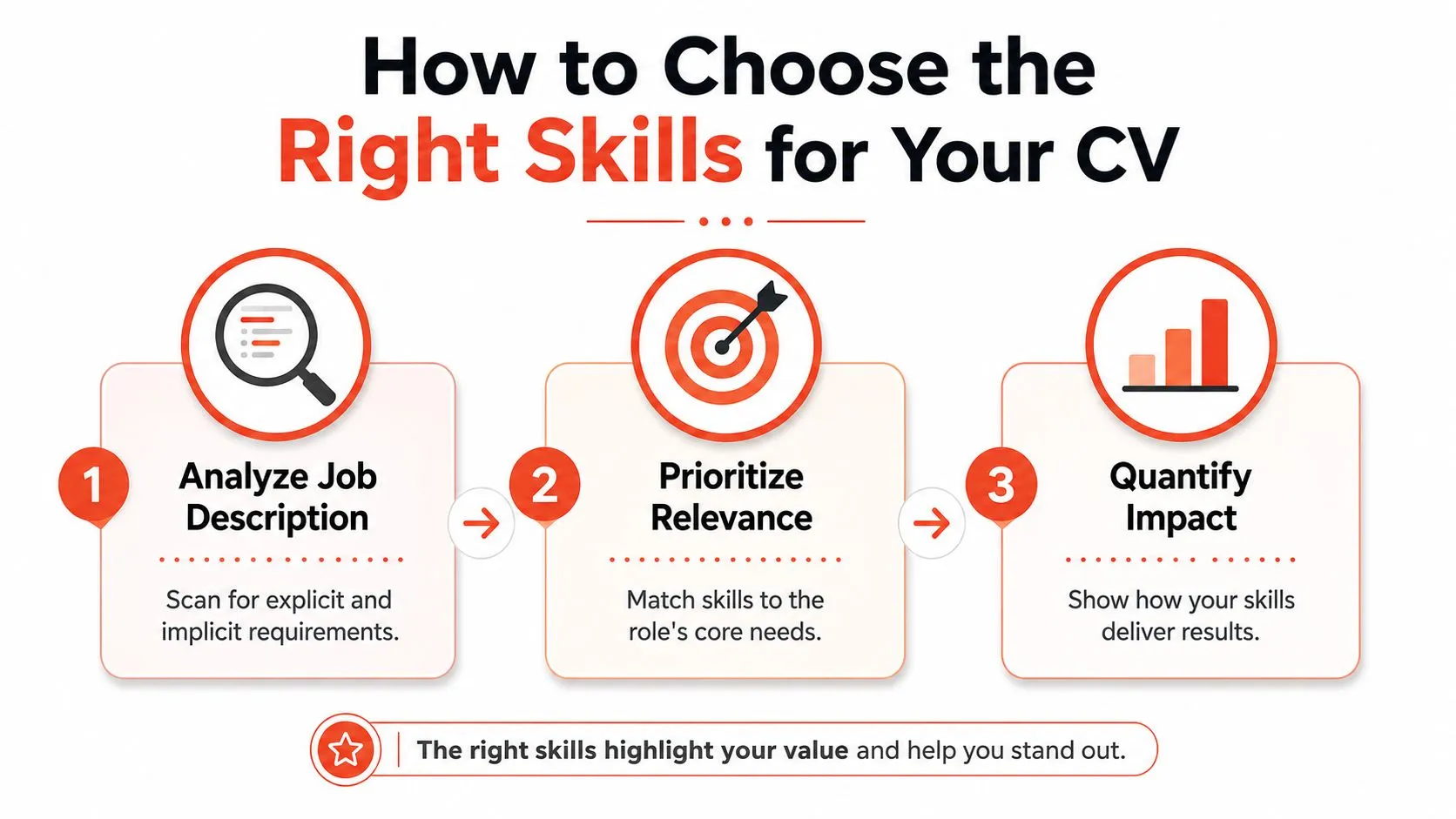
Start with the job ad, not your ego
The fastest way to ruin this section is to write the version that makes you feel impressive instead of the version that matches the role.
To maximize ATS compatibility and recruiter relevance, the skills section must include 8 to 15 targeted skills where 70% are hard skills and 30% are soft skills, using exact terminology from the job description because ATS algorithms frequently miss synonyms, according to Resumonk's guide to writing a resume skills section.
That “exact terminology” part matters more than people think. If the role asks for “SQL,” don't get cute with “database querying.” If it says “Amazon EC2,” don't hide behind “cloud infrastructure.”
Use this three-step filter
Analyze the role
Read the job description like a detective.
Look for:
- Named tools such as NetSuite, HubSpot, Power BI, Kubernetes
- Core activities such as forecasting, stakeholder management, process improvement
- Repeated language that signals what the employer cares about most
Repeated terms usually point to the core of the role.
Build a private master list
Make a long list for yourself. Keep it off the CV.
Include:
- tools you use confidently
- methods you apply regularly
- domain knowledge you've built
- transferable capabilities you can prove
This private list is your inventory, not your final answer.
Curate the final list
Now cut hard. Choose the skills that best match the role and best match the evidence in your experience section.
A strong final mix usually includes:
- Role-specific hard skills first
- Supporting tools second
- A few transferable capabilities only if you can prove them
What “curated” looks like
Bad list for a senior operations role:
- Leadership
- Communication
- Microsoft Office
- Teamwork
- Operations
- Problem Solving
- Excel
- Strategy
- Detail-Oriented
- Time Management
- ERP
- Collaboration
Better list:
- S&OP Planning
- Inventory Forecasting
- ERP Systems
- Excel
- Power BI
- Vendor Management
- Process Improvement
- KPI Reporting
- Cross-Functional Leadership
- Change Management
That second list sounds like an actual operator.
Don't ask, “What skills do I have?” Ask, “What skills tell the clearest story about why I fit this role?”
If you want help extracting that story, an online resume writer like StoryCV can guide you through your work history and turn it into a sharper set of role-matched skills. That's useful when you know your work was strong but your wording keeps going soft.
Formatting That Beats Bots and Brains
A good list can still fail if it looks like a mess.
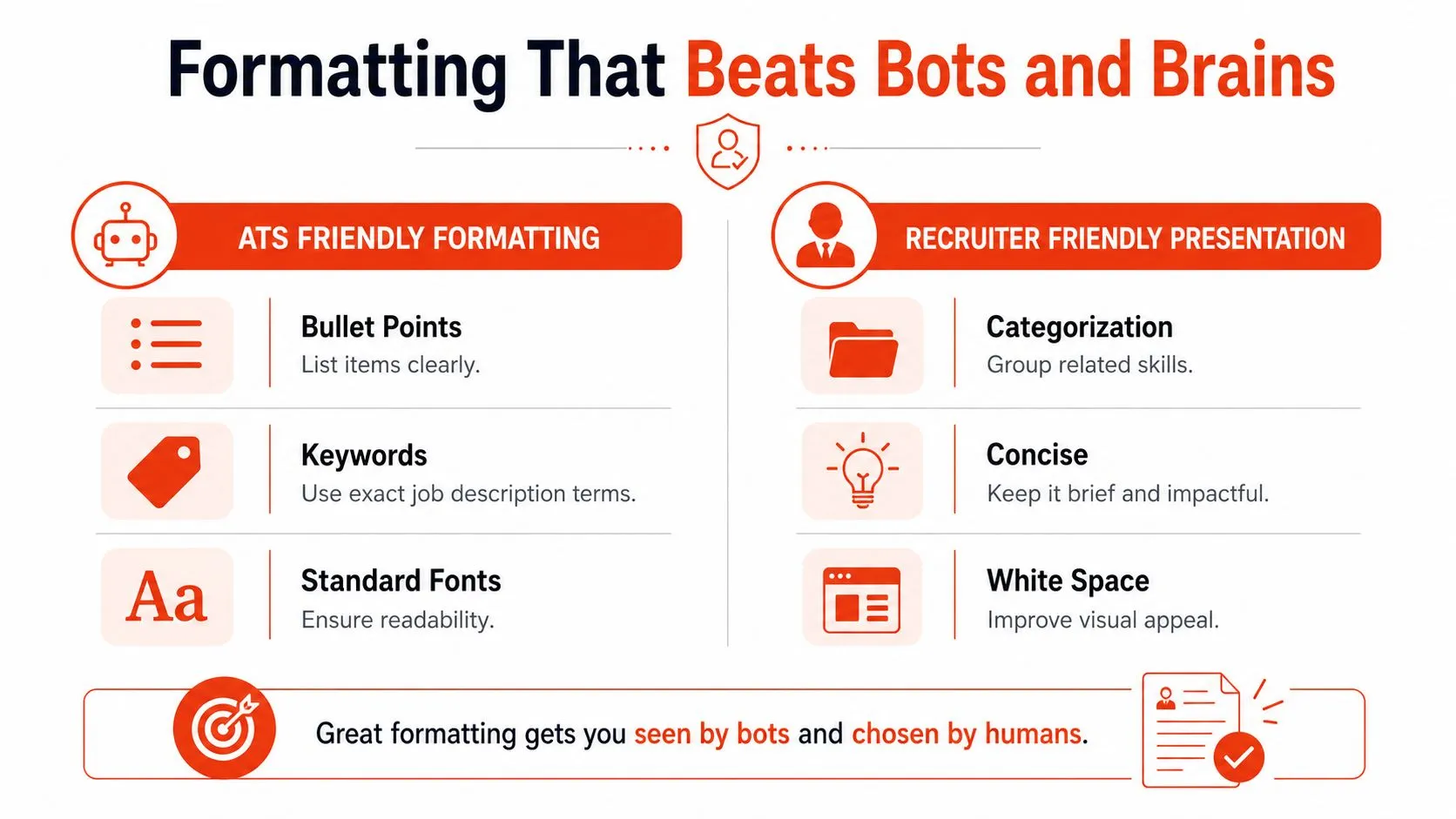
Stop using bars, stars, and cute nonsense
A high-impact skills section should contain a curated inventory of 10 to 30 relevant skills, organized by functional category such as Technical, Tools, and Methods, rather than by proficiency level, and it should exclude visual proficiency indicators like star ratings or bars because these are unreadable by ATS systems, based on Locked In AI's advice on listing resume skills.
Those rating bars are especially bad. “Excel ★★★★☆” tells me nothing. Compared to whom. For what kind of work. In what context.
Use categories that help scanning
For mid-to-senior professionals, grouped skills work better than one giant blob.
Try structures like:
| Category | Example entries |
|---|---|
| Technical | SQL, Python, Tableau |
| Tools | Salesforce, Jira, Looker |
| Methods | Agile, forecasting, process mapping |
That format helps humans scan and helps software parse.
Placement and wording matter
Keep the section easy to find. Don't bury essential skills on page two if the role is tool-heavy.
A few rules worth following:
- Use exact names. Write “Salesforce” instead of “CRM platforms” if Salesforce is the relevant one.
- Keep labels standard. “Skills” or “Core Skills” works. Don't invent clever headings.
- Stay readable. Standard fonts, simple bullets, clean spacing.
- Skip proficiency scales. Your experience bullets should prove depth.
If you want to understand how screening systems read resumes before a recruiter does, this explanation of AI resume screening is worth your time.
A recruiter should be able to scan your skills section in a few seconds and immediately know your lane.
That's the standard.
CV Skills Section Examples by Role
Abstract advice is cheap. Examples are better.
The average resume in 2024 listed 15 skills, up from 13 in 2023, a 15% increase, according to Enhancv's resume statistics roundup. That doesn't mean you should dump in more. It means professionals are documenting a broader range of relevant skills. The good ones are still selective.
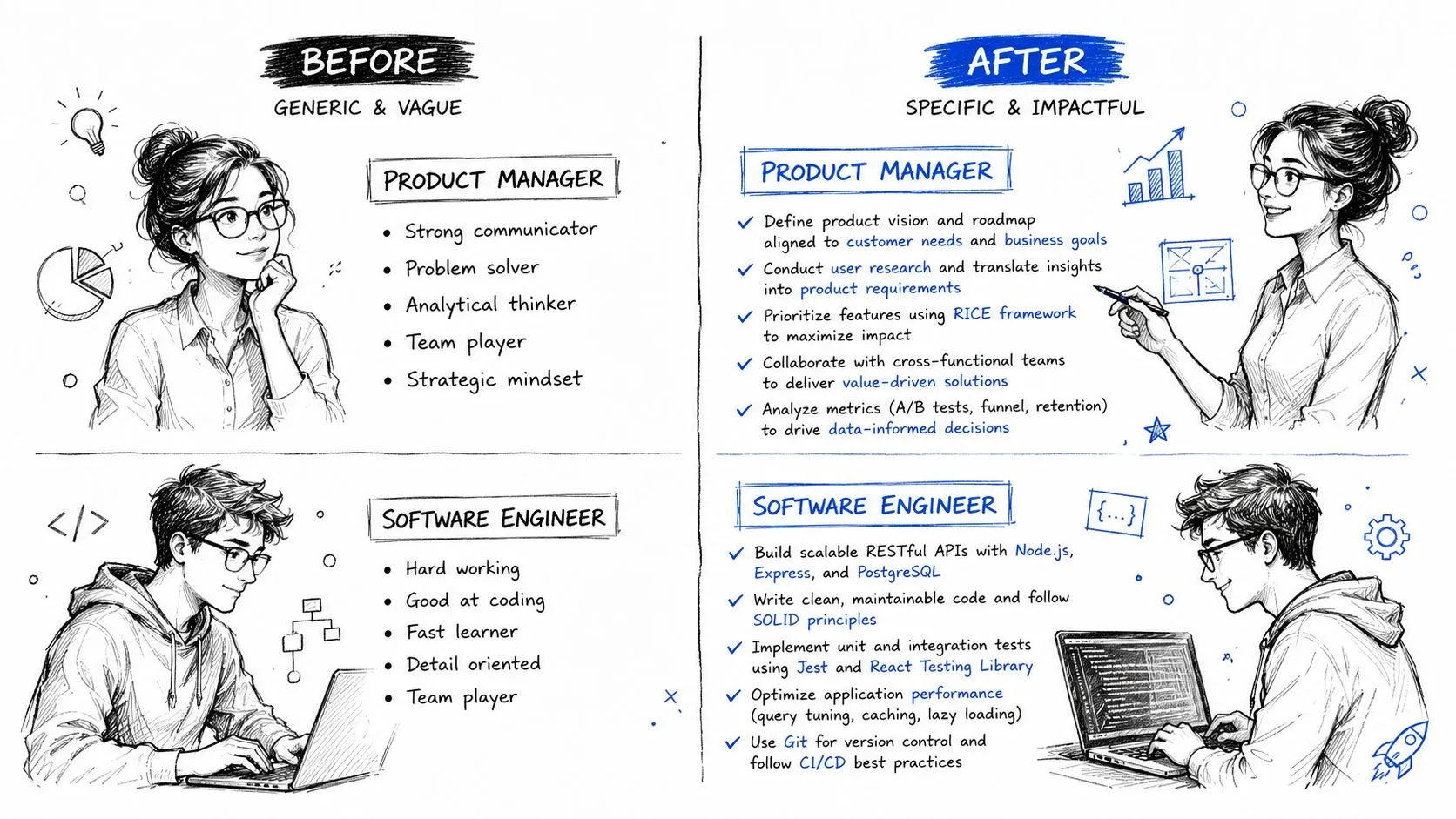
Product Manager
Before
Leadership, communication, product strategy, agile, teamwork, collaboration, problem solving, roadmap planning, data, UX, stakeholder management, innovation
After
Core Skills
Product Strategy, Roadmap Prioritization, User Research, Experimentation, Stakeholder Alignment
Tools
Jira, Confluence, Amplitude, Figma
Methods
Agile, A/B Testing, Backlog Management
Why it works: this version sounds like a product manager who has shipped things. It also gives the experience section a job. That section should then prove roadmap decisions, experiments, and cross-functional alignment.
Software Engineer
Before
Java, Python, teamwork, communication, AWS, problem solving, APIs, leadership, cloud, debugging, DevOps, agile
After
Languages
Python, Java, SQL
Cloud and Infrastructure
AWS, Docker, Kubernetes
Engineering Practices
API Design, CI/CD, Debugging, Test Automation
This is easier to trust. It also creates obvious proof points for work history bullets like CI/CD improvements, API work, or production debugging.
A quick visual walkthrough helps here:
Operations Director
Before
Operations, leadership, communication, management, strategic planning, team building, KPIs, Excel, process improvement, problem solving, ERP, logistics
After
Operations
Process Improvement, KPI Reporting, Inventory Planning, Vendor Management
Systems
ERP Systems, Excel, Power BI
Leadership
Cross-Functional Leadership, Change Management, Team Development
This version gives shape to seniority. It shows operating depth, systems fluency, and people leadership without turning into buzzword soup.
That same thinking applies outside tech and corporate roles. If you're targeting healthcare positions, for example, browsing remote physician assistant jobs can show how role-specific wording appears in real postings. Use that language carefully and only where it accurately matches your background.
The best skills section examples don't try to sound impressive. They sound specific.
Your Skills Section Is a Promise
Your skills section is not an appendix. It's an opening argument.
Every skill you list is a promise that the rest of the CV can back up. If the evidence isn't there, cut the skill. If the skill matters but the proof is weak, fix the experience bullet.
The standard to use
When you write the skills section of a CV, keep the bar simple:
- Curate hard so the list reflects the role, not your autobiography
- Prove traits elsewhere instead of listing empty soft skills
- Format for scanning with clear categories and plain language
- Match the story between skills and experience
If you struggle to turn real work into convincing evidence, study a few strong impact statement examples. That's where the promise gets verified.
A weak skills section says, “I've heard these words before.”
A strong one says, “This is what I do, and here's where I proved it.”
StoryCV is an Online Resume Writer built for people who've done meaningful work but need help saying it clearly. It uses a guided writing process to turn your experience into a sharp, evidence-backed resume, including a skills section that sounds like you and matches the role.