
Quantifiable achievements usually aren't missing. They just weren't being watched. People did the work first and measured it never, so by the time they sit down to write a resume, the number feels gone even though it probably lived in a project doc, a manager's feedback, a spreadsheet, or somebody's memory.
That's the problem. Not arithmetic. Attention.
If you've done solid work for years and still feel stuck, stop assuming your experience is “non-quantifiable.” Start assuming you never tracked the right thing while you were doing it. Resume guidance keeps pushing measurable outcomes because recruiters trust evidence more than task lists, and frameworks like Action + Metric + Result or Action Verb + Result (Quantified) + Timeframe keep showing up for a reason, they turn memory into proof (Indeed, Resume Genius). StoryCV sits in that gap too, because its job is to help people uncover the impact behind the work they already did.
Why Your Resume Feels Numberless
A resume starts looking weak when you write from memory alone. Memory gives you duties, not evidence. It gives you “managed,” “supported,” and “handled,” while the useful stuff, the scope, the throughput, the time saved, the before and after, gets buried in the actual workday.
That's why so many smart professionals think they have no quantifiable achievements. They're not wrong about the paperwork. They're wrong about the conclusion. If nobody tracked the metric in the moment, it can feel like the metric never existed. Usually, that's false. Usually, it just wasn't being watched.
The work happened before the writing
Recruiter guidance keeps pointing candidates back to numbers such as revenue, costs saved, percentages, time saved, team size, and volume because numbers answer a better question than duties do, namely how much changed (Indeed). The work was real, but the record was never built while you were doing it.
Practical rule: If you didn't track the metric, don't assume it's gone. Assume you need to reconstruct it from context.
That reconstruction separates a bland resume from a credible one. Resume writing advice keeps returning to the same point, baseline first, change second, and scope always matters (Resume Genius, Bragbook). If you can remember what changed, what it touched, and roughly how big the work was, you're already closer than you think.
For people who need help turning rough experience into usable bullets, a guided editor like Tutorbase can be useful because it pushes you to dig for context instead of accepting a vague duty statement and calling it done.
Stop treating recall like a dead end
The biggest mistake is emotional, not technical. People hit one missing number, panic, and downgrade the whole bullet. Bad move. A resume is a compact performance record, and performance records are usually reconstructed from pieces, not retrieved from one perfect dashboard.
So the first job is to stop asking, “Do I have a number?” Ask, “What would have been measurable if I'd been paying attention?” That shift changes the whole game. You stop defending weak bullets and start excavating the work you already know was valuable.
Where to Find the Numbers
The numbers are usually sitting in front of you. Not in a polished final report, but in your own trail of work, old emails, project notes, manager feedback, and the dull admin details people ignore until resume time. The problem is rarely that the number never existed. The problem is that nobody was paying attention while the work was happening.
Team size, volume, time, cadence, before and after
Start with the easiest recoveries.
- Team or project size: How many people were on the project, the pod, the account, or the rollout?
- Volume handled: How many tickets, clients, campaigns, files, launches, or meetings were you dealing with?
- Time saved: Did you make a process faster, cleaner, or less manual, even if nobody named the gain at the time?
- Frequency or cadence: Did the work happen daily, weekly, monthly, or per quarter?
- Before and after: What was true before your work, and what was true after it?
Ask the questions that force the work back into focus. How big was the thing? How often did it happen? What got faster? What changed after you touched it? Those questions usually shake loose a usable number, or at least a usable estimate, from memory.
| Question to ask | What it usually reveals | Why it matters |
|---|---|---|
| How many people were involved? | Team size or scope | Shows responsibility |
| How much did you handle? | Volume | Shows throughput |
| What got faster? | Time saved | Shows efficiency |
| How often did it happen? | Cadence | Shows consistency |
| What was different before? | Before and after | Shows change |
A lot of candidates treat the absence of a dashboard as the absence of a metric. Wrong move. The metric may have lived in a calendar, a queue, a spreadsheet, or your own routine. Vernovis makes the same point in practical terms, the number is often recoverable if you look at baseline, change, and scope with a cooler head. The same logic shows up in a solid guide on how to write bullet points in a resume, because weak bullets usually miss context before they miss math.
Use the right kind of memory
Some roles make this easier than others. Sales remembers revenue. Operations remembers throughput. Knowledge work remembers cycle time, turnaround, and review load. If you cannot find a clean number, look for the count of something you touched or the speed of something you improved.
An old project file, a manager email, or a meeting note may be enough. You are not building a forensic report. You are rebuilding enough context to write accurately, and sometimes that means choosing the clearest count or estimating carefully from the work itself.
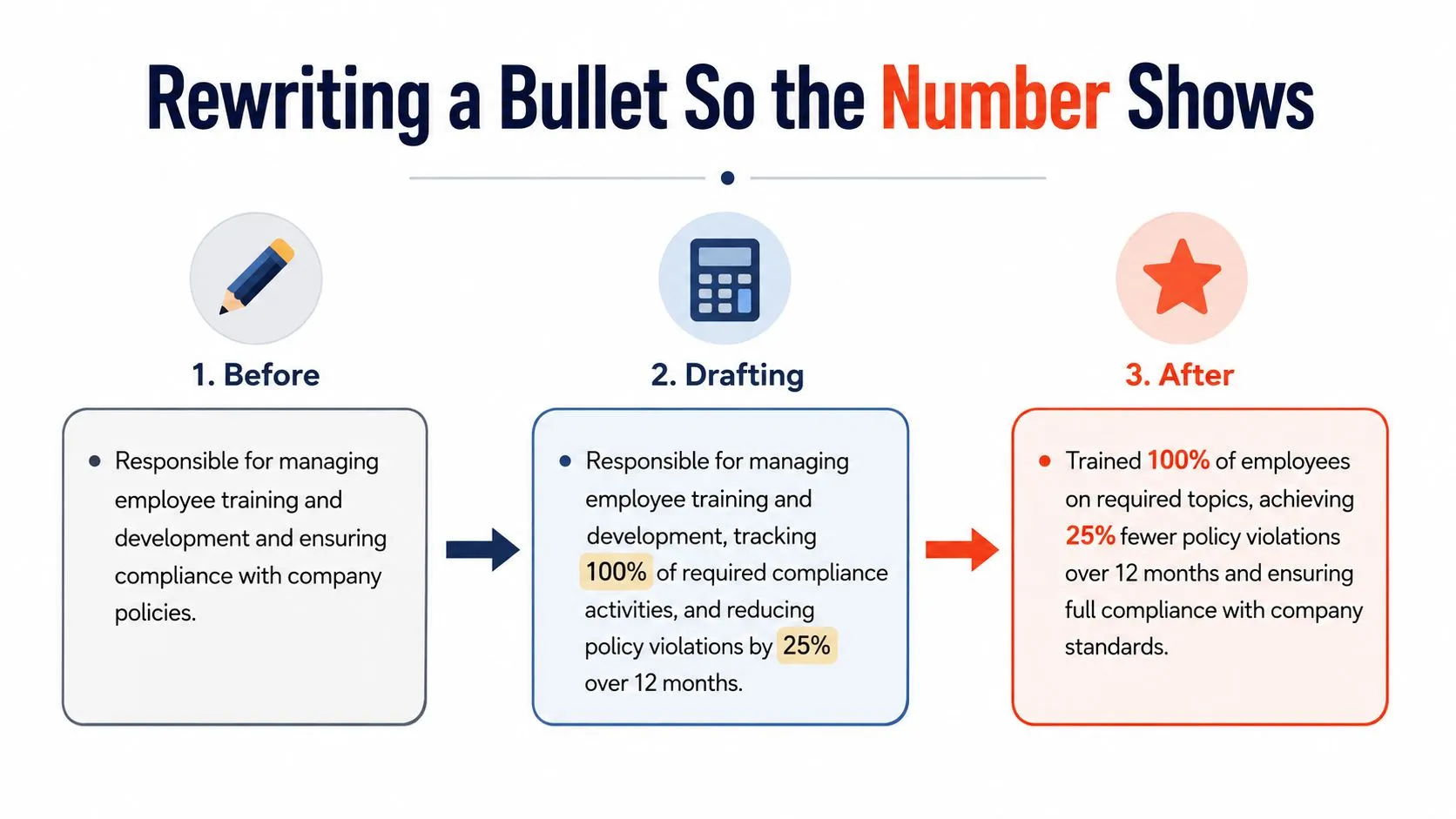
A diagram illustrating how to rewrite a resume bullet point by including quantifiable metrics and data.
Rewriting a Bullet So the Number Shows
A number only helps if the sentence lands. The cleanest resume bullets follow the same skeleton every time, action first, context second, result last. That's the structure behind the common Action + Context + Result and XYZ patterns, and it's the reason quantified bullets read like proof instead of chores (WahResume, Wonsulting). The point isn't to sound formulaic. The point is to stop sounding slippery.
Three hypothetical rewrites
Before, the bullet says: “Managed project updates.”
After, in an operations role, it becomes: “Led weekly project updates for a 12-person team, keeping deliverables on track across the full rollout.”
Before, the bullet says: “Improved customer support.”
After, in a knowledge-work role, it becomes: “Reduced response time across the support queue by tightening triage and routing, so follow-ups moved faster and clearer.”
Before, the bullet says: “Helped new managers onboard.”
After, in a leadership role, it becomes: “Built onboarding support for new managers across multiple departments, giving them a faster path to independent decisions.”
These are hypothetical on purpose. The point is the shape, not the fantasy number. If you have a real count, use it. If you have a real time window, add it. If the best proof is scope or turnaround, write that.
Good bullet rule: one main achievement, one main metric, one clean sentence. Don't cram three weak numbers into one line and call it better.
The internal mechanics matter too. The best bullets usually start with a verb that does something, then they name the context, then they end on the measurable result. That's not because recruiters worship formatting. It's because the structure makes the value visible fast (StoryCV bullet guidance).
Don't bury the number
If the metric is hidden in the middle of a long sentence, it's wasted. Recruiters skim. ATS systems skim. Busy humans skim. Put the proof where a fast reader can catch it.
When you do have a clean metric, use it boldly and keep the rest tight. When you don't, don't fake the polish. Write the sentence first, then trim the junk. The bullet should sound like something a competent person wrote after thinking, not something a template spat out after three rounds of sanding.
The Five Categories of Metrics Recruiters Trust
A resume does not need a random number. It needs the right kind of number, and the problem is usually attention during the work, not a lack of metrics after the fact. If you were watching the process closely, the proof is usually already there. For a clean way to sort that proof, StoryCV's guide to metrics in a resume is a useful reference.
Recruiters trust a few broad categories because they map cleanly to impact: money, time, volume, scope, and quality. Pick the bucket that matches the work rather than the one that looks most dramatic. That choice matters more than stuffing in the flashiest figure you can find.
One bucket per bullet
Use one primary metric per bullet. If you try to prove everything at once, you usually prove nothing. Guidance on quantified achievements also points toward the narrowest metric that shows business impact, with the rest of the line kept clean WahResume.
| Category | What it measures | Best for | Hypothetical example |
|---|---|---|---|
| Financial impact | Dollars, budgets, revenue | Sales, finance, procurement | “Cut operating costs across a monthly budget.” |
| Operational efficiency | Hours saved, process improvement, turnaround | Operations, admin, support | “Shortened review cycles on a recurring process.” |
| Volume | Work handled, customers served, projects completed | Service, project work, support | “Handled a large queue of client requests.” |
| Scope | Team size, project size, regions, ownership | Leadership, program work, cross-functional roles | “Coordinated work across multiple teams.” |
| Quality | Error reduction, adoption, retention, satisfaction | Product, support, nonprofit, people leadership | “Improved the quality of outcomes for a recurring workflow.” |
Quality gets overlooked too often. A lot of work creates value through adoption, compliance, trust, and better decisions, and those outcomes still deserve a metric when you can name one clearly. If your role lives there, do not shove it into a money bucket just because money feels safer.
A useful test is simple. If the bullet answers “How much?” or “How big?” clearly, it probably works. If it answers neither, you may be dressing up effort as impact. Quantified achievements work best when the number is narrow, honest, and tied to the actual result, not the grind behind it.
Match the bucket to the role
If you work in a role where quality shifts matter more than dollars, use that category and say what changed. The resume gets stronger when the metric matches the problem you solved. The wrong bucket makes a solid achievement look awkward, while the right one makes the point fast.
When the Right Answer Is No Number at All
Sometimes a resume bullet should stay unquantified. If the work was about judgment, trust-building, stakeholder alignment, risk calls, or other qualitative change, forcing a number onto it can make the line feel fake. Recruiters see that instantly. They have read enough resumes to know when a count was added after the fact.
Write the judgment, not the guess
A strong non-quantified bullet still has shape. It names the decision, the scope, and the consequence.
Before, in a made-up leadership example: “Improved team morale.”
After: “Reset team norms after a difficult reorganization, helping managers regain trust and clarify expectations for the group.”
Before, in a policy or operations example: “Handled sensitive issues.”
After: “Advised on sensitive cases involving cross-team disagreement, keeping decisions consistent and reducing escalation noise.”
Skipping the number makes the bullet stronger when the impact is qualitative. It stops you from pretending the work was a dashboard when it was really a judgment call. If the outcome matters but the count does not exist in a clean form, write the outcome plainly.
Practical rule: If the best number you can write is a guess you'd have to defend in an interview, leave it out.
There is one narrow exception. If the work was measurable but the exact figure is fuzzy, use a conservative range only if you can stand behind it. That keeps the bullet honest without pretending your memory is a dashboard, as noted earlier. If the number needs a story to survive scrutiny, drop it and write the judgment instead.
Two honest rewrites
A fuzzy but measurable bullet might become, “Supported onboarding for a small set of new hires each month, keeping setup consistent during a busy hiring period.” That stays honest if the exact count is gone but the scope is real.
A purely qualitative bullet might become, “Gave leadership clear options during a messy priority shift, which helped the team move faster with less backtracking.” No fake count. No invented precision. Just the actual impact.
The line is simple. Use a metric when the work supports one. Leave it out when the number would be theater.
The same discipline helps with formatting. StoryCV ATS guidance covers how to keep bullets readable for both software and people, and that matters because a good point can still get lost in bad structure.
If the work was about engagement rather than volume, the metric may still exist somewhere in the background. That is why engagement ideas for studio operators can be useful. They show you where the signal lives, then you decide whether to count it or describe the judgment that led to the result.
ATS-Friendly Rules for Numbers on the Page
A metric is useless if the resume is a mess. Applicant tracking systems still sort and scan resumes before a human opens them, so the page has to read cleanly first and please the machine second. Keep the bullet easy to read, keep the number visible, and save the clever formatting for somewhere else, if you use it at all. StoryCV ATS guidance
Keep the line legible
Use standard numerals, not words. Write 25%, not “twenty-five percent.” Put the number in plain text, not inside a table or text box where parsing can get awkward. Keep the action verb at the front, because buried metrics are easy to miss and hard for software to interpret cleanly.
Recruiters do not need decoration. They need the number to show up fast.
Do not turn the bullet into a sentence graveyard. One clean line beats a paragraph packed with commas. If the metric is the proof, give it space. If you bury it under too much context, you force the reader to do the sorting for you, and that hurts the point.
The same rule applies to roles where engagement or retention matters. The engagement ideas for studio operators piece points to the same habit, track the signal you care about, then put it where people can see it. Good writing and good operations both fail when the important number gets buried.
Simple formatting checklist
- Use numerals: Standard numbers are easier to scan than words.
- Keep bullets in text: Tables and text boxes can break readability.
- Avoid special treatment: Do not style the metric so heavily that it disappears.
- Front-load the proof: Lead with the action, keep the result visible.
The formatting rule is simple. If a human cannot spot the proof in two seconds, the bullet is too clever for its own good. Clean structure shows respect for the reader.
Quantified Impact Versus Impact That Hasn't Been Counted Yet
A quantified achievement isn't “better” work. It's work you paid attention to. That's the part people keep missing. The resume doesn't reward the loudest accomplishment, it rewards the clearest one, and clarity usually starts with counting something while the work is still in motion.
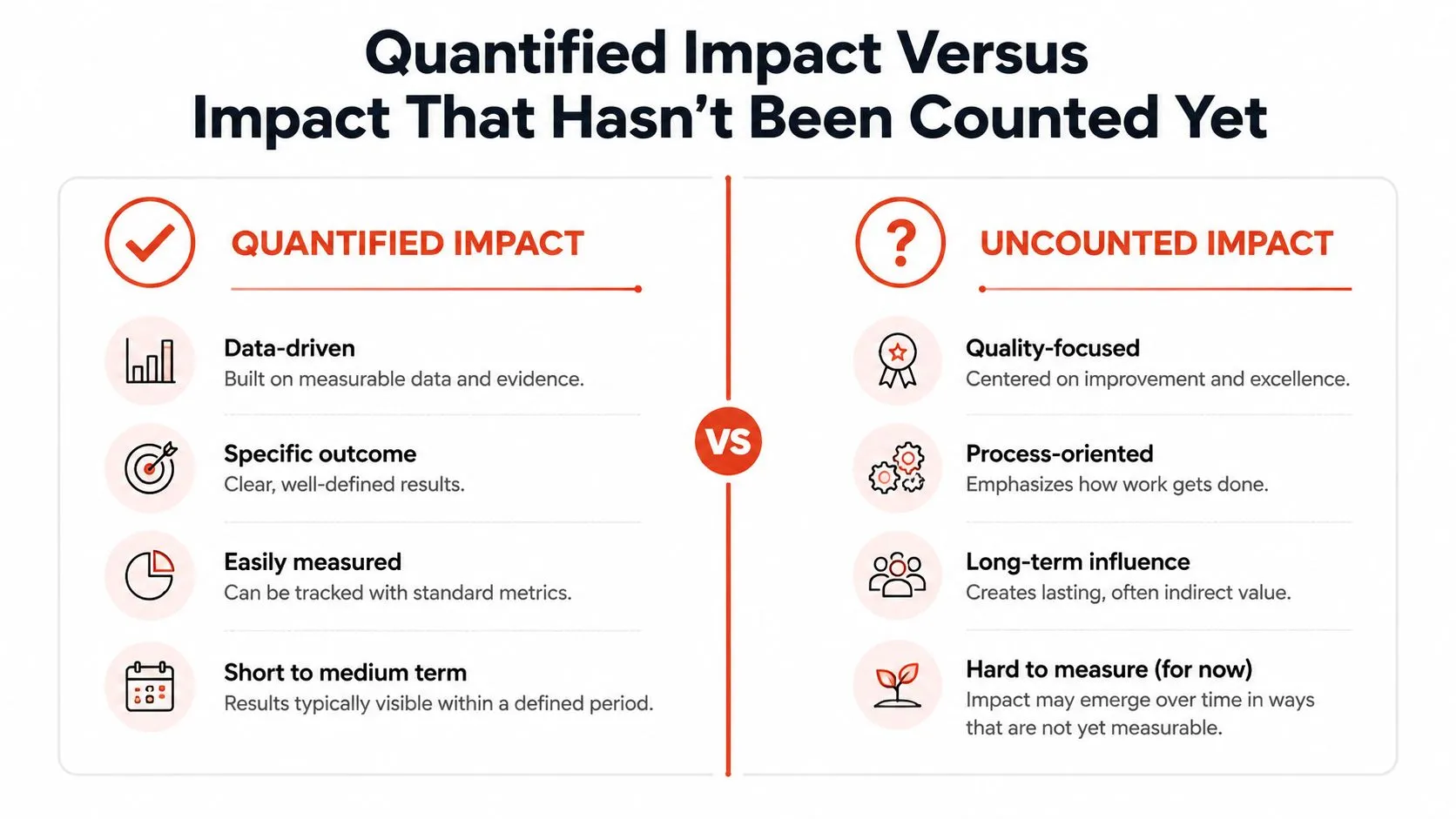
The line to remember is this. Quantified impact is impact that got counted. Uncounted impact is still impact, it just hasn't been measured yet.
Keep the five places in mind, team size, volume, time, cadence, before and after. Keep the five buckets in mind, money, efficiency, volume, scope, quality. And when the work is judgment-heavy, write the judgment plainly instead of faking a number to make the bullet look busier.
A strong resume doesn't pretend every accomplishment came with a dashboard. It shows the truth cleanly, counts what can be counted, and leaves the rest honest.
If your bullets are still too vague, StoryCV can help you turn raw experience into clear resume language by interviewing you about scope, outcomes, and context, then drafting the line for you. Start with your strongest role at StoryCV, and build a resume that shows what you changed, not just what you were assigned.