The usual advice about pet peeves is to stop letting small things bother you. That's fine for someone's coffee order. It's bad advice for a resume that hides your contribution or a meeting invite that doesn't explain why you're needed.
Small habits can make good work harder to recognize. A duty-based bullet leaves a recruiter guessing. A vague follow-up gives a hiring manager nothing to act on. A file named resume_final_v3_REAL_new.pdf makes an otherwise finished application look unfinished.
Merriam-Webster defines a pet peeve as a frequent subject of complaint. That distinction matters. Not every preference deserves a rule, and a formatting mistake isn't evidence that someone can't do the job.
Fix habits that make other people guess, repeat work, or search for the point. Leave harmless differences alone.
These pet peeve examples focus on that boundary. Each pairs a weak line with a stronger alternative and the thinking behind the rewrite. The examples are illustrative, not achievements to copy into your resume. Use the method. Supply your own facts.
1. Vague Resume Bullets Recruiters Have to Decode
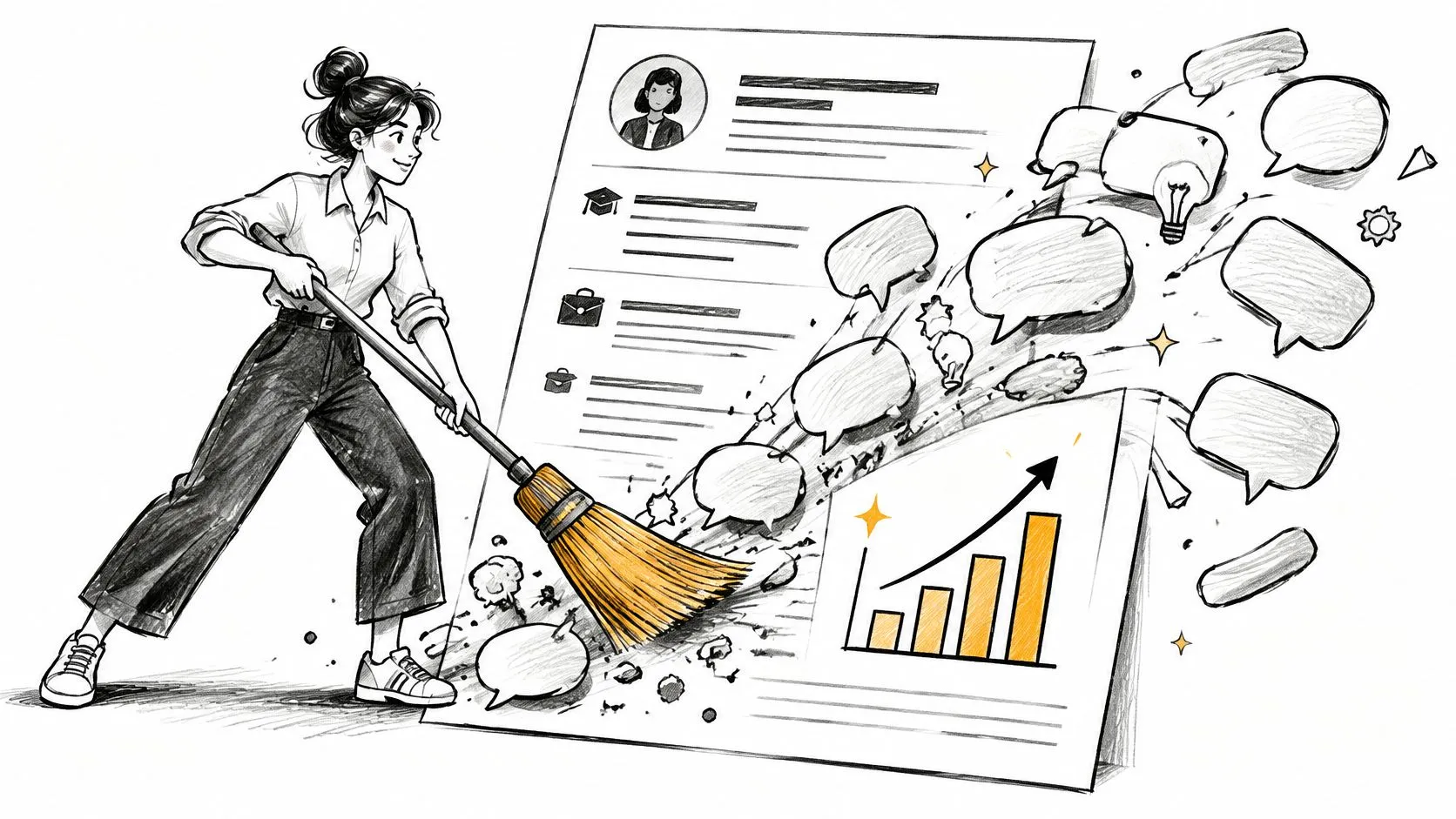
Managed social media accounts describes an assignment. It doesn't explain your judgment, the problem you handled, or what improved because you were there.
That's the problem with duty-based bullets. A recruiter shouldn't have to reconstruct your contribution from your job title.

Move From Assignment to Contribution
Weak: Managed social media accounts.
Stronger, illustrative: Rebuilt a business-to-business brand's social content calendar around customer questions, helping sales receive more relevant inbound inquiries.
The stronger version identifies context, action, and outcome. It tells the reader what you changed rather than listing the channel you managed.
Try the same move in customer support:
- Weak: Responsible for customer support.
- Stronger, illustrative: Created approved replies for recurring setup questions, helping support agents respond consistently and reducing repeat explanations.
Before rewriting, ask what was different after your work. Did customers understand the product better? Did colleagues spend less time correcting errors? Did you remove a recurring handoff problem?
Delete “responsible for” only after you've found the contribution. Replacing it with “managed” won't fix missing substance. If you can't remember metrics, start with scope: customers served, systems maintained, stakeholders involved, or the complexity you handled.
The same reasoning helps you build a stronger tech resume. Name the system, explain the intervention, and show what changed for the people using it.
2. Buzzword Overload in Resume Summaries
Dynamic, results-driven professional with a passion for excellence asks the reader to accept your own review of yourself. It gives them nothing to evaluate.
A useful summary does a different job. It identifies your professional lane and the kind of problem you're equipped to solve.
Replace Praise With Evidence
Consider an operations professional moving into a broader leadership role.
Weak: Detail-oriented team player with excellent communication skills.
Stronger, illustrative: Operations lead who simplified vendor onboarding across regional warehouses by clarifying approval ownership and replacing scattered email requests with a shared intake process.
The improvement isn't a more impressive adjective. It's the explanation of what the person noticed, changed, and made easier.
You don't need to cram your whole history into the summary. Choose the experience most relevant to the role you want, then let your work history support it.
- Replace “strategic”: Explain which decision you made and why it mattered.
- Replace “collaborative”: Name the teams you brought together and the problem they resolved.
- Replace “detail-oriented”: Describe an error you caught or a control you introduced.
Use these professional summary examples for resumes to compare approaches, not to borrow a stranger's identity.
A summary should also match your actual level of ownership. If you supported a rollout, say so. Don't inflate coordination into executive leadership.
The verdict: Keep the facts. Cut the self-applause. A specific contribution makes a stronger case than an adjective you'd never be asked to prove.
3. Inconsistent Formatting Across Your Resume
Mixed date styles aren't a character flaw. They're an avoidable reading problem.
When headings, dates, and bullets keep changing, the reader has to relearn how your document works. Your experience deserves that attention instead.
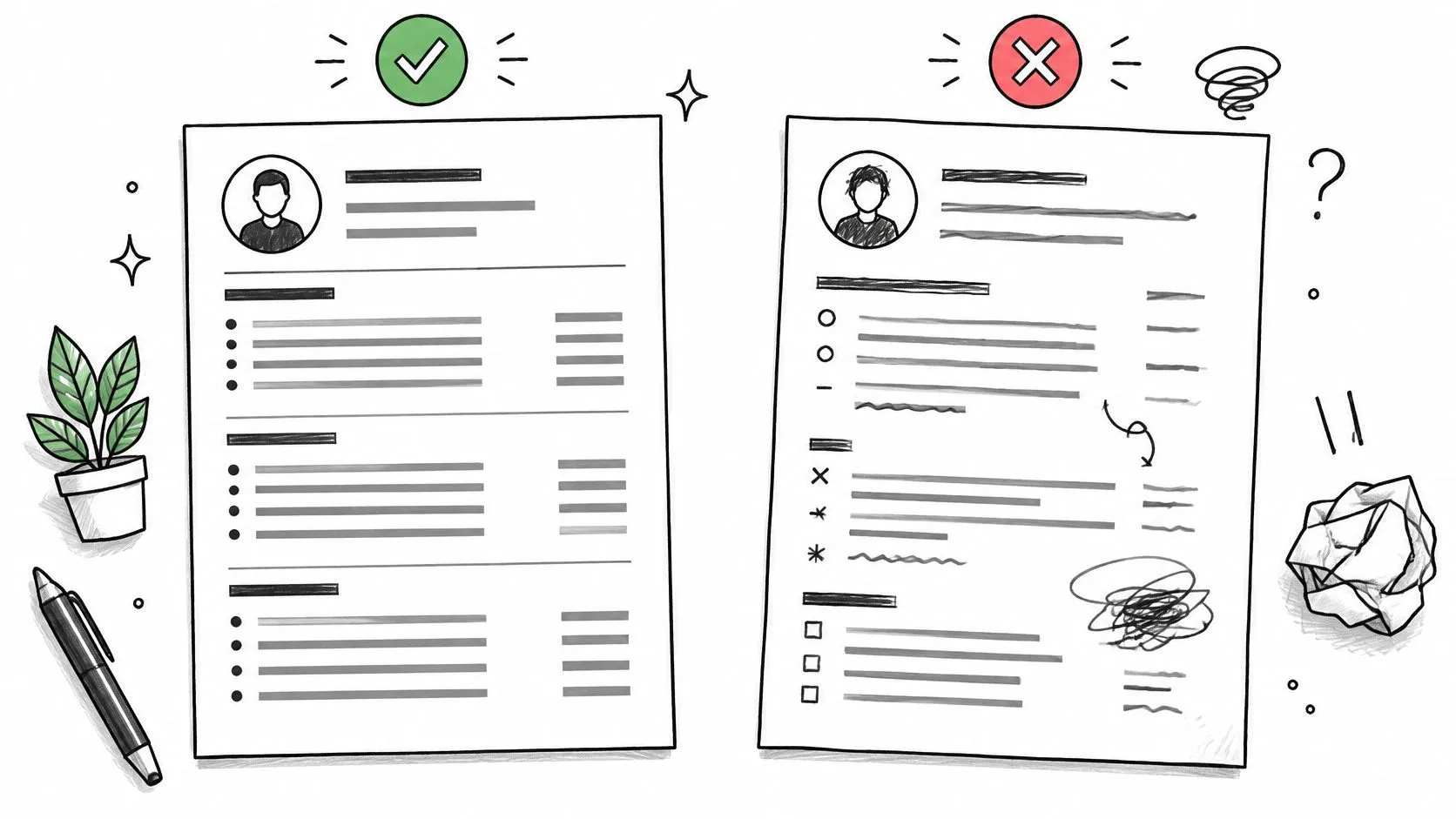
Weak presentation: Abbreviated months in one role, numeric dates in another, and years alone somewhere else.
Stronger presentation: The same month-and-year style, heading hierarchy, and bullet alignment throughout.
Standardize the Pattern, Not the Facts
The thinking here is simple: make comparable information look comparable. A job title should look like the other job titles. An employer name shouldn't suddenly resemble a section heading.
Tense needs the same judgment. Use past tense for previous roles and completed achievements. Use present tense for work you still perform in your current role, not for every bullet under your current employer.
- Set styles: In Microsoft Word or Google Docs, use consistent paragraph styles rather than manually adjusting every heading.
- Remove spacing hacks: Don't align dates with repeated spaces. Use a right-aligned tab stop or a straightforward stacked layout.
- Inspect the export: Open the PDF and check page breaks, bullet indentation, and whether the text remains selectable.
Don't add an end month you can't verify just to make the dates look tidy. Consistency isn't permission to invent precision.
The fix: Choose a clear pattern and apply it everywhere. Spend your editing energy on the substance once the document stops asking the reader to decode its layout.
4. Meetings That Should Have Been Emails
A meeting invitation labeled Quick sync? transfers the planning work to everyone receiving it. They have to ask what it's about, what to prepare, and whether they're needed.
This isn't just a personal dislike of calendars. In a SurveyMonkey study of full-time workers, unnecessary meetings ranked as the leading workplace annoyance at 22%.
Weak invite: Quick sync on the launch?
Stronger message:
Decision needed: Choose whether to launch with the current checkout flow or delay for the accessibility fix.
Recommendation: Delay until the fix passes testing.
Response needed: Confirm your decision before the release cutoff.
The stronger version supplies the decision, options, and timing. People can respond without attending a meeting just to discover the question.
Keep Meetings for Work That Needs Discussion
Use a meeting when people need to resolve competing priorities, examine uncertainty together, or handle a sensitive conversation. Send a message when you need a straightforward update or approval.
Before accepting an unclear invitation, ask the organizer what decision the group needs to make. Before sending one, write that decision at the top.
The same distinction improves resume writing.
Weak: Attended weekly project meetings.
Stronger, illustrative: Replaced routine status meetings with written updates and reserved live discussions for blocked decisions.
That rewrite works because it describes a change in how people worked. Only claim the improvement if you introduced it, and add measured time savings only when you can support them.

5. Talking Over People in Interviews and Meetings
You recognize the topic. You have a relevant example. You start answering before the other person finishes.
The intention may be enthusiasm. The result is that you're responding to the question you expected, not necessarily the question they asked.
In a survey reported by SHRM, 48% of respondents identified interrupting others as an irritation. That makes this a useful habit to examine, not a reason to label someone difficult after an accidental overlap.
Show That You Heard the Point
Weak response: I know, but what we really need is a better process.
Stronger response: The approval handoff sounds like the main bottleneck. Is the delay happening before review or after someone requests changes?
The stronger response does more than sound polite. It checks the problem before proposing a solution.
- Let the question finish: In an interview, note your key word instead of jumping in.
- Reflect the substance: Summarize the concern briefly, without repeating the entire conversation.
- Repair an overlap: Stop and let the other person continue. Don't turn an interruption into a contest.
If listening led to a concrete work improvement, describe that on your resume.
Weak: Excellent listener and communicator.
Stronger, illustrative: Gathered feedback from support agents and revised the escalation guide to clarify which cases required engineering review.
The thinking moves from a personality claim to an observable action. It shows what you learned from others and what you did with it.
The verdict: Listening isn't waiting for your turn. It's using what the other person said to improve your next question or decision.
6. Unclear Job Titles and Internal Jargon
Operations Wizard may be your official title. Outside your company, it doesn't explain whether you supervised fulfillment, planned capacity, or managed office supplies.
Internal acronyms create the same problem. They make sense to colleagues who already know your organization. A recruiter doesn't have that context.
Weak: Operations Wizard leading the Phoenix pod.
Stronger, illustrative: Operations Wizard (fulfillment operations), supervising warehouse dispatch and coordinating inventory handoffs.
The stronger line preserves the official title while explaining the function. It doesn't invent a promotion to make the role sound familiar.
Translate the work. Don't upgrade the title.
Explain What an Outsider Needs to Know
Start with what your team delivered. Then identify the part you owned and the people who relied on it.
For example, a technical program manager shouldn't write Drove the Atlas initiative across CX and SRE and assume the names explain the work.
Stronger, illustrative: Coordinated customer experience and site reliability engineering teams during a service migration, clarifying launch dependencies and escalation ownership.
- Keep titles accurate: Add a plain-language functional description when the official title is unusual.
- Expand unfamiliar acronyms: Spell out the term when the reader needs it to understand your contribution.
- Remove internal labels: Keep a project name only if it helps explain the work.
The thinking is the same as translating between departments. You're not simplifying the achievement. You're supplying the context the listener doesn't have.
The fix: Ask whether someone outside your employer could explain your role after reading the line. If they can't, replace insider shorthand with the function, action, and outcome.
7. Ghosting After Interviews and Applications
Silence from an employer isn't proof that your interview went badly. Hiring teams can leave candidates without a clear answer, and candidates can also disappear instead of closing the loop.
The employer side is a substantial frustration: 59.0% of job seekers identified applying and receiving no response from employers as a top job-search challenge in iHire's 2025 State of Online Recruiting report.
Follow Up Without Chasing Indefinitely
Weak: Just checking in again??
Stronger, illustrative: Thank you for discussing the operations role with me. Our conversation about vendor onboarding reinforced my interest. Please let me know whether there's an updated timeline or any additional information I can provide.
The stronger version names the conversation, confirms interest, and gives the recipient a clear question. It doesn't apologize for existing or demand an immediate decision.
- Follow the agreed timeline: If the interviewer gave a decision date, wait until it passes before asking for an update.
- Keep the message useful: Mention the role and offer relevant information, not another copy of your entire career history.
- Close your own loop: If you withdraw or accept another offer, tell the hiring team directly.
Use a clear follow-up letter format, then remove anything that doesn't help the recipient respond.
You can improve the message. You can't make someone answer it. Keep applying rather than treating repeated follow-ups as a job-search strategy.
For your next interview, prepare concrete stories about problems you handled, decisions you made, and outcomes you can defend. That gives both the conversation and the follow-up something meaningful to reference.
8. Messy File Names in Resume Uploads
resume_final_v3_REAL_new.pdf is a useful reminder to you and a useless label to someone else. It describes your editing process instead of identifying the document.
This is a small fix. Keep it small. A messy filename doesn't prove you're unqualified, but a clear one makes your application easier to identify.
Weak: resume_final_v3_REAL_new.pdf
Stronger: Jane-Doe-Operations-Manager-Resume.pdf
Name the File for the Recipient
The thinking changes from Which version was I editing? to What will help this person recognize my resume?
Use your name and a recognizable document label. Add the target role when it helps distinguish applications, and follow the employer's instructions if they specify a naming convention or file type.
- Keep editing labels private: Store drafts separately rather than sending files labeled old, revised, or final-final.
- Check the correct version: Confirm that the summary and experience match the intended application.
- Open the attachment: Inspect the exported document, not just the source file.
- Test readability: Make sure the PDF text is selectable and nothing was clipped during export.
A sensible name for your resume should be easy to recognize without opening it. Don't cram the entire job description into the filename.
The same rule applies to portfolios and cover letters. Identify yourself, identify the document, and leave out your drafting history.
The verdict: This won't rescue weak content. It will remove an unnecessary distraction from strong content. Rename the file, inspect the attachment, and move on to the parts of the application that require real judgment.
Pet Peeve Examples at a Glance
| Item | Where It Shows Up | What It Signals | Quick Fix |
|---|---|---|---|
| Vague Resume Bullets | Experience section; duty-focused bullets without scope or outcomes | Effort without clear impact; hard to distinguish from other candidates | State the context, action, and result; add scope or metrics where possible |
| Buzzword Overload | Resume summaries and skills sections | Generic claims without evidence | Replace adjectives with specific, defensible facts |
| Inconsistent Formatting | Dates, tenses, spacing, fonts, and bullet styles across the resume | Carelessness that distracts from your experience | Standardize dates and formatting; use consistent tense and check the exported PDF |
| Meetings That Should Have Been Emails | Agenda-free invites and meetings for decisions suited to written messages | Poor respect for others' time and unnecessary process | Ask for an agenda; state the decision needed and options in a concise message |
| Talking Over People | Interviews and team conversations | Poor listening and reduced trust | Let others finish, pause before responding, and summarize their point |
| Unclear Job Titles and Internal Jargon | Job titles, acronyms, project names, and team descriptions on a resume | Experience may be difficult for outsiders to understand | Use a standard title, explain acronyms, and describe the team's work |
| Ghosting After Interviews | Post-interview and application communication | Poor communication and disregard for candidates or hiring teams | Send a brief, polite follow-up about a week after the interview |
| Messy File Names | Resume file uploads and recruiter download folders | Lack of attention to presentation and document organization | Name the file with your name and target role; check the exported PDF |
Fix the Pattern, Not Just the Sentence
These pet peeve examples share a practical problem: someone leaves the other person to supply missing context. The recruiter has to guess what changed. The colleague has to discover the meeting's purpose. The interviewer has to finish a question while the candidate is already answering.
The fix isn't to become obsessively polished. It's to make your meaning easier to understand.
Start with the habit that feels uncomfortably familiar. If your resume lists duties, choose a bullet and work backward from the assignment to the contribution.
Find the Missing Evidence
Write down the situation before you touched it. Name the part you owned, the action you took, and what happened afterward.
- Context: What was broken, slow, unclear, or newly required?
- Action: What did you personally decide, create, change, or coordinate?
- Outcome: What became easier, safer, faster, or more reliable?
- Evidence: Which records, feedback, or work artifacts support that description?
If you can't find numbers, don't invent them. Check project notes, performance reviews, dashboards, support records, and launch documents. When a metric isn't available, describe a concrete outcome you can defend.
Weak: Managed onboarding.
Stronger, illustrative: Rebuilt the onboarding handoff between sales and implementation, giving new customers a named owner and a clear launch plan.
That's stronger because it explains the intervention. It also creates useful follow-up questions: What was going wrong before? What did you own? How did you know the revised handoff worked?
A good resume line isn't the most impressive version of events. It's the clearest defensible account of your contribution.
Don't edit everything at once. Fix a vague bullet, standardize the document, and prepare an interview story that supports what you wrote.
The aim is consistent across resumes, meetings, and follow-ups: say what matters, give enough context, and make the next action clear. You don't need more impressive language. You need to stop making other people guess.
StoryCV is an Online Resume Writer that asks questions about your real work and turns your answers into resume-ready writing. Bring a vague bullet to StoryCV, talk through the problem, your actions, and what changed, and draft a role that explains your contribution clearly.