

A hiring manager can read a beautifully formatted resume and still have no idea what you changed. The popular advice to pick a template and list your responsibilities solves the wrong problem.
Your resume professional experience section isn't a job description. It's an argument that your work made a difference.
What Screeners Read Before Anything Else
Experience is where employers look for proof. Skills and education help them interpret it, but neither explains what happened because you were there.
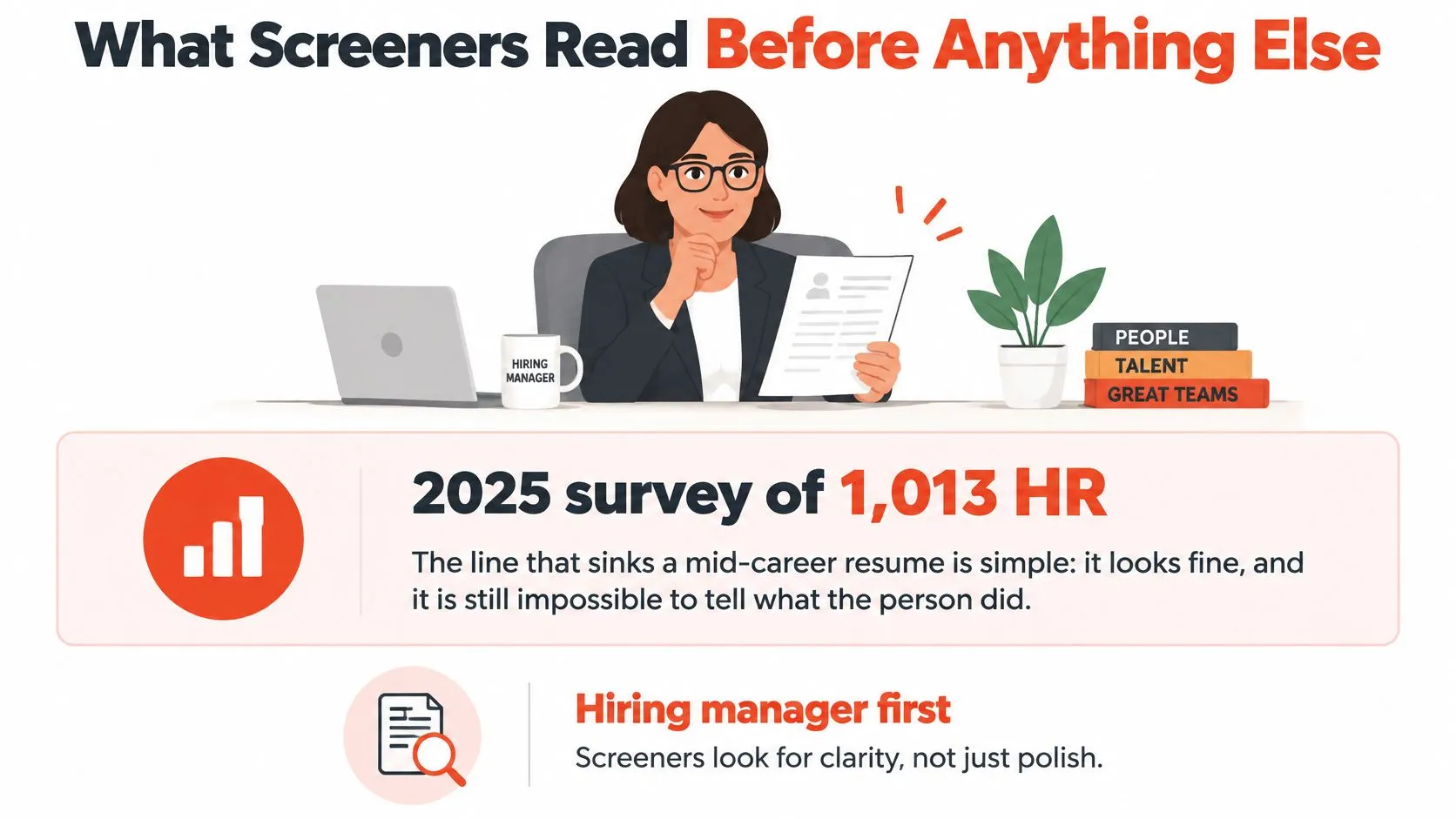
The Jobseeker hiring survey asked 1,013 human-resources professionals across 59 countries in 2025 about their screening priorities and presentation preferences; their responses are below.
Where HR looks on a resume
| Signal | Share of HR | Writing consequence |
|---|---|---|
| Opens work experience first | 82.6% | Lead with roles, not a skills dump |
| Focuses first on skills | 63.7% | Skills support experience; they do not replace it |
| Looks for an education match | 37.7% | Degrees are context, not the proof |
| Looks for quantifiable achievements | 32.5% | Put a number on what changed |
| Prefers reverse-chronological order | 94.5% | Newest role on top |
These aren't mutually exclusive answers. The table separates where screeners direct their attention from what they want to find there.
Clear professional experience matters more than decorative polish.
Make a decision about the change
A duty tells a hiring manager that a job existed. An accomplishment tells them why your contribution mattered.
Look for changes in revenue, cost, speed, quality, risk, or customer outcomes. Maintaining a critical service also counts, provided you explain its scale and the standard you sustained.
A bullet is a decision about what changed, not a description of everything you touched.
For established professionals, the missing piece usually isn't a stronger verb. It's remembering the backlog before the fix, the customer's problem, or the decision that prevented an expensive mistake.
If recall is where you're stuck, StoryCV asks about your actual work rather than making you fill boxes. Tell my story.
If you're considering a move into a different field, Patriot CDL's guide can help you explore high-paying careers with fast training. Choose a direction first, then select experience that makes that move believable.
Shape the Last 10 to 15 Years
What stays in professional experience
| Material | Decision | Rule |
|---|---|---|
| Last 10 to 15 years | Keep, newest first | Shows seniority without an archive |
| Older role that proves a qualification | Keep, short | One or two proof bullets only |
| Unrelated early jobs | Cut | They dilute the roles people actually read |
| Job title | Use a searchable standard title | Put scope in the bullet, not the title |
| Generic soft-skill labels | Cut as labels | Show the behavior inside an outcome |
Jobscan's resume-writing guide recommends presenting the last 10 to 15 years of work history in reverse-chronological order, with measurable accomplishments rather than an exhaustive employment archive.
Treat that span as a selection guide, not a rule that erases valuable work. An older role stays when it proves a relevant qualification, establishes domain knowledge, or explains a meaningful career turn.
Give each role enough context
A stranger doesn't know your employer's business or your internal reporting structure. Add a short context line describing the company type and the business area you owned.
For example, a finance manager at a regional distributor might identify responsibility for inventory accounting and branch reporting. That tells the reader more than a company name they don't recognize.
Keep your actual job title. If it's obscure, add an accurate standard equivalent in parentheses rather than replacing it with a grander title.
- Current or closest-fit role: Give it about four to six bullets when you have distinct achievements worth including.
- Previous role: Aim for two or three strong bullets, not a duplicate account of the same responsibilities.
- Older relevant roles: Keep one or two proof bullets that establish something the recent roles don't.
Those are editing limits, not quotas. Don't manufacture content to reach them. For a closer selection decision, use our guide to how many jobs should be on a resume.
Show progression without another biography
Keep promotions within the same company as separate role entries with their own dates. The reader should see when your authority, scope, or specialty changed.
Use present tense for ongoing work. Use past tense for completed achievements, including finished projects in your current job.
Career gaps don't need an apology inside professional experience. If a break needs context, give it a dated line with an honest description, such as caregiving leave, relevant retraining, or freelance work with a completed deliverable.
You don't need to disclose medical details or turn every private period into professional achievement. A certification belongs only if you earned it; a project belongs only if you did it.
Cut test: If removing a line doesn't make the target job less believable, remove it.
Turn a Duty into an Evidence Chain
The sentence comes last. First, recover the evidence.
In a descriptive analysis of 2,483 public resumes across 24 job categories, CareerStanding's public-resume study found that 54.8% contained no quantified result, with an average of only 1.85 quantified figures across the entire work history.
That's a content problem, not a template problem. Build a metric inventory before polishing bullets.
Use this chain to organize the facts.
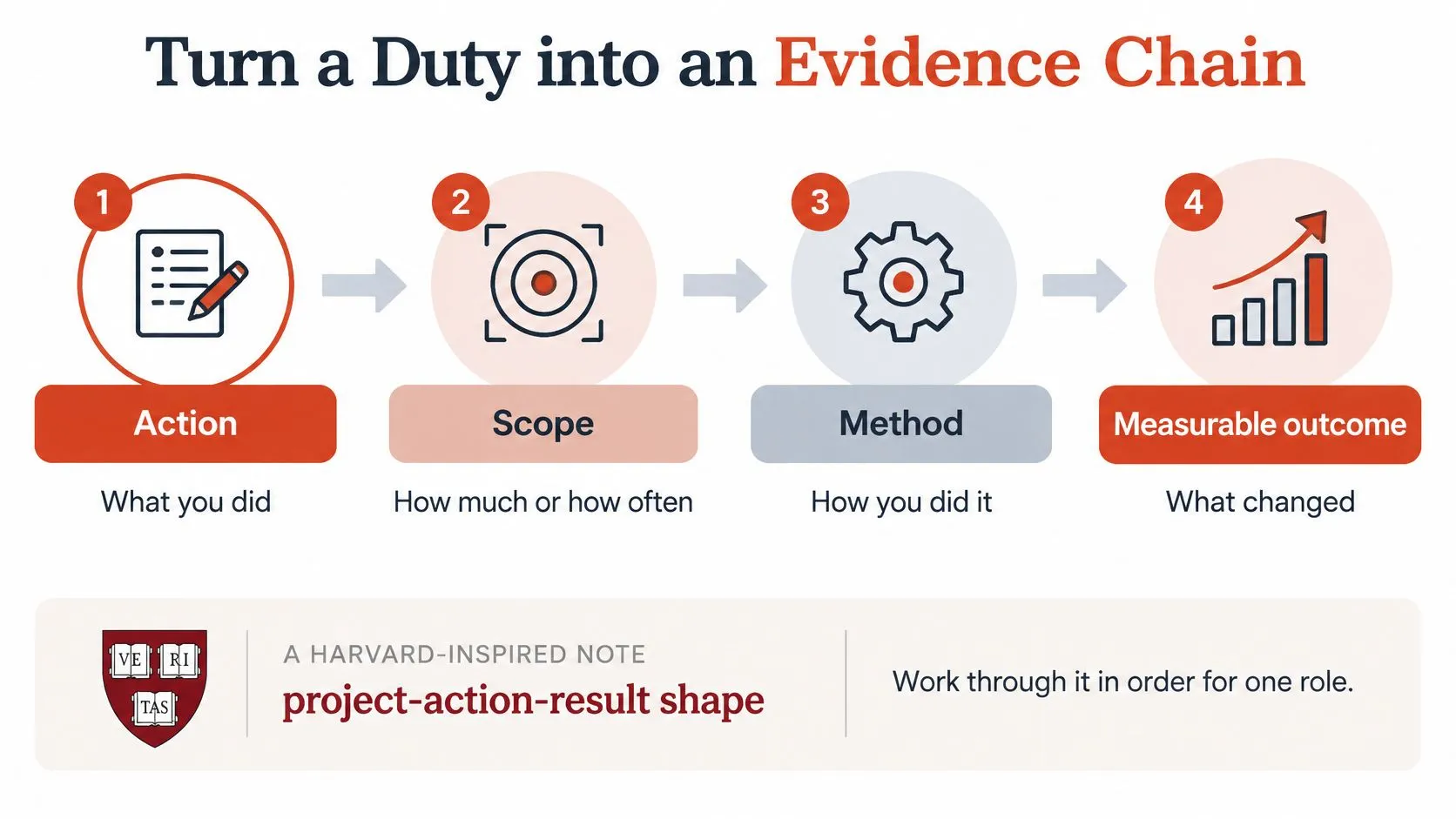
Recover the facts in order
Action → scope → method → measurable outcome
Harvard FAS's industry-resume guidance uses a project-action-result structure and recommends identifying methods or tools and quantifying results where appropriate. The same editorial principle applies here: describe the work, your intervention, and the evidence.
-
List the recurring duties. Start with rough notes, not finished sentences. For a finance role, that might mean reconciliations, close coordination, variance analysis, and audit preparation.
-
Find the problem and baseline. What made the work necessary? Record the starting cycle time, error rate, backlog, cost, or risk. Check close calendars, project reports, performance reviews, and dashboards you're authorized to access.
-
Name your action, scope, and method. Use a verb you personally earned: reconciled, redesigned, negotiated, automated, or implemented. Add the business units involved and the process or software you used. Don't lead with vague assistance language.
-
Record the after-state. Capture the result in percentage, currency, volume, time, quality, or customer scope. Include the comparison period in your notes. Time spent in a job isn't an achievement.
-
Separate your contribution from the team's result. Leading a migration and improving processing speed are different claims. Record who owned implementation, how performance was measured, and whether your change explains the difference.
-
Read the line aloud. Cut background that doesn't affect the claim. Keep enough detail for someone to understand both your contribution and its consequence.
Don't let precision outrun evidence
A baseline reconstructed from a vague memory isn't a defensible metric. If you can't retrieve the number, describe the observable result plainly instead of inventing a percentage.
We ask targeted questions about your industry, role, and accomplishments to uncover the missing details. StoryCV doesn't write a bullet until it has the problem, the action, and the result.
Find my words.
For a video explanation of writing professional experience, watch this walkthrough.
Before and After Lines by Role
These are hypothetical rewrites, not achievements to borrow. Each proof line assumes the candidate can substantiate the scope, method, and outcome.
Duty lines versus proof lines
| Role | Duty line | Illustrative proof line |
|---|---|---|
| Operations | Managed network infrastructure. | Managed a 600-device Cisco network across 14 sites, using proactive monitoring and failover testing to maintain 99.99% uptime. |
| Product | Responsible for the roadmap. | Reprioritized the onboarding roadmap using support-ticket analysis, removing duplicate legal and security reviews and cutting activation time from 10 days to 6. |
| Finance | Owned the monthly close. | Standardized reconciliations across 4 entities, reducing monthly close from 8 business days to 5. |
| People management | Managed a team of analysts. | Hired and onboarded 3 analysts using a skills matrix and queue-based training, enabling the team to reduce overdue cases from 120 to 45. |
The edits don't merely replace weak verbs. They supply missing facts a hiring manager can evaluate.
Read what each edit establishes
Operations needs scale and service quality. The asset and site counts establish the size of the environment; monitoring and failover testing explain how the candidate maintained it. Keep the uptime figure exact, and know whether it measures the entire network or a particular service.
Don't imply you designed the architecture if you maintained it. Technical ownership has boundaries.
Product needs a decision, not a document. The rewrite identifies the evidence used to prioritize work and the reviews removed. The original activation time must come from a defined measure, not the slowest customer you remember.
The product manager owned prioritization. Engineering, legal, security, and implementation teams may have owned delivery. The bullet shouldn't erase them.
Give the result a verifiable boundary
Finance needs comparable periods. The entity count establishes reporting scope, while the close-time change shows the result of standardizing reconciliations. Preserve the original business-day baseline and confirm that both periods use the same definition of close.
A controller should be able to trace that claim to the close calendar. If you standardized only part of the process, name that part.
People management needs a consequence beyond headcount. Hiring describes an activity; reducing overdue work demonstrates why the hires mattered. Preserve the starting queue count and define what made a case overdue.
The manager owned hiring and onboarding. The analysts cleared the cases. The wording deliberately distinguishes those contributions.
Don't round the baseline to make the improvement look cleaner. A neat sentence isn't worth an inaccurate claim.
A career changer can keep a title that doesn't resemble the target role. The bullet must make the transferable capability explicit: vendor cost control, incident response, financial reconciliation, or stakeholder decisions.
Pick the row closest to your last role. Rewrite a real duty with facts from your own work before polishing anything else.
Make It Readable to Software and People
Run machine alignment before human editing. There's little value in a persuasive role description if the software separates its title from its dates or misses the relevant qualification.
Jobscan's State of the Job Search reports that 98.4% of Fortune 500 companies, 492 of 500, use an applicant tracking system, and identifies recruiter filter rates of 76.4% for skills, 55.3% for job titles, and 59.7% for education.
Those figures explain why recognizable language matters. They don't justify stuffing your experience section with every phrase in a job posting.
Keep the passes separate.
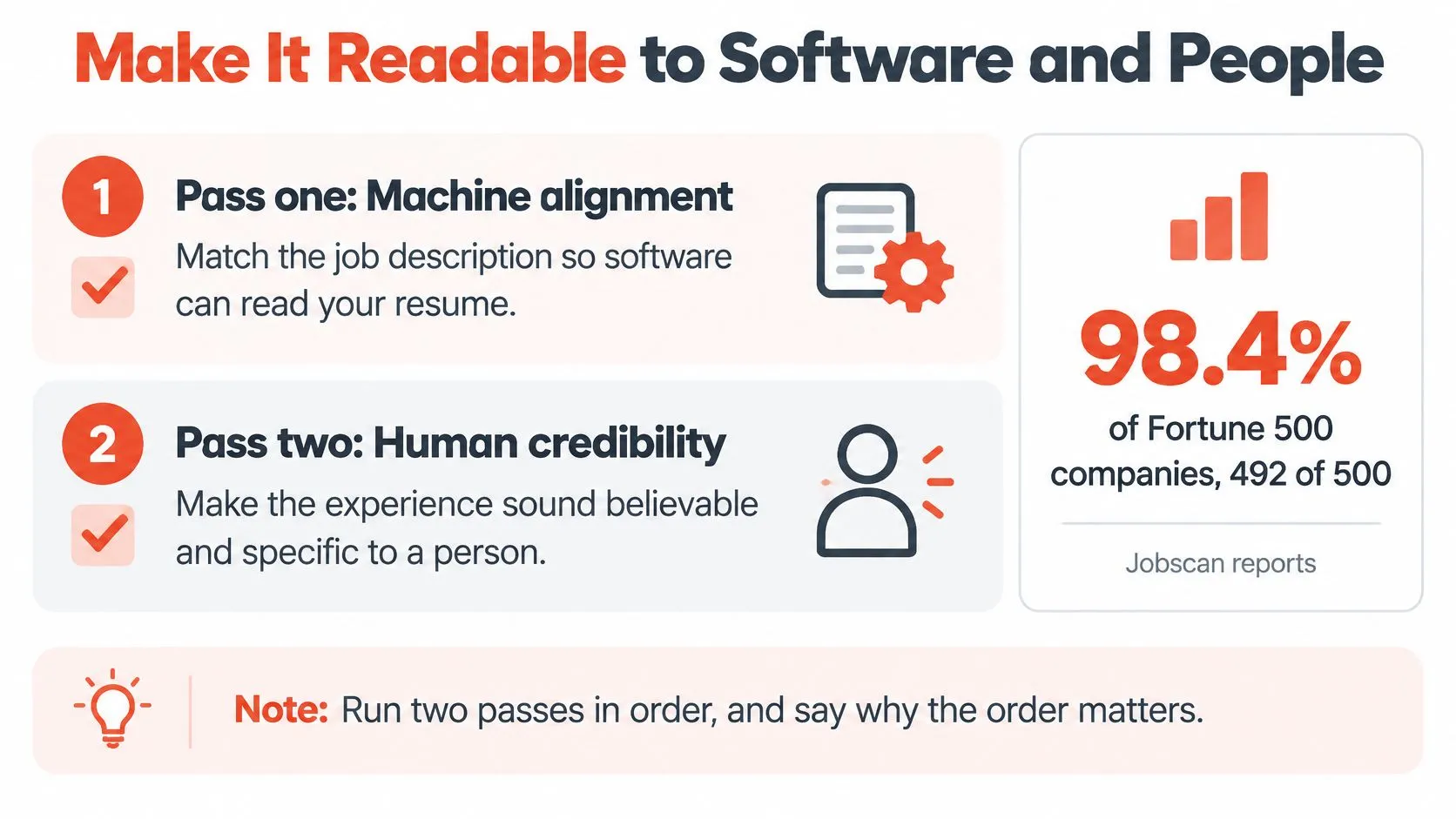
Pass one for machine alignment
Use Professional Experience as the section label. Keep titles ordinary and retain the exact names of tools, methods, and domain skills when they accurately describe your work.
Keep text boxes, columns, icons, and graphics out of the role block. Use a straightforward reading order with employer, title, dates, and bullets grouped together.
Compare the posting with your actual experience. A genuine equivalent can be clarified; an unfamiliar skill can't be added merely because the employer asks for it.
For sentence-level guidance, our explanation of ATS resume bullet points shows how to keep relevant language explicit without sacrificing readability.
Pass two for human credibility
A recruiter can find a keyword and still reject the claim around it. Show what using that skill enabled you to deliver, decide, or improve.
For banking professionals experimenting with automated writing, 24hourEDU's AI tips for banking resumes offer a role-specific starting point. Keep the boundary firm: generated wording must not upgrade support work into ownership or imply credentials you don't hold.
Run these checks before sending the document:
- Factuality check: Compare each claim with your records. Verify units, comparison periods, and your share of the result.
- Keyword-to-evidence check: Make sure every borrowed phrase has actual work behind it. Delete anything you couldn't explain in an interview.
- Plain-text check: Paste the resume into a text editor. Confirm that employers, titles, dates, and bullets still appear together in the intended order.
These checks catch keyword stuffing, team results claimed as solo work, inconsistent tense, and jargon that conceals the business consequence.
Final standard: Accurate overlap with the job, plus a professional story someone can retell.
A dense keyword score isn't the objective. A hiring manager should understand what you can do and why they should believe it.
Write Your Own Roles from Memory
Start with the job you're proudest of and the result you've been underselling. Not the easiest role to describe. The one where you made a decision that mattered.
Write down what you remember without trying to sound employable. Include the broken process, the stakeholder who needed something, the constraint, and the point when you realized your approach was working.
Use questions instead of synonyms
Our resume questions to ask yourself can help you recover details that don't appear in your existing resume.
- Recover the setting: What was happening when you took responsibility?
- Identify the decision: What did you choose, change, stop, or introduce?
- Locate the evidence: What record or observable outcome confirms the result?
StoryCV is an Online Resume Writer. We provide editorial judgment at software speed by asking about your work and turning your answers into clear writing.
Every figure comes from your answers. If a number isn't in the answer, it doesn't go in the bullet. Review the draft against what you did.
Test a role before rewriting everything
You receive clear, concise bullet points you can use across your resume and applications. Copy them into the resume you already have; you don't need another template.
StoryCV is free to start, with two finished bullet points included. Many finish a full resume in 1 to 1.5 hours.
Begin with a role and check whether the writing finally matches the work. The offer isn't a ranking, an interview guarantee, or a new career. It's a clearer account of the experience you already earned.
StoryCV turns answers about your real work into resume-ready bullet points. Bring the role you've been underselling, and we'll help you articulate the problem, your action, and the result. Visit StoryCV and start my role.