

The popular answer, three to six jobs, is useful and incomplete. It tells you how many roles to detail, not how many jobs your resume should acknowledge. Delete an old role and you may create a timeline gap that invites more questions than the role ever would.
The Question Almost Everyone Gets Wrong
Most candidates treat “how many jobs should be on resume” as a counting problem. Hiring managers don't sit there tallying entries. They scan for a credible career story, relevant experience, and evidence that you can handle the role in front of them.
The better question is structural:
Does this resume make your career progression easy to understand?
A recent graduate with internships, freelance work, and part-time experience shouldn't delete relevant roles just to match a rule designed for an experienced executive. A director with a long employment history shouldn't list every position with full bullets either. The right number depends on relevance, recency, and the distinct value each role adds.

Counting is the shortcut
The widely cited default is about 3 to 6 relevant jobs, with the precise number shaped by seniority and fit, as summarized by Monster's resume guidance. That's a sensible starting point for detailed entries. It isn't a mandatory deletion rule.
Your resume needs to show what you did, what changed because of your work, and how one role led to the next. A job earns space when it supports that story. An irrelevant role doesn't become valuable because it brings the count to six, and a relevant older role doesn't become harmful because it falls outside a neat range.
Structure beats arithmetic. Use the count as a pressure check, then use judgment to decide what stays visible.
Why Cutting Old Jobs Creates a Gap You Cannot Afford
Deleting early-career roles doesn't shorten your career. It removes evidence from the timeline.
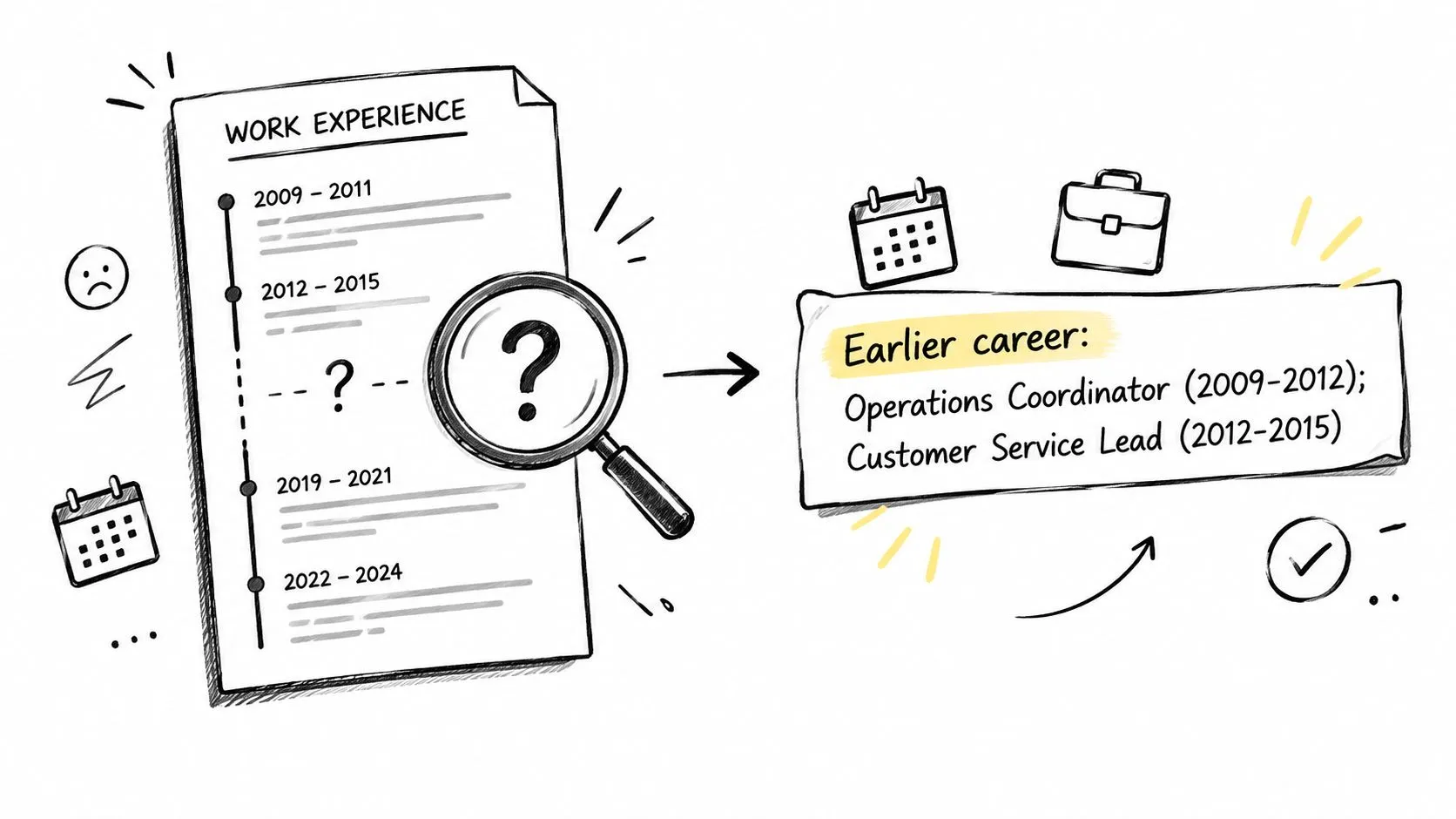
Suppose your resume begins with a role from 2018 and runs to the present, while your actual career started years earlier. The missing period raises obvious questions: what were you doing, and why isn't it shown? You might have a perfectly reasonable answer, but the resume has already made the reader work to find it.
The fix is compression, not deletion. Keep recent and relevant roles detailed. Collapse older work into a short line that preserves employers, titles, and dates without spending valuable space on bullets.
Use two different mechanics
Cut a role when it has no relevance, adds no useful context, and doesn't explain a meaningful part of your timeline.
Compress a role when removing it would create confusion, hide progression, or leave a gap that an interviewer will ask about.
For example:
Cut version
- 2018 to present, Senior Operations Manager
- Nothing shown before 2018
Compressed version
Earlier career: Operations Coordinator, Acme Co. (2009-2012); Customer Service Lead, Beta Inc. (2012-2015); Operations Analyst, Gamma Ltd. (2015-2018)
That line names the employers, shows continuity, and takes only a small amount of vertical space. It doesn't compete with your recent achievements, but it closes the obvious question.
For more guidance on keeping dates clear without overloading the page, use this guide to dates on a resume. Your employment history should be selective, but it shouldn't look edited to the point of suspicion.
The 10 to 15 Year Window and the 3 to 6 Job Rule
Two conventions dominate resume advice. The first is to focus detailed work history on roughly the last 10 to 15 years. The second is to include roughly 3 to 6 detailed jobs. Indeed's resume guidance connects the time window to a practical range of roles, often about 2 to 5 jobs, depending on how quickly someone progressed.
These conventions work because recent experience usually carries the clearest evidence of your current level. They also prevent older responsibilities from pushing stronger, newer achievements off the page.
But neither rule survives every career.
When the window works
Use the 10-to-15-year window when:
- Your recent roles show the capabilities required for the target job.
- Earlier positions repeat responsibilities already proven later.
- Your career has progressed steadily and older detail adds little.
- You can preserve the earlier timeline with a compressed line.
The rule breaks when older experience supplies a capability that your recent roles don't show. A technical specialist, military veteran, researcher, or career changer may need to keep an earlier title visible because it explains the foundation of their expertise or the ownership they carried.
When the job count works
The 3-to-6 range is a useful default for conventional career paths. It becomes less useful when your work is project-based, highly specialized, or spread across freelance engagements. In those cases, a role may represent a distinct capability rather than a simple rung on a ladder.
Use this test:
If a recruiter asked about a missing role, would your answer require the resume to show it?
If yes, keep the role visible, either with full detail or in a compressed career-history line. Resume Worded's advice on listing jobs also emphasizes recency and relevance over a complete employment archive. That's the right principle. The rules are defaults. Your target role gets the final vote.
How Many Jobs by Career Stage
Career stage changes the risk. Early in your career, leaving out a relevant role can make the resume look empty. Later, listing every role can bury the evidence that matters.
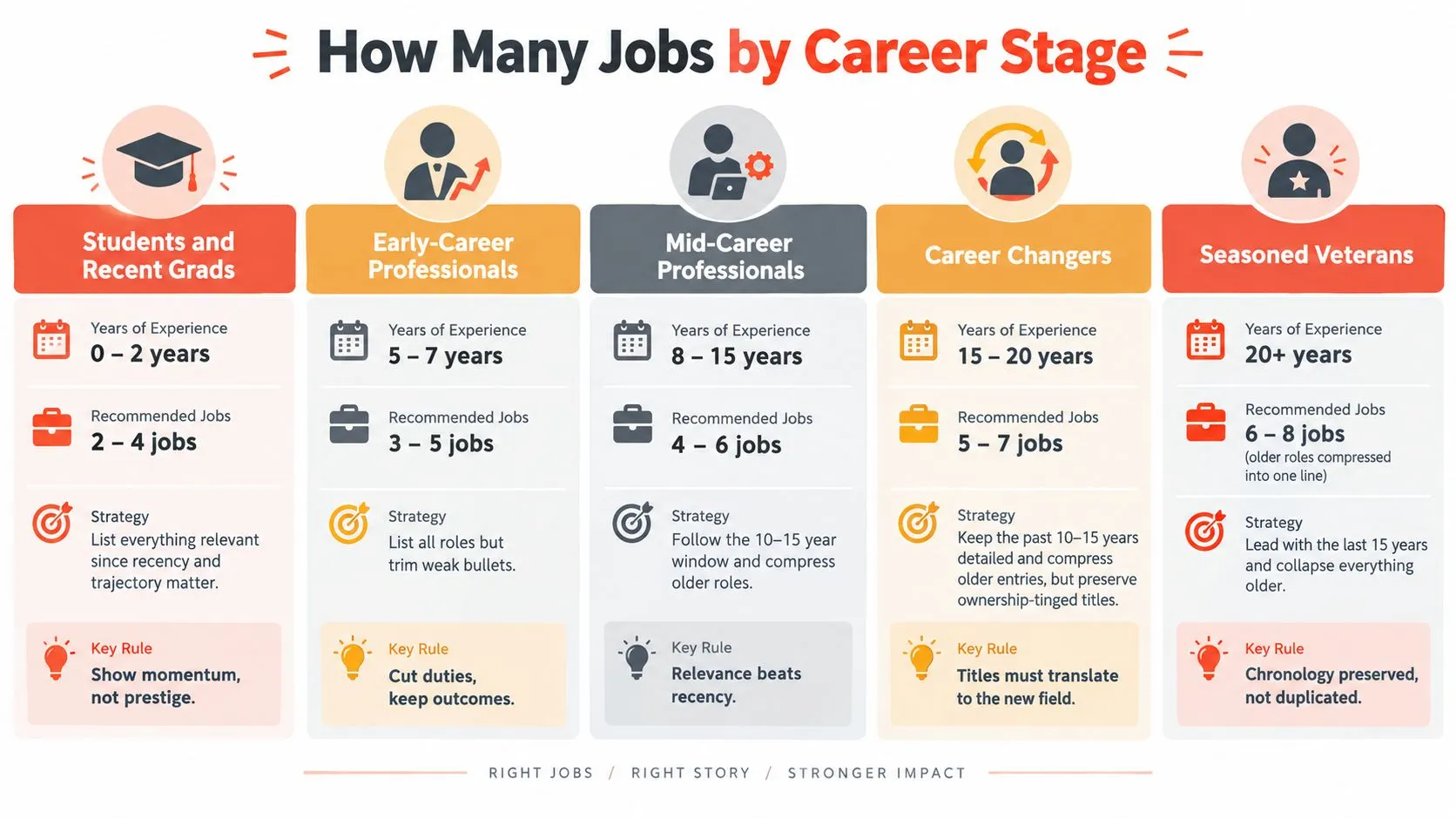
| Career Stage | Years of Experience | Jobs to List | Strategy | Key Rule |
|---|---|---|---|---|
| Students and recent graduates | 0-2 years | 2-4 jobs | Include relevant gigs, internships, and projects | Show momentum, not prestige |
| Early-career professionals | 5-7 years | 3-5 jobs | List roles, then trim weak bullets | Cut duties, keep outcomes |
| Mid-career professionals | 8-15 years | 4-6 jobs | Detail the recent window and compress older work | Relevance beats recency |
| Career changers | 15-20 years | 5-7 jobs | Detail recent work, compress older roles, preserve transferable ownership | Titles must translate |
| Seasoned veterans | 20+ years | 6-8 jobs | Lead with recent work and collapse older history into one line | Preserve chronology, don't duplicate |
Students and early-career professionals
Students and recent graduates should include relevant internships, campus roles, freelance assignments, and part-time work. The resume has less professional history, so trajectory matters more than prestige.
Early-career professionals can list most roles, but each entry doesn't deserve equal attention. Keep the strongest outcomes and remove routine duties that appear in every similar job description.
Mid-career professionals
For someone with 6 to 8 years of relevant experience, one guideline recommends covering roughly 8 to 10 years of history, as described by Indeed's detailed resume guidance. Detail roles that prove your current scope. Compress older positions when they explain progression but don't add target-role evidence.
Career changers and veterans
Career changers should retain older titles when those titles show ownership that transfers to the new field. A former operations lead may need that earlier leadership role visible even when changing into program management.
Seasoned professionals should lead with the most recent work and compress earlier history into one line. Don't repeat the same achievement across several promotions at one employer. Show progression once, then use the space to prove the level you're pursuing.
ATS, Page Length, and Why Two Pages Changes the Math
Page length is a formatting problem, not a content problem. Many professionals can use two pages when their experience needs room, and recent resume research reports that only 35% of job seekers use a one-page resume, while 40% submit resumes between 1.5 and 2 pages and 9% exceed two pages, according to Monster's State of the Resume 2026.
That changes the practical math. You don't need to destroy your timeline to force every career detail onto one page. You need a clear hierarchy.
What ATS systems actually need
Applicant tracking systems generally benefit from:
- Standard headings: Use labels such as Experience, Education, and Skills.
- Readable dates: Keep dates next to the matching employer and title.
- Simple formatting: Avoid decorative layouts that separate titles, employers, and dates.
- Plain text content: Write achievements in language a parser and a human can understand.
A compressed history line can serve both audiences:
Earlier career: Sales Associate, Acme Co. (2014-2017); Account Manager, Beta Inc. (2017-2019)
For a practical look at when a longer document makes sense, see whether a resume can be two pages. The goal isn't to beat a page-count rule. It's to make the strongest evidence easy to find while keeping the timeline intact.
Trimming and Expanding Entries Without Lying
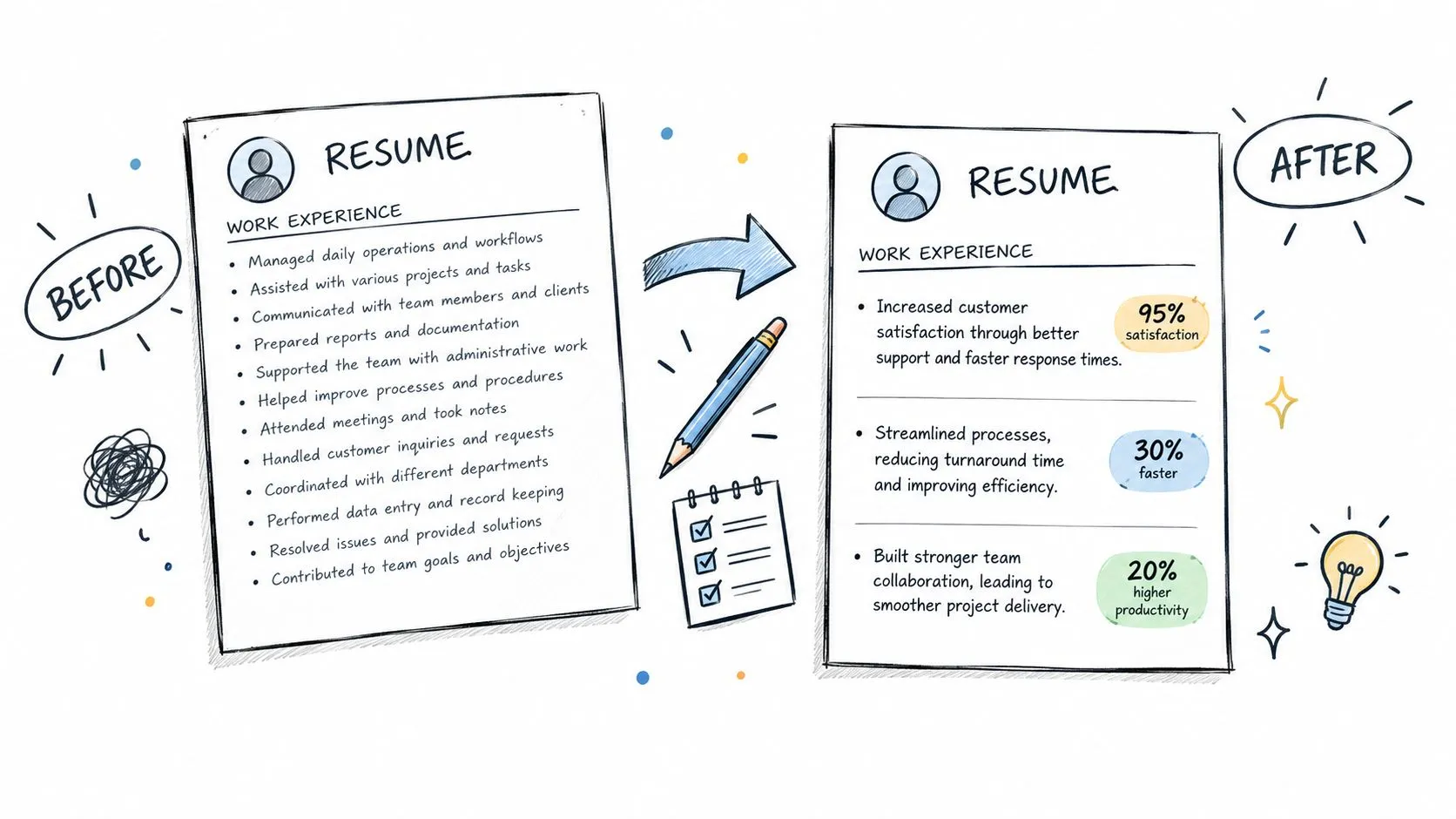
Resumes usually fail because entries waste space on duties. The solution isn't automatically fewer jobs. It's better evidence inside the jobs you keep.
Consider this overloaded entry:
Managed customer accounts, handled escalations, trained new hires, processed orders, attended weekly meetings, updated CRM.
It lists activity without showing scale, quality, or change. A tighter version uses three specific outcomes:
- Resolved 40+ escalations per month with a 95% satisfaction rate.
- Trained 6 new hires, all promoted within 12 months.
- Reduced order processing time by 30% by redesigning the CRM workflow.
Those figures come from the supplied example. Use numbers only when you can verify them from your own records, performance reviews, project summaries, dashboards, or manager feedback. Never fill a missing result with a guess.
Expand the right roles
A thin entry may deserve more space when it proves a capability central to the target job. Start with the responsibility, add context, then state the outcome:
Weak
Managed network infrastructure.
Stronger
Managed a 600-device Cisco network across 14 sites, maintaining 99.99% uptime.
That example works because it answers three questions: what was managed, in what environment, and what changed or stayed reliable because of the work.
For a useful reference on writing a tailored resume for knowledge workers, pay attention to how the work connects to the target role rather than how many bullets appear under each employer.
Compress the weak roles
A role with repetitive duties, limited relevance, or no defensible outcomes should shrink. Keep the title, employer, dates, and one line of context if the role helps maintain the timeline.
If you have several short stints, don't hide them by falsifying dates or merging unrelated employers. Use the structure described in this resume guide for multiple short stints. Honest compression protects credibility. It also gives your strongest roles room to do their job.
A Structure That Closes the Question Before It Is Asked
The answer to how many jobs should be on resume isn't a hard cap. It's a structure with two levels of detail.
Use full entries for the roles that prove your fit now. Use a compact line for earlier work that preserves chronology without forcing the reader through outdated bullets.
Copy this format:
Earlier Career (2002-2012): Operations Coordinator, ABC Co; Sales Associate, DOR Corp; Assistant Store Manager, BOR Co
The heading does three jobs. It identifies the period, signals that the roles are intentionally summarized, and keeps the employment timeline visible. You don't need to explain every early responsibility, but the reader can see where your experience began and how it developed.
That gives you a simple system:
- Keep relevant roles detailed.
- Compress older roles that support the timeline.
- Cut irrelevant work that adds no context.
- Check every remaining entry against the target job.
A 3-to-6 detailed-role range may fit many professionals. A longer or shorter history can still be right when every visible entry earns its space. Older work doesn't need to dominate the resume, but deleting it entirely can create a question you could have answered in three lines.
Open your resume today. Find every role outside the 10- to 15-year window, then rewrite that history as one compressed line. Keep the employers, titles, and dates. Remove the bullets. Your timeline will read as deliberate instead of incomplete.
StoryCV helps you talk through the work you did, then turns the context, actions, and outcomes into resume-ready writing. If choosing which jobs matter is harder than formatting them, try StoryCV and start with the role that best represents where you're going next.